



Die Einfachheit von Python und sein leistungsstarkes Ökosystem machen es zu einer hervorragenden Wahl für die Integration der E-Mail-Verifizierung in Ihre Anwendungen. Egal, ob Sie eine Webanwendung mit Django oder Flask entwickeln, Daten mit pandas verarbeiten oder automatisierte Workflows erstellen – die professionelle E-Mail-Verifizierung stellt sicher, dass Ihre E-Mail-Kommunikation echte Empfänger erreicht und Ihre Absender-Reputation schützt.
Dieser umfassende Leitfaden führt Sie durch die Integration der BillionVerify E-Mail-Verifizierungs-API mit Python, von der einfachen Einzelverifizierung bis hin zur erweiterten Batch-Verarbeitung und produktionsreifen Implementierungen.
Voraussetzungen und Setup
Bevor Sie in den Code eintauchen, stellen Sie sicher, dass Sie die richtige Umgebung konfiguriert haben. Dieses Tutorial setzt voraus, dass Sie Python 3.8 oder höher auf Ihrem System installiert haben.
Installation der erforderlichen Pakete
Beginnen Sie mit der Installation der notwendigen Pakete. Wir verwenden die requests-Bibliothek für die HTTP-Kommunikation, werden aber später auch aiohttp für asynchrone Operationen erkunden.
pip install requests python-dotenv
Für asynchrone Unterstützung und erweiterte Funktionen:
pip install aiohttp pandas
Projektstruktur
Organisieren Sie Ihr Projekt mit einer sauberen Struktur, die Zuständigkeiten trennt:
email_verification/
├── __init__.py
├── client.py           # Main verification client
├── models.py           # Data models
├── exceptions.py       # Custom exceptions
├── utils.py            # Helper functions
├── batch_processor.py  # Batch verification logic
└── examples/
    ├── basic_usage.py
    ├── flask_integration.py
    └── django_integration.py
Umgebungskonfiguration
Erstellen Sie eine .env-Datei, um Ihre API-Anmeldedaten sicher zu speichern:
BV_API_KEY=your_api_key_here
EMAILVERIFY_API_URL=https://api.billionverify.com/v1
Laden Sie diese Variablen in Ihrer Anwendung:
import os
from dotenv import load_dotenv

load_dotenv()

API_KEY = os.getenv('BV_API_KEY')
API_URL = os.getenv('EMAILVERIFY_API_URL', 'https://api.billionverify.com/v1')
Grundlegende E-Mail-Verifizierung
Beginnen wir mit der einfachsten Implementierung: der Verifizierung einer einzelnen E-Mail-Adresse mit Pythons requests-Bibliothek.
Einfache Verifizierungsfunktion
import requests
from typing import Dict, Any

def verify_email(email: str, api_key: str) -> Dict[str, Any]:
    """
    Verify a single email address using the BillionVerify API.

    Args:
        email: The email address to verify
        api_key: Your BillionVerify API key

    Returns:
        Dictionary containing verification results

    Raises:
        requests.RequestException: If the API request fails
    """
    url = "https://api.billionverify.com/v1/verify"

    headers = {
        "Authorization": f"Bearer {api_key}",
        "Content-Type": "application/json"
    }

    payload = {"email": email}

    response = requests.post(url, json=payload, headers=headers, timeout=30)
    response.raise_for_status()

    return response.json()

# Example usage
if __name__ == "__main__":
    result = verify_email("test@example.com", API_KEY)
    print(f"Email valid: {result.get('is_valid')}")
    print(f"Deliverable: {result.get('is_deliverable')}")
Verstehen der Antwort
Die API gibt eine umfassende Antwort mit mehreren Verifizierungsindikatoren zurück:
{
    "email": "user@example.com",
    "is_valid": True,
    "is_deliverable": True,
    "is_disposable": False,
    "is_role_based": False,
    "is_catch_all": False,
    "is_free_provider": True,
    "risk_score": 15,
    "domain": "example.com",
    "mx_records": ["mx1.example.com", "mx2.example.com"],
    "smtp_check": True,
    "verification_time_ms": 245
}
Jedes Feld liefert wertvolle Informationen:
- is_valid: Ob das E-Mail-Format syntaktisch korrekt ist
- is_deliverable: Ob das Postfach existiert und E-Mails empfangen kann
- is_disposable: Identifiziert temporäre oder Wegwerf-E-Mail-Adressen
- is_role_based: Erkennt generische Adressen wie info@ oder support@
- is_catch_all: Zeigt Domains an, die alle Adressen akzeptieren
- risk_score: Numerische Bewertung von 0 (niedrigstes Risiko) bis 100 (höchstes Risiko)
Erstellen eines produktionsreifen Clients
Für Produktionsanwendungen benötigen Sie eine robuste Client-Klasse, die Authentifizierung, Wiederholungsversuche, Rate-Limiting und Fehlerbehandlung elegant verwaltet.
Benutzerdefinierte Exceptions
Definieren Sie zunächst benutzerdefinierte Exceptions für eine bessere Fehlerbehandlung:
# exceptions.py

class EmailVerificationError(Exception):
    """Base exception for email verification errors."""
    pass

class AuthenticationError(EmailVerificationError):
    """Raised when API authentication fails."""
    pass

class RateLimitError(EmailVerificationError):
    """Raised when API rate limit is exceeded."""
    def __init__(self, retry_after: int = 60):
        self.retry_after = retry_after
        super().__init__(f"Rate limit exceeded. Retry after {retry_after} seconds.")

class ValidationError(EmailVerificationError):
    """Raised when email validation fails."""
    pass

class APIError(EmailVerificationError):
    """Raised for general API errors."""
    def __init__(self, status_code: int, message: str):
        self.status_code = status_code
        super().__init__(f"API error {status_code}: {message}")
Datenmodelle
Verwenden Sie Dataclasses oder Pydantic für typsichere Antwortverarbeitung:
# models.py

from dataclasses import dataclass
from typing import List, Optional

@dataclass
class VerificationResult:
    """Represents the result of an email verification."""
    email: str
    is_valid: bool
    is_deliverable: bool
    is_disposable: bool
    is_role_based: bool
    is_catch_all: bool
    is_free_provider: bool
    risk_score: int
    domain: str
    mx_records: List[str]
    smtp_check: bool
    verification_time_ms: int

    @classmethod
    def from_dict(cls, data: dict) -> 'VerificationResult':
        """Create a VerificationResult from API response dictionary."""
        return cls(
            email=data.get('email', ''),
            is_valid=data.get('is_valid', False),
            is_deliverable=data.get('is_deliverable', False),
            is_disposable=data.get('is_disposable', False),
            is_role_based=data.get('is_role_based', False),
            is_catch_all=data.get('is_catch_all', False),
            is_free_provider=data.get('is_free_provider', False),
            risk_score=data.get('risk_score', 100),
            domain=data.get('domain', ''),
            mx_records=data.get('mx_records', []),
            smtp_check=data.get('smtp_check', False),
            verification_time_ms=data.get('verification_time_ms', 0)
        )

    def is_safe_to_send(self) -> bool:
        """Determine if it's safe to send emails to this address."""
        return (
            self.is_valid and
            self.is_deliverable and
            not self.is_disposable and
            self.risk_score < 50
        )
Die Haupt-Client-Klasse
Implementieren Sie nun den vollständig ausgestatteten Verifizierungs-Client:
# client.py

import time
import logging
from typing import Optional, List
import requests
from requests.adapters import HTTPAdapter
from urllib3.util.retry import Retry

from .models import VerificationResult
from .exceptions import (
    AuthenticationError,
    RateLimitError,
    ValidationError,
    APIError
)

logger = logging.getLogger(__name__)

class EmailVerificationClient:
    """
    Production-ready client for the BillionVerify email verification API.

    Features:
    - Automatic retry with exponential backoff
    - Rate limit handling
    - Connection pooling
    - Comprehensive error handling
    - Response caching (optional)
    """

    DEFAULT_BASE_URL = "https://api.billionverify.com/v1"
    DEFAULT_TIMEOUT = 30
    MAX_RETRIES = 3

    def __init__(
        self,
        api_key: str,
        base_url: Optional[str] = None,
        timeout: int = DEFAULT_TIMEOUT,
        max_retries: int = MAX_RETRIES
    ):
        """
        Initialize the email verification client.

        Args:
            api_key: Your BillionVerify API key
            base_url: Optional custom API base URL
            timeout: Request timeout in seconds
            max_retries: Maximum number of retry attempts
        """
        if not api_key:
            raise ValueError("API key is required")

        self.api_key = api_key
        self.base_url = base_url or self.DEFAULT_BASE_URL
        self.timeout = timeout
        self.max_retries = max_retries

        # Configure session with retry logic
        self.session = self._create_session()

    def _create_session(self) -> requests.Session:
        """Create a requests session with retry configuration."""
        session = requests.Session()

        # Configure retry strategy
        retry_strategy = Retry(
            total=self.max_retries,
            backoff_factor=1,
            status_forcelist=[429, 500, 502, 503, 504],
            allowed_methods=["GET", "POST"]
        )

        adapter = HTTPAdapter(
            max_retries=retry_strategy,
            pool_connections=10,
            pool_maxsize=20
        )

        session.mount("http://", adapter)
        session.mount("https://", adapter)

        # Set default headers
        session.headers.update({
            "Authorization": f"Bearer {self.api_key}",
            "Content-Type": "application/json",
            "User-Agent": "BillionVerify-Python/1.0"
        })

        return session

    def _handle_response(self, response: requests.Response) -> dict:
        """
        Handle API response and raise appropriate exceptions.

        Args:
            response: The requests Response object

        Returns:
            Parsed JSON response

        Raises:
            AuthenticationError: For 401/403 responses
            RateLimitError: For 429 responses
            APIError: For other error responses
        """
        if response.status_code == 401:
            raise AuthenticationError("Invalid API key")

        if response.status_code == 403:
            raise AuthenticationError("Access forbidden. Check API key permissions.")

        if response.status_code == 429:
            retry_after = int(response.headers.get('Retry-After', 60))
            raise RateLimitError(retry_after)

        if response.status_code == 400:
            error_data = response.json()
            raise ValidationError(error_data.get('message', 'Validation failed'))

        if response.status_code >= 400:
            raise APIError(response.status_code, response.text)

        return response.json()

    def verify(self, email: str) -> VerificationResult:
        """
        Verify a single email address.

        Args:
            email: The email address to verify

        Returns:
            VerificationResult object with verification details
        """
        url = f"{self.base_url}/verify"

        logger.debug(f"Verifying email: {email}")

        response = self.session.post(
            url,
            json={"email": email},
            timeout=self.timeout
        )

        data = self._handle_response(response)
        result = VerificationResult.from_dict(data)

        logger.info(
            f"Verified {email}: valid={result.is_valid}, "
            f"deliverable={result.is_deliverable}, "
            f"risk_score={result.risk_score}"
        )

        return result

    def verify_batch(
        self,
        emails: List[str],
        callback_url: Optional[str] = None
    ) -> str:
        """
        Submit a batch of emails for verification.

        Args:
            emails: List of email addresses to verify
            callback_url: Optional webhook URL for results notification

        Returns:
            Batch ID for tracking the verification job
        """
        url = f"{self.base_url}/verify/batch"

        payload = {"emails": emails}
        if callback_url:
            payload["callback_url"] = callback_url

        response = self.session.post(
            url,
            json=payload,
            timeout=self.timeout
        )

        data = self._handle_response(response)
        batch_id = data.get('batch_id')

        logger.info(f"Submitted batch verification: {batch_id} ({len(emails)} emails)")

        return batch_id

    def get_batch_status(self, batch_id: str) -> dict:
        """
        Get the status of a batch verification job.

        Args:
            batch_id: The batch ID returned from verify_batch

        Returns:
            Dictionary with batch status and progress
        """
        url = f"{self.base_url}/verify/batch/{batch_id}"

        response = self.session.get(url, timeout=self.timeout)
        return self._handle_response(response)

    def get_batch_results(self, batch_id: str) -> List[VerificationResult]:
        """
        Get the results of a completed batch verification.

        Args:
            batch_id: The batch ID returned from verify_batch

        Returns:
            List of VerificationResult objects
        """
        url = f"{self.base_url}/verify/batch/{batch_id}/results"

        response = self.session.get(url, timeout=self.timeout)
        data = self._handle_response(response)

        return [VerificationResult.from_dict(item) for item in data.get('results', [])]

    def close(self):
        """Close the underlying session."""
        self.session.close()

    def __enter__(self):
        return self

    def __exit__(self, exc_type, exc_val, exc_tb):
        self.close()
Batch-E-Mail-Verifizierung
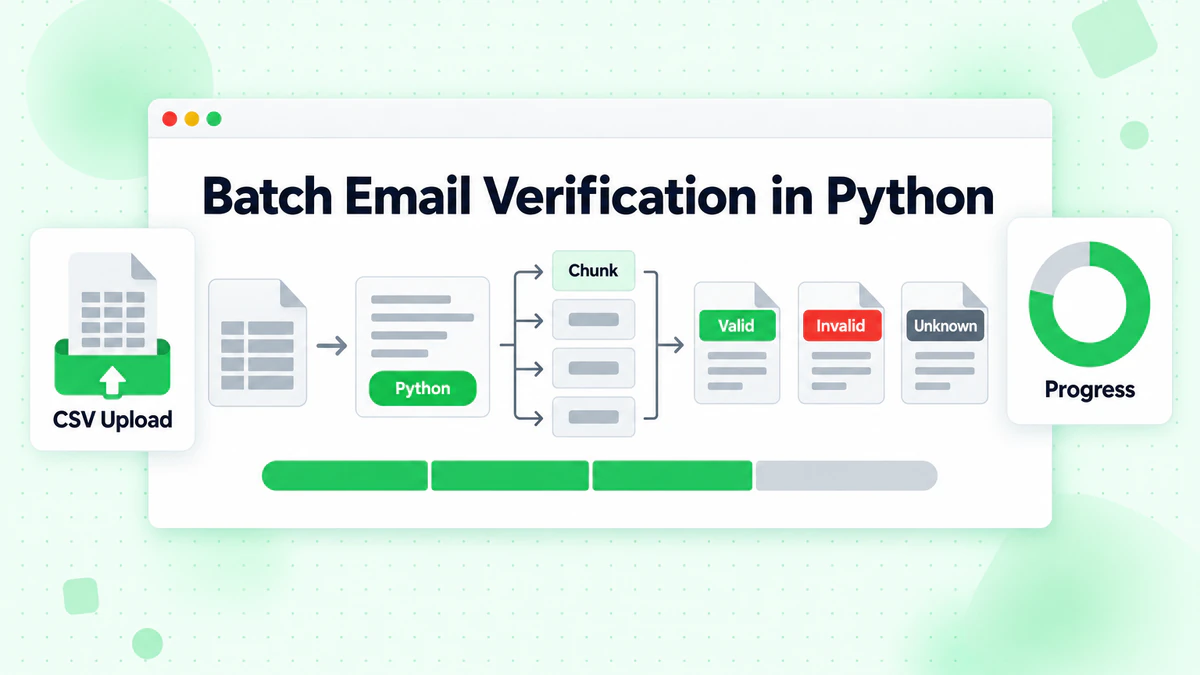
Die Verarbeitung großer E-Mail-Listen erfordert eine effiziente Batch-Verarbeitung. Hier erfahren Sie, wie Sie robuste Batch-Verifizierung mit Fortschrittsverfolgung und Ergebnisverwaltung implementieren.
Batch-Processor-Implementierung
# batch_processor.py

import time
import logging
from typing import List, Callable, Optional
from concurrent.futures import ThreadPoolExecutor, as_completed

from .client import EmailVerificationClient
from .models import VerificationResult
from .exceptions import RateLimitError

logger = logging.getLogger(__name__)

class BatchProcessor:
    """
    Process large email lists with progress tracking and result handling.
    """

    def __init__(
        self,
        client: EmailVerificationClient,
        batch_size: int = 1000,
        max_workers: int = 5,
        progress_callback: Optional[Callable[[int, int], None]] = None
    ):
        """
        Initialize the batch processor.

        Args:
            client: EmailVerificationClient instance
            batch_size: Number of emails per batch submission
            max_workers: Maximum concurrent verification threads
            progress_callback: Optional callback for progress updates
        """
        self.client = client
        self.batch_size = batch_size
        self.max_workers = max_workers
        self.progress_callback = progress_callback

    def process_list(
        self,
        emails: List[str],
        use_async_batch: bool = True
    ) -> List[VerificationResult]:
        """
        Process a list of emails with optimal strategy.

        Args:
            emails: List of email addresses
            use_async_batch: Use async batch API for large lists

        Returns:
            List of verification results
        """
        total = len(emails)
        logger.info(f"Starting verification of {total} emails")

        if total <= 10:
            # Small list: verify individually
            return self._process_sequential(emails)
        elif use_async_batch and total > 100:
            # Large list: use batch API
            return self._process_batch_api(emails)
        else:
            # Medium list: use concurrent individual verification
            return self._process_concurrent(emails)

    def _process_sequential(
        self,
        emails: List[str]
    ) -> List[VerificationResult]:
        """Process emails sequentially."""
        results = []
        total = len(emails)

        for i, email in enumerate(emails):
            try:
                result = self.client.verify(email)
                results.append(result)
            except RateLimitError as e:
                logger.warning(f"Rate limit hit, waiting {e.retry_after}s")
                time.sleep(e.retry_after)
                result = self.client.verify(email)
                results.append(result)
            except Exception as e:
                logger.error(f"Failed to verify {email}: {e}")
                results.append(self._create_error_result(email, str(e)))

            if self.progress_callback:
                self.progress_callback(i + 1, total)

        return results

    def _process_concurrent(
        self,
        emails: List[str]
    ) -> List[VerificationResult]:
        """Process emails concurrently with thread pool."""
        results = []
        total = len(emails)
        completed = 0

        with ThreadPoolExecutor(max_workers=self.max_workers) as executor:
            future_to_email = {
                executor.submit(self._verify_with_retry, email): email
                for email in emails
            }

            for future in as_completed(future_to_email):
                email = future_to_email[future]
                try:
                    result = future.result()
                    results.append(result)
                except Exception as e:
                    logger.error(f"Failed to verify {email}: {e}")
                    results.append(self._create_error_result(email, str(e)))

                completed += 1
                if self.progress_callback:
                    self.progress_callback(completed, total)

        return results

    def _process_batch_api(
        self,
        emails: List[str]
    ) -> List[VerificationResult]:
        """Process emails using the async batch API."""
        all_results = []
        total = len(emails)
        processed = 0

        # Split into batches
        batches = [
            emails[i:i + self.batch_size]
            for i in range(0, total, self.batch_size)
        ]

        for batch_num, batch in enumerate(batches, 1):
            logger.info(f"Submitting batch {batch_num}/{len(batches)}")

            # Submit batch
            batch_id = self.client.verify_batch(batch)

            # Wait for completion with polling
            results = self._wait_for_batch(batch_id)
            all_results.extend(results)

            processed += len(batch)
            if self.progress_callback:
                self.progress_callback(processed, total)

        return all_results

    def _wait_for_batch(
        self,
        batch_id: str,
        poll_interval: int = 5,
        max_wait: int = 3600
    ) -> List[VerificationResult]:
        """
        Wait for batch verification to complete.

        Args:
            batch_id: The batch ID to wait for
            poll_interval: Seconds between status checks
            max_wait: Maximum seconds to wait

        Returns:
            List of verification results
        """
        start_time = time.time()

        while time.time() - start_time < max_wait:
            status = self.client.get_batch_status(batch_id)

            if status.get('status') == 'completed':
                return self.client.get_batch_results(batch_id)

            if status.get('status') == 'failed':
                raise RuntimeError(f"Batch {batch_id} failed: {status.get('error')}")

            progress = status.get('progress', 0)
            logger.debug(f"Batch {batch_id} progress: {progress}%")

            time.sleep(poll_interval)

        raise TimeoutError(f"Batch {batch_id} did not complete within {max_wait}s")

    def _verify_with_retry(
        self,
        email: str,
        max_retries: int = 3
    ) -> VerificationResult:
        """Verify email with retry logic for rate limits."""
        for attempt in range(max_retries):
            try:
                return self.client.verify(email)
            except RateLimitError as e:
                if attempt < max_retries - 1:
                    time.sleep(e.retry_after)
                else:
                    raise

        raise RuntimeError(f"Failed to verify {email} after {max_retries} attempts")

    @staticmethod
    def _create_error_result(email: str, error: str) -> VerificationResult:
        """Create a result object for failed verification."""
        return VerificationResult(
            email=email,
            is_valid=False,
            is_deliverable=False,
            is_disposable=False,
            is_role_based=False,
            is_catch_all=False,
            is_free_provider=False,
            risk_score=100,
            domain=email.split('@')[-1] if '@' in email else '',
            mx_records=[],
            smtp_check=False,
            verification_time_ms=0
        )
Arbeiten mit CSV-Dateien und Pandas
Für Datenverarbeitungs-Workflows integrieren Sie mit pandas:
import pandas as pd
from typing import Optional

def verify_csv_file(
    client: EmailVerificationClient,
    input_file: str,
    output_file: str,
    email_column: str = 'email',
    batch_size: int = 1000
) -> pd.DataFrame:
    """
    Verify emails from a CSV file and save results.

    Args:
        client: EmailVerificationClient instance
        input_file: Path to input CSV file
        output_file: Path to output CSV file
        email_column: Name of the column containing emails
        batch_size: Processing batch size

    Returns:
        DataFrame with verification results
    """
    # Read input file
    df = pd.read_csv(input_file)

    if email_column not in df.columns:
        raise ValueError(f"Column '{email_column}' not found in CSV")

    emails = df[email_column].dropna().tolist()

    # Process with progress tracking
    processor = BatchProcessor(
        client,
        batch_size=batch_size,
        progress_callback=lambda done, total: print(f"Progress: {done}/{total}")
    )

    results = processor.process_list(emails)

    # Create results DataFrame
    results_df = pd.DataFrame([
        {
            'email': r.email,
            'is_valid': r.is_valid,
            'is_deliverable': r.is_deliverable,
            'is_disposable': r.is_disposable,
            'is_role_based': r.is_role_based,
            'is_catch_all': r.is_catch_all,
            'risk_score': r.risk_score,
            'domain': r.domain
        }
        for r in results
    ])

    # Merge with original data
    merged = df.merge(results_df, left_on=email_column, right_on='email', how='left')

    # Save results
    merged.to_csv(output_file, index=False)

    # Print summary
    print(f"\nVerification Summary:")
    print(f"  Total emails: {len(emails)}")
    print(f"  Valid: {results_df['is_valid'].sum()}")
    print(f"  Deliverable: {results_df['is_deliverable'].sum()}")
    print(f"  Disposable: {results_df['is_disposable'].sum()}")
    print(f"  High risk (score >= 50): {(results_df['risk_score'] >= 50).sum()}")

    return merged
Asynchrone Verifizierung mit asyncio
Verwenden Sie für Hochleistungsanwendungen Pythons asyncio mit aiohttp:
import asyncio
import aiohttp
from typing import List, Optional
from dataclasses import dataclass

class AsyncEmailVerificationClient:
    """
    Asynchronous email verification client using aiohttp.
    """

    def __init__(
        self,
        api_key: str,
        base_url: str = "https://api.billionverify.com/v1",
        concurrency_limit: int = 10
    ):
        self.api_key = api_key
        self.base_url = base_url
        self.semaphore = asyncio.Semaphore(concurrency_limit)
        self._session: Optional[aiohttp.ClientSession] = None

    async def _get_session(self) -> aiohttp.ClientSession:
        """Get or create aiohttp session."""
        if self._session is None or self._session.closed:
            self._session = aiohttp.ClientSession(
                headers={
                    "Authorization": f"Bearer {self.api_key}",
                    "Content-Type": "application/json"
                }
            )
        return self._session

    async def verify(self, email: str) -> dict:
        """Verify a single email asynchronously."""
        async with self.semaphore:
            session = await self._get_session()
            url = f"{self.base_url}/verify"

            async with session.post(url, json={"email": email}) as response:
                if response.status == 429:
                    retry_after = int(response.headers.get('Retry-After', 60))
                    await asyncio.sleep(retry_after)
                    return await self.verify(email)

                response.raise_for_status()
                return await response.json()

    async def verify_many(self, emails: List[str]) -> List[dict]:
        """Verify multiple emails concurrently."""
        tasks = [self.verify(email) for email in emails]
        results = await asyncio.gather(*tasks, return_exceptions=True)

        return [
            r if not isinstance(r, Exception) else {"email": emails[i], "error": str(r)}
            for i, r in enumerate(results)
        ]

    async def close(self):
        """Close the aiohttp session."""
        if self._session and not self._session.closed:
            await self._session.close()

    async def __aenter__(self):
        return self

    async def __aexit__(self, exc_type, exc_val, exc_tb):
        await self.close()


# Usage example
async def main():
    emails = [
        "user1@example.com",
        "user2@example.com",
        "user3@example.com"
    ]

    async with AsyncEmailVerificationClient(api_key="your_key") as client:
        results = await client.verify_many(emails)

        for result in results:
            if "error" in result:
                print(f"Error: {result['error']}")
            else:
                print(f"{result['email']}: valid={result['is_valid']}")

# Run the async function
asyncio.run(main())
Flask-Integration
Integrieren Sie die E-Mail-Verifizierung in eine Flask-Webanwendung:
from flask import Flask, request, jsonify
from functools import wraps
import os

from email_verification import EmailVerificationClient, ValidationError

app = Flask(__name__)

# Initialize client once
verification_client = EmailVerificationClient(
    api_key=os.getenv('BV_API_KEY')
)

def verify_email_param(f):
    """Decorator to verify email parameter in requests."""
    @wraps(f)
    def decorated_function(*args, **kwargs):
        email = request.json.get('email') if request.is_json else request.form.get('email')

        if not email:
            return jsonify({"error": "Email is required"}), 400

        try:
            result = verification_client.verify(email)

            if not result.is_deliverable:
                return jsonify({
                    "error": "Please provide a valid email address",
                    "details": {
                        "is_disposable": result.is_disposable,
                        "risk_score": result.risk_score
                    }
                }), 400

            # Attach result to request for use in route
            request.email_verification = result

        except ValidationError as e:
            return jsonify({"error": str(e)}), 400
        except Exception as e:
            # Log error but don't block user
            app.logger.error(f"Email verification failed: {e}")

        return f(*args, **kwargs)

    return decorated_function


@app.route('/api/register', methods=['POST'])
@verify_email_param
def register():
    """User registration endpoint with email verification."""
    data = request.json

    # Email has been verified by decorator
    email = data.get('email')
    verification = getattr(request, 'email_verification', None)

    # Warn about disposable emails but allow
    warning = None
    if verification and verification.is_disposable:
        warning = "You're using a disposable email. Some features may be limited."

    # Create user (your implementation)
    user = create_user(email=email, **data)

    response = {"success": True, "user_id": user.id}
    if warning:
        response["warning"] = warning

    return jsonify(response), 201


@app.route('/api/verify-email', methods=['POST'])
def verify_email_endpoint():
    """Standalone email verification endpoint."""
    email = request.json.get('email')

    if not email:
        return jsonify({"error": "Email is required"}), 400

    try:
        result = verification_client.verify(email)

        return jsonify({
            "email": result.email,
            "is_valid": result.is_valid,
            "is_deliverable": result.is_deliverable,
            "is_disposable": result.is_disposable,
            "risk_score": result.risk_score,
            "safe_to_send": result.is_safe_to_send()
        })

    except ValidationError as e:
        return jsonify({"error": str(e)}), 400
    except Exception as e:
        return jsonify({"error": "Verification service unavailable"}), 503


if __name__ == '__main__':
    app.run(debug=True)
Django-Integration
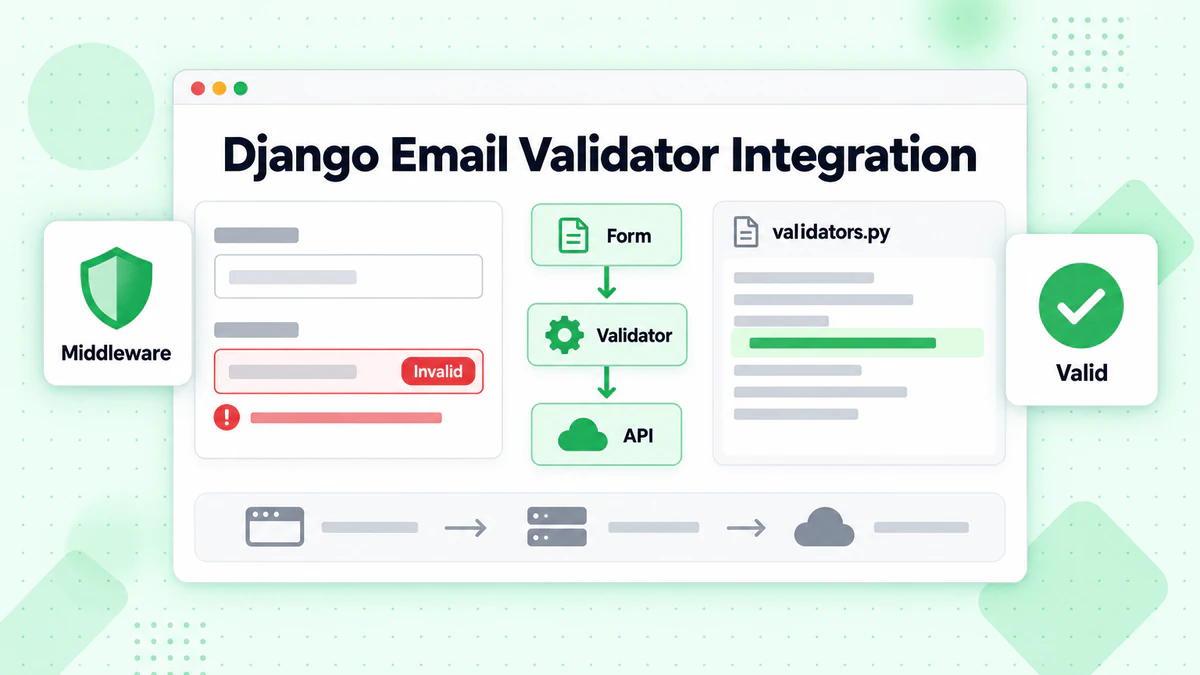
Erstellen Sie für Django-Anwendungen einen wiederverwendbaren Formularvalidator und Middleware:
# validators.py
from django.core.exceptions import ValidationError
from django.conf import settings

from email_verification import EmailVerificationClient

def get_verification_client():
    """Get or create verification client."""
    if not hasattr(get_verification_client, '_client'):
        get_verification_client._client = EmailVerificationClient(
            api_key=settings.BV_API_KEY
        )
    return get_verification_client._client


def validate_email_deliverable(email: str) -> None:
    """
    Django validator to check email deliverability.

    Usage in forms:
        email = forms.EmailField(validators=[validate_email_deliverable])
    """
    client = get_verification_client()

    try:
        result = client.verify(email)

        if not result.is_valid:
            raise ValidationError("Please enter a valid email address.")

        if not result.is_deliverable:
            raise ValidationError(
                "This email address doesn't appear to exist. "
                "Please check for typos."
            )

        if result.is_disposable:
            raise ValidationError(
                "Please use a permanent email address, "
                "not a disposable one."
            )

    except ValidationError:
        raise
    except Exception as e:
        # Log but don't block on service errors
        import logging
        logging.error(f"Email verification failed: {e}")


# forms.py
from django import forms
from .validators import validate_email_deliverable

class RegistrationForm(forms.Form):
    email = forms.EmailField(
        validators=[validate_email_deliverable],
        help_text="We'll send a confirmation email to this address."
    )
    password = forms.CharField(widget=forms.PasswordInput)

    def clean_email(self):
        email = self.cleaned_data['email']
        # Additional cleaning if needed
        return email.lower().strip()


# middleware.py
from django.http import JsonResponse
from django.conf import settings

class EmailVerificationMiddleware:
    """
    Middleware to verify emails in API requests.

    Add to MIDDLEWARE setting:
        'myapp.middleware.EmailVerificationMiddleware',
    """

    VERIFICATION_PATHS = ['/api/register/', '/api/contact/']

    def __init__(self, get_response):
        self.get_response = get_response

    def __call__(self, request):
        # Check if path needs verification
        if request.path in self.VERIFICATION_PATHS and request.method == 'POST':
            import json

            try:
                data = json.loads(request.body)
                email = data.get('email')

                if email:
                    from .validators import get_verification_client
                    client = get_verification_client()
                    result = client.verify(email)

                    if not result.is_safe_to_send():
                        return JsonResponse({
                            'error': 'Invalid email address',
                            'details': {
                                'is_valid': result.is_valid,
                                'is_deliverable': result.is_deliverable,
                                'is_disposable': result.is_disposable
                            }
                        }, status=400)

                    # Attach to request for views
                    request.email_verification = result

            except (json.JSONDecodeError, Exception):
                pass

        return self.get_response(request)
Response-Caching
Reduzieren Sie API-Aufrufe und verbessern Sie die Leistung mit intelligentem Caching:
import hashlib
import json
import time
from typing import Optional
from functools import lru_cache

class CachedEmailVerificationClient(EmailVerificationClient):
    """
    Email verification client with response caching.
    """

    def __init__(
        self,
        api_key: str,
        cache_ttl: int = 86400,  # 24 hours default
        **kwargs
    ):
        super().__init__(api_key, **kwargs)
        self.cache_ttl = cache_ttl
        self._cache = {}

    def _cache_key(self, email: str) -> str:
        """Generate cache key from email."""
        normalized = email.lower().strip()
        return hashlib.md5(normalized.encode()).hexdigest()

    def verify(self, email: str, skip_cache: bool = False) -> VerificationResult:
        """
        Verify email with caching.

        Args:
            email: Email to verify
            skip_cache: Force fresh verification

        Returns:
            VerificationResult from cache or API
        """
        cache_key = self._cache_key(email)

        # Check cache
        if not skip_cache and cache_key in self._cache:
            cached_data, cached_time = self._cache[cache_key]

            if time.time() - cached_time < self.cache_ttl:
                return cached_data

        # Fetch from API
        result = super().verify(email)

        # Cache result
        self._cache[cache_key] = (result, time.time())

        return result

    def clear_cache(self):
        """Clear all cached results."""
        self._cache.clear()

    def remove_from_cache(self, email: str):
        """Remove specific email from cache."""
        cache_key = self._cache_key(email)
        self._cache.pop(cache_key, None)


# Redis-based caching for distributed systems
import redis

class RedisCachedClient(EmailVerificationClient):
    """Email verification client with Redis caching."""

    def __init__(
        self,
        api_key: str,
        redis_url: str = "redis://localhost:6379",
        cache_ttl: int = 86400,
        **kwargs
    ):
        super().__init__(api_key, **kwargs)
        self.redis = redis.from_url(redis_url)
        self.cache_ttl = cache_ttl
        self.cache_prefix = "email_verify:"

    def verify(self, email: str, skip_cache: bool = False) -> VerificationResult:
        """Verify with Redis caching."""
        cache_key = f"{self.cache_prefix}{email.lower().strip()}"

        # Check cache
        if not skip_cache:
            cached = self.redis.get(cache_key)
            if cached:
                data = json.loads(cached)
                return VerificationResult.from_dict(data)

        # Fetch from API
        result = super().verify(email)

        # Cache result
        self.redis.setex(
            cache_key,
            self.cache_ttl,
            json.dumps({
                'email': result.email,
                'is_valid': result.is_valid,
                'is_deliverable': result.is_deliverable,
                'is_disposable': result.is_disposable,
                'is_role_based': result.is_role_based,
                'is_catch_all': result.is_catch_all,
                'is_free_provider': result.is_free_provider,
                'risk_score': result.risk_score,
                'domain': result.domain,
                'mx_records': result.mx_records,
                'smtp_check': result.smtp_check,
                'verification_time_ms': result.verification_time_ms
            })
        )

        return result
Testen Ihrer Integration
Schreiben Sie umfassende Tests, um sicherzustellen, dass Ihre Integration korrekt funktioniert:
import pytest
from unittest.mock import Mock, patch

from email_verification import EmailVerificationClient
from email_verification.models import VerificationResult
from email_verification.exceptions import AuthenticationError, RateLimitError


@pytest.fixture
def client():
    """Create test client."""
    return EmailVerificationClient(api_key="test_key")


@pytest.fixture
def mock_response():
    """Create mock API response."""
    return {
        "email": "test@example.com",
        "is_valid": True,
        "is_deliverable": True,
        "is_disposable": False,
        "is_role_based": False,
        "is_catch_all": False,
        "is_free_provider": False,
        "risk_score": 10,
        "domain": "example.com",
        "mx_records": ["mx.example.com"],
        "smtp_check": True,
        "verification_time_ms": 150
    }


class TestEmailVerificationClient:
    """Tests for EmailVerificationClient."""

    def test_verify_valid_email(self, client, mock_response):
        """Test successful email verification."""
        with patch.object(client.session, 'post') as mock_post:
            mock_post.return_value.status_code = 200
            mock_post.return_value.json.return_value = mock_response

            result = client.verify("test@example.com")

            assert result.is_valid is True
            assert result.is_deliverable is True
            assert result.risk_score == 10

    def test_verify_disposable_email(self, client):
        """Test detection of disposable email."""
        mock_data = {
            "email": "temp@mailinator.com",
            "is_valid": True,
            "is_deliverable": True,
            "is_disposable": True,
            "is_role_based": False,
            "is_catch_all": False,
            "is_free_provider": False,
            "risk_score": 80,
            "domain": "mailinator.com",
            "mx_records": [],
            "smtp_check": True,
            "verification_time_ms": 100
        }

        with patch.object(client.session, 'post') as mock_post:
            mock_post.return_value.status_code = 200
            mock_post.return_value.json.return_value = mock_data

            result = client.verify("temp@mailinator.com")

            assert result.is_disposable is True
            assert result.risk_score == 80
            assert result.is_safe_to_send() is False

    def test_authentication_error(self, client):
        """Test handling of authentication errors."""
        with patch.object(client.session, 'post') as mock_post:
            mock_post.return_value.status_code = 401

            with pytest.raises(AuthenticationError):
                client.verify("test@example.com")

    def test_rate_limit_handling(self, client, mock_response):
        """Test rate limit error handling."""
        with patch.object(client.session, 'post') as mock_post:
            mock_post.return_value.status_code = 429
            mock_post.return_value.headers = {'Retry-After': '30'}

            with pytest.raises(RateLimitError) as exc_info:
                client.verify("test@example.com")

            assert exc_info.value.retry_after == 30


class TestVerificationResult:
    """Tests for VerificationResult model."""

    def test_from_dict(self, mock_response):
        """Test creating result from dictionary."""
        result = VerificationResult.from_dict(mock_response)

        assert result.email == "test@example.com"
        assert result.is_valid is True
        assert result.domain == "example.com"

    def test_is_safe_to_send_valid(self, mock_response):
        """Test safe to send for valid email."""
        result = VerificationResult.from_dict(mock_response)
        assert result.is_safe_to_send() is True

    def test_is_safe_to_send_disposable(self, mock_response):
        """Test safe to send blocks disposable."""
        mock_response['is_disposable'] = True
        mock_response['risk_score'] = 80

        result = VerificationResult.from_dict(mock_response)
        assert result.is_safe_to_send() is False

    def test_is_safe_to_send_high_risk(self, mock_response):
        """Test safe to send blocks high risk."""
        mock_response['risk_score'] = 75

        result = VerificationResult.from_dict(mock_response)
        assert result.is_safe_to_send() is False
Best Practices für Fehlerbehandlung
Implementieren Sie eine umfassende Fehlerbehandlung für Produktionszuverlässigkeit:
import logging
from typing import Optional, Callable
from functools import wraps

logger = logging.getLogger(__name__)

def with_verification_fallback(
    fallback_value: bool = True,
    log_errors: bool = True
):
    """
    Decorator to handle verification errors gracefully.

    Args:
        fallback_value: Value to return on error
        log_errors: Whether to log errors
    """
    def decorator(func: Callable):
        @wraps(func)
        def wrapper(*args, **kwargs):
            try:
                return func(*args, **kwargs)
            except AuthenticationError:
                logger.critical("Email verification API authentication failed")
                raise  # Re-raise auth errors
            except RateLimitError as e:
                if log_errors:
                    logger.warning(f"Rate limit exceeded, retry after {e.retry_after}s")
                return fallback_value
            except Exception as e:
                if log_errors:
                    logger.error(f"Email verification failed: {e}")
                return fallback_value
        return wrapper
    return decorator


class SafeEmailVerifier:
    """
    Wrapper that provides safe verification with fallbacks.
    """

    def __init__(
        self,
        client: EmailVerificationClient,
        strict_mode: bool = False,
        default_result: Optional[VerificationResult] = None
    ):
        self.client = client
        self.strict_mode = strict_mode
        self.default_result = default_result or self._create_default_result()

    def verify(self, email: str) -> VerificationResult:
        """
        Verify email with graceful error handling.

        In non-strict mode, returns a permissive default on errors.
        In strict mode, propagates errors.
        """
        try:
            return self.client.verify(email)
        except AuthenticationError:
            # Always propagate auth errors
            raise
        except (RateLimitError, Exception) as e:
            logger.error(f"Verification error for {email}: {e}")

            if self.strict_mode:
                raise

            # Return permissive default
            result = self._create_default_result()
            result.email = email
            return result

    def _create_default_result(self) -> VerificationResult:
        """Create a permissive default result."""
        return VerificationResult(
            email="",
            is_valid=True,
            is_deliverable=True,
            is_disposable=False,
            is_role_based=False,
            is_catch_all=False,
            is_free_provider=False,
            risk_score=0,
            domain="",
            mx_records=[],
            smtp_check=True,
            verification_time_ms=0
        )
Überwachung und Protokollierung
Implementieren Sie eine ordnungsgemäße Überwachung für Produktionsbereitstellungen:
import time
import logging
from dataclasses import dataclass, field
from typing import Dict, List
from datetime import datetime, timedelta
from collections import defaultdict

@dataclass
class VerificationMetrics:
    """Track verification metrics for monitoring."""

    total_verifications: int = 0
    successful_verifications: int = 0
    failed_verifications: int = 0
    total_response_time_ms: int = 0
    errors_by_type: Dict[str, int] = field(default_factory=lambda: defaultdict(int))
    results_by_status: Dict[str, int] = field(default_factory=lambda: defaultdict(int))
    hourly_counts: Dict[str, int] = field(default_factory=lambda: defaultdict(int))

    @property
    def success_rate(self) -> float:
        if self.total_verifications == 0:
            return 0.0
        return self.successful_verifications / self.total_verifications * 100

    @property
    def avg_response_time_ms(self) -> float:
        if self.successful_verifications == 0:
            return 0.0
        return self.total_response_time_ms / self.successful_verifications

    def record_success(self, result: VerificationResult):
        """Record a successful verification."""
        self.total_verifications += 1
        self.successful_verifications += 1
        self.total_response_time_ms += result.verification_time_ms

        # Track status distribution
        if result.is_deliverable:
            self.results_by_status['deliverable'] += 1
        if result.is_disposable:
            self.results_by_status['disposable'] += 1
        if result.is_catch_all:
            self.results_by_status['catch_all'] += 1

        # Track hourly usage
        hour_key = datetime.now().strftime('%Y-%m-%d-%H')
        self.hourly_counts[hour_key] += 1

    def record_error(self, error_type: str):
        """Record a verification error."""
        self.total_verifications += 1
        self.failed_verifications += 1
        self.errors_by_type[error_type] += 1

    def get_summary(self) -> dict:
        """Get metrics summary."""
        return {
            'total_verifications': self.total_verifications,
            'success_rate': f"{self.success_rate:.1f}%",
            'avg_response_time_ms': f"{self.avg_response_time_ms:.0f}",
            'errors_by_type': dict(self.errors_by_type),
            'results_distribution': dict(self.results_by_status)
        }


class MonitoredEmailVerificationClient(EmailVerificationClient):
    """Client with built-in monitoring and metrics."""

    def __init__(self, *args, **kwargs):
        super().__init__(*args, **kwargs)
        self.metrics = VerificationMetrics()
        self.logger = logging.getLogger(f"{__name__}.{self.__class__.__name__}")

    def verify(self, email: str) -> VerificationResult:
        """Verify with metrics tracking."""
        start_time = time.time()

        try:
            result = super().verify(email)
            self.metrics.record_success(result)

            # Log verification details
            self.logger.info(
                "email_verification",
                extra={
                    'email_domain': result.domain,
                    'is_valid': result.is_valid,
                    'is_deliverable': result.is_deliverable,
                    'is_disposable': result.is_disposable,
                    'risk_score': result.risk_score,
                    'response_time_ms': result.verification_time_ms
                }
            )

            return result

        except Exception as e:
            error_type = type(e).__name__
            self.metrics.record_error(error_type)

            self.logger.error(
                "email_verification_error",
                extra={
                    'email_domain': email.split('@')[-1] if '@' in email else 'unknown',
                    'error_type': error_type,
                    'error_message': str(e),
                    'duration_ms': int((time.time() - start_time) * 1000)
                }
            )

            raise
Fazit
Die Integration der BillionVerify E-Mail-Verifizierungs-API mit Python ermöglicht es Ihnen, robuste E-Mail-Validierung in jede Anwendung zu integrieren. Die Muster und Beispiele in diesem Leitfaden bieten eine solide Grundlage für den Produktionseinsatz.
Wichtige Erkenntnisse für eine erfolgreiche Python-Integration:
Verwenden Sie eine strukturierte Client-Klasse mit ordnungsgemäßer Fehlerbehandlung, Retry-Logik und Connection-Pooling für Zuverlässigkeit
Implementieren Sie Caching, um API-Aufrufe zu reduzieren und Antwortzeiten für häufig verifizierte Adressen zu verbessern
Wählen Sie die richtige Verarbeitungsstrategie basierend auf Ihrem Volumen: sequenziell für kleine Listen, parallele Threads für mittlere Volumina und Batch-API für große Listen
Nutzen Sie async/await mit aiohttp für Hochdurchsatzanwendungen, die viele E-Mails schnell verifizieren müssen
Integrieren Sie mit Ihrem Framework unter Verwendung von Decorators, Validators oder Middleware-Mustern, die natürlich zu Django, Flask oder anderen Python-Frameworks passen
Überwachen und messen Sie Ihre Verifizierungsnutzung mit Metriken-Tracking, um Muster zu verstehen und Kosten zu optimieren
Behandeln Sie Fehler elegant mit Fallbacks, die Benutzer nicht blockieren, wenn der Verifizierungsdienst vorübergehend nicht verfügbar ist
Beginnen Sie mit der grundlegenden Client-Implementierung und fügen Sie schrittweise Funktionen wie Caching, Batch-Verarbeitung und Überwachung hinzu, wenn Ihre Anforderungen wachsen. Das modulare Design macht es einfach, die Integration für Ihre spezifischen Anforderungen anzupassen.
Testen Sie für Produktionsbereitstellungen immer gründlich mit Ihren erwarteten E-Mail-Mustern und -Volumina, implementieren Sie eine ordnungsgemäße Protokollierung für Debugging und richten Sie Alarme für Authentifizierungsfehler oder ungewöhnliche Fehlerraten ein.
Teams, die Instantly oder Smartlead nutzen, verbessern ihre Zustellrate erheblich, wenn sie Listen vor dem Versand mit BillionVerify bereinigen.
Vergleichen Sie BillionVerify mit ZeroBounce bei Massenverifikation und API-Geschwindigkeit, bevor Sie sich für einen Anbieter entscheiden.