



Python의 간결함과 강력한 생태계는 애플리케이션에 이메일 검증을 통합하는 데 탁월한 선택입니다. Django나 Flask로 웹 애플리케이션을 구축하든, pandas로 데이터를 처리하든, 자동화된 워크플로우를 만들든, 전문적인 이메일 검증을 추가하면 이메일 통신이 실제 수신자에게 도달하고 발신자 평판을 보호할 수 있습니다.
이 포괄적인 가이드는 기본적인 단일 이메일 검증부터 고급 배치 처리 및 프로덕션 준비 구현까지 BillionVerify 이메일 검증 API를 Python과 통합하는 과정을 안내합니다.
사전 요구 사항 및 설정
코드를 시작하기 전에 적절한 환경이 구성되어 있는지 확인하세요. 이 튜토리얼은 시스템에 Python 3.8 이상이 설치되어 있다고 가정합니다.
필요한 패키지 설치
필요한 패키지를 설치하는 것부터 시작하세요. HTTP 통신을 위해 requests 라이브러리를 사용하지만, 나중에 비동기 작업을 위한 aiohttp도 살펴볼 것입니다.
pip install requests python-dotenv
비동기 지원 및 고급 기능을 위해:
pip install aiohttp pandas
프로젝트 구조
관심사를 분리하는 깔끔한 구조로 프로젝트를 구성하세요:
email_verification/
├── __init__.py
├── client.py           # Main verification client
├── models.py           # Data models
├── exceptions.py       # Custom exceptions
├── utils.py            # Helper functions
├── batch_processor.py  # Batch verification logic
└── examples/
    ├── basic_usage.py
    ├── flask_integration.py
    └── django_integration.py
환경 설정
API 자격 증명을 안전하게 저장하기 위한 .env 파일을 생성하세요:
BV_API_KEY=your_api_key_here
EMAILVERIFY_API_URL=https://api.billionverify.com/v1
애플리케이션에서 이러한 변수를 로드하세요:
import os
from dotenv import load_dotenv

load_dotenv()

API_KEY = os.getenv('BV_API_KEY')
API_URL = os.getenv('EMAILVERIFY_API_URL', 'https://api.billionverify.com/v1')
기본 이메일 검증
가장 간단한 구현부터 시작하겠습니다: Python의 requests 라이브러리를 사용하여 단일 이메일 주소를 검증하는 것입니다.
간단한 검증 함수
import requests
from typing import Dict, Any

def verify_email(email: str, api_key: str) -> Dict[str, Any]:
    """
    Verify a single email address using the BillionVerify API.

    Args:
        email: The email address to verify
        api_key: Your BillionVerify API key

    Returns:
        Dictionary containing verification results

    Raises:
        requests.RequestException: If the API request fails
    """
    url = "https://api.billionverify.com/v1/verify"

    headers = {
        "Authorization": f"Bearer {api_key}",
        "Content-Type": "application/json"
    }

    payload = {"email": email}

    response = requests.post(url, json=payload, headers=headers, timeout=30)
    response.raise_for_status()

    return response.json()

# Example usage
if __name__ == "__main__":
    result = verify_email("test@example.com", API_KEY)
    print(f"Email valid: {result.get('is_valid')}")
    print(f"Deliverable: {result.get('is_deliverable')}")
응답 이해하기
API는 여러 검증 지표가 포함된 포괄적인 응답을 반환합니다:
{
    "email": "user@example.com",
    "is_valid": True,
    "is_deliverable": True,
    "is_disposable": False,
    "is_role_based": False,
    "is_catch_all": False,
    "is_free_provider": True,
    "risk_score": 15,
    "domain": "example.com",
    "mx_records": ["mx1.example.com", "mx2.example.com"],
    "smtp_check": True,
    "verification_time_ms": 245
}
각 필드는 유용한 정보를 제공합니다:
- is_valid: 이메일 형식이 구문적으로 올바른지 여부
- is_deliverable: 메일함이 존재하고 메일을 받을 수 있는지 여부
- is_disposable: 임시 또는 일회용 이메일 주소인지 식별
- is_role_based: info@ 또는 support@와 같은 일반 주소를 감지
- is_catch_all: 모든 주소를 수락하는 도메인인지 표시
- risk_score: 0(최저 위험)부터 100(최고 위험)까지의 수치적 평가
프로덕션 준비 클라이언트 구축
프로덕션 애플리케이션의 경우, 인증, 재시도, 속도 제한 및 오류 처리를 우아하게 처리하는 견고한 클라이언트 클래스가 필요합니다.
사용자 정의 예외
먼저 더 나은 오류 처리를 위한 사용자 정의 예외를 정의하세요:
# exceptions.py

class EmailVerificationError(Exception):
    """Base exception for email verification errors."""
    pass

class AuthenticationError(EmailVerificationError):
    """Raised when API authentication fails."""
    pass

class RateLimitError(EmailVerificationError):
    """Raised when API rate limit is exceeded."""
    def __init__(self, retry_after: int = 60):
        self.retry_after = retry_after
        super().__init__(f"Rate limit exceeded. Retry after {retry_after} seconds.")

class ValidationError(EmailVerificationError):
    """Raised when email validation fails."""
    pass

class APIError(EmailVerificationError):
    """Raised for general API errors."""
    def __init__(self, status_code: int, message: str):
        self.status_code = status_code
        super().__init__(f"API error {status_code}: {message}")
데이터 모델
타입 안전 응답 처리를 위해 dataclasses 또는 Pydantic을 사용하세요:
# models.py

from dataclasses import dataclass
from typing import List, Optional

@dataclass
class VerificationResult:
    """Represents the result of an email verification."""
    email: str
    is_valid: bool
    is_deliverable: bool
    is_disposable: bool
    is_role_based: bool
    is_catch_all: bool
    is_free_provider: bool
    risk_score: int
    domain: str
    mx_records: List[str]
    smtp_check: bool
    verification_time_ms: int

    @classmethod
    def from_dict(cls, data: dict) -> 'VerificationResult':
        """Create a VerificationResult from API response dictionary."""
        return cls(
            email=data.get('email', ''),
            is_valid=data.get('is_valid', False),
            is_deliverable=data.get('is_deliverable', False),
            is_disposable=data.get('is_disposable', False),
            is_role_based=data.get('is_role_based', False),
            is_catch_all=data.get('is_catch_all', False),
            is_free_provider=data.get('is_free_provider', False),
            risk_score=data.get('risk_score', 100),
            domain=data.get('domain', ''),
            mx_records=data.get('mx_records', []),
            smtp_check=data.get('smtp_check', False),
            verification_time_ms=data.get('verification_time_ms', 0)
        )

    def is_safe_to_send(self) -> bool:
        """Determine if it's safe to send emails to this address."""
        return (
            self.is_valid and
            self.is_deliverable and
            not self.is_disposable and
            self.risk_score < 50
        )
메인 클라이언트 클래스
이제 완전한 기능을 갖춘 검증 클라이언트를 구현하세요:
# client.py

import time
import logging
from typing import Optional, List
import requests
from requests.adapters import HTTPAdapter
from urllib3.util.retry import Retry

from .models import VerificationResult
from .exceptions import (
    AuthenticationError,
    RateLimitError,
    ValidationError,
    APIError
)

logger = logging.getLogger(__name__)

class EmailVerificationClient:
    """
    Production-ready client for the BillionVerify email verification API.

    Features:
    - Automatic retry with exponential backoff
    - Rate limit handling
    - Connection pooling
    - Comprehensive error handling
    - Response caching (optional)
    """

    DEFAULT_BASE_URL = "https://api.billionverify.com/v1"
    DEFAULT_TIMEOUT = 30
    MAX_RETRIES = 3

    def __init__(
        self,
        api_key: str,
        base_url: Optional[str] = None,
        timeout: int = DEFAULT_TIMEOUT,
        max_retries: int = MAX_RETRIES
    ):
        """
        Initialize the email verification client.

        Args:
            api_key: Your BillionVerify API key
            base_url: Optional custom API base URL
            timeout: Request timeout in seconds
            max_retries: Maximum number of retry attempts
        """
        if not api_key:
            raise ValueError("API key is required")

        self.api_key = api_key
        self.base_url = base_url or self.DEFAULT_BASE_URL
        self.timeout = timeout
        self.max_retries = max_retries

        # Configure session with retry logic
        self.session = self._create_session()

    def _create_session(self) -> requests.Session:
        """Create a requests session with retry configuration."""
        session = requests.Session()

        # Configure retry strategy
        retry_strategy = Retry(
            total=self.max_retries,
            backoff_factor=1,
            status_forcelist=[429, 500, 502, 503, 504],
            allowed_methods=["GET", "POST"]
        )

        adapter = HTTPAdapter(
            max_retries=retry_strategy,
            pool_connections=10,
            pool_maxsize=20
        )

        session.mount("http://", adapter)
        session.mount("https://", adapter)

        # Set default headers
        session.headers.update({
            "Authorization": f"Bearer {self.api_key}",
            "Content-Type": "application/json",
            "User-Agent": "BillionVerify-Python/1.0"
        })

        return session

    def _handle_response(self, response: requests.Response) -> dict:
        """
        Handle API response and raise appropriate exceptions.

        Args:
            response: The requests Response object

        Returns:
            Parsed JSON response

        Raises:
            AuthenticationError: For 401/403 responses
            RateLimitError: For 429 responses
            APIError: For other error responses
        """
        if response.status_code == 401:
            raise AuthenticationError("Invalid API key")

        if response.status_code == 403:
            raise AuthenticationError("Access forbidden. Check API key permissions.")

        if response.status_code == 429:
            retry_after = int(response.headers.get('Retry-After', 60))
            raise RateLimitError(retry_after)

        if response.status_code == 400:
            error_data = response.json()
            raise ValidationError(error_data.get('message', 'Validation failed'))

        if response.status_code >= 400:
            raise APIError(response.status_code, response.text)

        return response.json()

    def verify(self, email: str) -> VerificationResult:
        """
        Verify a single email address.

        Args:
            email: The email address to verify

        Returns:
            VerificationResult object with verification details
        """
        url = f"{self.base_url}/verify"

        logger.debug(f"Verifying email: {email}")

        response = self.session.post(
            url,
            json={"email": email},
            timeout=self.timeout
        )

        data = self._handle_response(response)
        result = VerificationResult.from_dict(data)

        logger.info(
            f"Verified {email}: valid={result.is_valid}, "
            f"deliverable={result.is_deliverable}, "
            f"risk_score={result.risk_score}"
        )

        return result

    def verify_batch(
        self,
        emails: List[str],
        callback_url: Optional[str] = None
    ) -> str:
        """
        Submit a batch of emails for verification.

        Args:
            emails: List of email addresses to verify
            callback_url: Optional webhook URL for results notification

        Returns:
            Batch ID for tracking the verification job
        """
        url = f"{self.base_url}/verify/batch"

        payload = {"emails": emails}
        if callback_url:
            payload["callback_url"] = callback_url

        response = self.session.post(
            url,
            json=payload,
            timeout=self.timeout
        )

        data = self._handle_response(response)
        batch_id = data.get('batch_id')

        logger.info(f"Submitted batch verification: {batch_id} ({len(emails)} emails)")

        return batch_id

    def get_batch_status(self, batch_id: str) -> dict:
        """
        Get the status of a batch verification job.

        Args:
            batch_id: The batch ID returned from verify_batch

        Returns:
            Dictionary with batch status and progress
        """
        url = f"{self.base_url}/verify/batch/{batch_id}"

        response = self.session.get(url, timeout=self.timeout)
        return self._handle_response(response)

    def get_batch_results(self, batch_id: str) -> List[VerificationResult]:
        """
        Get the results of a completed batch verification.

        Args:
            batch_id: The batch ID returned from verify_batch

        Returns:
            List of VerificationResult objects
        """
        url = f"{self.base_url}/verify/batch/{batch_id}/results"

        response = self.session.get(url, timeout=self.timeout)
        data = self._handle_response(response)

        return [VerificationResult.from_dict(item) for item in data.get('results', [])]

    def close(self):
        """Close the underlying session."""
        self.session.close()

    def __enter__(self):
        return self

    def __exit__(self, exc_type, exc_val, exc_tb):
        self.close()
배치 이메일 검증
대량 이메일 목록 처리에는 효율적인 배치 처리가 필요합니다. 진행 상황 추적 및 결과 관리를 포함한 강력한 배치 검증을 구현하는 방법은 다음과 같습니다.
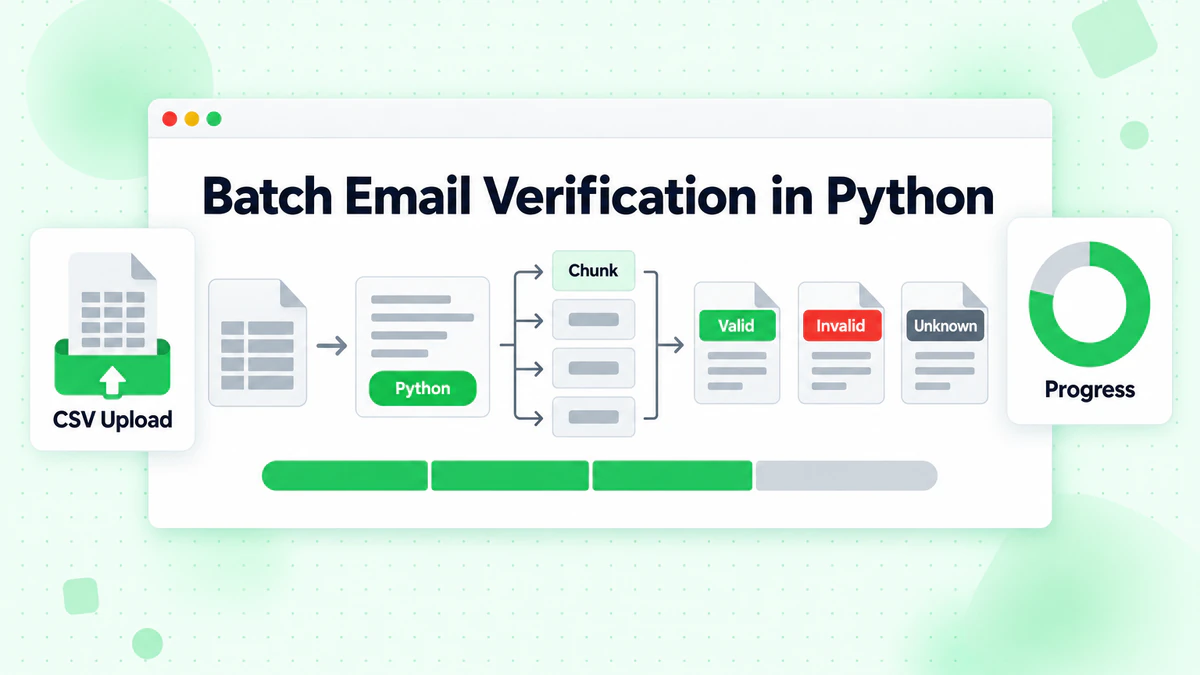
배치 프로세서 구현
# batch_processor.py

import time
import logging
from typing import List, Callable, Optional
from concurrent.futures import ThreadPoolExecutor, as_completed

from .client import EmailVerificationClient
from .models import VerificationResult
from .exceptions import RateLimitError

logger = logging.getLogger(__name__)

class BatchProcessor:
    """
    Process large email lists with progress tracking and result handling.
    """

    def __init__(
        self,
        client: EmailVerificationClient,
        batch_size: int = 1000,
        max_workers: int = 5,
        progress_callback: Optional[Callable[[int, int], None]] = None
    ):
        """
        Initialize the batch processor.

        Args:
            client: EmailVerificationClient instance
            batch_size: Number of emails per batch submission
            max_workers: Maximum concurrent verification threads
            progress_callback: Optional callback for progress updates
        """
        self.client = client
        self.batch_size = batch_size
        self.max_workers = max_workers
        self.progress_callback = progress_callback

    def process_list(
        self,
        emails: List[str],
        use_async_batch: bool = True
    ) -> List[VerificationResult]:
        """
        Process a list of emails with optimal strategy.

        Args:
            emails: List of email addresses
            use_async_batch: Use async batch API for large lists

        Returns:
            List of verification results
        """
        total = len(emails)
        logger.info(f"Starting verification of {total} emails")

        if total <= 10:
            # Small list: verify individually
            return self._process_sequential(emails)
        elif use_async_batch and total > 100:
            # Large list: use batch API
            return self._process_batch_api(emails)
        else:
            # Medium list: use concurrent individual verification
            return self._process_concurrent(emails)

    def _process_sequential(
        self,
        emails: List[str]
    ) -> List[VerificationResult]:
        """Process emails sequentially."""
        results = []
        total = len(emails)

        for i, email in enumerate(emails):
            try:
                result = self.client.verify(email)
                results.append(result)
            except RateLimitError as e:
                logger.warning(f"Rate limit hit, waiting {e.retry_after}s")
                time.sleep(e.retry_after)
                result = self.client.verify(email)
                results.append(result)
            except Exception as e:
                logger.error(f"Failed to verify {email}: {e}")
                results.append(self._create_error_result(email, str(e)))

            if self.progress_callback:
                self.progress_callback(i + 1, total)

        return results

    def _process_concurrent(
        self,
        emails: List[str]
    ) -> List[VerificationResult]:
        """Process emails concurrently with thread pool."""
        results = []
        total = len(emails)
        completed = 0

        with ThreadPoolExecutor(max_workers=self.max_workers) as executor:
            future_to_email = {
                executor.submit(self._verify_with_retry, email): email
                for email in emails
            }

            for future in as_completed(future_to_email):
                email = future_to_email[future]
                try:
                    result = future.result()
                    results.append(result)
                except Exception as e:
                    logger.error(f"Failed to verify {email}: {e}")
                    results.append(self._create_error_result(email, str(e)))

                completed += 1
                if self.progress_callback:
                    self.progress_callback(completed, total)

        return results

    def _process_batch_api(
        self,
        emails: List[str]
    ) -> List[VerificationResult]:
        """Process emails using the async batch API."""
        all_results = []
        total = len(emails)
        processed = 0

        # Split into batches
        batches = [
            emails[i:i + self.batch_size]
            for i in range(0, total, self.batch_size)
        ]

        for batch_num, batch in enumerate(batches, 1):
            logger.info(f"Submitting batch {batch_num}/{len(batches)}")

            # Submit batch
            batch_id = self.client.verify_batch(batch)

            # Wait for completion with polling
            results = self._wait_for_batch(batch_id)
            all_results.extend(results)

            processed += len(batch)
            if self.progress_callback:
                self.progress_callback(processed, total)

        return all_results

    def _wait_for_batch(
        self,
        batch_id: str,
        poll_interval: int = 5,
        max_wait: int = 3600
    ) -> List[VerificationResult]:
        """
        Wait for batch verification to complete.

        Args:
            batch_id: The batch ID to wait for
            poll_interval: Seconds between status checks
            max_wait: Maximum seconds to wait

        Returns:
            List of verification results
        """
        start_time = time.time()

        while time.time() - start_time < max_wait:
            status = self.client.get_batch_status(batch_id)

            if status.get('status') == 'completed':
                return self.client.get_batch_results(batch_id)

            if status.get('status') == 'failed':
                raise RuntimeError(f"Batch {batch_id} failed: {status.get('error')}")

            progress = status.get('progress', 0)
            logger.debug(f"Batch {batch_id} progress: {progress}%")

            time.sleep(poll_interval)

        raise TimeoutError(f"Batch {batch_id} did not complete within {max_wait}s")

    def _verify_with_retry(
        self,
        email: str,
        max_retries: int = 3
    ) -> VerificationResult:
        """Verify email with retry logic for rate limits."""
        for attempt in range(max_retries):
            try:
                return self.client.verify(email)
            except RateLimitError as e:
                if attempt < max_retries - 1:
                    time.sleep(e.retry_after)
                else:
                    raise

        raise RuntimeError(f"Failed to verify {email} after {max_retries} attempts")

    @staticmethod
    def _create_error_result(email: str, error: str) -> VerificationResult:
        """Create a result object for failed verification."""
        return VerificationResult(
            email=email,
            is_valid=False,
            is_deliverable=False,
            is_disposable=False,
            is_role_based=False,
            is_catch_all=False,
            is_free_provider=False,
            risk_score=100,
            domain=email.split('@')[-1] if '@' in email else '',
            mx_records=[],
            smtp_check=False,
            verification_time_ms=0
        )
CSV 파일 및 Pandas 작업
데이터 처리 워크플로우의 경우 pandas와 통합하세요:
import pandas as pd
from typing import Optional

def verify_csv_file(
    client: EmailVerificationClient,
    input_file: str,
    output_file: str,
    email_column: str = 'email',
    batch_size: int = 1000
) -> pd.DataFrame:
    """
    Verify emails from a CSV file and save results.

    Args:
        client: EmailVerificationClient instance
        input_file: Path to input CSV file
        output_file: Path to output CSV file
        email_column: Name of the column containing emails
        batch_size: Processing batch size

    Returns:
        DataFrame with verification results
    """
    # Read input file
    df = pd.read_csv(input_file)

    if email_column not in df.columns:
        raise ValueError(f"Column '{email_column}' not found in CSV")

    emails = df[email_column].dropna().tolist()

    # Process with progress tracking
    processor = BatchProcessor(
        client,
        batch_size=batch_size,
        progress_callback=lambda done, total: print(f"Progress: {done}/{total}")
    )

    results = processor.process_list(emails)

    # Create results DataFrame
    results_df = pd.DataFrame([
        {
            'email': r.email,
            'is_valid': r.is_valid,
            'is_deliverable': r.is_deliverable,
            'is_disposable': r.is_disposable,
            'is_role_based': r.is_role_based,
            'is_catch_all': r.is_catch_all,
            'risk_score': r.risk_score,
            'domain': r.domain
        }
        for r in results
    ])

    # Merge with original data
    merged = df.merge(results_df, left_on=email_column, right_on='email', how='left')

    # Save results
    merged.to_csv(output_file, index=False)

    # Print summary
    print(f"\nVerification Summary:")
    print(f"  Total emails: {len(emails)}")
    print(f"  Valid: {results_df['is_valid'].sum()}")
    print(f"  Deliverable: {results_df['is_deliverable'].sum()}")
    print(f"  Disposable: {results_df['is_disposable'].sum()}")
    print(f"  High risk (score >= 50): {(results_df['risk_score'] >= 50).sum()}")

    return merged
asyncio를 사용한 비동기 검증
고성능 애플리케이션의 경우 aiohttp와 함께 Python의 asyncio를 사용하세요:
import asyncio
import aiohttp
from typing import List, Optional
from dataclasses import dataclass

class AsyncEmailVerificationClient:
    """
    Asynchronous email verification client using aiohttp.
    """

    def __init__(
        self,
        api_key: str,
        base_url: str = "https://api.billionverify.com/v1",
        concurrency_limit: int = 10
    ):
        self.api_key = api_key
        self.base_url = base_url
        self.semaphore = asyncio.Semaphore(concurrency_limit)
        self._session: Optional[aiohttp.ClientSession] = None

    async def _get_session(self) -> aiohttp.ClientSession:
        """Get or create aiohttp session."""
        if self._session is None or self._session.closed:
            self._session = aiohttp.ClientSession(
                headers={
                    "Authorization": f"Bearer {self.api_key}",
                    "Content-Type": "application/json"
                }
            )
        return self._session

    async def verify(self, email: str) -> dict:
        """Verify a single email asynchronously."""
        async with self.semaphore:
            session = await self._get_session()
            url = f"{self.base_url}/verify"

            async with session.post(url, json={"email": email}) as response:
                if response.status == 429:
                    retry_after = int(response.headers.get('Retry-After', 60))
                    await asyncio.sleep(retry_after)
                    return await self.verify(email)

                response.raise_for_status()
                return await response.json()

    async def verify_many(self, emails: List[str]) -> List[dict]:
        """Verify multiple emails concurrently."""
        tasks = [self.verify(email) for email in emails]
        results = await asyncio.gather(*tasks, return_exceptions=True)

        return [
            r if not isinstance(r, Exception) else {"email": emails[i], "error": str(r)}
            for i, r in enumerate(results)
        ]

    async def close(self):
        """Close the aiohttp session."""
        if self._session and not self._session.closed:
            await self._session.close()

    async def __aenter__(self):
        return self

    async def __aexit__(self, exc_type, exc_val, exc_tb):
        await self.close()


# Usage example
async def main():
    emails = [
        "user1@example.com",
        "user2@example.com",
        "user3@example.com"
    ]

    async with AsyncEmailVerificationClient(api_key="your_key") as client:
        results = await client.verify_many(emails)

        for result in results:
            if "error" in result:
                print(f"Error: {result['error']}")
            else:
                print(f"{result['email']}: valid={result['is_valid']}")

# Run the async function
asyncio.run(main())
Flask 통합
Flask 웹 애플리케이션에 이메일 검증을 통합하세요:
from flask import Flask, request, jsonify
from functools import wraps
import os

from email_verification import EmailVerificationClient, ValidationError

app = Flask(__name__)

# Initialize client once
verification_client = EmailVerificationClient(
    api_key=os.getenv('BV_API_KEY')
)

def verify_email_param(f):
    """Decorator to verify email parameter in requests."""
    @wraps(f)
    def decorated_function(*args, **kwargs):
        email = request.json.get('email') if request.is_json else request.form.get('email')

        if not email:
            return jsonify({"error": "Email is required"}), 400

        try:
            result = verification_client.verify(email)

            if not result.is_deliverable:
                return jsonify({
                    "error": "Please provide a valid email address",
                    "details": {
                        "is_disposable": result.is_disposable,
                        "risk_score": result.risk_score
                    }
                }), 400

            # Attach result to request for use in route
            request.email_verification = result

        except ValidationError as e:
            return jsonify({"error": str(e)}), 400
        except Exception as e:
            # Log error but don't block user
            app.logger.error(f"Email verification failed: {e}")

        return f(*args, **kwargs)

    return decorated_function


@app.route('/api/register', methods=['POST'])
@verify_email_param
def register():
    """User registration endpoint with email verification."""
    data = request.json

    # Email has been verified by decorator
    email = data.get('email')
    verification = getattr(request, 'email_verification', None)

    # Warn about disposable emails but allow
    warning = None
    if verification and verification.is_disposable:
        warning = "You're using a disposable email. Some features may be limited."

    # Create user (your implementation)
    user = create_user(email=email, **data)

    response = {"success": True, "user_id": user.id}
    if warning:
        response["warning"] = warning

    return jsonify(response), 201


@app.route('/api/verify-email', methods=['POST'])
def verify_email_endpoint():
    """Standalone email verification endpoint."""
    email = request.json.get('email')

    if not email:
        return jsonify({"error": "Email is required"}), 400

    try:
        result = verification_client.verify(email)

        return jsonify({
            "email": result.email,
            "is_valid": result.is_valid,
            "is_deliverable": result.is_deliverable,
            "is_disposable": result.is_disposable,
            "risk_score": result.risk_score,
            "safe_to_send": result.is_safe_to_send()
        })

    except ValidationError as e:
        return jsonify({"error": str(e)}), 400
    except Exception as e:
        return jsonify({"error": "Verification service unavailable"}), 503


if __name__ == '__main__':
    app.run(debug=True)
Django 통합
Django 애플리케이션의 경우 재사용 가능한 폼 검증기와 미들웨어를 만드세요:
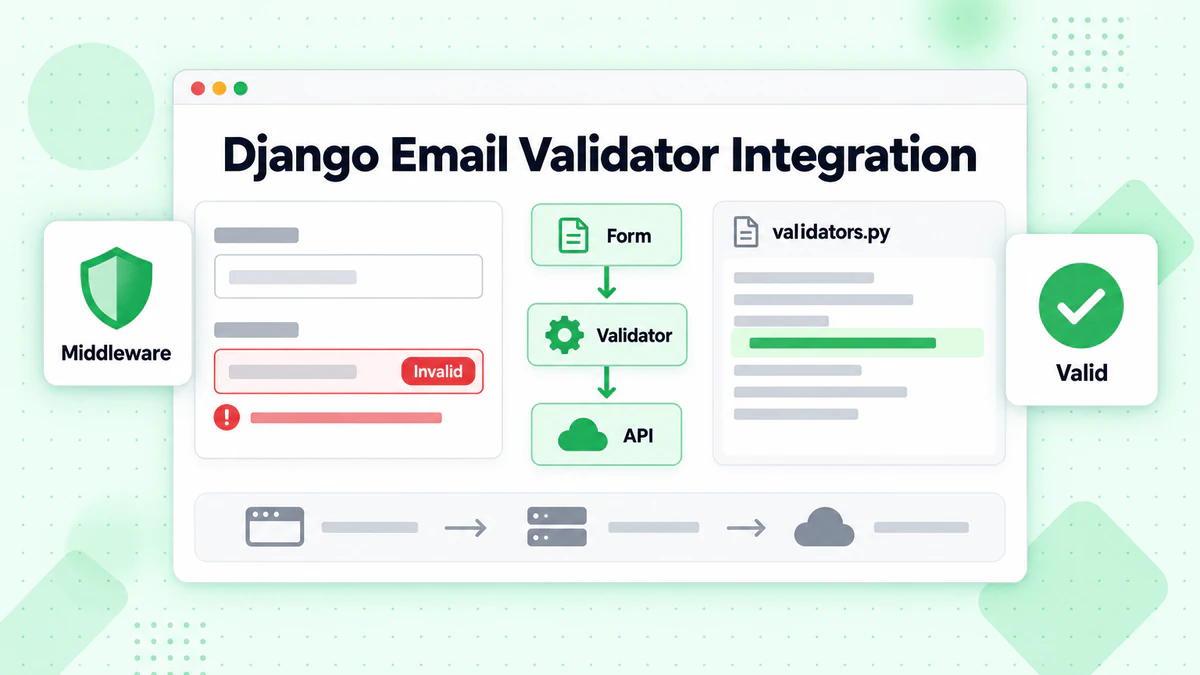
# validators.py
from django.core.exceptions import ValidationError
from django.conf import settings

from email_verification import EmailVerificationClient

def get_verification_client():
    """Get or create verification client."""
    if not hasattr(get_verification_client, '_client'):
        get_verification_client._client = EmailVerificationClient(
            api_key=settings.BV_API_KEY
        )
    return get_verification_client._client


def validate_email_deliverable(email: str) -> None:
    """
    Django validator to check email deliverability.

    Usage in forms:
        email = forms.EmailField(validators=[validate_email_deliverable])
    """
    client = get_verification_client()

    try:
        result = client.verify(email)

        if not result.is_valid:
            raise ValidationError("Please enter a valid email address.")

        if not result.is_deliverable:
            raise ValidationError(
                "This email address doesn't appear to exist. "
                "Please check for typos."
            )

        if result.is_disposable:
            raise ValidationError(
                "Please use a permanent email address, "
                "not a disposable one."
            )

    except ValidationError:
        raise
    except Exception as e:
        # Log but don't block on service errors
        import logging
        logging.error(f"Email verification failed: {e}")


# forms.py
from django import forms
from .validators import validate_email_deliverable

class RegistrationForm(forms.Form):
    email = forms.EmailField(
        validators=[validate_email_deliverable],
        help_text="We'll send a confirmation email to this address."
    )
    password = forms.CharField(widget=forms.PasswordInput)

    def clean_email(self):
        email = self.cleaned_data['email']
        # Additional cleaning if needed
        return email.lower().strip()


# middleware.py
from django.http import JsonResponse
from django.conf import settings

class EmailVerificationMiddleware:
    """
    Middleware to verify emails in API requests.

    Add to MIDDLEWARE setting:
        'myapp.middleware.EmailVerificationMiddleware',
    """

    VERIFICATION_PATHS = ['/api/register/', '/api/contact/']

    def __init__(self, get_response):
        self.get_response = get_response

    def __call__(self, request):
        # Check if path needs verification
        if request.path in self.VERIFICATION_PATHS and request.method == 'POST':
            import json

            try:
                data = json.loads(request.body)
                email = data.get('email')

                if email:
                    from .validators import get_verification_client
                    client = get_verification_client()
                    result = client.verify(email)

                    if not result.is_safe_to_send():
                        return JsonResponse({
                            'error': 'Invalid email address',
                            'details': {
                                'is_valid': result.is_valid,
                                'is_deliverable': result.is_deliverable,
                                'is_disposable': result.is_disposable
                            }
                        }, status=400)

                    # Attach to request for views
                    request.email_verification = result

            except (json.JSONDecodeError, Exception):
                pass

        return self.get_response(request)
응답 캐싱
지능적인 캐싱으로 API 호출을 줄이고 성능을 개선하세요:
import hashlib
import json
import time
from typing import Optional
from functools import lru_cache

class CachedEmailVerificationClient(EmailVerificationClient):
    """
    Email verification client with response caching.
    """

    def __init__(
        self,
        api_key: str,
        cache_ttl: int = 86400,  # 24 hours default
        **kwargs
    ):
        super().__init__(api_key, **kwargs)
        self.cache_ttl = cache_ttl
        self._cache = {}

    def _cache_key(self, email: str) -> str:
        """Generate cache key from email."""
        normalized = email.lower().strip()
        return hashlib.md5(normalized.encode()).hexdigest()

    def verify(self, email: str, skip_cache: bool = False) -> VerificationResult:
        """
        Verify email with caching.

        Args:
            email: Email to verify
            skip_cache: Force fresh verification

        Returns:
            VerificationResult from cache or API
        """
        cache_key = self._cache_key(email)

        # Check cache
        if not skip_cache and cache_key in self._cache:
            cached_data, cached_time = self._cache[cache_key]

            if time.time() - cached_time < self.cache_ttl:
                return cached_data

        # Fetch from API
        result = super().verify(email)

        # Cache result
        self._cache[cache_key] = (result, time.time())

        return result

    def clear_cache(self):
        """Clear all cached results."""
        self._cache.clear()

    def remove_from_cache(self, email: str):
        """Remove specific email from cache."""
        cache_key = self._cache_key(email)
        self._cache.pop(cache_key, None)


# Redis-based caching for distributed systems
import redis

class RedisCachedClient(EmailVerificationClient):
    """Email verification client with Redis caching."""

    def __init__(
        self,
        api_key: str,
        redis_url: str = "redis://localhost:6379",
        cache_ttl: int = 86400,
        **kwargs
    ):
        super().__init__(api_key, **kwargs)
        self.redis = redis.from_url(redis_url)
        self.cache_ttl = cache_ttl
        self.cache_prefix = "email_verify:"

    def verify(self, email: str, skip_cache: bool = False) -> VerificationResult:
        """Verify with Redis caching."""
        cache_key = f"{self.cache_prefix}{email.lower().strip()}"

        # Check cache
        if not skip_cache:
            cached = self.redis.get(cache_key)
            if cached:
                data = json.loads(cached)
                return VerificationResult.from_dict(data)

        # Fetch from API
        result = super().verify(email)

        # Cache result
        self.redis.setex(
            cache_key,
            self.cache_ttl,
            json.dumps({
                'email': result.email,
                'is_valid': result.is_valid,
                'is_deliverable': result.is_deliverable,
                'is_disposable': result.is_disposable,
                'is_role_based': result.is_role_based,
                'is_catch_all': result.is_catch_all,
                'is_free_provider': result.is_free_provider,
                'risk_score': result.risk_score,
                'domain': result.domain,
                'mx_records': result.mx_records,
                'smtp_check': result.smtp_check,
                'verification_time_ms': result.verification_time_ms
            })
        )

        return result
통합 테스트
통합이 올바르게 작동하는지 확인하기 위해 포괄적인 테스트를 작성하세요:
import pytest
from unittest.mock import Mock, patch

from email_verification import EmailVerificationClient
from email_verification.models import VerificationResult
from email_verification.exceptions import AuthenticationError, RateLimitError


@pytest.fixture
def client():
    """Create test client."""
    return EmailVerificationClient(api_key="test_key")


@pytest.fixture
def mock_response():
    """Create mock API response."""
    return {
        "email": "test@example.com",
        "is_valid": True,
        "is_deliverable": True,
        "is_disposable": False,
        "is_role_based": False,
        "is_catch_all": False,
        "is_free_provider": False,
        "risk_score": 10,
        "domain": "example.com",
        "mx_records": ["mx.example.com"],
        "smtp_check": True,
        "verification_time_ms": 150
    }


class TestEmailVerificationClient:
    """Tests for EmailVerificationClient."""

    def test_verify_valid_email(self, client, mock_response):
        """Test successful email verification."""
        with patch.object(client.session, 'post') as mock_post:
            mock_post.return_value.status_code = 200
            mock_post.return_value.json.return_value = mock_response

            result = client.verify("test@example.com")

            assert result.is_valid is True
            assert result.is_deliverable is True
            assert result.risk_score == 10

    def test_verify_disposable_email(self, client):
        """Test detection of disposable email."""
        mock_data = {
            "email": "temp@mailinator.com",
            "is_valid": True,
            "is_deliverable": True,
            "is_disposable": True,
            "is_role_based": False,
            "is_catch_all": False,
            "is_free_provider": False,
            "risk_score": 80,
            "domain": "mailinator.com",
            "mx_records": [],
            "smtp_check": True,
            "verification_time_ms": 100
        }

        with patch.object(client.session, 'post') as mock_post:
            mock_post.return_value.status_code = 200
            mock_post.return_value.json.return_value = mock_data

            result = client.verify("temp@mailinator.com")

            assert result.is_disposable is True
            assert result.risk_score == 80
            assert result.is_safe_to_send() is False

    def test_authentication_error(self, client):
        """Test handling of authentication errors."""
        with patch.object(client.session, 'post') as mock_post:
            mock_post.return_value.status_code = 401

            with pytest.raises(AuthenticationError):
                client.verify("test@example.com")

    def test_rate_limit_handling(self, client, mock_response):
        """Test rate limit error handling."""
        with patch.object(client.session, 'post') as mock_post:
            mock_post.return_value.status_code = 429
            mock_post.return_value.headers = {'Retry-After': '30'}

            with pytest.raises(RateLimitError) as exc_info:
                client.verify("test@example.com")

            assert exc_info.value.retry_after == 30


class TestVerificationResult:
    """Tests for VerificationResult model."""

    def test_from_dict(self, mock_response):
        """Test creating result from dictionary."""
        result = VerificationResult.from_dict(mock_response)

        assert result.email == "test@example.com"
        assert result.is_valid is True
        assert result.domain == "example.com"

    def test_is_safe_to_send_valid(self, mock_response):
        """Test safe to send for valid email."""
        result = VerificationResult.from_dict(mock_response)
        assert result.is_safe_to_send() is True

    def test_is_safe_to_send_disposable(self, mock_response):
        """Test safe to send blocks disposable."""
        mock_response['is_disposable'] = True
        mock_response['risk_score'] = 80

        result = VerificationResult.from_dict(mock_response)
        assert result.is_safe_to_send() is False

    def test_is_safe_to_send_high_risk(self, mock_response):
        """Test safe to send blocks high risk."""
        mock_response['risk_score'] = 75

        result = VerificationResult.from_dict(mock_response)
        assert result.is_safe_to_send() is False
오류 처리 모범 사례
프로덕션 안정성을 위한 포괄적인 오류 처리를 구현하세요:
import logging
from typing import Optional, Callable
from functools import wraps

logger = logging.getLogger(__name__)

def with_verification_fallback(
    fallback_value: bool = True,
    log_errors: bool = True
):
    """
    Decorator to handle verification errors gracefully.

    Args:
        fallback_value: Value to return on error
        log_errors: Whether to log errors
    """
    def decorator(func: Callable):
        @wraps(func)
        def wrapper(*args, **kwargs):
            try:
                return func(*args, **kwargs)
            except AuthenticationError:
                logger.critical("Email verification API authentication failed")
                raise  # Re-raise auth errors
            except RateLimitError as e:
                if log_errors:
                    logger.warning(f"Rate limit exceeded, retry after {e.retry_after}s")
                return fallback_value
            except Exception as e:
                if log_errors:
                    logger.error(f"Email verification failed: {e}")
                return fallback_value
        return wrapper
    return decorator


class SafeEmailVerifier:
    """
    Wrapper that provides safe verification with fallbacks.
    """

    def __init__(
        self,
        client: EmailVerificationClient,
        strict_mode: bool = False,
        default_result: Optional[VerificationResult] = None
    ):
        self.client = client
        self.strict_mode = strict_mode
        self.default_result = default_result or self._create_default_result()

    def verify(self, email: str) -> VerificationResult:
        """
        Verify email with graceful error handling.

        In non-strict mode, returns a permissive default on errors.
        In strict mode, propagates errors.
        """
        try:
            return self.client.verify(email)
        except AuthenticationError:
            # Always propagate auth errors
            raise
        except (RateLimitError, Exception) as e:
            logger.error(f"Verification error for {email}: {e}")

            if self.strict_mode:
                raise

            # Return permissive default
            result = self._create_default_result()
            result.email = email
            return result

    def _create_default_result(self) -> VerificationResult:
        """Create a permissive default result."""
        return VerificationResult(
            email="",
            is_valid=True,
            is_deliverable=True,
            is_disposable=False,
            is_role_based=False,
            is_catch_all=False,
            is_free_provider=False,
            risk_score=0,
            domain="",
            mx_records=[],
            smtp_check=True,
            verification_time_ms=0
        )
모니터링 및 로깅
프로덕션 배포를 위한 적절한 모니터링을 구현하세요:
import time
import logging
from dataclasses import dataclass, field
from typing import Dict, List
from datetime import datetime, timedelta
from collections import defaultdict

@dataclass
class VerificationMetrics:
    """Track verification metrics for monitoring."""

    total_verifications: int = 0
    successful_verifications: int = 0
    failed_verifications: int = 0
    total_response_time_ms: int = 0
    errors_by_type: Dict[str, int] = field(default_factory=lambda: defaultdict(int))
    results_by_status: Dict[str, int] = field(default_factory=lambda: defaultdict(int))
    hourly_counts: Dict[str, int] = field(default_factory=lambda: defaultdict(int))

    @property
    def success_rate(self) -> float:
        if self.total_verifications == 0:
            return 0.0
        return self.successful_verifications / self.total_verifications * 100

    @property
    def avg_response_time_ms(self) -> float:
        if self.successful_verifications == 0:
            return 0.0
        return self.total_response_time_ms / self.successful_verifications

    def record_success(self, result: VerificationResult):
        """Record a successful verification."""
        self.total_verifications += 1
        self.successful_verifications += 1
        self.total_response_time_ms += result.verification_time_ms

        # Track status distribution
        if result.is_deliverable:
            self.results_by_status['deliverable'] += 1
        if result.is_disposable:
            self.results_by_status['disposable'] += 1
        if result.is_catch_all:
            self.results_by_status['catch_all'] += 1

        # Track hourly usage
        hour_key = datetime.now().strftime('%Y-%m-%d-%H')
        self.hourly_counts[hour_key] += 1

    def record_error(self, error_type: str):
        """Record a verification error."""
        self.total_verifications += 1
        self.failed_verifications += 1
        self.errors_by_type[error_type] += 1

    def get_summary(self) -> dict:
        """Get metrics summary."""
        return {
            'total_verifications': self.total_verifications,
            'success_rate': f"{self.success_rate:.1f}%",
            'avg_response_time_ms': f"{self.avg_response_time_ms:.0f}",
            'errors_by_type': dict(self.errors_by_type),
            'results_distribution': dict(self.results_by_status)
        }


class MonitoredEmailVerificationClient(EmailVerificationClient):
    """Client with built-in monitoring and metrics."""

    def __init__(self, *args, **kwargs):
        super().__init__(*args, **kwargs)
        self.metrics = VerificationMetrics()
        self.logger = logging.getLogger(f"{__name__}.{self.__class__.__name__}")

    def verify(self, email: str) -> VerificationResult:
        """Verify with metrics tracking."""
        start_time = time.time()

        try:
            result = super().verify(email)
            self.metrics.record_success(result)

            # Log verification details
            self.logger.info(
                "email_verification",
                extra={
                    'email_domain': result.domain,
                    'is_valid': result.is_valid,
                    'is_deliverable': result.is_deliverable,
                    'is_disposable': result.is_disposable,
                    'risk_score': result.risk_score,
                    'response_time_ms': result.verification_time_ms
                }
            )

            return result

        except Exception as e:
            error_type = type(e).__name__
            self.metrics.record_error(error_type)

            self.logger.error(
                "email_verification_error",
                extra={
                    'email_domain': email.split('@')[-1] if '@' in email else 'unknown',
                    'error_type': error_type,
                    'error_message': str(e),
                    'duration_ms': int((time.time() - start_time) * 1000)
                }
            )

            raise
결론
BillionVerify 이메일 검증 API를 Python과 통합하면 모든 애플리케이션에 강력한 이메일 유효성 검사를 구축할 수 있습니다. 이 가이드의 패턴과 예제는 프로덕션 사용을 위한 견고한 기반을 제공합니다.
성공적인 Python 통합을 위한 핵심 요약:
구조화된 클라이언트 클래스 사용 - 안정성을 위한 적절한 오류 처리, 재시도 로직 및 연결 풀링 포함
캐싱 구현 - API 호출을 줄이고 자주 검증되는 주소의 응답 시간 개선
올바른 처리 전략 선택 - 볼륨에 따라: 소규모 목록은 순차 처리, 중간 볼륨은 동시 스레드, 대규모 목록은 배치 API 사용
async/await 활용 - 많은 이메일을 빠르게 검증해야 하는 고처리량 애플리케이션에는 aiohttp 사용
프레임워크와 통합 - Django, Flask 또는 기타 Python 프레임워크와 자연스럽게 어울리는 데코레이터, 검증기 또는 미들웨어 패턴 사용
모니터링 및 측정 - 메트릭 추적으로 검증 사용량을 모니터링하여 패턴을 이해하고 비용 최적화
오류를 우아하게 처리 - 검증 서비스가 일시적으로 사용할 수 없을 때 사용자를 차단하지 않는 폴백 제공
기본 클라이언트 구현으로 시작하여 필요에 따라 캐싱, 배치 처리 및 모니터링과 같은 기능을 점진적으로 추가하세요. 모듈식 설계로 특정 요구 사항에 맞게 통합을 쉽게 사용자 정의할 수 있습니다.
프로덕션 배포의 경우 항상 예상되는 이메일 패턴 및 볼륨으로 철저히 테스트하고, 디버깅을 위한 적절한 로깅을 구현하며, 인증 실패 또는 비정상적인 오류율에 대한 알림을 설정하세요.
Instantly 또는 Smartlead를 사용하는 팀은 캠페인 전에 BillionVerify로 목록을 정리하여 전달성을 크게 향상시킬 수 있습니다.
인증 제공업체를 선택하기 전에 정확도와 속도 면에서 BillionVerify와 ZeroBounce를 비교해 보세요.