




Email compliance means following the laws that govern commercial email in every place your recipients live, not only where your company is registered. Four questions decide most of it. Do you have permission to send, does each email say who you are, can a person leave in one step, and can you prove all of that later? The United States lets you send until someone opts out, while the EU, the UK, Canada and Australia expect permission first. Penalties run from about $53,000 per email in the US to multi-million fines in Europe and Canada.
This guide sets the email compliance rules of each region side by side, then covers the parts they share: consent, records, privacy notices and unsubscribe handling. Every rule comes from the statute, the regulator or the mailbox provider's own page, as read in November 2026. It is a summary, not legal advice, and we have no connection with any regulator, mailbox provider or vendor named here.
Regulators revise guidance and adjust penalty amounts, so confirm the live page before you rely on a number. BillionVerify is an email verification service, and the last sections show where list cleaning fits next to the law and where it does not.
Key facts (checked November 2026):
- The FTC's CAN-SPAM Act compliance guide states that each separate email in violation can bring a penalty of up to $53,088, and that the law has no exception for business-to-business email.
- Article 13 of the ePrivacy Directive allows direct marketing to individual subscribers only with prior consent, plus one exception for marketing similar goods of your own to existing customers.
- Article 83(5) of the GDPR caps fines for consent and data subject rights violations at EUR 20 million, or 4% of annual turnover worldwide if that is higher.
- Section 157 of the UK Data Protection Act 2018 sets the higher maximum penalty at GBP 17.5 million or 4% of turnover, and that ceiling has covered PECR email breaches since 5 February 2026.
- Canada's Anti-Spam Legislation (CASL) caps the penalty for a business at $10 million for each violation and gives senders 10 business days to act on an unsubscribe request.
- Google's email sender guidelines require one-click unsubscribe in marketing email from anyone sending more than 5,000 emails a day to Gmail.
Which Email Laws Apply to Your Campaigns
In email compliance, a law follows the recipient, not the sender. A company in Texas that emails a reader in Berlin answers to EU rules as well as US ones, because Article 3(2) of the GDPR reaches controllers outside the Union that offer goods or services to people there. Canada's law attaches to any email sent or accessed through a computer system in Canada. The US statute covers all marketing email aimed at US inboxes. A list with mixed locations is therefore held to the strictest rule among its subscribers.
The table puts the main regimes side by side. It covers only consent and unsubscribe rules; penalties come later, and the sections that follow explain each row.
| Law | Consent model | Unsubscribe handling | Mechanism must keep working |
|---|---|---|---|
| CAN-SPAM (US) | None before the first email; opt-out afterwards | Honor the request in 10 business days | 30 days from sending |
| GDPR and ePrivacy (EU) | Prior consent, or the soft opt-in for a company's own similar products | Stop once the person objects; withdrawal must be as easy as giving consent | Not set as a day count |
| PECR (UK) | Consent from individual subscribers, with the soft opt-in as an exception | Simple, free way to refuse in every email | No day count in the regulation |
| CASL (Canada) | Express or implied consent | Act inside 10 business days at the latest | 60 days after sending |
| Spam Act (Australia) | Express or inferred consent | Honor in five working days | 30 days from the send date |
Two patterns stand out. The strictest consent rules sit in Europe, Canada and Australia, and the shortest unsubscribe clock is Australia's five working days. A sender that builds one process around opt-in consent, a visible unsubscribe link and a five-day suppression rule meets the consent and unsubscribe terms of every row, though not the other duties each law adds. Yahoo's two-day processing rule for bulk senders, covered later, is tighter still, but it is a mailbox policy and not a law.
CAN-SPAM in the United States
The CAN-SPAM Act is a federal law about commercial email, and it does not ask you to get permission before you send. It asks that each email be honest about its sender and subject, carry a postal address and give a working unsubscribe route. The FTC enforces it.
Its guide stresses that the law covers every commercial email, not only bulk campaigns, so even an announcement of a new product line to former customers has to comply. Our CAN-SPAM Act guide walks through the statute section by section; this part keeps to what a multi-region email compliance program needs.
What each commercial email must carry
The FTC lists seven duties. Header information must be accurate, so the From, To, Reply-To and routing details identify the person or business that started the email. The subject line must reflect the content. The email must be labeled clearly and conspicuously as an advertisement, and it must show a valid physical postal address. That can be a street address, a post office box registered with the US Postal Service or a private mailbox registered with a commercial mail receiving agency.
Two duties concern opting out. Each email needs a clear and conspicuous explanation of how to opt out. The sender must act on an opt-out within 10 business days, and the mechanism has to keep working for at least 30 days after sending, as section 7704 of Title 15 provides. The seventh duty covers agents: you cannot contract away your legal responsibility by hiring an email marketer.
Opt-out limits that trip up senders
The opt-out may not cost money or demand more than an email address. The FTC rules out fees, requests for personal details beyond the address, and any step other than a reply or a single web page visit. Once a person opts out, you cannot sell or transfer their details, even inside a mailing list, unless the buyer is a company hired to help you comply. A preference menu is allowed, but it must offer a choice to stop all marketing from you.
Transactional email follows lighter rules. The guide limits that category to five kinds of content, such as confirming a deal the recipient already agreed to, warranty or safety notices, and changes to an ongoing account. It warns that the law reads these categories narrowly, so a promotional newsletter does not turn transactional because the reader is a customer.
State laws and who enforces CAN-SPAM
The federal statute overrides most state email rules. Section 7707 supersedes any state law that expressly regulates commercial email, except to the extent it prohibits falsity or deception. That is why a US sender works from one federal checklist instead of fifty. State attorneys general can still sue under section 7706 for up to $250 per email, with a $2,000,000 cap for most violations, and a court may triple the award for willful or aggravated conduct.
GDPR and ePrivacy in the European Union
Two EU instruments govern marketing by email, and they work together. The ePrivacy Directive decides when you may send an electronic marketing email at all. The GDPR decides how you may handle the personal data behind it, because an email address that identifies a person counts as personal information. A sender usually needs to satisfy both, and our GDPR email marketing guide goes deeper on the data side.
What counts as valid consent
Article 4(11) of the GDPR defines consent as a freely given, specific, informed and unambiguous indication of wishes, given by a statement or a clear affirmative action. Recital 32 adds that silence, pre-ticked boxes and inactivity do not count. When one form covers several purposes, the consent has to cover each of them. Article 7(1) puts the burden on you, since the controller must be able to demonstrate that the person agreed.
Withdrawal has its own rule. Article 7(3) lets the person withdraw at any time and says it must be as easy to withdraw as to give. A subscriber who joined with one click on a website cannot be asked to write a letter to leave. This is the principle behind most well-built unsubscribe links.
The soft opt-in and business email
Article 13(2) of the ePrivacy Directive lets a company reuse contact details it collected during the sale of a product or service to market its own similar products. Customers must be told clearly, free of charge and at the time of collection that they can object, and the option returns with every email. Anything beyond that falls under the consent rule in Article 13(1).
Company mailboxes are a gray area at EU level. Article 13(5) applies the consent rule to subscribers who are natural persons and leaves each Member State to protect the legitimate interests of other subscribers. So the rule for a corporate mailbox depends on the recipient's country. The careful reading is to treat any mailbox that names a person as personal data and to ask for consent.
Opting out of marketing under Article 21
Article 21 of the GDPR gives every person a right to object to direct marketing, with no balancing test. After they object, the personal data can no longer be processed for that purpose. The right has to be brought to the person's attention at the latest at the first contact, in a way that is clear and separate from other information. Recital 47 notes that direct marketing may be regarded as carried out for a legitimate interest, which is why the GDPR alone does not always demand consent. For email, the ePrivacy consent rule still applies on top.
PECR in the United Kingdom
The UK kept the ePrivacy rules in the Privacy and Electronic Communications Regulations, known as PECR. Regulation 22 covers unsolicited marketing email to individual subscribers. A sender may not send it unless the recipient has previously notified the sender that they consent.
The main exception is the soft opt-in. You must have obtained the contact details during a sale or negotiations for a sale, market only your similar products and services, and give the recipient a simple way to refuse when the details were collected and in every later email.
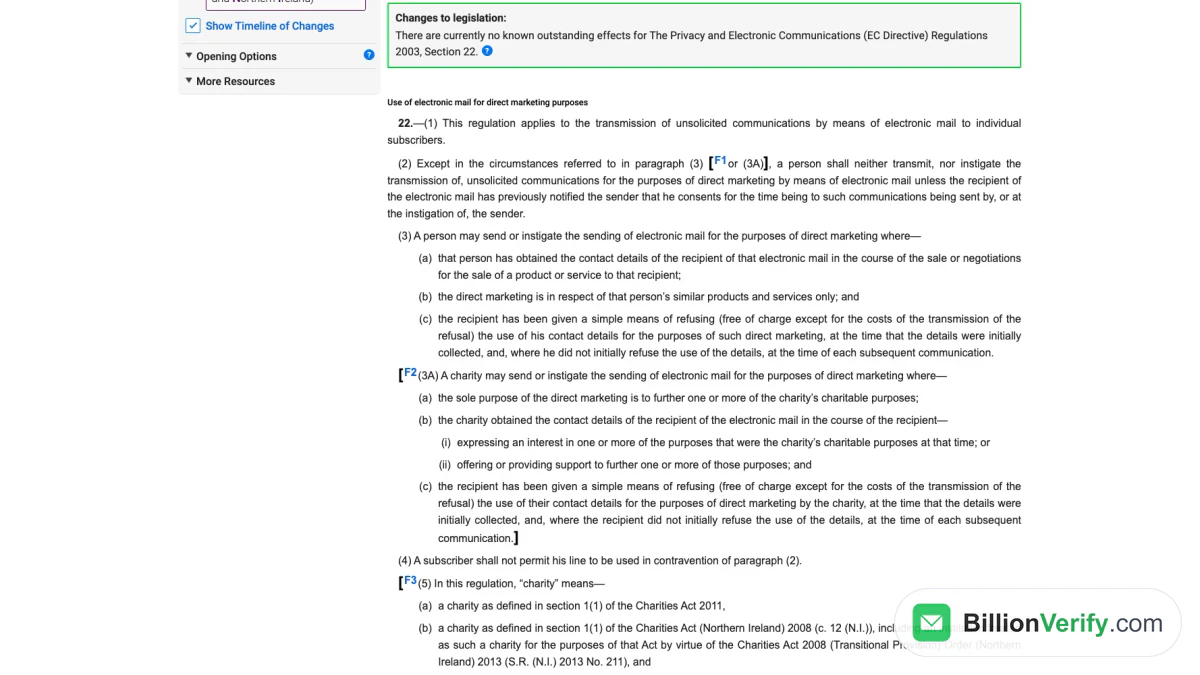
Screenshot: the legislation.gov.uk page for regulation 22 of PECR, with the consent rule and the soft opt-in conditions, captured in November 2026.
The ICO sets out the company side in its business-to-business marketing guidance. The email rule does not apply to corporate subscribers, meaning bodies with a separate legal status such as companies and limited liability partnerships, so a business-to-business email to a company needs no consent under PECR.
Sole traders and some partnerships are different. PECR treats them like individuals, and the ICO advises that if you cannot tell which kind of subscriber a mailbox belongs to, you should treat it as an individual's. It also suggests a do-not-email list for corporate contacts who object, although PECR does not require you to honor their opt-out.
Two 2026 changes matter. The Data (Use and Access) Act 2025 added a charity soft opt-in in regulation 22(3A), effective 5 February 2026, for emails whose sole purpose is to further the charity's aims. The same Act replaced the PECR enforcement schedule. Schedule 13 of the Act lists regulation 22 among the provisions that carry the higher maximum amount, which section 157 treats as the top penalty band.
CASL in Canada
The Canadian law, known as CASL, is the strictest of the regimes on consent. Section 6 bans sending a commercial electronic email unless the recipient has consented, expressly or by implication, and unless the email identifies the sender, gives contact information and carries an unsubscribe mechanism. Section 13 of the Anti-Spam Legislation puts the burden on the sender, because a person who claims to have consent has the onus of proving it.
Express and implied consent
The CRTC, which enforces the unsolicited-email rules, describes express consent as a proactive opt-in, such as signing up on a website. It rules out pre-checked boxes, since silence or inaction is not consent.
Its guidance on implied consent covers the narrower alternative. Under section 10(9) of the Act, implied consent exists only in a few situations, and the main one is an existing business relationship.
That relationship runs on a clock. The Act counts a purchase, a lease or an accepted business opportunity within the previous two years, a contract that is current or recently expired, and an inquiry or application made within the previous six months. A recipient who conspicuously published an address, or handed it over without saying they want no email, can also count as consent by implication, but only when the email relates to their business role. The CRTC reminds senders that the onus of proof stays with them.
Unsubscribe, records and business email
Section 11 requires an unsubscribe mechanism that lets the person say, at no cost and by the same electronic means, that they want no more email. You must keep it valid for at least 60 days and give effect to a request without delay, and no later than 10 business days after the request. The CRTC adds that this holds whatever kind of consent you rely on.
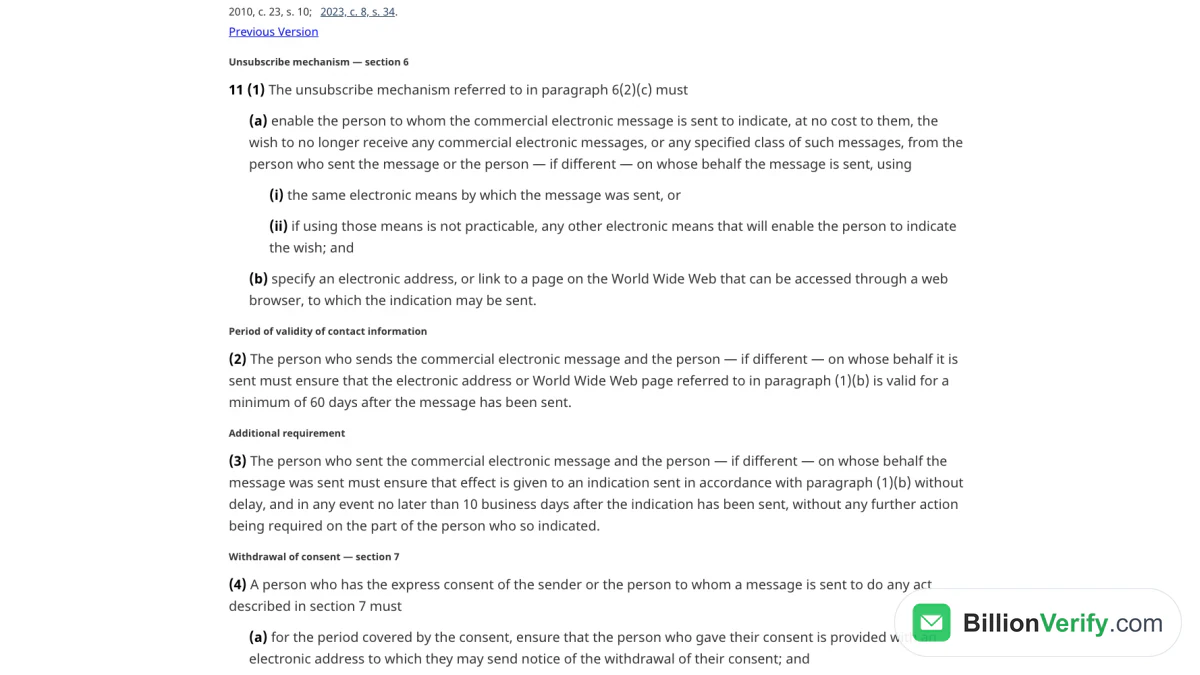
Screenshot: section 11 of the Anti-Spam Legislation on the Justice Laws site, with the 60-day validity and the deadline for acting, taken in Nov 2026.
The CRTC's frequently asked questions describe an exemption for email between employees or representatives of organizations that have a relationship, where the email concerns the activities of the organization receiving it. A mere acquaintance between two employees does not create that relationship. If the exemption applies, consent, identification and unsubscribe are not required. The same page says the Anti-Spam Legislation sets no retention period for records, so you should keep proof of consent for as long as you keep writing to the person.
One more detail matters for list quality. Section 6(4) treats an email as sent once transmission starts, and calls it immaterial whether the destination exists or the email arrives. Writing to a dead mailbox is therefore no defense, and it is no way around the rules either.
The Spam Act in Australia
The Australian Communications and Media Authority applies the Spam Act 2003. On its guidance page for senders, the ACMA states that you need each recipient's consent before sending marketing email, even when someone else sends it for you. Consent is either express, such as a form, a ticked box or a phone call, or inferred from a provable, ongoing relationship where the marketing relates directly to it. The ACMA calls express consent best practice and inferred consent less reliable.
The same page sets the unsubscribe terms. Each marketing email needs clear instructions, and the request has to be honored within five working days. The option must be free, must stay functional for 30 days once the email is out, and must not make the person log in or hand over extra personal details.
The ACMA also puts the burden of proof on you. It asks you to record who gave consent, when and how, and it warns that when you buy or borrow a marketing list you stay responsible for the consent behind every address.
California Privacy Law and Email
Because CAN-SPAM displaces most state email laws, California's main effect on email marketing comes from privacy law. The California Consumer Privacy Act regulates the personal information you collect, including an email address, and the people behind it gain rights over that information. The Attorney General's CCPA page says it applies to for-profit businesses that operate in California and meet one of three tests: gross annual revenue above a threshold, buying, selling or sharing the data of 100,000 or more California residents or households, or earning half of revenue from selling personal information.
The revenue threshold moves over time. The AG's page still shows $25 million, while the California Privacy Protection Agency's monetary threshold update lists $26,625,000 from 1 January 2025, with administrative fines of up to $2,663 per violation or $7,988 per intentional violation. The agency adjusts these amounts every odd-numbered year.
For an email program the practical duties are a notice at collection that names the categories of information and the purposes, and a way to stop the sale or sharing of information. A business that sells or shares personal information must offer a "Do Not Sell or Share My Personal Information" link and answer those requests within 15 business days. A signup form that feeds subscriber details to advertising platforms for cross-context behavioral advertising falls inside that rule. Whether a plain newsletter signup triggers the link depends on what happens to the data afterwards, but the notice at collection applies either way.
Penalties and Real Enforcement
Penalties differ by region in size and in who imposes them. In the United States the FTC and state attorneys general act. In Europe national data protection authorities do. In Canada the CRTC does, and in Australia the ACMA does. The table lists the ceilings published by the lawmakers or regulators.
| Regime | Maximum | Basis |
|---|---|---|
| CAN-SPAM | $53,088 per violating email | FTC guide; 16 CFR 1.98 for penalties assessed after 17 January 2025 |
| CAN-SPAM, state attorney general | $250 per email, capped at $2,000,000 for most violations | 15 U.S.C. 7706(f) |
| GDPR | EUR 20 million, or four percent of global turnover if higher | Article 83(5) |
| PECR | GBP 17.5 million, or a 4% share of turnover if higher | Section 157 of the 2018 Act, applied by the 2025 Act |
| CASL | $10 million per violation for a business, $1 million for an individual | Section 20(4) |
| CCPA | $2,663 for each violation, $7,988 if intentional | CPPA adjustment from 1 January 2025 |
The ceilings are not the usual outcome, so two real cases show how regulators have acted. In August 2024 the FTC announced a settlement with Verkada. The company agreed to pay $2.95 million over CAN-SPAM violations, the largest penalty the FTC had obtained under that law.
The complaint said Verkada sent more than 30 million promotional emails over three years, and that they broke the law in four ways, including ignoring unsubscribe requests and leaving out a physical postal address.
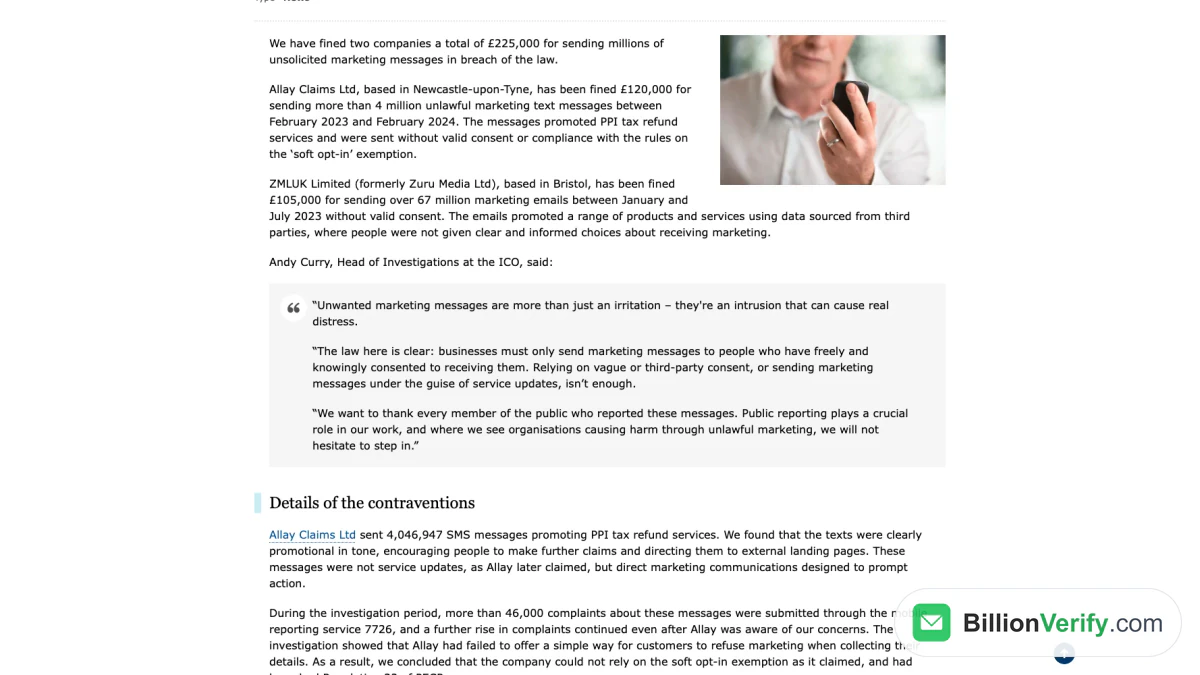
Screenshot: the ICO news release announcing fines for nuisance marketing, as of Nov 2026.
In January 2026 the ICO fined ZMLUK Limited GBP 105,000 for sending more than 67 million marketing emails between January and July 2023 without valid consent. The data came from a third-party website that showed people a list of 361 partner companies with no way to choose among them.
The ICO found that this gave no informed, specific consent. It added that the company relied on third-party data without enough due diligence, and that bundled partner consent does not meet the standard. The two cases share the same habits: ignoring opt-outs and trusting purchased or shared data.
Consent, Records and Privacy Notices
Every email compliance regime above comes back to three questions. What did the person agree to, can you show it, and did you tell them what you would do with their details? A signup process that answers all three satisfies the opt-in regimes covered above, and it does no harm under CAN-SPAM.
Collect consent in a form that stands up
Use an unticked checkbox or a button that says plainly what the person will receive, and keep marketing consent apart from the terms of service. The GDPR demands a clear affirmative action, CASL bans pre-checked boxes, and the ACMA lists forms, ticked boxes and phone calls as valid. Name your company, say what kind of email you will send, and say how often. Do not bundle several purposes or partner companies into one tick, since that is the exact failure the ICO punished.
A confirmation email after signup, often called double opt-in, makes the record stronger because it also proves the person controls the mailbox. None of the laws discussed here mandates it, so treat it as a technical choice. A confirmation step is normal, but the ACMA warns that you cannot send an email just to ask for consent, because that email is itself marketing.
Keep records of consent
Regulators place the burden of proof on the sender, so records are the real evidence. The ACMA recommends noting who gave consent, when and how. The CRTC lists records worth keeping: unsubscribe requests and the actions taken, evidence of express consent, consent logs and campaign records. A usable log stores the address, the timestamp, the exact form wording or version shown, the source page and the IP address or other proof of the action.
Keep the log for as long as you write to that person. The CRTC notes that no retention period is prescribed and that express consent does not expire, so the record must last as long as the relationship. Keep suppression records as well, because they prove you stopped.
Write a privacy notice that matches the signup
Article 13 of the GDPR lists what you owe a person when you collect their data: your identity and contact details, the purposes and legal basis, the recipients, how long you will keep it, their rights including withdrawal of consent, and their right to complain to a supervisory authority. In California the notice at collection must name the categories of data and the purposes. A single privacy policy page linked from the signup form can cover both, as long as it matches what the form actually does. Section 10(1) of CASL adds that a request for consent must state clearly and simply the purpose and who is asking.
One-Click Unsubscribe and Suppression in Practice
Unsubscribing is the one email compliance duty every regime shares, and it is where mailbox providers press harder than regulators. Google's guidelines call for a clearly visible unsubscribe link in the body and one-click unsubscribe for bulk senders above 5,000 daily emails to Gmail. Yahoo asks bulk senders for a working list-unsubscribe header, a visible link and processing within two days. Both also set a spam complaint ceiling. Yahoo wants the rate under 0.3%, and Google wants it under 0.10% with 0.30% never reached.
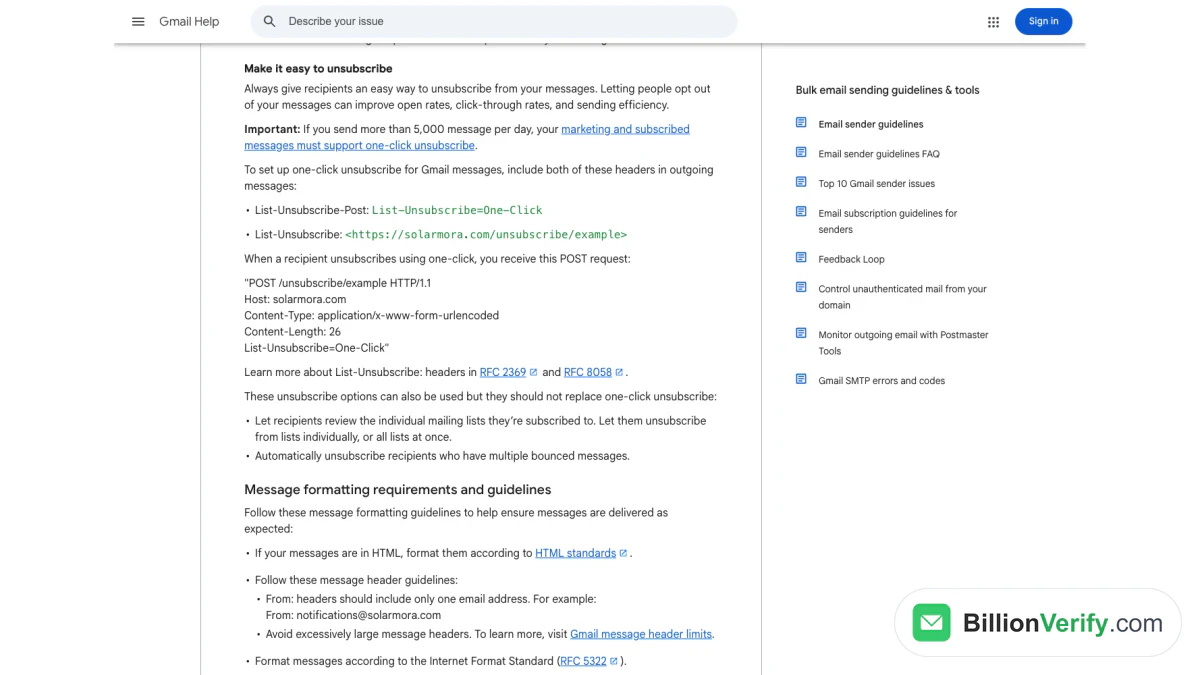
Screenshot: the Gmail Help page on sender guidelines, with its unsubscribe section for high-volume senders, viewed in Nov 2026.
The one-click method is standardized in RFC 8058. A message carries two headers, the HTTPS address must identify the recipient and the list, and the message needs a valid DKIM signature that covers List-Unsubscribe and List-Unsubscribe-Post. Yahoo's sender requirements call the POST method for one-click unsubscribe highly recommended and the mailto method acceptable. The snippet below builds both headers with Python's standard library and prints them, and its output was checked on Python 3.15.
from email.message import EmailMessage

msg = EmailMessage()
msg["From"] = "News <news@mail.example.com>"
msg["List-Unsubscribe"] = "<https://mail.example.com/unsub/8f3a1c>, <mailto:unsub@mail.example.com?subject=unsubscribe>"
msg["List-Unsubscribe-Post"] = "List-Unsubscribe=One-Click"

for name in ("List-Unsubscribe", "List-Unsubscribe-Post"):
    print(f"{name}: {msg[name]}")

# List-Unsubscribe: <https://mail.example.com/unsub/8f3a1c>, <mailto:unsub@mail.example.com?subject=unsubscribe>
# List-Unsubscribe-Post: List-Unsubscribe=One-Click
When the reader presses the provider's unsubscribe button, the provider sends an HTTPS POST to that first link. Your endpoint has to act on that request alone, with no login and no confirmation page. The handler below does that and records the token as suppressed; it was run behind a small local test server and answered a sample request with status 200.
from http.server import BaseHTTPRequestHandler
from urllib.parse import parse_qs

SUPPRESSED = set()  # in production: a database table, checked before every send

class Unsubscribe(BaseHTTPRequestHandler):
    def do_POST(self):
        token = self.path.rsplit("/", 1)[-1]
        body = self.rfile.read(int(self.headers.get("Content-Length", 0))).decode()
        if parse_qs(body).get("List-Unsubscribe") != ["One-Click"]:
            self.send_response(400)
            self.end_headers()
            return
        SUPPRESSED.add(token)          # act on the POST itself
        self.send_response(200)
        self.end_headers()
Design the suppression table to outlast any campaign. Check it before every send from every tool, apply it across all brands that share an audience, and never delete a row, because the record is your proof. One shared table is also what satisfies the shortest legal clock. Google also lists automatic unsubscribing of recipients who have bounced several times as an extra practice, though it says that should not replace one-click unsubscribe.
Clean Lists Are Part of Email Compliance
Verification does not create permission. A valid mailbox is not a consenting subscriber, and no verification result converts a purchased file into a lawful one. The ZMLUK case shows what regulators look at: where the data came from and whether the person really chose to receive the email. Consent and verification answer different questions, and email compliance needs both.
What verification does is protect two things the law cares about. The first is accuracy. GDPR Article 5(1)(d) requires personal data to be accurate and kept up to date, with every reasonable step taken to erase or fix inaccurate data without delay. Addresses that bounce or no longer exist are inaccurate data. The second is sender reputation. Google tells senders to write only to people who want the email and says a high spam rate leads to more spam classification. Its own list of extra practices includes removing recipients who bounced several times, which shows how providers expect senders to treat dead mailboxes. Our explainer on email bounce rate covers how to measure it.
Check an address before you send, ideally when it is collected. Syntax, domain and mailbox tests catch typos, and risk flags separate disposable inboxes, role accounts such as sales@ and catch-all domains from personal mailboxes. A free email checker like BillionVerify runs a live SMTP check on one address with no signup and reports each risk flag separately. You can also verify an email address for free in the verifier, and the same layers run on whole files through bulk email verification and through the API. Valid and invalid results cost a credit each, unknown results cost nothing, and a free account gets 20 credits on each day it is used, up to 600 a month, with no credit card.
Verification also helps with the sorting that PECR and CASL require. The UK rules split corporate subscribers from individuals, and a reverse email lookup reports the organization and domain behind an address, which helps you judge whether a contact is a company mailbox or a personal one.
Texts fall under the same consent laws as email in the UK and Canada, so a file that mixes numbers and addresses should have its numbers checked too. A free phone number validator confirms that a number is valid for its country and normalizes it to E.164.
An Email Compliance Checklist Before You Send
The steps below turn the regional rules into one email compliance process. Run them for each new list and each new campaign type, and keep a dated note of the answers.
- Map where your recipients live, and apply the strictest regime among them.
- Record consent for each address with the date, the form wording and the source, reject pre-ticked boxes, and treat unclear cases as individuals.
- Put your legal name, a valid postal address and a contact route in every commercial email, with a visible unsubscribe link.
- Process unsubscribes automatically, and check the suppression table before every send.
- Verify addresses at collection and before each large send, publish a notice at collection and a privacy policy that mirror the signup form, and review the rules each year.
FAQs
Do I need consent to send marketing emails?
It depends on where the recipient lives. Every regime outside the US requires consent or a narrow exception, such as the soft opt-in for existing customers or implied consent after a recent purchase. The United States does not require prior permission, but it does require an honest email and a working opt-out. If your audience spans regions, collect consent from everyone.
Does CAN-SPAM apply to business-to-business email?
Yes. The FTC says there is no business-to-business carve-out, so every such email must comply. The picture changes outside the US: PECR exempts corporate subscribers from its consent rule, and CASL exempts some email between organizations that already have a relationship.
How fast must I process an unsubscribe request?
The legal deadlines are 10 business days in both the US and Canada, and a five-day clock in Australia. Europe and the UK set no day count, so the safe reading is to stop at once. Yahoo wants bulk senders done within two days. The practical answer is to suppress the recipient automatically the moment the request arrives.
What is the difference between GDPR and CAN-SPAM?
CAN-SPAM regulates how a commercial email looks and how unsubscribing works. The GDPR regulates the personal data behind the email, and it needs a lawful basis such as consent before you use the contact. They overlap on opting out. A US sender with subscribers in the EU has to satisfy both.
Can I email a purchased list?
It is risky everywhere, and unlawful in many places without proof of consent. The ICO fined a company that sent 67 million emails using data from a third-party site, and the ACMA says buyers stay responsible for each address's consent. Under CAN-SPAM a purchased list is not banned, but unsubscribe duties and the other rules still apply.
Is double opt-in required?
No law in this guide requires it. Consent must be an affirmative, provable choice, and a confirmation email strengthens that proof because it also shows the person controls the inbox. Many senders adopt it for that reason and because it cuts typos and fake signups.
What is email compliance?
It is the practice of meeting the permission, sender-identity and opt-out rules that apply wherever your recipients live. The rules differ by region, so a sender needs one process built on the strictest of them. Records of consent and of opt-outs are part of it, because regulators expect the sender to prove what it did.
Does email verification make my list compliant?
No. Verification tells you whether a mailbox can receive mail, not whether its owner agreed to your emails. It supports compliance by removing inaccurate addresses and protecting your sending reputation, while consent records, unsubscribe handling and a privacy notice remain your responsibility.
Watch: Email Verification Software Features: Full Product Tour