



The California Consumer Privacy Act (CCPA), as amended by the California Privacy Rights Act (CPRA), represents the most comprehensive state-level privacy law in the United States. While not an email-specific regulation like CAN-SPAM, CCPA significantly impacts how businesses collect, use, and share email addresses and subscriber data. This guide explains how California's privacy laws affect email marketing and provides practical compliance strategies.
Understanding CCPA and CPRA
Before diving into email marketing implications, let's understand what these laws are and who they apply to.
What Is CCPA?
The California Consumer Privacy Act, effective January 1, 2020, gives California residents new rights over their personal information and imposes obligations on businesses that collect it.
Core CCPA Principles:
- Transparency: Consumers must know what data is collected and why
- Control: Consumers can access, delete, and opt out of data sales
- Non-Discrimination: Businesses can't penalize consumers for exercising rights
- Accountability: Businesses must implement reasonable security measures
What Is CPRA?
The California Privacy Rights Act, effective January 1, 2023, amends and strengthens CCPA:
Key CPRA Additions:
- Created the California Privacy Protection Agency (CPPA) for enforcement
- Added "sensitive personal information" category with extra protections
- Introduced "right to correct" inaccurate information
- Established "right to limit use" of sensitive data
- Extended data minimization requirements
- Created new contractor and service provider obligations
Who Must Comply?
CCPA/CPRA Applies to Businesses That:
- Do business in California, AND
- Meet ANY of these thresholds:
- Annual gross revenue over $25 million
- Buy, sell, or share personal information of 100,000+ California residents/households annually
- Derive 50%+ of annual revenue from selling/sharing personal information
Important Clarifications:
- You don't need a physical presence in California
- "Doing business in California" includes having California customers
- Thresholds are evaluated annually
- Small businesses may still be covered if they handle significant personal data
What Is Personal Information Under CCPA?
Personal information is broadly defined as information that identifies, relates to, describes, is reasonably capable of being associated with, or could reasonably be linked to a particular consumer or household.
Examples Relevant to Email Marketing:
- Email addresses
- Names
- IP addresses
- Device identifiers
- Browsing history
- Purchase history
- Inferences drawn from any of the above
Sensitive Personal Information (extra protections under CPRA):
- Government ID numbers
- Financial account information
- Precise geolocation
- Racial/ethnic origin
- Religious beliefs
- Genetic data
- Biometric data
- Health information
- Sex life/orientation data
For most email marketers, standard personal information rules apply. Sensitive personal information is typically not collected in email marketing contexts.
CCPA Consumer Rights and Email Marketing
CCPA grants California residents specific rights that affect how you manage email subscriber data.
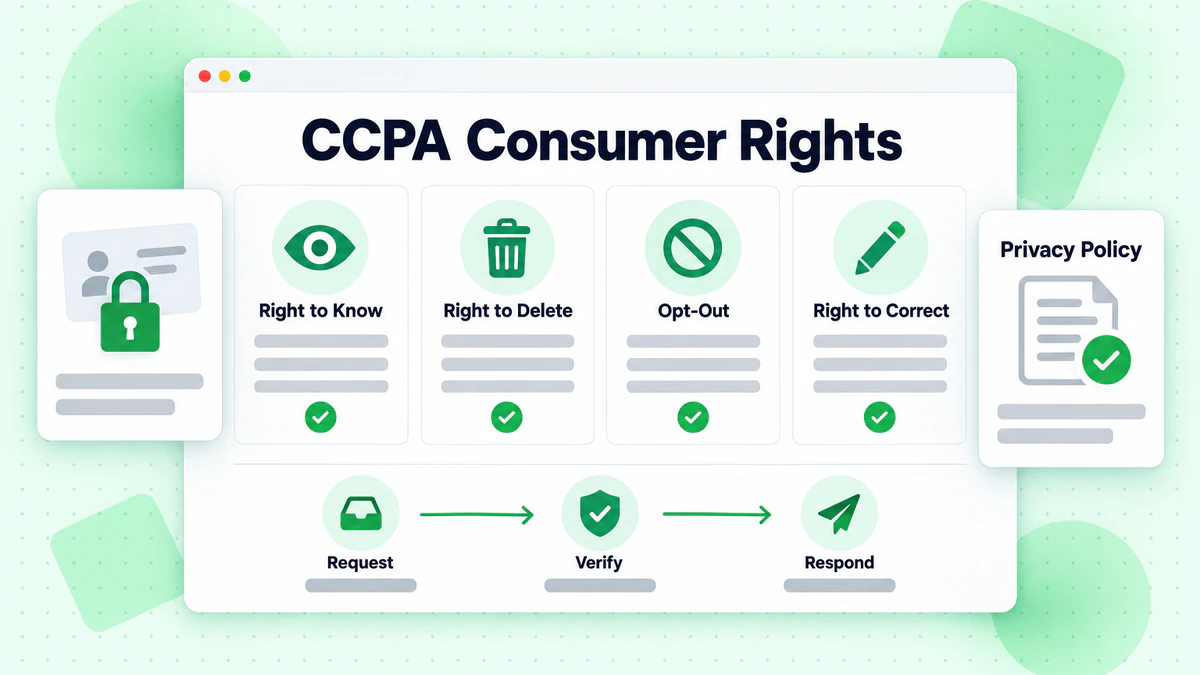
Right to Know (Access)
What It Means: Consumers can request disclosure of:
- Categories of personal information collected
- Specific pieces of personal information collected
- Sources of information
- Business purposes for collection
- Categories of third parties with whom information is shared
Email Marketing Implications:
- Be prepared to provide all data you hold about a subscriber
- Include email addresses, names, engagement data, purchase history
- Document your data collection sources and purposes
- Track third-party sharing (ESPs, analytics, advertisers)
Request Response Requirements:
- Verify consumer identity before responding
- Respond within 45 days (extendable to 90 days with notice)
- Provide information free of charge
- Deliver in portable, readily usable format
Right to Delete
What It Means: Consumers can request deletion of their personal information, with certain exceptions.
Email Marketing Implications:
- Must delete email address and associated data upon request
- Delete from marketing lists, CRM, analytics platforms
- Direct service providers to delete as well
- May keep suppression list entry to prevent re-adding
Exceptions to Deletion:
- Completing transactions the data was collected for
- Detecting security incidents
- Exercising free speech rights
- Complying with legal obligations
- Internal uses aligned with consumer expectations
Practical Approach: Treat deletion requests similarly to unsubscribe requests, but more comprehensively—delete all data, not just stop sending emails.
Right to Correct (CPRA)
What It Means: Consumers can request correction of inaccurate personal information.
Email Marketing Implications:
- Provide mechanism to update profile information
- Process correction requests within 45 days
- Update across all systems where data is stored
- Notify service providers to correct as well
Right to Opt Out of Sale/Sharing
What It Means: Consumers can direct businesses not to sell or share their personal information.
"Selling" Under CCPA: Broadly defined—includes exchanging data for monetary or other valuable consideration.
"Sharing" Under CPRA: Includes disclosing data for cross-context behavioral advertising, even without payment.
Email Marketing Implications:
- If you share subscriber data with advertising platforms for targeting, that may constitute "sharing"
- Retargeting based on email lists may trigger opt-out rights
- Data enrichment through third parties may involve "sale"
"Do Not Sell or Share My Personal Information" Link: Required on your website if you sell or share data. Must be:
- Clear and conspicuous
- Easy to find (typically in footer)
- Functional without account creation
Right to Limit Use of Sensitive Personal Information
What It Means: Consumers can limit use of sensitive personal information to what's necessary for service delivery.
Email Marketing Implications: Most email marketing doesn't involve sensitive personal information. However, if you collect:
- Precise location data for local offers
- Health information for health-related marketing
- Financial data for financial services marketing
You must provide a "Limit the Use of My Sensitive Personal Information" link and honor limitation requests.
Right to Non-Discrimination
What It Means: Businesses cannot discriminate against consumers who exercise their CCPA rights.
Prohibited Actions:
- Denying goods or services
- Charging different prices
- Providing different quality levels
- Threatening any of the above
Email Marketing Implications:
- Cannot refuse to send requested transactional emails
- Cannot provide inferior email content to those who exercised rights
- Cannot charge extra for email subscriptions after opt-out requests
Permitted Differentiation: You can offer incentives for data sharing, but they must:
- Be reasonably related to data value
- Be disclosed upfront
- Not be coercive
CCPA Compliance for Email Marketers
Now let's translate CCPA requirements into practical email marketing compliance.
Privacy Policy Requirements
Required Disclosures:
Categories of Personal Information Collected: List what you collect in the past 12 months:
- Identifiers (name, email, IP address)
- Internet activity (browsing, email engagement)
- Commercial information (purchase history)
- Inferences (derived preferences, segments)
Sources of Personal Information:
- Directly from consumers (signup forms)
- Automatically (cookies, email opens)
- From third parties (purchased lists, enrichment)
Business Purposes:
- Marketing communications
- Personalization
- Analytics and improvement
- Fraud prevention
Categories of Third Parties:
- Email service providers
- Analytics providers
- Advertising platforms
- Data enrichment services
Consumer Rights and How to Exercise Them:
- Description of each right
- How to submit requests
- Verification process
- Response timeframe
Do Not Sell/Share Disclosure: State whether you sell/share data. If yes, include opt-out link.
Privacy Policy Best Practices
Format Requirements:
- Reasonably accessible
- Available in languages you transact in
- Updated at least annually
- Dated with last update
Best Practices:
- Use clear, plain language
- Organize with headers and sections
- Include California-specific section
- Link prominently from website and signup forms
Data Collection Practices
Notice at Collection: Before collecting personal information, inform consumers of:
- Categories of information being collected
- Purposes for collection
- Whether information will be sold/shared
- Retention periods (or criteria for determining)
For Email Signup Forms:
By providing your email address, you agree to receive
marketing communications from BillionVerify. We collect
your email, name, and engagement data to personalize
content and improve our services. We do not sell your
personal information. View our Privacy Policy for details
on your California privacy rights.
Data Minimization (CPRA): Collect only what's reasonably necessary for disclosed purposes. For email marketing:
- Email address (required)
- Name (reasonable for personalization)
- Extensive demographic data (may be excessive without clear purpose)
Third-Party Management
Service Provider Agreements: When sharing subscriber data with email service providers, ensure contracts include:
- Limitations on data use to contractual purposes
- Prohibition on selling or sharing the data
- Requirement to comply with consumer requests
- Appropriate security measures
- Restrictions on subcontractor use
Third-Party Advertising: If you upload email lists to advertising platforms:
- This may constitute "sharing" under CPRA
- Requires "Do Not Sell or Share" link
- Must honor opt-out requests
- Consider using hashed emails to reduce exposure
Consumer Request Handling
Verification Process: Before responding to requests, verify the requestor is the actual consumer:
For Right to Know/Delete:
- Match identifying information in your records
- Request additional verification (email confirmation, security questions)
- Reasonable verification methods based on risk
For Opt-Out:
- No verification required
- Must accept without account creation
- Honor immediately
Response Process:
- Acknowledge receipt within 10 days
- Verify identity
- Locate all personal information
- Fulfill request within 45 days
- Document request and response
Designated Request Methods: Provide at least two methods:
- Toll-free number
- Website form
- Email address (acceptable)
- If you have online accounts: account-based requests
Email List Management Under CCPA
CCPA affects how you build, maintain, and use email lists.
List Building Compliance
First-Party Collection:
- Provide notice at collection
- Link to privacy policy
- State clearly what emails they'll receive
- Don't require email for unrelated services
Third-Party Lists: Using purchased or rented lists is risky under CCPA:
- You need to verify the seller had proper consent
- You must provide notice at first contact
- Consumers can request deletion
- May constitute "buying" personal information
Best Practice: Build lists organically through your own collection efforts. It's more compliant and performs better.
List Verification and Quality
Maintaining clean email lists supports CCPA compliance:
Why List Quality Matters:
- Invalid addresses suggest poor data practices
- Bought lists often lack proper consent
- Bounces indicate data that should be deleted
Using Email Verification: BillionVerify's email verification helps maintain compliance:
- Verify at collection to ensure accuracy
- Regular bulk verification removes invalid addresses
- Supports data accuracy principle
- Identifies potentially problematic sources
Data Retention
CPRA Requirements: Don't retain personal information longer than reasonably necessary.
Email Marketing Considerations:
- How long to keep inactive subscribers?
- When to delete engagement history?
- What's your retention policy?
Practical Approach:
- Define retention periods for each data type
- Implement automated deletion processes
- Document retention decisions
- Consider 2-3 years for email engagement data
- Review and update policies annually
Honoring Consumer Requests
Access Requests: Be prepared to provide:
- Email address
- Name and profile data
- Engagement history (opens, clicks)
- Purchase history
- Segment assignments
- Source of collection
Deletion Requests: Delete from:
- Primary marketing database
- Email service provider
- CRM system
- Analytics platforms
- Backup systems (within reasonable time)
- Enrichment providers you've shared with
Keep in Suppression List: Maintain a suppression record to prevent re-adding the address. This is permitted even after deletion.
CCPA vs. Other Privacy Laws
Understanding how CCPA relates to other regulations helps build comprehensive compliance.
CCPA vs. GDPR
| Aspect | CCPA | GDPR |
|---|---|---|
| Geographic Scope | California residents | EU residents |
| Consent Required | No (opt-out model) | Yes (opt-in for marketing) |
| Right to Delete | Yes | Yes |
| Right to Access | Yes | Yes |
| Right to Portability | Yes | Yes |
| Sale/Sharing Opt-Out | Yes | N/A (consent required) |
| Private Right of Action | Limited (data breaches) | No (except UK) |
| Maximum Penalties | $7,500/intentional violation | 4% global revenue |
Practical Approach: If you have both EU and California subscribers, GDPR compliance generally covers CCPA requirements, plus additional consent measures.
For comprehensive GDPR guidance, see our GDPR email marketing guide.
CCPA vs. CAN-SPAM
CAN-SPAM and CCPA address different aspects of email:
CAN-SPAM: Commercial email content and sending practices
- Unsubscribe mechanism
- Accurate headers
- Physical address
CCPA: Data privacy and consumer rights
- Access to data
- Deletion rights
- Opt-out of data sales
Both Are Required: Comply with CAN-SPAM for email content and CCPA for data practices.
For CAN-SPAM guidance, see our CAN-SPAM compliance guide.
Other State Privacy Laws
California led the way, but other states are following:
Virginia Consumer Data Protection Act (VCDPA): Effective January 2023 Colorado Privacy Act (CPA): Effective July 2023 Connecticut Data Privacy Act (CTDPA): Effective July 2023 Utah Consumer Privacy Act (UCPA): Effective December 2023
And More Coming: Texas, Oregon, Montana, Delaware, and other states have passed or proposed privacy laws.
Practical Approach: Build a compliance framework that can adapt to new state laws. Core principles are similar—transparency, consumer rights, and data protection.
CCPA Compliance Checklist
Use this checklist to assess your email marketing CCPA compliance.
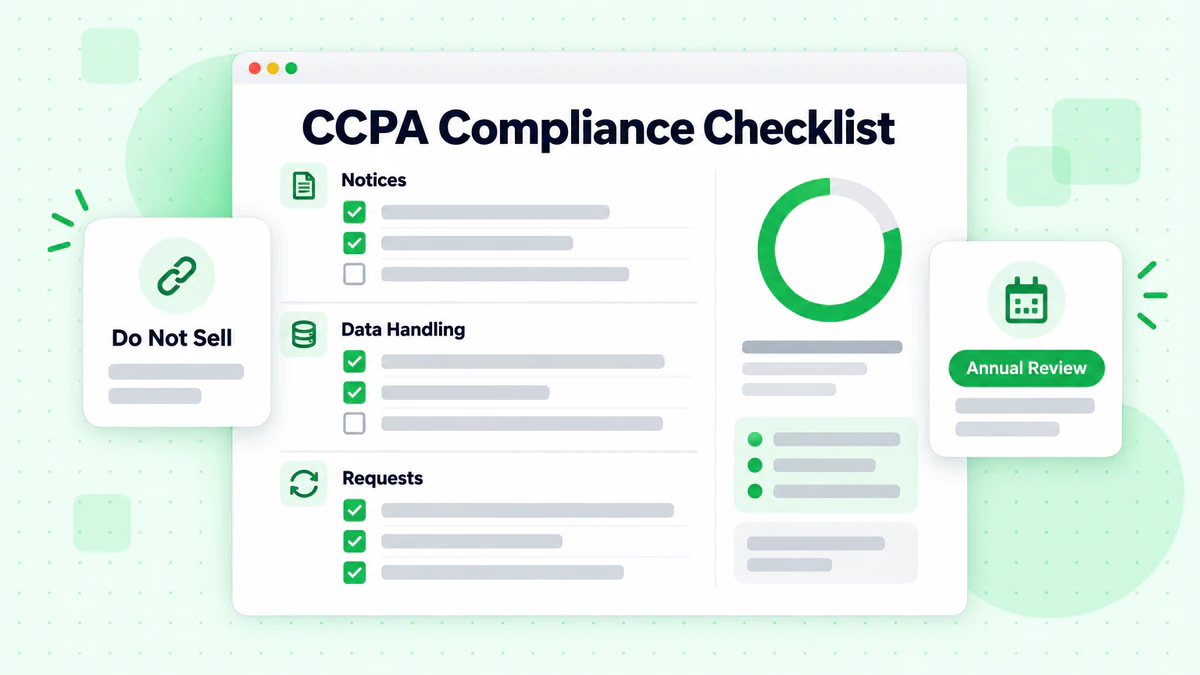
Privacy Policy and Notices
- [ ] Privacy policy includes all required CCPA disclosures
- [ ] California-specific section addresses state rights
- [ ] Policy updated within last 12 months
- [ ] Policy accessible from website footer
- [ ] "Do Not Sell or Share" link present (if applicable)
- [ ] "Limit Sensitive Personal Information" link present (if applicable)
- [ ] Notice at collection provided before data collection
Data Collection
- [ ] Email signup forms include privacy notice
- [ ] Notice at collection covers categories and purposes
- [ ] Data minimization principle followed
- [ ] Third-party list sources documented
- [ ] Collection sources can be traced for each record
Consumer Request Handling
- [ ] At least two request submission methods available
- [ ] Verification process documented
- [ ] 10-day acknowledgment process in place
- [ ] 45-day response process in place
- [ ] Staff trained on request handling
- [ ] Request log maintained
Data Management
- [ ] All data storage locations documented
- [ ] Service provider agreements include CCPA provisions
- [ ] Deletion process covers all systems
- [ ] Suppression list maintained
- [ ] Retention periods defined
- [ ] Regular email verification conducted
Third-Party Relationships
- [ ] Service provider contracts updated for CCPA
- [ ] Sharing/selling activities documented
- [ ] Opt-out mechanisms honor all data sharing
- [ ] Third parties notified of deletion requests
- [ ] Advertising platform usage evaluated for "sharing"
Common CCPA Mistakes in Email Marketing
Avoid these frequent compliance pitfalls.
Mistake 1: Ignoring CCPA Because You're Not in California
The Problem: Assuming geographic distance means CCPA doesn't apply.
The Reality: If you have California customers and meet thresholds, you must comply regardless of your location.
The Fix: Evaluate your California customer base and apply CCPA protections to those residents.
Mistake 2: Incomplete Privacy Policy
The Problem: Privacy policy doesn't include all required CCPA disclosures.
The Fix:
- Audit policy against CCPA requirements
- Add California-specific section
- Update annually
Mistake 3: No Process for Consumer Requests
The Problem: Lacking systems to handle access, deletion, or opt-out requests.
The Fix:
- Create intake processes for each request type
- Train staff on handling
- Implement tracking and documentation
- Test request fulfillment
Mistake 4: Failing to Delete from All Systems
The Problem: Deleting from main list but forgetting ESP, CRM, or analytics.
The Fix:
- Document all systems holding subscriber data
- Create deletion workflows covering each
- Verify deletion completion
- Maintain suppression lists
Mistake 5: Not Updating Service Provider Contracts
The Problem: Contracts with email service providers lack CCPA-required provisions.
The Fix:
- Review existing contracts
- Add required limitations and obligations
- Ensure compliance certification language
- Update as regulations evolve
Mistake 6: Treating CCPA as One-Time Project
The Problem: Implementing compliance once and not maintaining it.
The Fix:
- Schedule annual policy reviews
- Monitor regulatory updates
- Train new staff on requirements
- Regularly audit compliance
Building a Sustainable Compliance Program
Long-term CCPA compliance requires ongoing commitment.
Documentation Best Practices
What to Document:
- Data inventory (what you collect and where)
- Collection sources for each data point
- Purposes for each data type
- Third-party relationships and contracts
- Consumer request log
- Staff training records
- Compliance assessments
Documentation Benefits:
- Demonstrates good faith compliance
- Simplifies consumer request fulfillment
- Supports audit responses
- Enables consistent processes
Staff Training
Who Needs Training:
- Marketing team members
- Customer service staff
- IT and data teams
- Legal and compliance
Training Topics:
- CCPA/CPRA basics
- Consumer rights overview
- Request handling procedures
- Data handling requirements
- Escalation processes
Ongoing Monitoring
Regular Activities:
- Annual privacy policy review
- Quarterly data inventory updates
- Monthly request processing audits
- Ongoing regulatory monitoring
- Periodic third-party assessments
Integration with Email Marketing Operations
Embed Compliance in Workflows:
- Include privacy notice in signup processes
- Add verification to list import procedures
- Build deletion into unsubscribe workflows
- Connect request handling to CRM
Tools That Support Compliance:
- Email verification services like BillionVerify for data accuracy
- Consent management platforms
- Privacy request automation tools
- Data mapping solutions
Conclusion
CCPA and CPRA add important privacy protections that affect how email marketers collect, use, and share subscriber data. While compliance requires ongoing effort, it aligns with best practices that also improve marketing effectiveness—transparent collection, quality data, and respect for consumer preferences.
Key Takeaways:
Know Your Obligations: Determine whether you meet CCPA thresholds and what requirements apply.
Update Your Privacy Policy: Ensure comprehensive CCPA disclosures are included and current.
Build Request Handling Processes: Be ready to fulfill access, deletion, and opt-out requests within required timeframes.
Manage Third Parties: Update service provider contracts and evaluate sharing practices.
Maintain Data Quality: Use email verification and list hygiene to support accuracy requirements.
Stay Current: Privacy law is evolving rapidly. Monitor developments and adapt accordingly.
California's privacy laws represent a significant shift toward consumer control over personal data. By embracing these principles in your email marketing program, you not only comply with current requirements but prepare for the broader privacy landscape that's emerging nationwide.
For comprehensive email compliance guidance covering multiple regulations, see our email compliance guide. Ensure your subscriber data is accurate and properly maintained with BillionVerify's email verification service.