



Email marketing remains one of the most effective digital marketing channels, with an average ROI of $42 for every $1 spent. However, this impressive return is only achievable when your emails actually reach real inboxes. That's where email verification becomes crucial. For a comprehensive overview, see our complete guide to email verification.
The Hidden Cost of Invalid Emails
Before diving into best practices, let's understand why email verification is non-negotiable in 2025:
1. Bounce Rate Impact
- Hard bounces from invalid emails damage your sender reputation
- ISPs monitor bounce rates closely - exceeding 2% can trigger spam filters
- Each bounce costs money and wastes marketing resources
- Learn how to reduce your email bounce rate effectively
2. Deliverability Consequences
- Poor list quality leads to inbox placement issues
- Major ISPs like Gmail and Outlook use engagement metrics to filter emails
- Invalid emails create a negative feedback loop affecting all your campaigns
3. Financial Implications
- You're paying to send emails to non-existent addresses
- ESP costs increase with larger lists
- Lost revenue from messages never reaching potential customers
Email Verification Best Practices
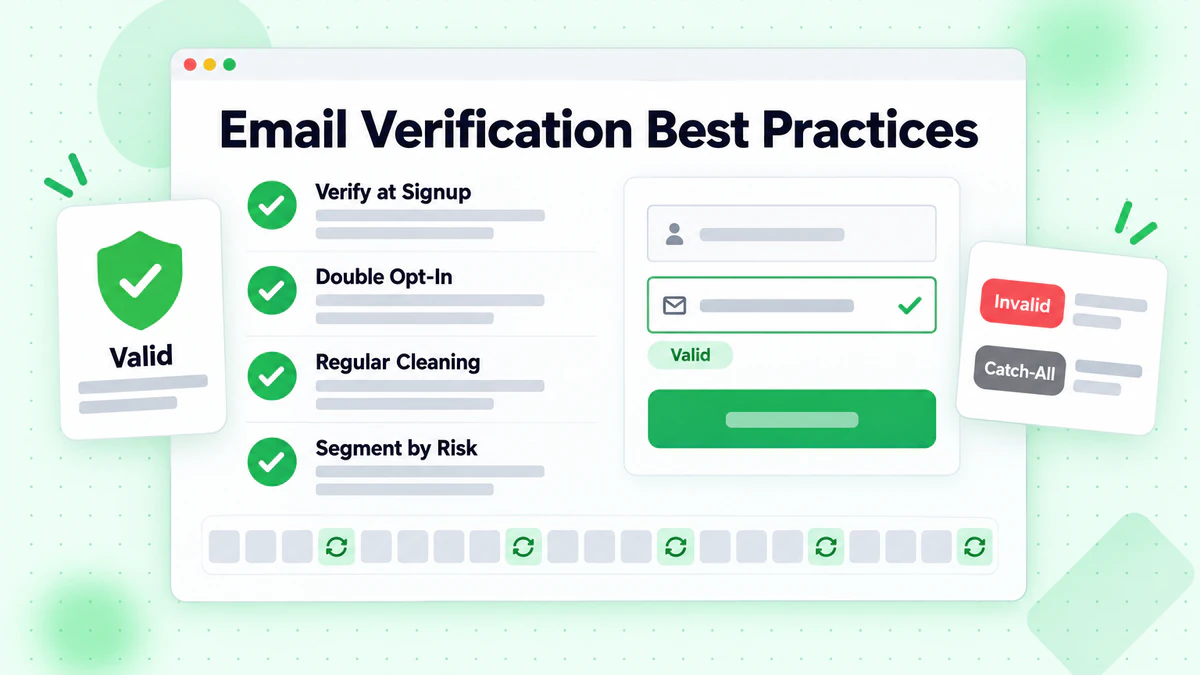
1. Verify at Point of Collection
The most effective strategy is preventing invalid emails from entering your database in the first place.
Implementation Tips:
- Use real-time API verification on signup forms
- Implement double opt-in for critical lists
- Add visual feedback for users during email entry
- See our guide on email verification during signup
BillionVerify Integration Example:
// Real-time verification on form submission
const verifyEmail = async (email) => {
  const response = await fetch('https://api.billionverify.com/v1/verify', {
    method: 'POST',
    headers: {
      'Authorization': 'Bearer YOUR_API_KEY',
      'Content-Type': 'application/json'
    },
    body: JSON.stringify({ email })
  });

  const result = await response.json();
  return result.status === 'valid';
};
2. Regular List Cleaning
Email lists decay at approximately 22.5% per year. Regular verification is essential.
Recommended Schedule:
- High-volume senders: Monthly verification
- Regular campaigns: Quarterly cleaning
- Seasonal businesses: Before each major campaign
What to Remove:
- Invalid syntax emails
- Non-existent domains
- Disposable email addresses
- Role-based emails (for B2C campaigns)
- Inactive subscribers (no opens in 6+ months)
For a complete guide, see how to clean your email list.
3. Segment Based on Verification Results
Not all verification results require the same action:
Valid Emails: Send normally Risky Emails:
- Accept-all domains: Send with caution
- Role accounts: Exclude from promotional emails
- Recently changed: Re-verify after 30 days
Invalid Emails: Remove immediately
4. Monitor Key Metrics
Track these metrics to gauge list health:
- Bounce Rate: Keep below 2%
- Complaint Rate: Target under 0.1%
- Engagement Rate: Open rates above 20%
- List Growth Rate: Healthy growth vs. decay
5. Implement Catch-All Detection
Catch-all domains accept all emails, making verification tricky.
Strategies:
- Use advanced verification services that detect catch-all servers
- Send to catch-all addresses separately with reduced frequency
- Monitor engagement closely and remove non-responders
Industry-Specific Considerations
E-commerce
- Verify before sending order confirmations
- Clean lists before major sales events
- Focus on transactional email deliverability
B2B Marketing
- Pay special attention to role-based emails
- Verify during lead scoring processes
- Consider company domain changes
Media & Publishing
- Verify newsletter subscribers regularly
- Implement re-engagement campaigns before removing subscribers
- Use progressive profiling to update email addresses
Advanced Verification Techniques
1. Syntax Validation
Check email format before making API calls:
^[a-zA-Z0-9._%+-]+@[a-zA-Z0-9.-]+\.[a-zA-Z]{2,}$
2. Domain Verification
- Check MX records existence
- Verify domain DNS configuration
- Detect temporary email providers
3. Mailbox Verification
- SMTP connection testing
- Intelligent retry mechanisms
- Greylisting detection
4. Risk Scoring
Modern verification services provide risk scores based on:
- Email age
- Domain reputation
- Previous bounce history
- Engagement patterns
Common Mistakes to Avoid
- Verifying Only Once: Email addresses change - regular verification is essential
- Ignoring Soft Bounces: Multiple soft bounces indicate deliverability issues
- Keeping All Catch-All Emails: These require special handling
- Not Segmenting by Risk: Treat different risk levels appropriately
- Delayed Verification: The sooner you verify, the better
The BillionVerify Advantage
When implementing these best practices, choosing the right verification service is crucial. BillionVerify offers:
- 99.9% Accuracy: Industry-leading verification accuracy
- Real-time API: Sub-second response times
- Bulk Processing: Handle millions of emails efficiently
- Risk Scoring: Advanced algorithms for nuanced decisions
- Global Coverage: Verify emails from any country
Conclusion
Email verification isn't just about maintaining a clean list - it's about protecting your sender reputation, maximizing ROI, and ensuring your messages reach real people who want to hear from you.
Start implementing these best practices today, and watch your email marketing metrics improve dramatically. Remember, in email marketing, quality always trumps quantity.
Ready to improve your email deliverability? Try BillionVerify's free email checker to see the difference professional verification can make.