

Email Validation API
Verify in Realtime
Use a simple API call to verify addresses during signup, enrichment, AI agent workflows, or custom list-processing pipelines.
Structured JSONReal-time responseSMTP verification
Get Started for Free
One endpoint for every verification type. A real-time email validation API with SMTP checks, structured JSON responses, and native MCP and Agent Skills integration.
Use a simple API call to verify addresses during signup, enrichment, AI agent workflows, or custom list-processing pipelines.
Every verification type is reachable through the same REST email validation API.
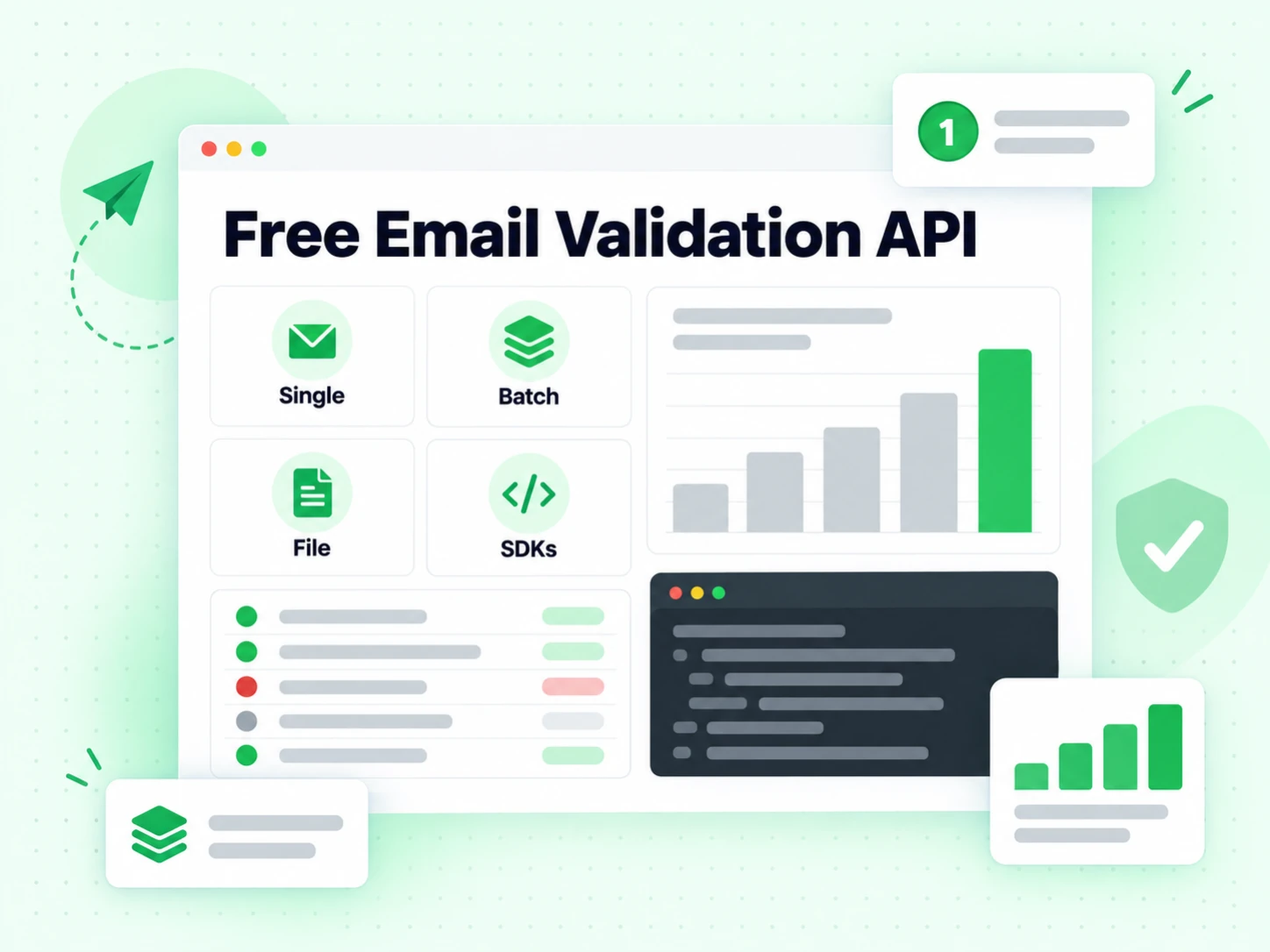
POST /verify — one real-time email validation API call with sub-3s response. Returns status, deliverability, quality score, and risk flags in one JSON object.
POST /verify/bulk — validate up to 50 addresses per API call, synchronously. All results come back in a single API response, on the same schema as single validation.
POST /verify/file — submit CSV or Excel files to the API for background processing. Results are delivered via webhook callback when the API job completes.
Type-safe client libraries for the free email validation api in Python, Node.js, Go, and PHP. Auto-retry on failure, full error handling, and identical response types across all languages.
Every real-time email validation API call runs the same multi-layer check automatically.
Check individual emails for validity, deliverability, and reputation. No account required.
Identify and block temporary email services before they pollute your list.
Detect emails likely to bounce before sending, protecting your sender reputation.
Receive API results asynchronously and query message history.
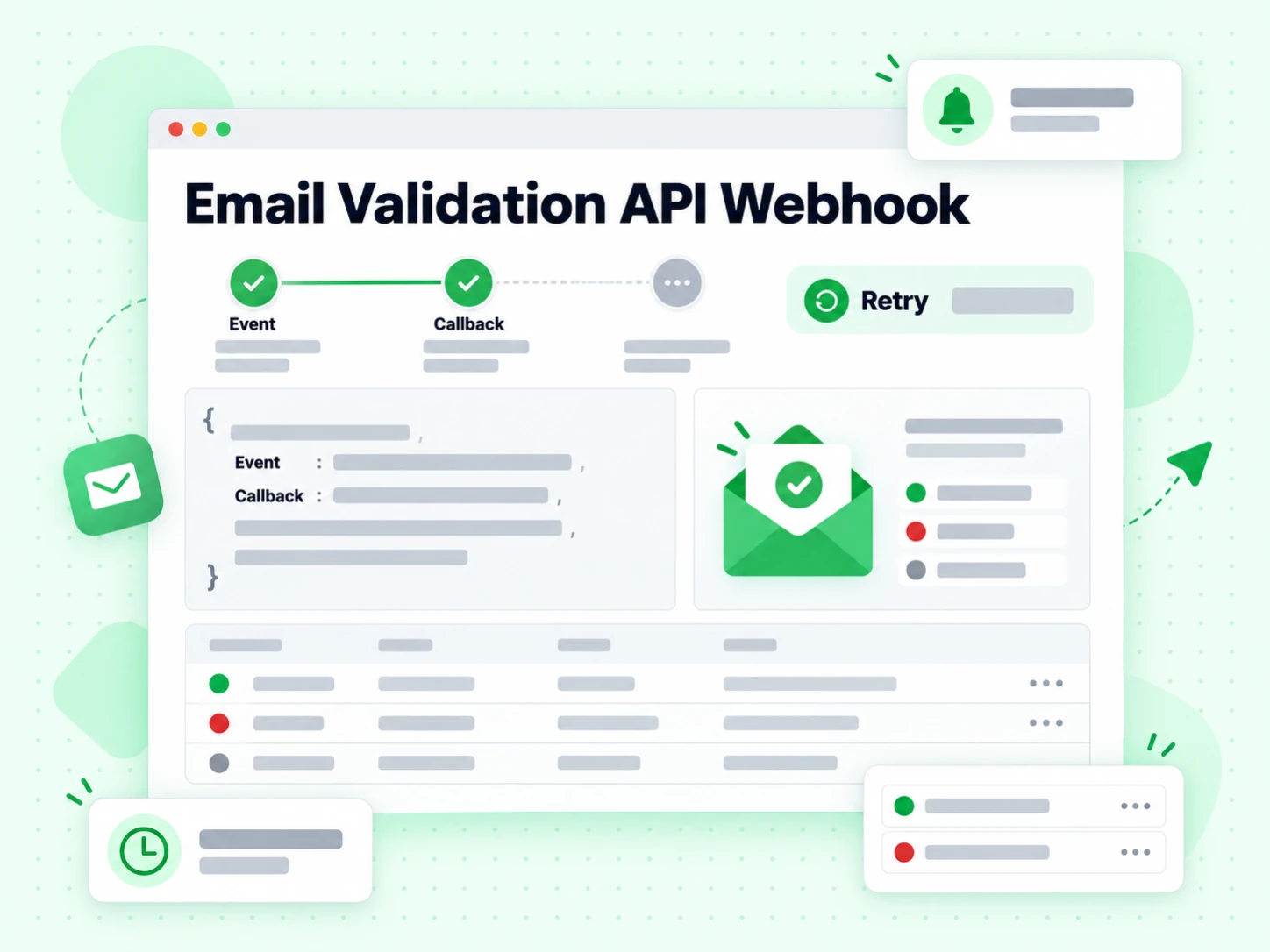
Async Delivery
Register HTTP endpoints to receive API results the moment a job or batch completes. The API supports custom payloads, automatic retry on failure, and per-job or global configuration.
Message History
Access the full webhook event log to retrieve past API results, debug delivery failures, or replay missed notifications. API events are retained for 30 days.
Connect the API to every major AI client and SDK without writing validation logic from scratch.
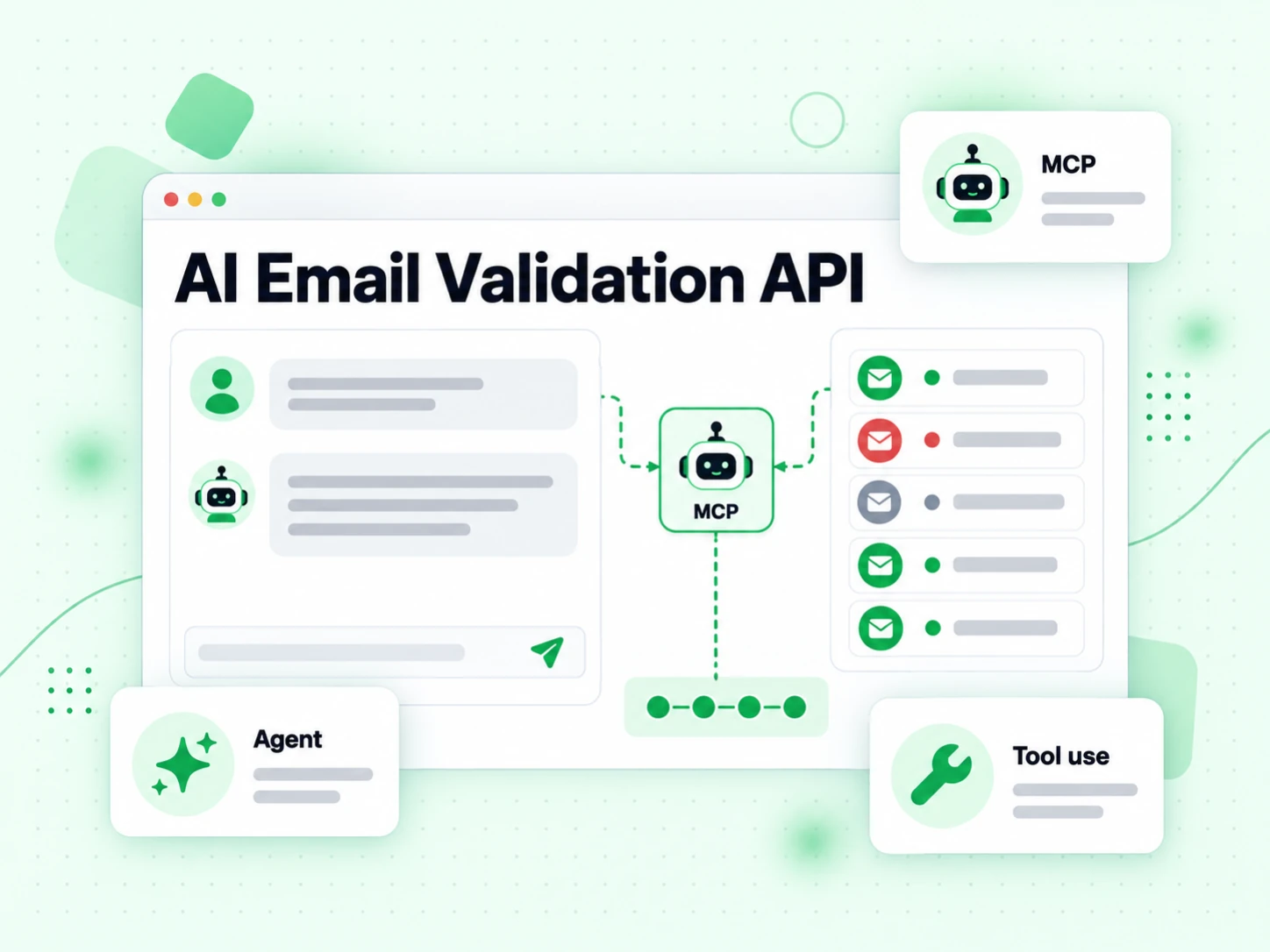
Validate emails in Claude Desktop and Cursor with natural language. Ask “is this address valid?” and get instant results from the same validation API — no API key setup, no code required.
One-click skills for Claude, Manus, and other agent platforms. The email validation API runs automatically inside any workflow without manual configuration.
Call the REST API directly from LangChain, CrewAI, any Anthropic or OpenAI SDK, or any HTTP client. The real-time email validation API returns structured JSON that parses without transformation — status, score, and flags included.
Every AI-native validation API tool in one platform.
Verify emails in Claude Desktop and Cursor with natural language. No code required.
One-click skills for Claude, Manus, and other agent platforms. Automatic email validation in any workflow.
Verify individual addresses with real-time SMTP checks and instant results.
Response contract
Most teams adopt a validation API to replace a regular expression. The upgrade only pays off if the API response carries more information than the boolean it replaces.
The API returns one of four statuses: deliverable, undeliverable, risky, or unknown. Four states exist because reality has four states, and any validation API that collapses them into true and false forces every caller to reinvent the missing nuance.
Branch on status first. Everything else in the free email validation api response explains the status rather than replacing it.
A quality score from 0 to 100 and a risk level let you sort a queue, prioritise sales follow-up, or tune a threshold per surface. They are derived API fields, so treat them as ordering hints rather than as the API verdict.
Gating on a score alone is how teams accidentally reject good customers. Gate on status; rank with score.
Every non-deliverable API answer carries a machine-readable reason. Invalid syntax, no mail route, mailbox rejected, and provider deferral are different problems with different fixes, and our free email validation api names each one instead of returning a generic failure.
Log the API reason code, not the prose. It is stable across releases, and it is what makes a support ticket about one address answerable months later.
Disposable, role account, catch-all, and free personal webmail arrive as independent API flags. An address can be perfectly deliverable and still carry three of them, which is exactly the case a syntax validator cannot express and an API can.
This is the practical difference between a real-time email validation API and a format check: the format check tells you the string is well-shaped, and the API tells you what the address actually is.
Migration
Teams usually arrive here with a regex or a library call already in the codebase. The API migration is small, but three habits have to change with it.
A regular expression proves a string could be an address. This free email validation api proves a mail server currently accepts it. Keep the regex as a cheap client-side hint if you like, but stop letting it decide whether a record is good.
In practice this means removing the branch that says valid format therefore save, and replacing it with a branch on the API status field.
A network call can be slow when a receiving provider is slow. Give the API a timeout your form can live with, and decide in advance what happens when it expires: usually accept the address, mark it unverified, and re-check with a later API call.
A real-time email validation API should never be the reason a signup fails. Degrade to unverified rather than to rejected.
Write the API status, reason code, flags, and a checked-at timestamp onto the record. A team that stores only a cleaned boolean cannot explain a suppression decision three campaigns later, and cannot tell fresh API evidence from stale.
Storing the full API response also lets you change policy without re-verifying: the facts stay, and only the rule that reads them moves.
Unknown is not an API error and not a failure. It means the receiving provider did not commit. Decide the retry policy in one place — a queue, a delay, a maximum API attempt count — rather than scattering ad-hoc retries through the codebase.
Most unknown results resolve on a later API call, which is why our free email validation api reports them honestly instead of guessing.
Integration surface
One endpoint, four API shapes. Pick by the size and latency of the work, not by preference.
POST /verify takes one address and returns the full JSON in one to three seconds. This is the real-time email validation API path used by signup forms, checkout, and profile edits.
Because it is a single API call with no job lifecycle, it is also the easiest surface to test against before you build anything larger.
POST /verify/bulk verifies up to 50 addresses synchronously and returns them on the same schema. Use it when a page or a job naturally handles a handful of records at a time.
The batch limit is a hard API boundary rather than a soft one. Larger payloads are rejected with a clear API error that points at the file endpoint, so nothing silently degrades into a slow request.
POST /verify/file accepts CSV or Excel, processes in the background, and calls your webhook when the API job finishes. Nothing has to hold a connection open while a large file runs.
For a list-shaped workload rather than an API-shaped one, Bulk Email Verification runs the same engine over an uploaded file with deduplication and a CSV export.
The MCP Server exposes the same email validation API to Claude Desktop and Cursor in natural language, and Agent Skills install it into agent platforms in one click. Both return the identical structured JSON as the REST API.
That keeps agent behaviour honest: the tool cannot summarise unknown as fine, because the free email validation api response is the thing the agent reads.
Scope
The API is narrow on purpose. Each item below is a real requirement — it just belongs somewhere else in your system, not in a validation API.
Our free email validation api can tell you an address accepts mail. It cannot tell you the person agreed to hear from you, and it does not read your suppression list.
Keep consent in your own system of record and check it before, not after, the API call.
A deliverable company address does not prove the named person controls it or still works there. Aliases, shared inboxes, and stale enrichment routinely break that assumption.
Use first-party data for identity. This free email validation api returns evidence about a mailbox, not about a human.
SMTP acceptance is a recipient-side fact. Whether your message reaches the inbox depends on sender reputation, authentication, content, and complaint history, none of which the API can observe.
Fix address quality with the API; fix placement with sender-side work and monitoring the API cannot do for you.
Every API response describes the moment of the call. Mailboxes close, aliases retire, and domains migrate, so a stored API result decays whether or not anyone re-reads it.
Re-verify on a schedule matched to how quickly your data changes, and let the checked-at timestamp drive that decision automatically.
Related surfaces
The same engine appears behind several API surfaces. Which one you want depends on who is asking and how many addresses are involved.
The Email Verification API documents the same endpoint for teams who search for verification rather than validation, with the SMTP evidence explained in more depth.
The schema, the credits, and the accuracy are identical — only the framing of the documentation differs.
When someone needs to look at a single result rather than automate anything, the Email Verifier runs the identical pipeline in the browser and shows every flag the API would return.
It is the quickest way to confirm engine behaviour before writing code against the free email validation api.
If the requirement really is format and mail routing only, the Email Validator stops at syntax and MX and never spends an SMTP check.
Use it for cheap pre-screening, and reserve the real-time email validation API for the records where a bounce would actually cost something.
Cached API results return in under 200ms. Full SMTP validation completes in 1–3 seconds on average, which is what makes this usable as the real-time email validation API inside a form. The API supports up to 6,000 single requests per minute and 1,500 batch requests per minute.
The validation API uses standard REST calls with JSON responses. Official SDKs are available for Python, Node.js, Go, and PHP. Most API integrations complete in under 30 minutes. The MCP Server and Agent Skills require no code at all — install once and the free email validation api works in any supported AI client.
The Starter plan is $20 for 20,000 credits at $0.001 per email — no monthly fees, you only pay for what you use. Volume pricing scales down to $0.00035 per email at 1M credits. The free email validation api tier provides 20 free credits every day you log in, up to 600 a month, with no credit card required.
Every API response includes the validation status (deliverable, undeliverable, risky, or unknown), a quality score from 0–100, a risk level, and reason codes. Disposable email flag, role account flag, catch-all detection, and typo correction suggestions are also included.
All API requests use HTTPS. API key authentication is required on every API call, and IP whitelisting is available for additional security. BillionVerify is fully GDPR and CCPA compliant with automatic data deletion after processing.
AI agents connect through the MCP Server (natural language in Claude and Cursor), pre-built Agent Skills (one-click install for Claude and Manus), or direct REST calls from LangChain, CrewAI, or any Anthropic or OpenAI SDK. Every path hits the same email validation api and returns the same structured JSON — no response transformation needed.
An email validation API and an email verification API usually name the same endpoint — one that checks whether an address is real and deliverable. BillionVerify runs SMTP-level checks, confirming the mailbox exists on the receiving server, rather than DNS or syntax validation alone. The single /verify endpoint returns status, quality score, disposable flag, role account flag, and catch-all detection in one JSON response.
One endpoint for every validation type. MCP Server and Agent Skills included. The free email validation api tier gives you 20 credits every day you log in, up to 600 a month, no credit card required.
600 free credits monthly · Native MCP Server integration · No credit card required