



The CAN-SPAM Act (Controlling the Assault of Non-Solicited Pornography And Marketing Act) is the primary law governing commercial email in the United States. Enacted in 2003, it establishes requirements for commercial messages, gives recipients the right to stop receiving emails, and outlines significant penalties for violations. This comprehensive guide covers everything you need to know about CAN-SPAM compliance—from the seven key requirements to practical implementation strategies.
Understanding the CAN-SPAM Act
Before diving into compliance requirements, it's essential to understand what CAN-SPAM is, who it applies to, and what types of messages it covers.
What Is the CAN-SPAM Act?
CAN-SPAM is a federal law that:
Establishes Rules for Commercial Email: Sets baseline requirements for all commercial messages sent to US recipients.
Gives Recipients Rights: Provides the right to opt out of future emails from any sender.
Creates Penalties for Violations: Authorizes significant fines for non-compliance.
Preempts State Laws: Generally supersedes state anti-spam laws, creating a unified national standard.
Key Distinction from GDPR: Unlike GDPR, CAN-SPAM doesn't require prior consent to send commercial email. However, just because something is legal doesn't mean it's effective—permission-based marketing still outperforms unsolicited outreach.
Who Must Comply with CAN-SPAM?
All Senders of Commercial Email to US Recipients:
- US-based businesses
- International businesses emailing US recipients
- Third parties sending on behalf of other businesses
- Affiliates and marketing partners
Responsibility Cannot Be Outsourced: Even if you use a third-party email service provider, you remain responsible for compliance. If an affiliate sends non-compliant emails on your behalf, both of you may be liable.
Types of Messages Under CAN-SPAM
CAN-SPAM distinguishes between commercial and transactional/relationship messages:
Commercial Messages (Full Requirements Apply):
- Primary purpose is advertising or promoting a commercial product or service
- Newsletters with commercial content
- Promotional offers and discounts
- Marketing announcements
- Lead nurturing campaigns
Transactional/Relationship Messages (Limited Requirements):
- Order confirmations
- Shipping notifications
- Account updates
- Password resets
- Warranty information
- Product recall notices
- Subscription status changes
How to Determine Message Type: The FTC uses a "primary purpose" test. If a message contains both commercial and transactional content, evaluate which is the primary purpose:
Primary Purpose Factors:
- Location of commercial vs. transactional content
- Portion of the message devoted to each purpose
- Subject line content
- Overall impression on a reasonable recipient
Mixed Content Example: An order confirmation (transactional) that includes a product recommendation section (commercial) is likely still transactional if the order details appear first and comprise most of the message.
The Seven CAN-SPAM Requirements
CAN-SPAM establishes seven main requirements for commercial email. Violating any of these can result in penalties.
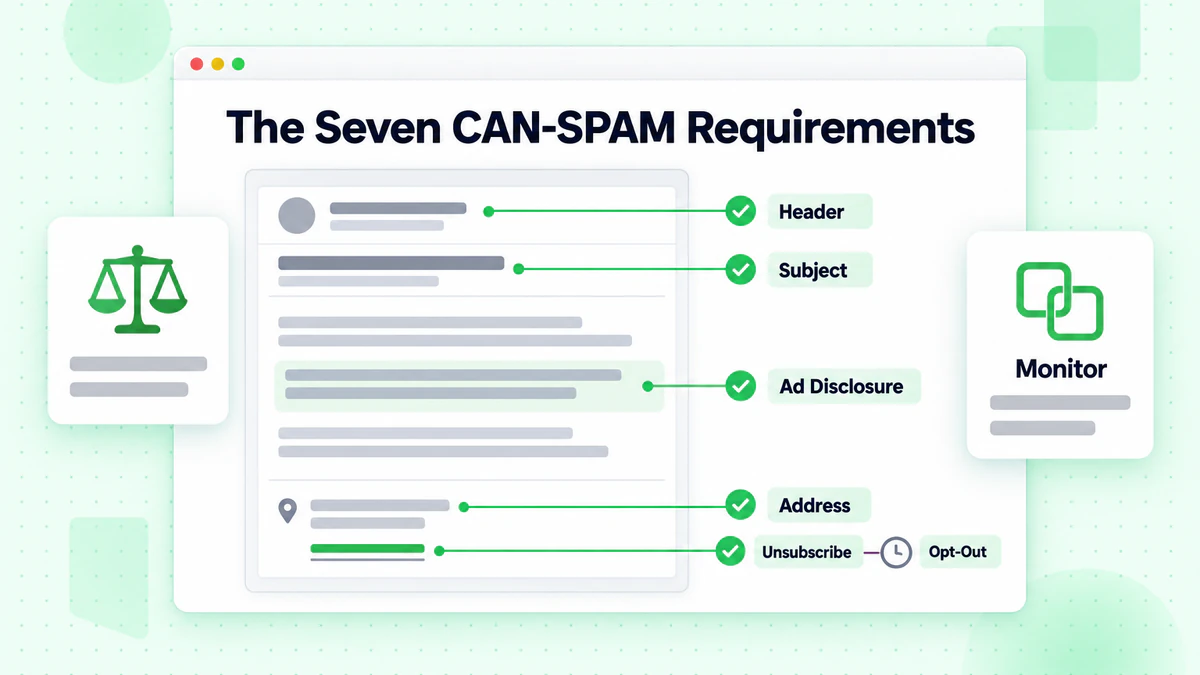
Requirement 1: No False or Misleading Header Information
The "From," "To," "Reply-To," and routing information must be accurate.
What This Means:
- "From" name and email must accurately identify the sender
- Domain names must be ones you legitimately use
- Reply-To addresses must route to you or someone authorized to handle responses
Compliant Examples:
From: "Sarah at BillionVerify" <sarah@billionverify.com>
From: "BillionVerify Marketing" <marketing@billionverify.com>
From: "BillionVerify" <newsletter@billionverify.com>
Non-Compliant Examples:
From: "Customer Service" <support@randomdomain.com>
(if you're not associated with that domain)

From: "Amazon" <deals@notyourdomain.com>
(impersonating another company)

From: "noreply@billionverify.com" with Reply-To pointing to an abandoned mailbox
Technical Considerations:
- Email authentication (SPF, DKIM, DMARC) supports compliance
- Third-party senders must clearly identify the actual sender
- Multiple "From" addresses on same campaign should be consistent
Requirement 2: No Deceptive Subject Lines
Subject lines must accurately reflect the content of the message.
The Standard: Would a reasonable recipient be misled about the subject matter?
Compliant Examples:
Subject: Your weekly marketing tips from BillionVerify
Subject: 20% off email verification - this week only
Subject: New feature announcement: Real-time API
Subject: Quick question about your email strategy
Non-Compliant Examples:
Subject: Re: Your account
(when it's not a reply about their account)

Subject: Invoice attached
(when there's no invoice, just marketing)

Subject: Action required
(when no action is actually required)

Subject: You've won!
(when they haven't won anything)
Gray Area Tactics: Some marketers use curiosity-driven subjects that technically don't mislead but push boundaries. Consider both legal compliance and subscriber trust when crafting subjects.
For more guidance, see our email subject lines guide.
Requirement 3: Identify the Message as an Advertisement
Commercial messages must be identifiable as advertisements.
Flexibility in Implementation: The law doesn't require specific language like "Advertisement" or "Ad." It gives senders discretion in how to disclose the commercial nature of the message.
Acceptable Approaches:
- Header notice: "This is a promotional message from BillionVerify"
- Clear promotional context throughout
- Footer disclosure: "You're receiving this promotional email because..."
- Obviously commercial content (sale announcements, product promotions)
When More Explicit Disclosure Is Needed:
- Content that might be mistaken for personal communication
- Editorial-style content with embedded promotions
- Messages that don't obviously appear commercial
Best Practice: If there's any doubt about whether your message is clearly commercial, add an explicit disclosure.
Requirement 4: Include Physical Postal Address
Every commercial email must include your valid physical postal address.
Acceptable Address Types:
- Current street address
- Post Office box registered with the US Postal Service
- Private mailbox (PMB) registered with a commercial mail receiving agency (like UPS Store)
Format Examples:
BillionVerify, Inc.
123 Main Street, Suite 100
San Francisco, CA 94105
BillionVerify, Inc.
PO Box 12345
San Francisco, CA 94102
Common Mistakes:
- Missing address entirely
- Using address of a location you no longer occupy
- International addresses only (US address required for US recipients)
- Unregistered PO boxes or mailboxes
For International Senders: If you're outside the US but emailing US recipients, you need a valid US postal address. Options include:
- US office address if you have one
- Registered agent address
- Commercial mail receiving service
Requirement 5: Provide Clear Unsubscribe Mechanism
Every commercial email must include a clear, conspicuous way to opt out.
Requirements for Unsubscribe Mechanism:
Easy to Find: Not hidden in fine print or difficult-to-read colors.
Easy to Execute:
- Must be able to unsubscribe with minimal effort
- No fees or charges
- No personal information beyond email address
- No login required
- No jumping through multiple pages
Technology Requirements:
- Link must be functional for at least 30 days after sending
- Must process requests within 10 business days (immediately is better)
- Can use unsubscribe link or email-based opt-out
Compliant Unsubscribe Formats:
[Unsubscribe from this list]

Manage preferences | Unsubscribe

Click here to unsubscribe or email unsubscribe@billionverify.com

Don't want these emails? [Unsubscribe instantly]
Non-Compliant Approaches:
To unsubscribe, send a letter to... (mailing address only)

Unsubscribe by logging into your account and navigating to settings

To unsubscribe, email us with your request and we'll process within 30 days
Requirement 6: Honor Opt-Out Requests Promptly
You must process opt-out requests within 10 business days.
After Processing, You Cannot:
- Send any further commercial emails to that address
- Sell or transfer the email address to another party
- Have another entity send on your behalf
Best Practices:
- Process immediately (within minutes, not days)
- Send confirmation that unsubscribe was processed
- Add to suppression list to prevent re-adding
- Apply across all marketing lists, not just one
Global vs. Selective Unsubscribe: CAN-SPAM allows offering "some" vs. "all" options, but:
- A global unsubscribe must be available
- If they choose global, honor it completely
- Preference centers can offer alternatives
Suppression List Management: Maintain permanent suppression lists to ensure unsubscribed addresses never receive marketing emails again, even if they appear on purchased or partner lists.
Requirement 7: Monitor Third-Party Compliance
You're responsible for what others send on your behalf.
This Applies To:
- Email service providers
- Marketing agencies
- Affiliates and partners
- Contractors and freelancers
Due Diligence Requirements:
- Contractually require CAN-SPAM compliance
- Monitor what's being sent in your name
- Establish approval processes for third-party campaigns
- Respond to complaints about partner-sent emails
Liability Example: If an affiliate sends spam promoting your product with deceptive subject lines and no unsubscribe link, both you and the affiliate may face penalties.
CAN-SPAM Penalties and Enforcement
Understanding the consequences of non-compliance underscores the importance of getting it right.
Civil Penalties
Per-Violation Fines:
- Up to $51,744 per email that violates CAN-SPAM
- Each separate email is a separate violation
- Penalties can multiply quickly with large sends
Example Scenario: Sending 10,000 non-compliant emails could theoretically result in over $500 million in fines. While maximum penalties aren't always assessed, the potential exposure is significant.
Aggravated Violations
Enhanced Penalties Apply For:
- Harvesting: Collecting addresses from websites without permission
- Dictionary Attacks: Generating addresses by combining words/numbers
- Automated Account Creation: Creating accounts to send spam
- Relay or Retransmission: Unauthorized use of other servers
- False Registration: Providing false information for domains or accounts
These practices can result in additional fines and criminal prosecution.
Criminal Penalties
Jail Time Is Possible For:
- Using false identity information
- Hacking to send emails
- Sending via hijacked computers (botnets)
- Using relay servers without authorization
Criminal penalties can include up to 5 years in prison.
Who Enforces CAN-SPAM?
Federal Trade Commission (FTC): Primary enforcement authority for most violations.
State Attorneys General: Can bring actions under CAN-SPAM.
Internet Service Providers: Can sue senders who violate the act.
Other Federal Agencies: FCC, banking regulators for their respective industries.
Notable Enforcement Actions
Significant CAN-SPAM Cases:
Jumpstart Technologies ($900,000): Deceptive subject lines, inadequate unsubscribe.
Phillip Flora ($2.5 million): Spamming pharmaceutical products.
Sanford Wallace ($4 million + criminal charges): Serial spammer with multiple violations.
Qchex ($8.5 million): Deceptive check payment schemes via email.
These cases demonstrate that enforcement is real and penalties are substantial.
CAN-SPAM Compliance Checklist
Use this comprehensive checklist to audit your email marketing program.
Pre-Send Checklist
Sender Information:
- [ ] "From" name accurately identifies sender
- [ ] "From" email address uses legitimate domain
- [ ] "Reply-To" routes to monitored mailbox
- [ ] Domain has valid SPF, DKIM, and DMARC records
Subject Line:
- [ ] Accurately reflects email content
- [ ] Not deceptive or misleading
- [ ] Doesn't falsely suggest prior relationship
Email Content:
- [ ] Commercial nature is identifiable
- [ ] Valid physical postal address included
- [ ] Unsubscribe mechanism present and visible
- [ ] Unsubscribe link is functional
- [ ] No deceptive content or false claims
Unsubscribe Process**:
- [ ] One-click or minimal-step unsubscribe
- [ ] No login required
- [ ] No fee charged
- [ ] No unnecessary personal information requested
- [ ] Confirmation sent after processing
- [ ] Processed within 10 business days (ideally immediately)
- [ ] Suppression list maintained and checked
Ongoing Compliance
List Management:
- [ ] Suppression list checked before every send
- [ ] List sources documented
- [ ] No purchased lists without verified consent
- [ ] Regular email verification to remove invalid addresses
- [ ] Email list hygiene practiced regularly
Third-Party Oversight:
- [ ] Contracts include CAN-SPAM compliance requirements
- [ ] Third-party sends monitored and approved
- [ ] Complaint handling process established
- [ ] Regular audits of partner practices
Documentation:
- [ ] Opt-out processing logs maintained
- [ ] Complaint records kept
- [ ] Third-party agreements documented
- [ ] Compliance training records
CAN-SPAM vs. Other Regulations
Understanding how CAN-SPAM compares to other laws helps navigate multi-jurisdictional compliance.
CAN-SPAM vs. GDPR
| Aspect | CAN-SPAM | GDPR |
|---|---|---|
| Consent Required | No (opt-out model) | Yes (opt-in model) |
| Geographic Scope | US recipients | EU residents |
| Maximum Penalty | $51,744/violation | €20M or 4% revenue |
| Unsubscribe Required | Yes | Yes |
| Privacy Rights | Limited | Extensive |
| Documentation | Basic | Extensive |
Practical Approach: If you email both US and EU recipients, follow GDPR standards—they exceed CAN-SPAM requirements.
For detailed GDPR guidance, see our GDPR email marketing guide.
CAN-SPAM vs. CASL
| Aspect | CAN-SPAM | CASL |
|---|---|---|
| Consent Required | No | Yes (express or implied) |
| Geographic Scope | US | Canada |
| Maximum Penalty | $51,744/violation | $10M CAD/violation |
| Private Right of Action | No (for individuals) | Yes |
CASL is significantly stricter than CAN-SPAM. Cold emailing Canadian contacts without proper consent is generally prohibited.
CAN-SPAM vs. CCPA/CPRA
CCPA/CPRA focuses on data privacy rather than email specifically:
CCPA Additions:
- Right to know what data is collected
- Right to delete personal information
- Right to opt out of data sales
- Non-discrimination for exercising rights
While CCPA doesn't directly regulate email content, it affects how you collect, store, and use email addresses.
Common CAN-SPAM Mistakes and How to Avoid Them
Learn from these frequent compliance failures.
Mistake 1: Missing Unsubscribe Link
The Problem: Sending commercial emails without a way to opt out.
How It Happens: Template errors, new employee mistakes, automated sequences without unsubscribe.
The Fix:
- Include unsubscribe in every template
- Audit all automated sequences
- Test every email before sending
- Use ESPs that require unsubscribe links
Mistake 2: Slow Unsubscribe Processing
The Problem: Taking more than 10 business days to process opt-outs.
How It Happens: Manual processes, technical issues, suppression list not synced.
The Fix:
- Automate unsubscribe processing
- Sync suppression lists in real-time
- Test unsubscribe flow regularly
- Set up alerts for processing delays
Mistake 3: Deceptive Subject Lines
The Problem: Using misleading subjects to boost open rates.
How It Happens: Pressure for metrics, not understanding the law, copying spam tactics.
The Fix:
- Train marketing team on compliance
- Review subjects against content
- Avoid "Re:" unless it's a real reply
- Build culture of honest marketing
Mistake 4: Missing Physical Address
The Problem: No postal address in commercial emails.
How It Happens: Template oversight, address not updated after move, international senders unaware of requirement.
The Fix:
- Add address to master templates
- Use footer components that auto-include address
- Audit templates quarterly
- Update immediately when address changes
Mistake 5: Invalid Email Addresses
The Problem: Sending to bad addresses indicates poor list practices and hurts deliverability.
How It Happens: Old lists, purchased data, no verification process.
The Fix:
- Verify emails at point of collection using real-time verification
- Run bulk verification before campaigns
- Remove bounces immediately
- Use BillionVerify for comprehensive list cleaning
Mistake 6: Ignoring Third-Party Compliance
The Problem: Affiliates or partners sending non-compliant emails on your behalf.
How It Happens: Lack of oversight, no contractual requirements, assuming they know the rules.
The Fix:
- Include compliance requirements in all agreements
- Review and approve partner email campaigns
- Monitor complaints and take action
- Conduct periodic audits
Building a CAN-SPAM Compliant Email Program
Beyond checking boxes, build a culture of compliance.
Email Marketing Best Practices
Permission-Based Marketing: While CAN-SPAM doesn't require consent, permission-based marketing outperforms:
- Higher open rates
- Better deliverability
- Fewer complaints
- Stronger customer relationships
See our email marketing best practices guide for more.
List Quality Focus: Maintaining clean email lists supports compliance and performance:
- Regular verification with BillionVerify
- Prompt bounce removal
- Engagement-based segmentation
- Re-permission campaigns for old lists
Transparent Practices: Build trust through transparency:
- Clear sender identity
- Honest subject lines
- Valuable content that matches expectations
- Easy, reliable unsubscribe
Team Training and Culture
Regular Training On:
- CAN-SPAM requirements
- Company email policies
- Complaint handling procedures
- Third-party management
Culture Elements:
- Compliance valued over short-term metrics
- Questions encouraged about borderline practices
- Regular policy reviews
- Learning from industry mistakes
Technical Infrastructure
Essential Technical Setup:
- Email authentication (SPF, DKIM, DMARC)
- Reliable unsubscribe processing
- Suppression list management
- Delivery monitoring
- Complaint feedback loops
Integration with Verification: Integrate email verification into your workflow:
- API verification at signup
- Bulk verification before campaigns
- Automated removal of invalid addresses
Conclusion
CAN-SPAM compliance is straightforward once you understand the requirements. The seven core rules—accurate headers, honest subjects, ad identification, physical address, clear unsubscribe, prompt processing, and third-party monitoring—aren't difficult to follow with proper processes in place.
Key Takeaways:
Compliance Is Non-Negotiable: Penalties of up to $51,744 per violation add up quickly. Invest in proper processes.
Go Beyond Minimum Requirements: Permission-based marketing performs better than the opt-out minimum CAN-SPAM allows.
Unsubscribe Is Sacred: Make it easy, process it fast, and never send to opted-out addresses.
Maintain List Quality: Use email verification to ensure you're reaching valid addresses with proper practices.
Monitor Third Parties: You're responsible for what others send on your behalf.
Document Everything: Maintain records of compliance practices, opt-outs, and third-party agreements.
CAN-SPAM sets the floor for commercial email in the United States, but successful marketers build far above that floor. By combining legal compliance with respect for subscriber preferences and commitment to list quality, you'll build an email program that drives results while staying on the right side of the law.
For broader compliance guidance covering international regulations, see our complete email compliance guide. And ensure every email reaches a valid address by verifying your lists with BillionVerify.