
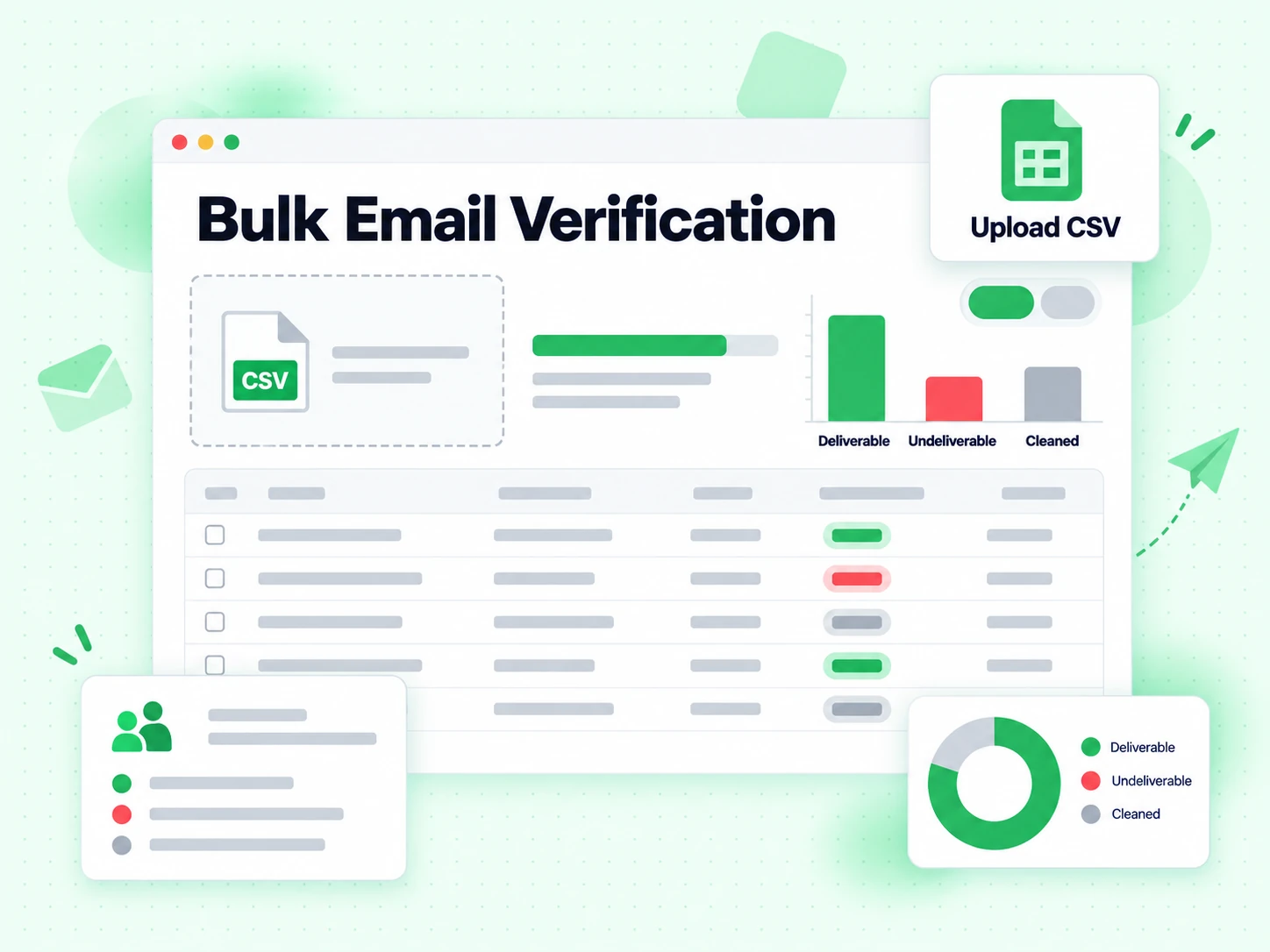
Clean Every List
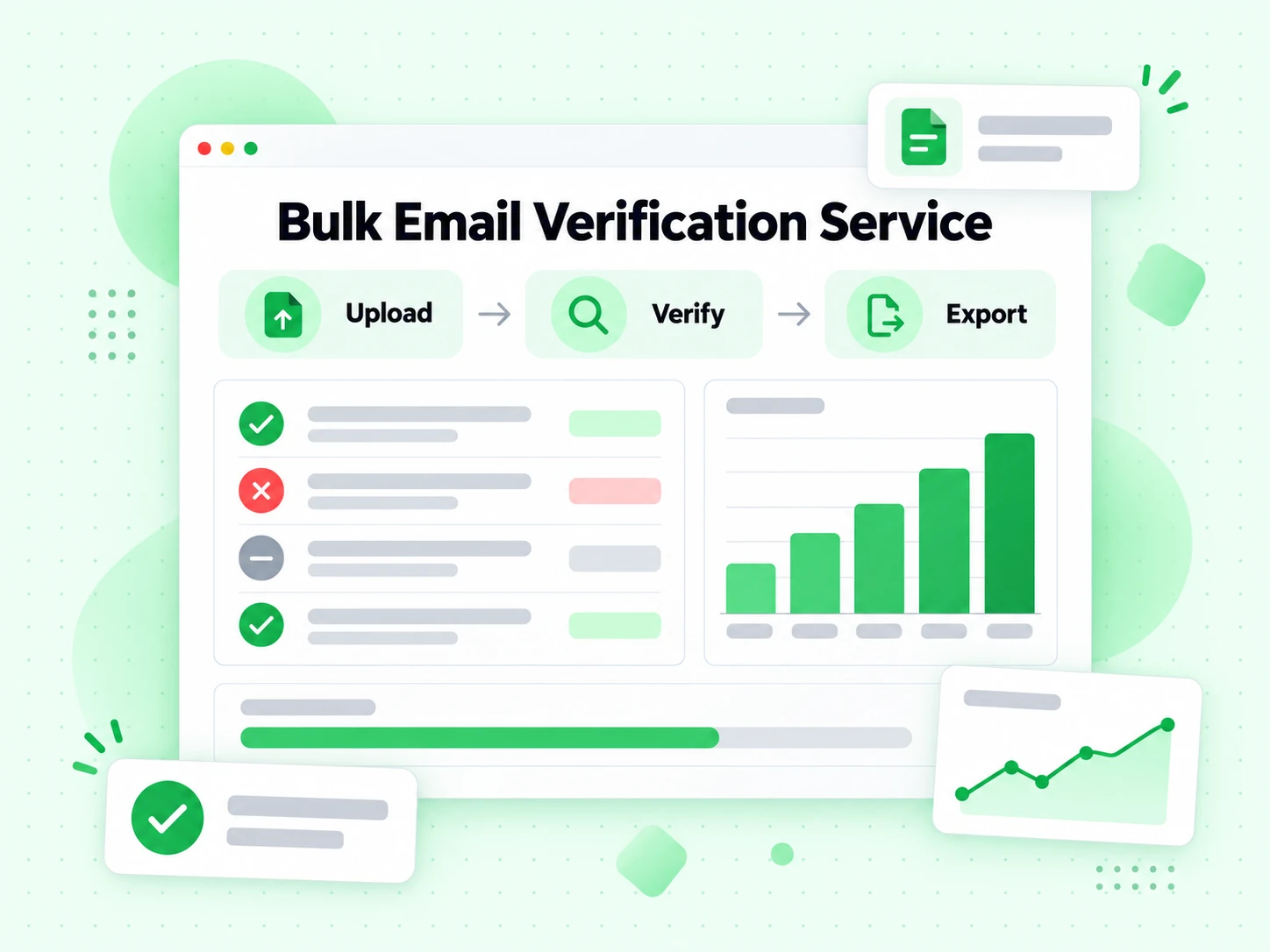
Turn large lists into clear validity distribution, status counts, and export-ready segments so sales and marketing teams can remove bad addresses before campaigns launch.

The bulk email verification service for any list — from hundreds to millions. Real-time batched checks or async bulk queue processing, all with 99.9% SMTP-level accuracy.

Turn large lists into clear validity distribution, status counts, and export-ready segments so sales and marketing teams can remove bad addresses before campaigns launch.

Each address in your bulk email list runs through the same multi-layer check automatically.

Check individual emails for validity, deliverability, and reputation. No account required.
Identify and block temporary email services before they pollute your list.
Detect emails likely to bounce before sending, protecting your sender reputation.
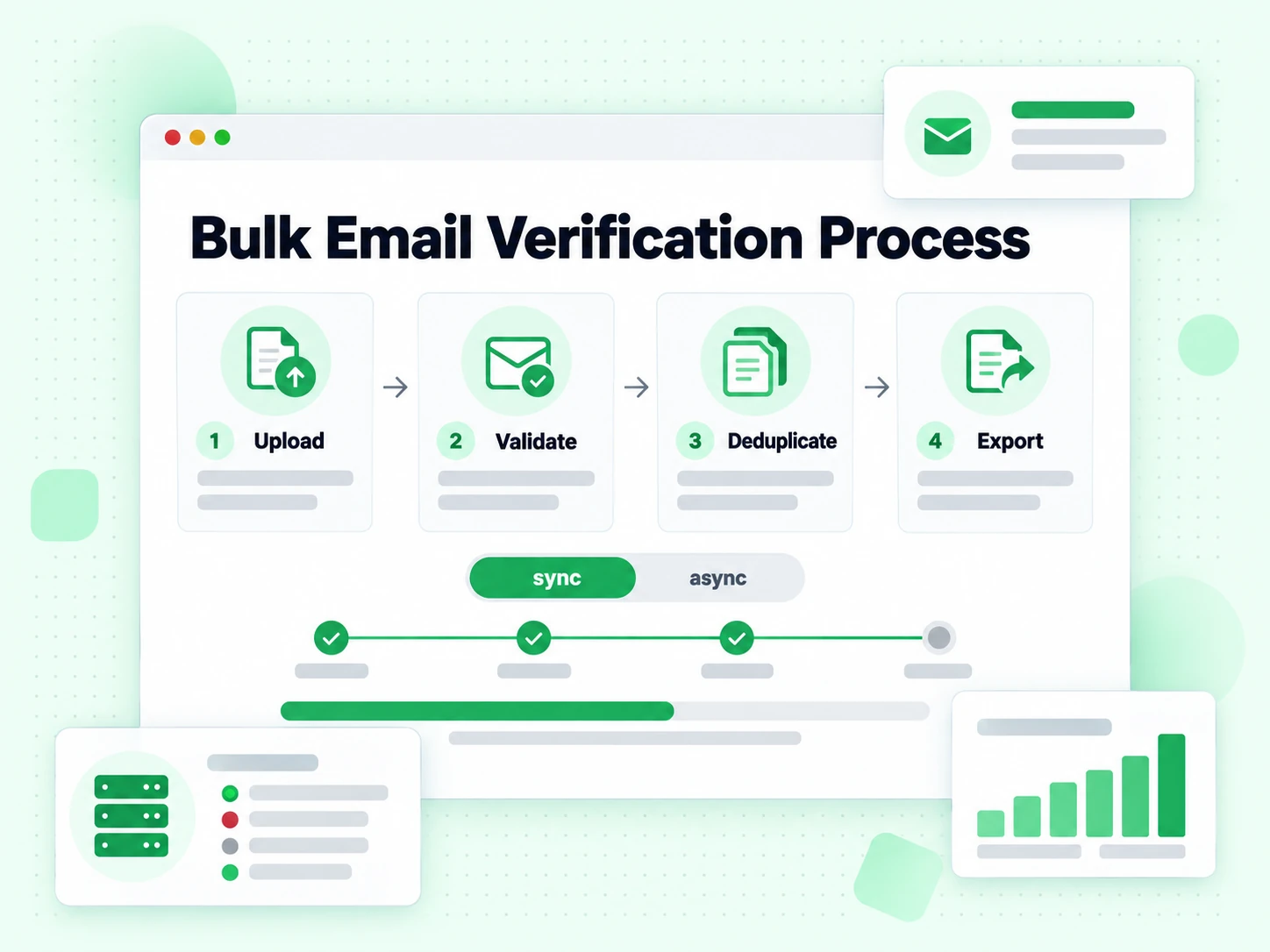
Every address goes through per-address SMTP verification, then your bulk list is processed in the mode you choose.

Per-Address Verification
Validates format against RFC standards before bulk email verification spends a credit. Catches typos, invalid characters, and structural errors instantly.
Confirms the domain exists and has valid mail server records configured to receive email, for every row in the bulk job.
Opens a real connection to the receiving mail server. No test email sent, no spam risk, even on a bulk run of millions.
Verifies the specific address exists on the server and is deliverable before your bulk export reaches the ESP.
Sync or async bulk processing
Choose the bulk email verification mode that fits your use case.
Batched API Calls
Send individual API requests in parallel batches. Each address returns a result immediately — ideal for real-time pipelines, sign-up flows, or small-to-medium bulk email lists.
Queue-Based
Submit a bulk list and let the queue handle the rest. Large bulk files are processed in the background at 50,000 addresses per hour. A webhook callback notifies you when the bulk job is complete.
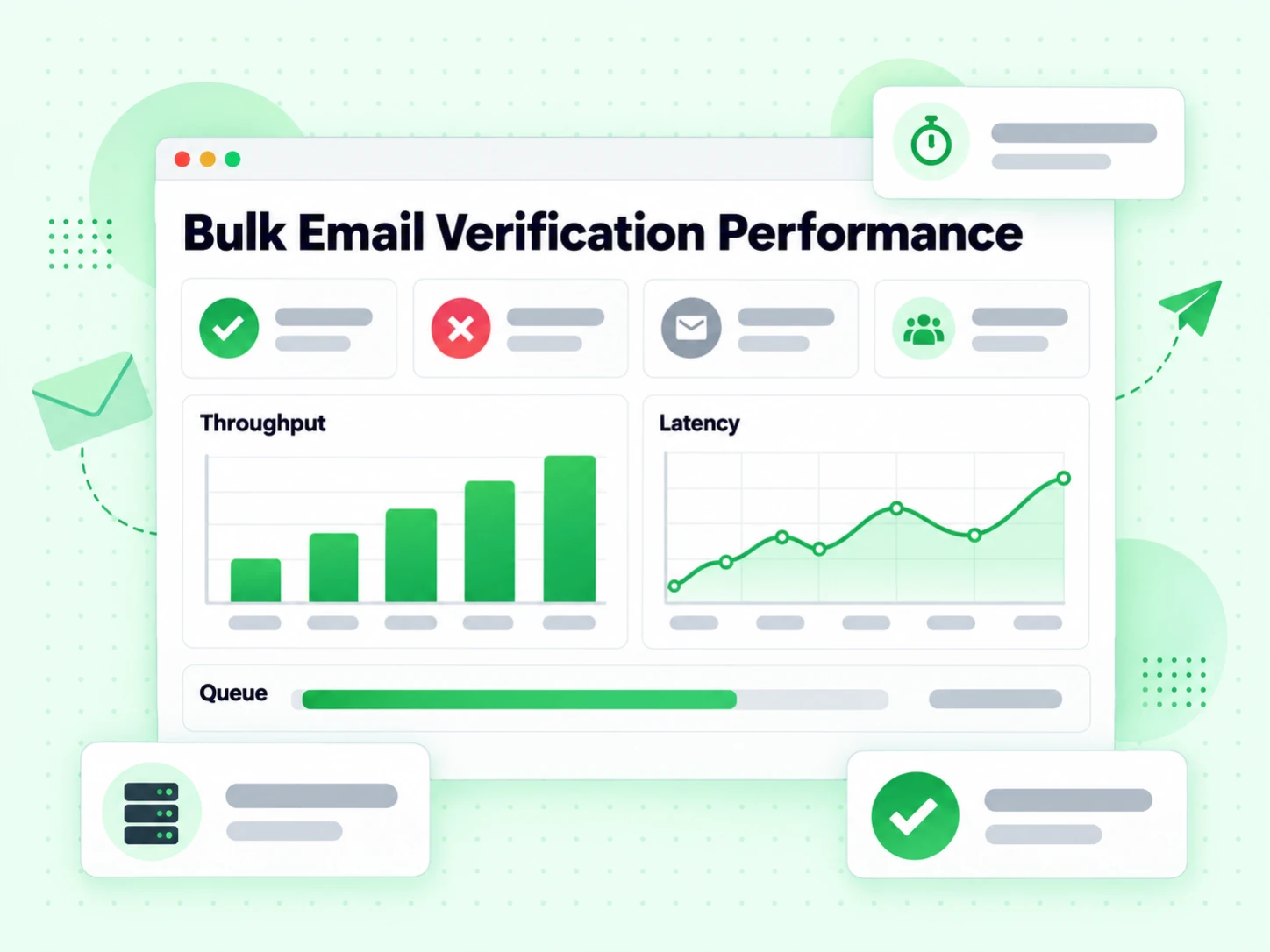
Built for speed, accuracy, and reliability at any bulk email verification volume.

<3s
Per Address
Full SMTP verification
50K/hr
Async Throughput
Queue-based processing
99.9%
Accuracy
SMTP-level precision
99.99%
Uptime
Enterprise reliability
Every bulk email tool in one platform, from single checks to millions of rows.
Verify individual addresses with real-time SMTP checks and instant results.
Remove invalid, risky, and inactive addresses to improve deliverability before every campaign.
Verify addresses in real time during signup, enrichment, or automation workflows.
Inside a bulk run
The bulk email verification service is not a faster version of a single check. It is a pipeline that must apply the same evidence rules to every row of a bulk list without losing reasons, order, or accountability.
Bulk email verification runs syntax, domain and MX resolution, and a live SMTP mailbox probe on each row. A bulk job does not sample the file, guess from the domain, or reuse a neighbouring row's verdict. The evidence behind row 400,000 is the same evidence behind row one.
That is what separates a real bulk email verification service from a list scrubber that only removes malformed strings. Scrubbing improves the shape of a file; bulk verification asks the receiving mail server whether each mailbox will accept mail.
Large files repeat addresses. A CRM export, three campaign lists, and a webinar registration file merged together can hold the same person five times. Our bulk email verification service normalizes and deduplicates before the SMTP stage, so you pay once for a unique address rather than once per row.
Deduplication is case-insensitive and whitespace-tolerant, which matters because manual data entry and spreadsheet copy-paste produce variants that look distinct to a naive bulk import but resolve to one mailbox.
Receiving providers defend themselves against unusual traffic. Any bulk email verification service that opens thousands of simultaneous connections to one provider gets throttled, greylisted, or blocked, and the bulk results become noise. BillionVerify paces bulk traffic per receiving domain and per egress identity.
That pacing is why a bulk run reports async throughput of 50,000 addresses per hour rather than a headline number that only holds for the first minute. Sustained bulk accuracy is worth more than a burst.
A bulk export that returns only valid or invalid throws away the information you need to act. Each row from a bulk email verification service carries the deliverability status plus the risk flags — disposable, role, catch-all, free webmail — that explain the verdict.
Preserve those columns when you import bulk results back into a CRM or ESP. A bulk email list cleaning service is only useful if the cleaning decision can be re-examined later without re-running the whole file.
Reading a bulk result file
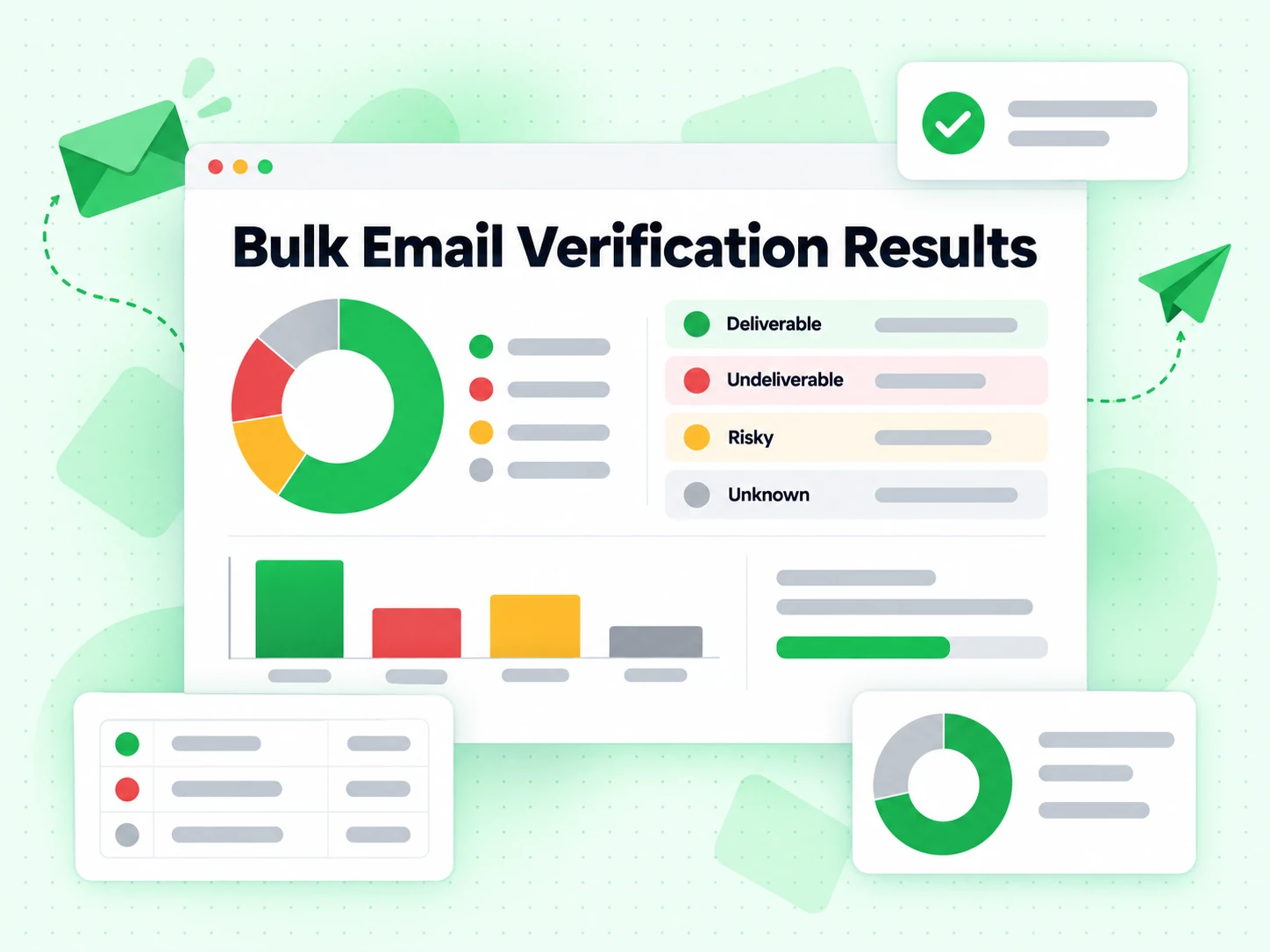
A finished bulk job produces four practical groups. Treating the export as a simple pass/fail column is the most common way teams lose good contacts or keep bad ones.
These addresses accepted an SMTP probe at bulk run time. They can enter your normal sending flow, subject to consent and segmentation rules that bulk verification does not evaluate.
Deliverable is a technical fact, not an audience judgement. Our bulk email verification service can tell you the mailbox answers; it cannot tell you the person wants your campaign.
Permanent failures are exactly what a bulk email list cleaning service exists to find. Suppress them before the send so the ESP never sees the hard bounce.
Keep the original value and the failure reason. Deleting the row loses the audit trail, and the next bulk import of the same source file will re-introduce the same bad addresses.
Catch-all domains, role accounts, disposable providers, and free personal webmail all appear as flags on otherwise accepting rows. A bulk run surfaces them; your policy decides what each one means for this campaign.
A B2B outbound sequence may exclude role addresses and keep catch-all in review. A consumer newsletter may accept both. The bulk email verification service should not make that choice for you.
Greylisting, temporary provider deferrals, and rate limits produce inconclusive answers on any bulk job of meaningful size. Those rows are not invalid, and a bulk export that quietly converts them to invalid is destroying data.
Re-run unknowns in a later bulk pass. The proportion usually falls sharply on the second attempt, because the temporary condition that caused it has cleared. A bulk email list cleaning service that skips this step reports a smaller, dirtier list.
Operating a bulk job
Bulk verification pays off when it sits at a fixed point in the list lifecycle instead of being run in a panic the night before a send.
Batched synchronous API calls return each result inline and suit lists up to roughly 10,000 addresses, real-time signup flows, and anything where a person is waiting. Async bulk submission suits everything larger.
An async bulk job accepts the file, processes it in the background, and calls your webhook when the bulk run completes. Nothing has to hold a connection open for hours.
Mailboxes decay. A bulk email verification service tells you the state of a list on the day it ran, and a list verified six months ago is a different list today. Re-run bulk verification before each major campaign.
For continuously growing lists, a small recurring bulk email verification job beats one enormous annual clean. It spreads the cost and keeps the sending reputation stable.
Write the status, the reason flags, and the bulk run timestamp back to each contact record. A team that stores only "cleaned: yes" cannot answer why a contact was suppressed three campaigns later.
Storing the bulk verification date also lets you decide automatically which bulk email rows need to enter the next run and which are still fresh. That is what turns a one-off clean into a bulk email list cleaning service you can operate.
A bulk email list cleaning service handles the backlog. New addresses should not rebuild that backlog. Call the Email Validation API at signup so every new row is verified before it ever reaches a bulk queue.
Using one engine for bulk and real-time keeps the definition of verified identical across the whole system, which is what makes the bulk numbers comparable over time.
Bulk limits
The value of a bulk run comes from a narrow, well-defined claim. Stretching that claim is how teams end up trusting a clean file that was never clean.
The bulk email verification service proves an address can receive mail. It says nothing about whether the owner agreed to hear from you. Consent and suppression lists stay your responsibility.
Verifying a purchased list makes it deliverable, not lawful or welcome. The bulk result improves your bounce rate; it does not improve your right to send.
Even a fully verified bulk export can land in spam if the sending domain has weak authentication, poor reputation, or complaint history. Those are sender-side problems that no bulk email list cleaning service can measure from the recipient side.
Run bulk verification to remove address-level failures, then treat deliverability of the campaign itself as a separate discipline.
A catch-all domain accepts every local part, so a bulk run cannot prove that any individual guessed address exists there. Large B2B files built from name patterns often contain thousands of such rows.
Keep catch-all as its own bulk segment. Merging it into deliverable inflates the apparent quality of the file and moves the bounce risk downstream.
The bulk job describes what the receiving servers said during that run. Employees leave, aliases retire, and domains migrate. A bulk verification result ages like any other observation.
Record when the bulk run happened and re-verify on a schedule that matches how quickly your bulk email audience changes. Every bulk email list cleaning service result is an observation with a date on it.
Related tools
Bulk is one entry point into the same verification engine. The neighbouring tools answer narrower questions on the way in or on the way out.
When you need to understand a single result in detail rather than clean a file, the Email Verifier runs the same SMTP pipeline on one address and shows every risk flag behind the verdict.
It is the right place to confirm how the engine behaves before committing a large bulk job to it.
The Email Verification API applies bulk-grade accuracy inside forms, CRM sync, and agent workflows without anyone uploading a file.
Bulk uploads and API calls share one pipeline, so a row verified in a bulk job and the same address verified through the API return the same evidence.
A one-off bulk run fixes today. Email List Cleaning describes the recurring bulk email list cleaning service pattern that keeps a database healthy between campaigns.
Treat bulk verification as a recurring operation with an owner, a schedule, and a metric, rather than as an emergency measure before a launch.
Each address in your bulk list goes through the same per-address SMTP verification — syntax check, domain lookup, MX record confirmation, and direct mailbox verification. The bulk email verification service then returns every row with its status and risk flags. Nothing is sampled or inferred from a neighbouring row.
No. Bulk uploads have unlimited rows and unlimited file size; bulk processing starts as soon as the upload completes.
The Starter plan is $20 for 20,000 credits at $0.001 per email — the lowest per-email rate among major providers. Volume pricing scales down to $0.00035 per email at 1,000,000 credits, so a large bulk email verification service run costs less per address than a small one.
Yes. Duplicate addresses are automatically detected and removed before bulk verification begins. This saves credits and keeps the bulk results accurate. Deduplication catches case and whitespace variants that a naive bulk import would treat as separate rows.
API results are returned inline as JSON for each address. Async bulk jobs deliver results via webhook when the run completes, or you can poll the job status endpoint. CSV export of the full bulk file is available from the dashboard.
Yes. The free tier gives you 20 free credits every day you log in, up to 600 a month, with no credit card required — enough to prove the bulk pipeline on a small list. All features are included: syntax, domain, MX, SMTP, and every risk flag.
Bulk email verification and bulk email checker refer to the same process — verifying many email addresses at once against live mail servers. BillionVerify handles both names with one bulk pipeline, so the terminology you use does not change the result you get.
A reliable bulk email list cleaning service goes beyond syntax checking to test whether each mailbox physically exists and accepts mail. It also preserves the reason for every removal, deduplicates before charging, and never silently converts an inconclusive bulk result into a hard invalid.
Real-time batched checks or async bulk queue processing for any list size. 99.9% SMTP-level accuracy, no monthly fees.
600 free credits monthly · 99.9% SMTP-level accuracy · No credit card required