

Email Verify Tools
Email Validator
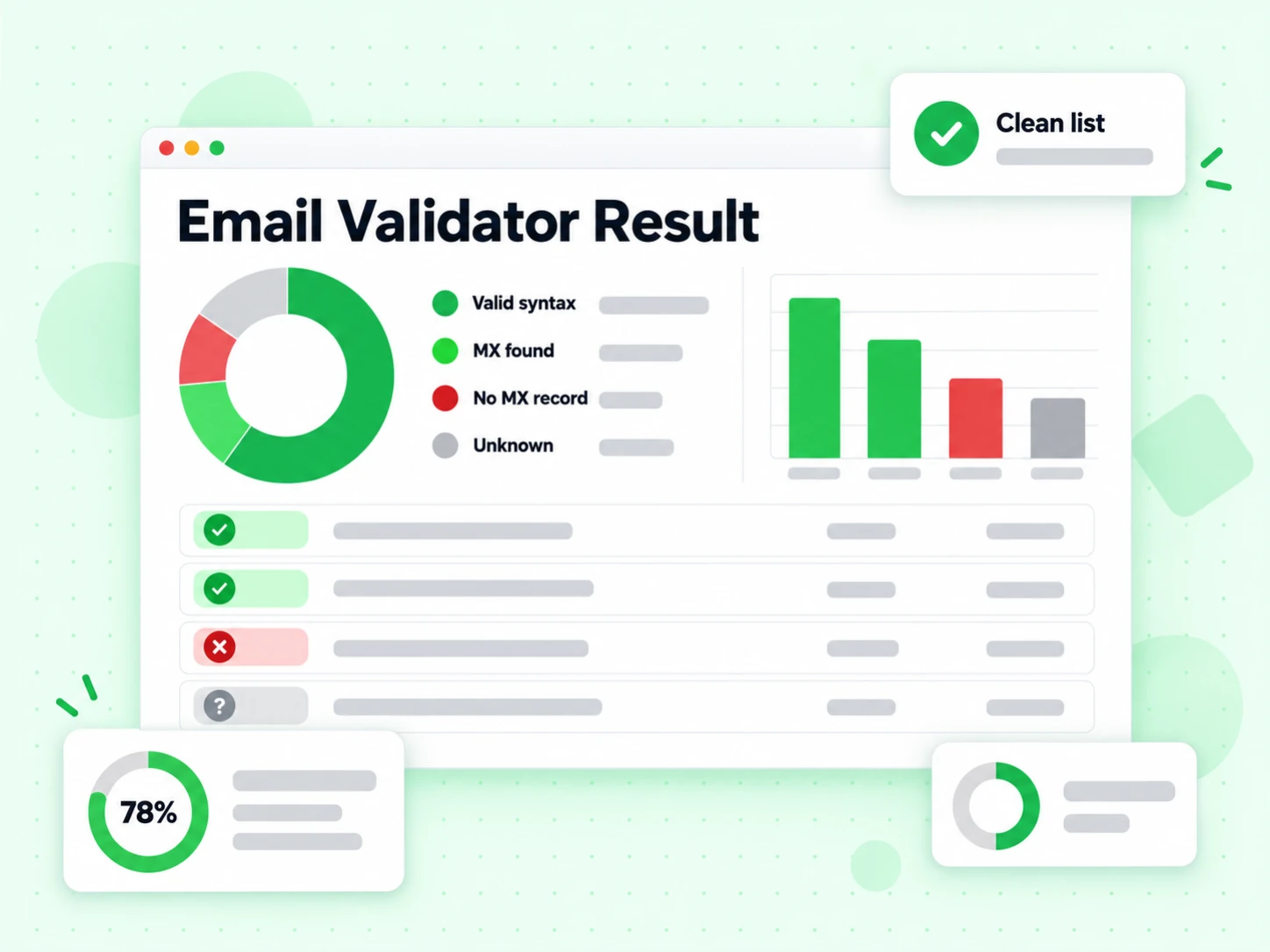
Validate email syntax and MX records in under a second. This tool does not run SMTP — the result is only format and domain mail-server readiness.
What is an email validator?
An email validator answers a narrower question than a verifier: is this string a well-formed address on a domain that publishes mail servers? That is format and MX — not proof a person or inbox exists.
Searchers use “email validator” and “validate email” when they want a fast, free screen. BillionVerify keeps this page honest: no fake deliverability claims, no SMTP handshake, unlimited shallow checks for legitimate use.
When bounce risk matters, move to the Email Checker or Email Verifier. Those tools add mailbox probes and risk flags on top of the same format foundation.
How the email validator works
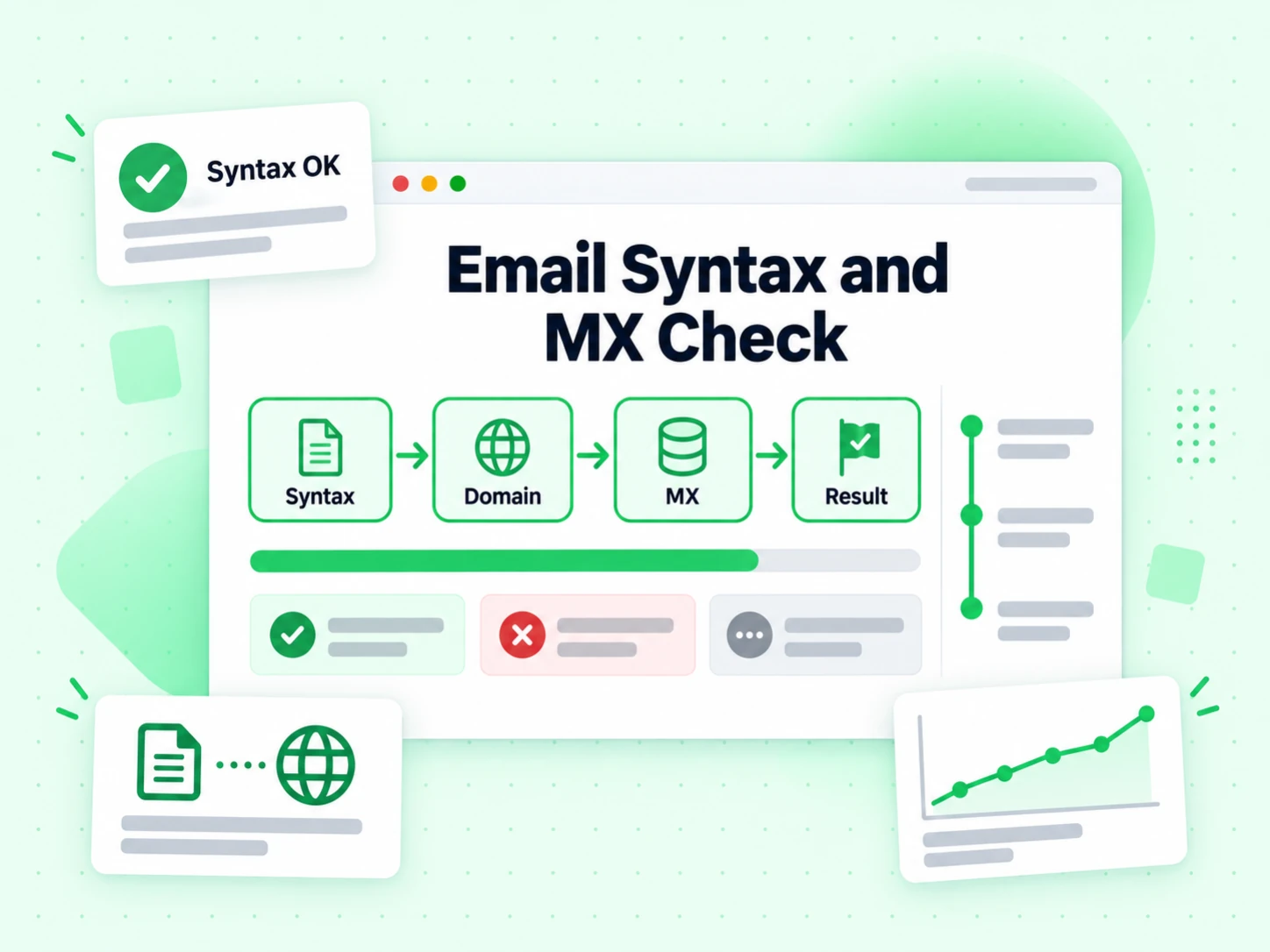
Two layers only. Intentionally no SMTP.
1. Parse and normalize
Check local-part and domain shape against practical format rules. Typos fail in milliseconds.
2. Resolve MX records
Confirm the domain publishes mail exchange records. No MX means the domain cannot receive mail.
3. Stop before the mailbox
We do not open an SMTP conversation. Catch-all domains can still pass this validator.
4. Point you to full proof
If you need deliverability, the Email Verifier and Email Checker run SMTP on the same product stack.
When to use an email validator
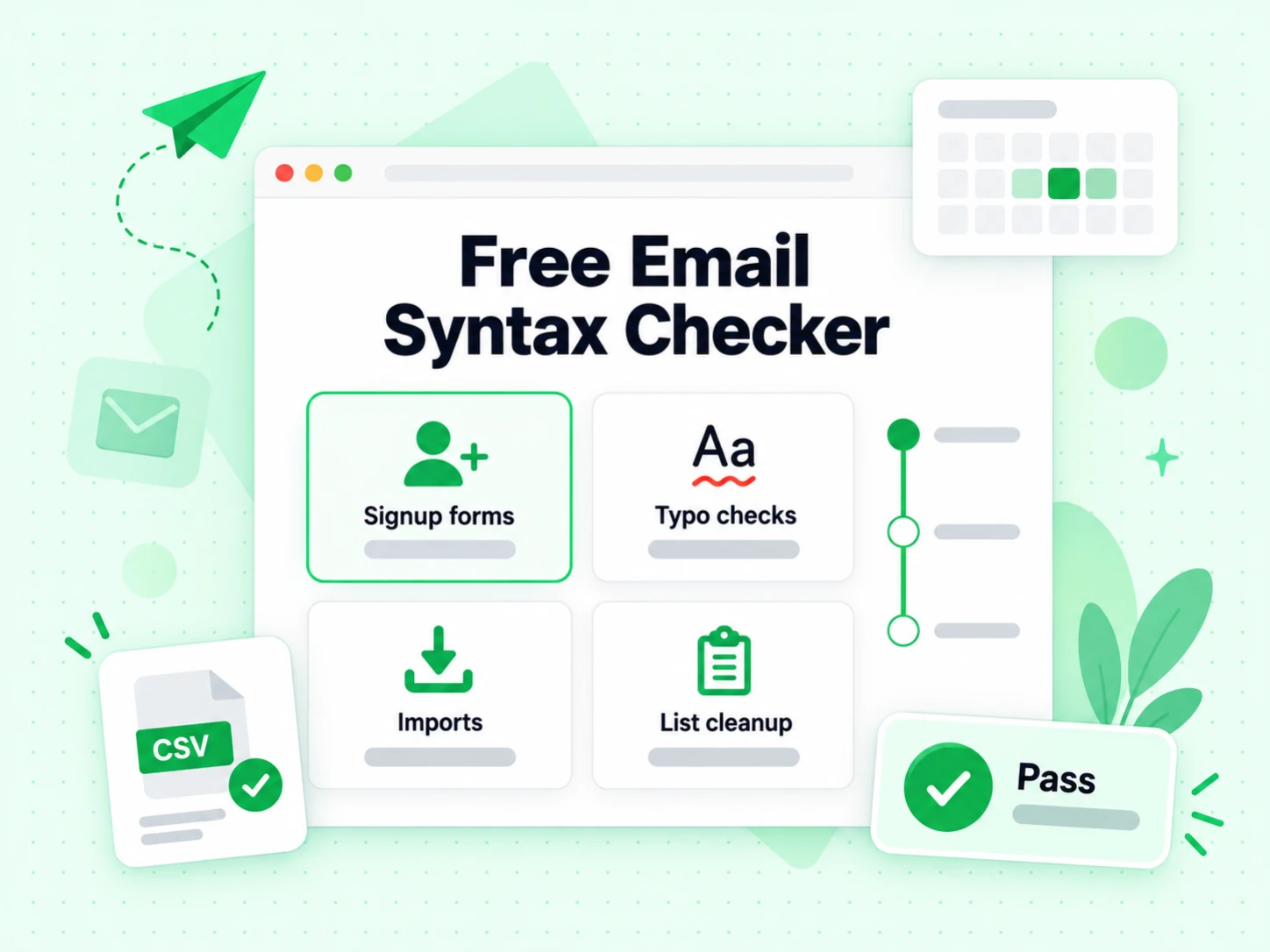
Use shallow validation when speed matters more than mailbox proof.
Catch obvious typos
Form fields and manual entry produce format errors. Fix them before any deeper check.
Confirm the domain can receive mail
No MX is an instant reject without burning SMTP quota.
Pre-screen before full verify
Cheap first filter before bulk SMTP jobs on large lists.
Not for send decisions alone
Do not treat format+MX OK as safe to cold email. Use SMTP tools for that.
Email validator vs other Email Verify Tools
These are interactive Email Verify Tools — not bulk jobs, not the API, not Free Tools (DNS / SPF / DKIM).
This page only returns format and MX. Other tools add SMTP or specialize in one risk flag.
| Tool | What it does | Use it when |
|---|---|---|
| Email Checker | Full SMTP + all risk flags on one address | When you want a complete multi-layer result in one place |
| Free Email Checker | Detect free personal webmail providers (Gmail, Yahoo, …) | Lead quality and B2B domain scoring — not free-of-charge verification |
| Email Validator | Syntax + MX only — no SMTP | Quick format and domain screen |
| Disposable Email Detection | Flags temporary / throwaway domains | Signup and lead capture |
| Bounce Email Checker | Focus on bounce and undeliverable risk | List hygiene for bounce-rate control |
| Catch-All Verifier | Detects catch-all domains | When SMTP accept is unreliable |
| Role Account Detection | Finds generic role addresses | B2B outreach quality |
| Email List Cleaning | Verify many addresses at once (paste or CSV) | When a single check is not enough and you need a cleaned list |
How to read a validation result
Valid (format & MX OK) means the address is well-formed and the domain has mail servers. It does not mean the mailbox exists. Invalid syntax or no MX means stop — deeper checks will not help until that is fixed.
There is no disposable, catch-all, or bounce reading on this page by design. Those require full verification or specialized tools.
Next steps after validation
Go deeper when format alone is not enough.
Frequently Asked Questions
1. What does an email validator check?
This email validator checks two layers only: (1) whether the address is well-formed (syntax/structure), and (2) whether the domain publishes MX records so it can receive mail. It does not open an SMTP conversation with the mailbox and cannot prove that a specific person or inbox exists. That honesty is intentional — format and MX are a cheap screen, not full email verification.
2. Does the email validator use SMTP?
No. SMTP mailbox verification is available on the Email Checker, list cleaning, and signed-in product flows. The validator stays fast and unlimited (soft rate limits only for abuse) by stopping at syntax and MX. If you need bounce risk and deliverability, open the Email Checker for a full SMTP result.
3. When should I use the email validator instead of the email checker?
Use the email validator when you only need a quick format and domain screen — catching typos, rejecting domains with no MX, or pre-filtering before a heavier job. Use the email checker when a wrong address costs you bounces, ESP penalties, or wasted SDR time. Many teams run validator-style checks at form entry and full SMTP email checking before campaigns or CRM import.
4. Is the email validator free?
Yes. Shallow validation (syntax + MX) is free and is not limited to the 20 full-SMTP quota used by the Email Checker. A soft rate limit may apply only to block automated abuse. For bulk CSV cleaning and API volume, sign up for an account.
5. Email validator vs email checker — which should I pick?
Pick the email validator for unlimited shallow checks: “does this look like email on a mail-capable domain?” Pick the email checker for multi-layer verification: SMTP deliverability plus disposable, catch-all, and role flags. They answer different questions; using a validator result as if it were full verification is a common deliverability mistake.
6. Can catch-all domains pass the email validator?
Yes. Catch-all domains usually publish valid MX records, so syntax + MX can look fine even when the specific local-part is not a real person. Only full verification tools (Email Checker / Catch-All Verifier) can surface catch-all uncertainty. If you enrich leads by guessing names@company.com, do not rely on the validator alone.
Need full SMTP deliverability?
Run the Email Checker for mailbox-level proof and risk flags, or sign up for bulk cleaning and API access.
20 free SMTP checks / 24h · No signup for shallow checks · Results in seconds