📍 Introducing MapLeads: Turn Google Maps, Bing Maps & Apple Maps into your lead list.Try MapLeads

Free phone validation tool

Free Phone Number Validator

Validate a phone number against international numbering plans and normalize valid results to E.164. No signup required.

Include plus and the country code when possible. National formats use the selected country. 20 free validations per IP each day.

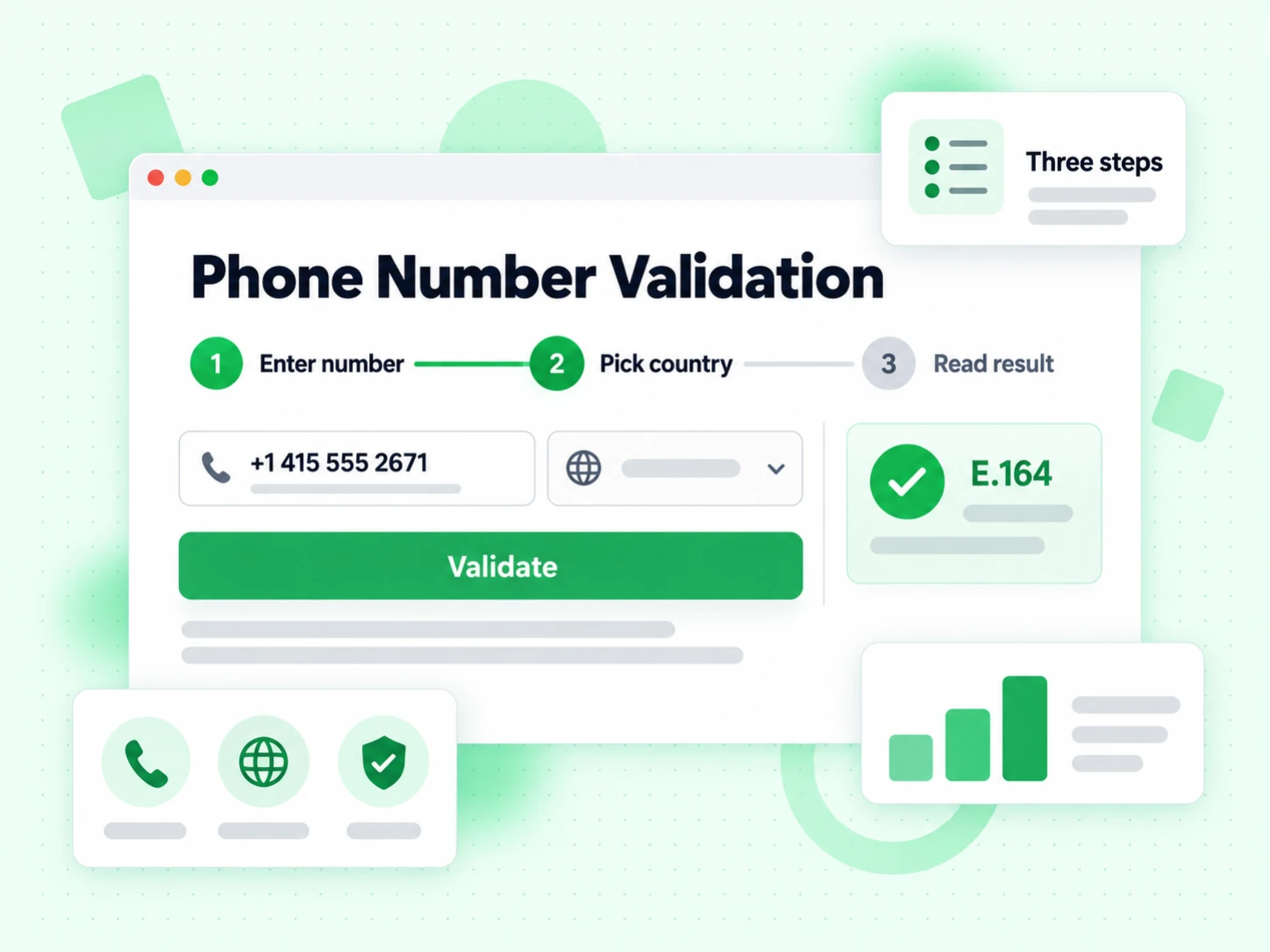
How to validate a phone number online

  1. 1

    Enter the phone number

    Use the international plus and country-code format when you have it.

  2. 2

    Choose a country for local input

    The selected country tells the validator how to interpret a number without a plus prefix.

  3. 3

    Review validity and formats

    Store valid numbers in E.164 and keep the original input only for display or audit.

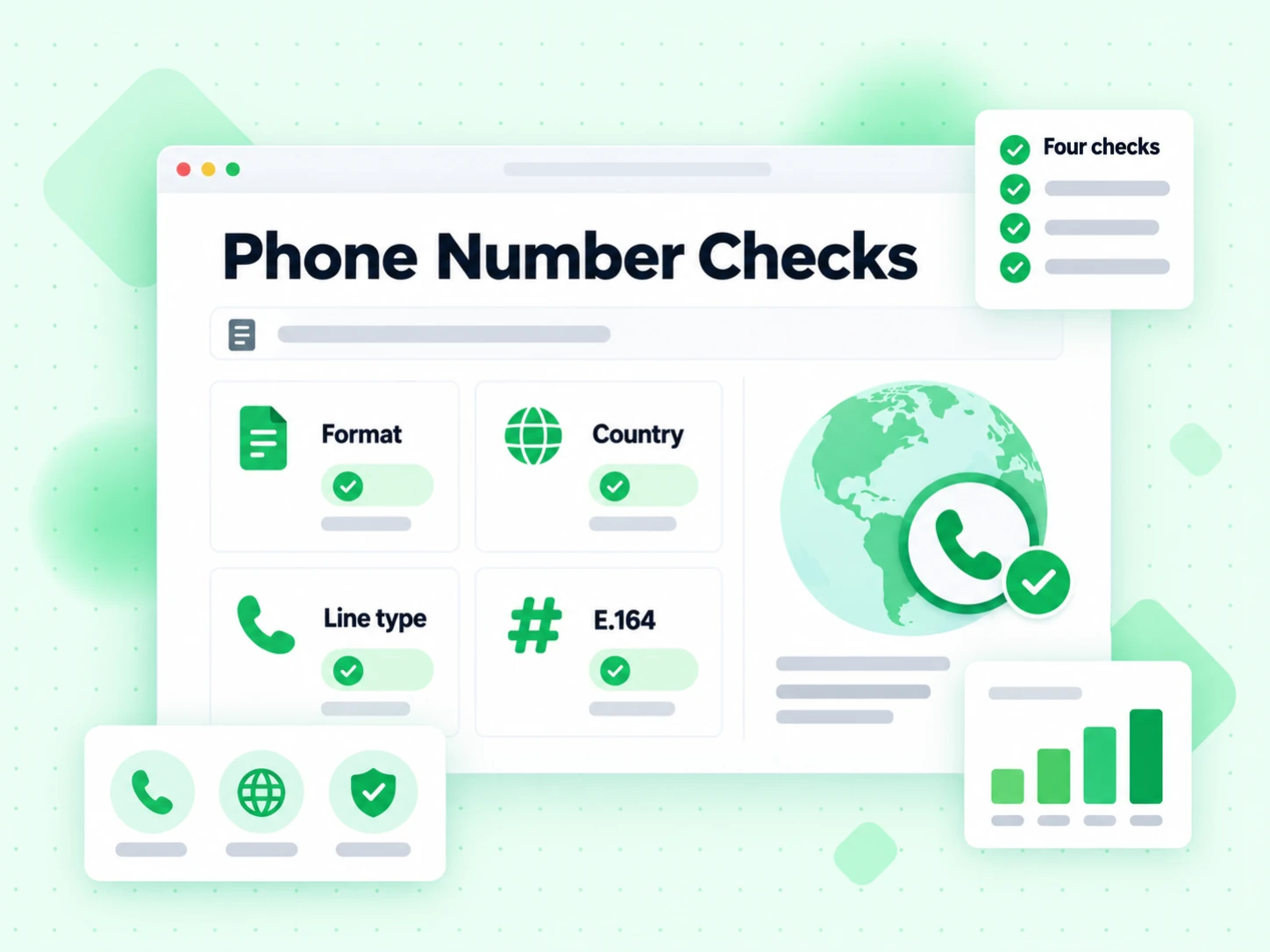
What this phone validator checks

A telephone number validator catches malformed country codes, impossible lengths, and invalid prefix patterns before data reaches your CRM or dialer.

Country and calling code

Map the number to an international calling code and numbering region.

Length and number pattern

Check possible length and assignable prefixes using server-side numbering metadata.

Possible line type

Classify mobile, fixed line, toll-free, VoIP, or unknown where the numbering plan supports it.

E.164 normalization

Return consistent E.164, international, and national formats for CRM and dialer imports.

Phone validation fundamentals

How phone number validation works

Start with the numbering plan: country context, length, prefix, and a consistent E.164 representation. These fundamentals explain what the validator can establish before any live network check.

A valid phone number starts with structure

A phone number is structurally valid when its country calling code, national length, and assignable digit pattern match the numbering plan for that region. Enter the full international number with a plus sign when possible. If you only have a national number, choose the country that should be used to interpret it.

A valid result describes the number pattern, not the live line. The number may still be unassigned, disconnected, ported, unreachable, or controlled by someone other than the person in your record. BillionVerify keeps that distinction visible in the result instead of turning a format check into a carrier or ownership claim.

The role of a phone number validator

A phone number validator parses telephone numbers according to country-specific numbering rules. It identifies the calling code and region, checks whether the national significant number has an allowed length and prefix, estimates a possible line type where the plan supports it, and returns normalized formats that downstream systems can store consistently.

This is more reliable than a hand-written list of country codes and digit counts. Countries add and retire ranges, use different lengths for different services, and sometimes share a calling code. BillionVerify runs the rules on the Go backend so the browser does not carry a simplified validation table or expose internal policy decisions.

How phone number validation works

The server first parses the input with either its explicit international calling code or the selected default region. It rejects text that cannot form a telephone number, then evaluates the parsed digits against full numbering-plan metadata. The response separates parse failure, possible length, valid assignable pattern, region, calling code, and possible type.

When the pattern is valid, the same parsed number is formatted as E.164, an international display value, and a national display value. The check does not dial the number or query a mobile network. Its purpose is deterministic data hygiene: catch malformed inputs early and give every valid record a stable canonical representation.

Country code, length, and assignable pattern

Three layers matter. First, the calling code must identify a supported country or numbering area. Second, the national number must have a permitted length for that plan. Third, the prefix and remaining digits must match a range that the plan recognizes as assignable to a service such as fixed line, mobile, toll-free, or VoIP.

Length alone is not enough. A string can contain the expected number of digits and still begin with an impossible area code or service prefix. That is why values such as +1 000-000-0000 must fail even though they resemble a North American number. Full metadata catches invalid patterns that a regular expression or country-length table misses.

E.164 creates one portable phone format

E.164 is the compact international representation commonly used to exchange and store telephone numbers. It starts with a plus sign, followed by the country calling code and national significant number. Spaces, parentheses, and local dialing punctuation are removed. A US example such as (415) 555-2671 becomes +14155552671.

Store the E.164 value as text, not as an integer. The plus sign communicates that the value is international, and some national numbers can contain meaningful leading zero conventions before parsing. Use the international or national formatted value for display, but keep one canonical E.164 field for matching, deduplication, CRM synchronization, and API calls.

National and international formats serve different contexts

National format is how people usually write a number inside one country. It may include a trunk prefix, spaces, parentheses, or region-specific grouping. International format adds the country calling code and presents the number for a caller outside that country. E.164 is the storage-oriented international form with only a plus sign and digits.

A national value is ambiguous without a region. “020 7946 0958” can be interpreted as a UK number only when GB is selected. “+44 20 7946 0958” carries that context in the input. If a CRM collects users from several countries, ask for a country alongside the field or encourage international input to avoid guessing.

Understand the result

Possible, valid, and live are different conclusions

A format check can reject impossible input and normalize a valid pattern. It cannot prove assignment, reachability, ownership, or a current carrier. These distinctions keep downstream decisions honest.

Why a phone number can show as invalid

The most common cause is missing or incorrect country context. A national number parsed under the wrong region can have the wrong expected length or an impossible prefix. Other failures include an unsupported calling code, too few digits, too many digits, punctuation that produces an extra plus sign, an extension mixed into the main number, or a prefix the numbering plan does not assign.

Check the reason shown in the result before editing the digits. Select the correct default country for local input, or add the plus sign and calling code for international input. Do not “fix” an invalid customer record by padding digits or replacing prefixes. Ask the contact for the complete number when the original source is ambiguous.

Possible length is weaker than a valid number pattern

A possible number usually means the digit count could fit the region. A valid number pattern adds a stricter check against ranges that the numbering metadata recognizes. This distinction matters because an unassigned-looking prefix can have the correct length. A validator should not promote every length match to a valid result.

BillionVerify exposes specific reasons such as possible local only, invalid country code, too short, invalid length, too long, or not a number. A valid pattern is the strongest offline conclusion, but it still does not prove assignment or reachability. Keep the result field and reason together if downstream users need to understand why a record was rejected.

Valid does not mean active or reachable

No. A number can match every published numbering rule while no carrier currently assigns it. It can also be assigned but disconnected, temporarily unreachable, blocked from a destination, configured for incoming calls only, or routed to a service that never answers. Offline format validation cannot observe those network states.

The free tool does not send an SMS, place a call, request an OTP, or use a live carrier response. Its valid status should be read as “valid numbering-plan pattern.” If your workflow needs proof that a person controls the line, obtain explicit first-party confirmation through an authorized verification flow rather than changing the meaning of this result.

Carrier lookup and HLR answer different questions

Format validation uses published numbering metadata. A carrier lookup queries commercial routing data for network or operator information. HLR-style checks may ask mobile-network infrastructure about registration or routing state. Those services have different costs, geographic coverage, latency, contractual restrictions, and privacy considerations. They are not part of this free validator.

BillionVerify does not return a current carrier, SIM status, roaming state, porting history, or live-line verdict. The possible type in the result comes from the number range, not a carrier query. Keeping the boundary explicit prevents a CRM from treating an inexpensive normalization step as real-time phone verification.

Line type is a numbering-plan estimate

Sometimes. Numbering plans can reserve recognizable ranges for mobile, fixed line, toll-free, premium-rate, shared-cost, VoIP, pager, personal-number, or other services. Where those ranges are distinct, the validator returns the possible type associated with the parsed pattern. Where the digits do not reveal the distinction, it returns a combined or unknown value.

North American numbers are a common limitation because fixed and mobile services share the same general numbering structure. A +1 number should not be labeled mobile merely because many people use mobile phones. “Fixed line or mobile” is the honest offline classification until a separate current carrier source supplies stronger evidence.

Number portability limits line-type accuracy

People and businesses can move numbers between carriers and, in some markets, between service technologies. A range originally allocated to one operator or type may no longer describe the current route. Published numbering metadata is excellent for parsing and structural validity, but allocation history is not the same as present network state.

Treat type as “possible from the number pattern.” Do not use it alone to decide whether to send SMS, place a call, price a message, or identify an owner. If the response says unknown or fixed line or mobile, preserve that uncertainty instead of forcing a more convenient category in your database.

Put clean phone data to work

Use validated formats without overstating the result

Apply the result as a data-quality signal: keep international context, store a canonical format, preserve uncertainty, and pair the phone record with the right email checks before outreach.

  1. 1

    Validate without calling, texting, or notifying

    No. Validation happens against server-side numbering rules and does not generate a phone call, SMS, WhatsApp message, Telegram request, OTP, or account-enumeration attempt. The person associated with the number receives no notification from this check. That makes it suitable for cleaning a single form or CRM value without creating an outreach event.

    A no-notification format check should not be confused with ownership verification. Only an authorized confirmation flow can show that someone currently controls a line. Keep consent, contact preference, and suppression decisions in their own systems. This tool does not check a do-not-call registry or grant permission to contact anyone.

  2. 2

    Validate international numbers with country context

    Yes. The parser supports international calling codes and country-specific numbering metadata across global regions. Use a leading plus sign for the clearest interpretation. The same digits can mean different things under different country assumptions, so a local-format input must be paired with the correct default country.

    International support does not mean every region exposes the same detail. Some plans have variable lengths, shared calling codes, overlapping fixed and mobile ranges, or incomplete type distinctions. The validator returns what the published pattern supports and uses unknown when a more precise answer would be speculation.

  3. 3

    Storing phone numbers in a CRM

    Keep one canonical E.164 field for search, deduplication, integrations, and outbound systems. Store the original user input separately only when you need to preserve presentation or audit how the value entered the CRM. Generate national and international display formats from the parsed canonical value instead of maintaining several independently editable copies.

    Phone formatting cleans one contact field. Before outreach, use the Email Verifier to check mailbox deliverability, the Free Email Checker to identify personal webmail, and the Email Validator for a fast syntax and MX screen. The Reverse Email Lookup adds public company context to a known email address.

  4. 4

    Single-number checks and CSV lists

    This free page validates one phone number per request. It does not upload a CSV, clean a whole phone list, expose a developer Phone API, or run bulk carrier and HLR checks. The 20-per-IP daily allowance is intended for individual research and form troubleshooting, not automated list processing.

    For email datasets, Email List Cleaning provides the supported bulk hygiene workflow. The Email Extractor can pull email addresses from pasted material before verification. Those links are email tools and should not be interpreted as a hidden bulk-phone product.

  5. 5

    Why the validation rules run on the server

    BillionVerify sends the phone input to a Go API that owns the numbering-plan metadata and result classification. The page does not ship a short hand-written table of country codes and lengths to the browser. Centralizing the rules keeps web clients consistent, makes policy changes reviewable, and prevents separate frontends from producing different answers for the same number.

    The server still performs an offline metadata check rather than a carrier request. “Server-side” describes where the rules run, not a stronger source of live network truth. The response exposes the distinction with explicit fields for valid pattern, possible type, normalized formats, and the fact that no live carrier or live-line confirmation was performed.

    This design also gives the public page one place to enforce safe input limits and a consistent 20-check daily allowance per IP. It does not create a secret phone database or hide a paid provider behind the form. The backend receives the value, evaluates the current rule set, and returns the result needed by the page.

  6. 6

    How to read every result field

    Start with valid or invalid, then read the reason. A parse error means the input could not form a number. Too short, too long, and invalid length describe the numbering-plan boundary. Invalid country code points to missing or unsupported international context. A valid pattern means the digits match an assignable range, subject to the live-line limitation.

    Country and calling code explain how the parser interpreted the input. E.164 is the canonical storage value. International and national formats are display values for different audiences. Number type is a possible classification derived from the range. Unknown and fixed line or mobile are meaningful answers and should remain unchanged in downstream systems.

    If a result surprises you, compare the original input, selected country, and normalized E.164 value before changing the record. The parser may have correctly applied a default region that the user did not intend. A good form lets the user correct the country or number and rerun the check, while preserving a clear validation message rather than silently rewriting their input.

  7. 7

    Designing a better phone-number form

    Use a visible phone-number label and a separate country selector for national input. Accept common spacing and punctuation, but show the normalized result after validation so the user can confirm it. Do not make a placeholder carry the only instructions. Explain whether extensions belong in another field and keep validation errors close to the input that needs correction.

    Validate after the user has enough information to act, not on every keystroke. A partially typed international number is expected to be too short, so aggressive red errors create noise. On submit or field blur, distinguish “could not parse,” “needs a country,” and “invalid for this numbering plan.” Specific messages reduce random edits and abandoned forms.

    Keep accessibility and international users in mind. A text-like input preserves the plus sign and leading characters better than a numeric control. Do not assume every country uses the same grouping or length. Let the formatting library present the national display, and store the canonical value separately so visual punctuation never becomes part of identity matching.

  8. 8

    A complete contact-data quality workflow

    Phone validation should sit beside, not replace, the other checks in a contact workflow. Normalize the number, preserve its validation reason, verify the email mailbox, classify provider and role risk, and keep the original source of each field. This gives sales and support teams an explainable record instead of one generic “valid contact” flag.

    Do not merge permission, identity, deliverability, and format into one score. A well-formed phone number does not prove consent to call. A deliverable email does not prove that the phone belongs to the same person. A public company match does not prove current employment. Separate fields let each downstream action use only the evidence it actually needs.

    Revalidate when the number is edited or imported under a different country assumption. Keep canonical values stable for deduplication, but do not permanently cache a live claim this tool never made. When your product later adds carrier, HLR, or ownership confirmation from an authorized provider, store those observations as separate, time-stamped evidence rather than overwriting format validity.

Real phone number validation examples

These reserved and illustrative inputs show what offline numbering metadata can prove and where the result must remain uncertain.

US example in E.164

+1 415-555-2671 matches a valid North American numbering pattern and normalizes to +14155552671. Its likely type is fixed line or mobile because the digits do not reliably distinguish the two. The familiar 555 example format is useful for demonstration, but the result does not prove a live, assigned, or reachable line.

UK international and national input

+44 20 7946 0958 carries its UK calling code and can be formatted for international or national display. The national form 020 7946 0958 also parses when GB is selected as the default country. Without +44 or a region choice, the same local-looking digits do not contain enough context for a reliable interpretation.

Invalid prefix with a plausible length

+1 000-000-0000 has a familiar length but an invalid North American pattern. A length-only checker can accept it incorrectly. Full numbering metadata rejects the impossible prefix, demonstrating why a phone number validator must do more than count digits or match a permissive regular expression.

Too short or malformed input

+44 20 is too short for the selected numbering plan. An input such as ++14155552671 is malformed because it contains a duplicated international prefix. The result reason separates these cases so the user can add missing digits, remove syntax errors, or request a fresh value instead of guessing at a correction.

Ambiguous number type

A valid result can still return unknown or fixed line or mobile. That is not a failed validation. It means the numbering pattern establishes country, length, and assignable range without proving the current service technology. The tool preserves that ambiguity because no live carrier lookup or HLR check ran.

Standards and sources

What the validation rules are based on

International numbering standards and authoritative numbering metadata define what an offline format check can prove. Regulatory guidance on number portability explains why current carrier and reachability require different evidence.

ITU-T E.164 defines the international numbering structure

The February 2026 edition of ITU-T E.164 defines eight categories of international public telecommunication numbers. Its length table keeps the maximum international E.164 number at 15 digits. That ceiling explains why E.164 is compact, but country-specific metadata is still required to validate the digits inside it. Read the official ITU-T E.164 record.

Google distinguishes possible length from a valid range

Google’s libphonenumber documentation describes possible-number checks as length-based and valid-number checks as using length plus prefix information. Its FAQ also warns: “Do not rely on libphonenumber to determine whether numbers are currently assigned to a specific user and reachable.” That is the same boundary this free validator exposes. Read the official libphonenumber FAQ.

FCC guidance explains why a number does not reveal its carrier

The US Federal Communications Commission states that customers who change providers in the same geographic area can keep their existing number. The FCC says porting can occur between wireline, IP, and wireless providers. A number-range classification can therefore differ from the current service provider or technology. Read the FCC number-porting guidance.

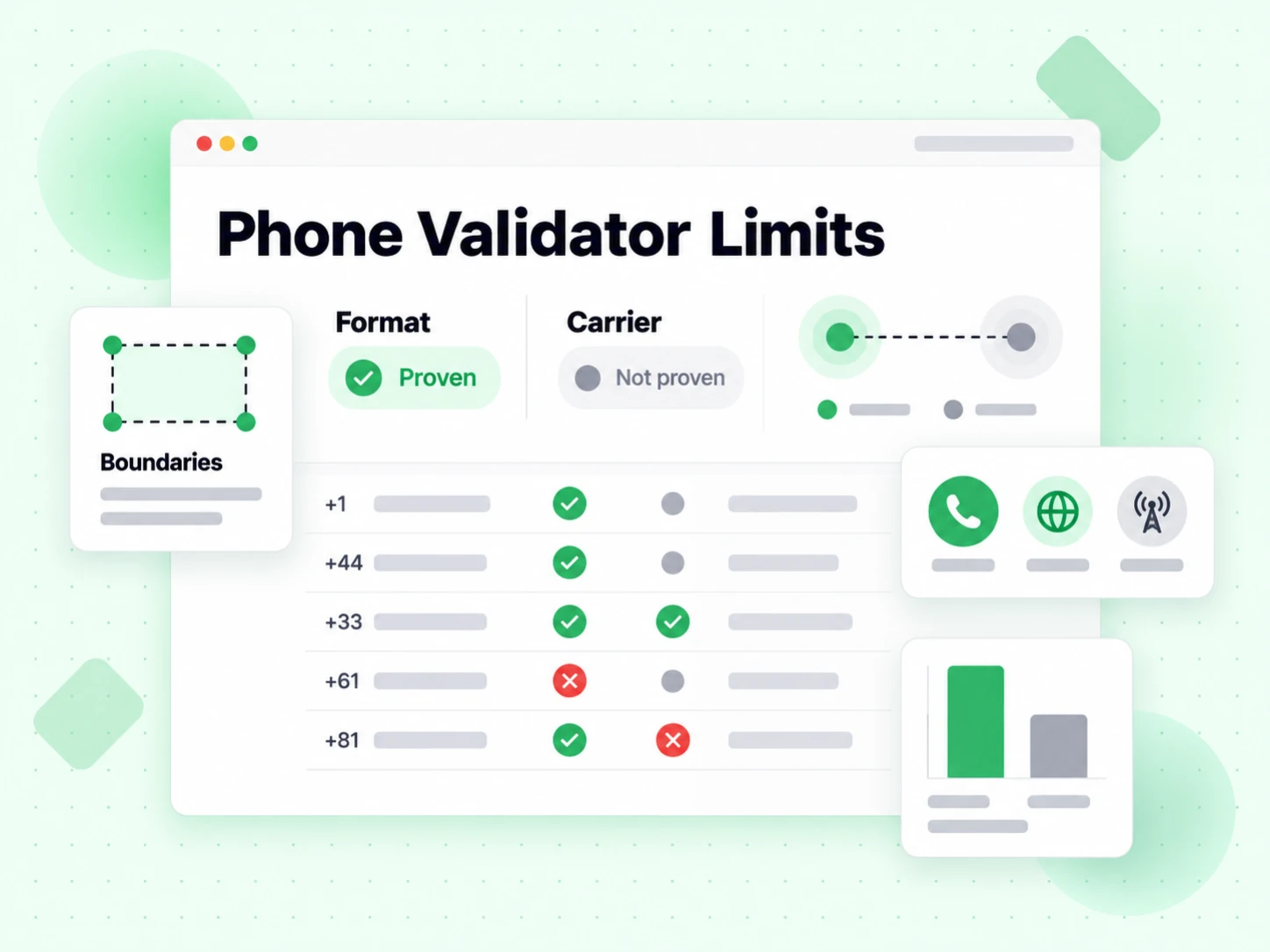
Phone validation is not live-line verification

The free phone number check uses published numbering rules. It does not contact a carrier or prove the line is active, assigned, reachable, or owned by a specific person.

Numbering plan checkLive carrier check
Country and valid lengthCurrent carrier
Assignable number patternAssigned or disconnected
Possible line typePorted line type
E.164 formattingNetwork reachability

Phone validator vs email verification tools

Phone formatting improves one contact field. Use these email tools to check address format, provider type, and mailbox deliverability before outreach.

Phone number validator FAQ

1. What does a phone number validator check?

It parses the country calling code, checks the national number against that country’s numbering plan, identifies a possible number type, and returns E.164, international, and national formats.

2. Does a valid result mean the phone line is active?

No. Valid means the digits match an assignable numbering pattern. It does not prove the number is connected, reachable, or owned by a particular person.

3. Can the validator identify mobile and landline numbers?

Only where the country numbering plan makes that distinction possible. In the United States and Canada, the digits often cannot distinguish mobile from fixed line.

4. What is E.164 phone number format?

E.164 is the international format used to store and exchange phone numbers. It starts with a plus sign and country calling code and contains no formatting punctuation.

5. Do I need to include the country code?

Including the plus sign and country calling code gives the clearest result. For a national-format number, select the country used to interpret it.

AI-First Email Verification

Build AI Workflows on Clean Data

Free tier for autonomous workflows — AI agents verify emails without billing setup. 99.9% SMTP-level accuracy.

Native MCP Server integration · 99.9% SMTP-level accuracy · Free tier, no credit card

99.9%
Accuracy
Real-time
API Speed
$0.00014
Per Email
100/day
Free Forever