



Cold email outreach remains one of the most effective B2B prospecting channels in 2025. When executed correctly, cold emails generate qualified leads at a fraction of the cost of paid advertising. This comprehensive guide covers everything you need to know about building and scaling a successful cold email program—from list building and email verification to crafting compelling messages that get responses.
What Is Cold Email outreach?
Cold email outreach is the practice of sending unsolicited emails to potential customers or business partners who have no prior relationship with your company. Unlike spam, effective cold email is targeted, personalized, and provides genuine value to recipients.
Cold Email vs. Spam: Key Differences
Understanding what separates legitimate cold outreach from spam is crucial for success:
Legitimate Cold Email:
- Targeted to specific, relevant recipients
- Personalized based on research
- Provides clear value proposition
- Includes easy opt-out option
- Sent from a real person/business
- Complies with anti-spam laws (CAN-SPAM, GDPR)
- Uses verified, clean email lists
Spam:
- Mass-sent to purchased, unverified lists
- Generic, one-size-fits-all messaging
- Focuses only on seller's interests
- Hides sender identity
- No opt-out mechanism
- Violates anti-spam regulations
- High bounce and complaint rates
Why Cold Email Still Works in 2025
Despite the rise of social selling and other channels, cold email remains effective for several reasons:
Direct Access: Email reaches decision-makers directly, bypassing gatekeepers that block phone calls.
Scalability: You can reach hundreds or thousands of prospects while maintaining personalization through automation.
Cost-Effectiveness: Compared to paid ads or trade shows, cold email delivers exceptional ROI when done correctly.
Measurability: Every metric—open rates, click rates, replies—can be tracked and optimized.
Timing Control: Unlike social media, you control exactly when your message arrives.
Cold Email Benchmarks for 2025
Before diving into strategy, understand what "good" looks like:
| Metric | Average | Good | Excellent |
|---|---|---|---|
| Open Rate | 20-25% | 30-40% | 45%+ |
| Reply Rate | 1-3% | 5-8% | 10%+ |
| Positive Reply Rate | 0.5-1% | 2-4% | 5%+ |
| Bounce Rate | 5-10% | 2-5% | Under 2% |
| Meeting Booking Rate | 0.5-1% | 2-3% | 5%+ |
These benchmarks vary by industry and target persona. Enterprise outreach typically sees lower reply rates but higher deal values.
Building a High-Quality Prospect List
Your cold email success depends primarily on list quality. The best copy in the world won't save a campaign targeting the wrong people with invalid emails.
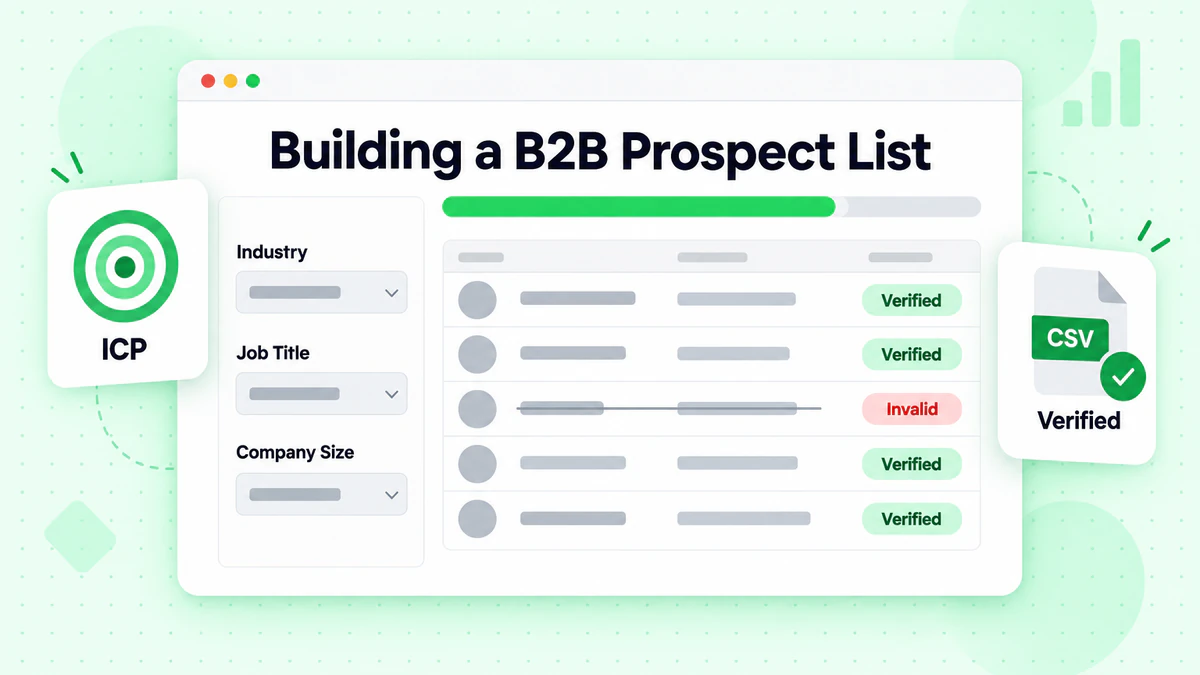
Defining Your Ideal Customer Profile (ICP)
Start by creating a detailed profile of your ideal customer:
Firmographic Criteria:
- Industry/vertical
- Company size (employees, revenue)
- Geography/location
- Technology stack
- Growth stage (startup, scale-up, enterprise)
Persona Criteria:
- Job titles/roles
- Department
- Seniority level
- Responsibilities
- Pain points
Behavioral Signals:
- Recent funding rounds
- Job postings (indicating growth)
- Technology adoption
- Content engagement
- Event attendance
Prospect Research Strategies
LinkedIn Sales Navigator: The primary tool for B2B prospecting. Use advanced filters to find prospects matching your ICP, then export or manually collect contact information.
Key LinkedIn filters to leverage:
- Job title keywords and seniority levels
- Company headcount ranges
- Industry classifications
- Geographic regions
- Years in current role
- Recent job changes (last 90 days)
- Posted content topics
- Group memberships
Company Websites: Check leadership pages, about sections, and press releases for key contacts. Look for:
- Executive team bios with email patterns
- Press releases announcing new hires
- Blog posts with author bylines
- Investor or partner pages
- Career pages indicating growth areas
Industry Events: Conference attendee lists and speaker rosters provide targeted prospects.
- Event sponsor lists
- Speaker lineup and session topics
- Exhibitor directories
- Networking app profiles
- Post-event content and recordings
Competitor Analysis: Who are your competitors' customers? They might be better served by your solution.
- G2/Capterra reviewer profiles
- Case study mentions
- Integration partner lists
- Social media followers and engagers
- Job postings mentioning competitor tools
Intent Data Providers: Tools like Bombora and G2 identify companies actively researching solutions like yours.
- Topic-based intent signals
- Review site activity
- Content consumption patterns
- Competitor comparison searches
- Demo request signals
News and Trigger Events: Monitor for timely outreach opportunities:
- Funding announcements (Crunchbase, TechCrunch)
- Leadership changes (LinkedIn, press releases)
- Expansion news (new office, market entry)
- Product launches
- Regulatory changes affecting their industry
- Mergers and acquisitions
Email Finding and Verification
Once you've identified prospects, you need accurate email addresses. This is where most campaigns fail.
Email Finding Methods:
- Email finder tools (Hunter, Apollo, Snov.io)
- LinkedIn email extraction
- Pattern-based guessing (firstname.lastname@company.com)
- Company website contact forms
- WHOIS lookups for smaller companies
Critical Step: Email Verification
Never skip email verification before launching campaigns. Sending to invalid addresses destroys your sender reputation and deliverability.
Why verification matters:
- Bounce rates above 5% trigger spam filters
- Invalid emails indicate to ISPs that you're not following best practices
- Spam traps (recycled invalid addresses) can blacklist your domain
- Catch-all addresses may accept emails but never deliver them
Use a service like BillionVerify to verify your prospect list before sending. Proper email list hygiene is non-negotiable for cold outreach success.
List Segmentation for Personalization
Don't treat your entire list identically. Segment by:
- Industry vertical
- Company size tier
- Job function/role
- Geographic region
- Pain point/use case
- Referral source
Segmentation enables relevant messaging that dramatically improves response rates.
Crafting Cold Emails That Get Responses
Writing effective cold emails is both art and science. Follow these principles for maximum impact.
The Anatomy of a High-Converting Cold Email
Subject Line (3-7 words):
- Creates curiosity without clickbait
- Personalized when possible
- Tests show lowercase often outperforms title case
Opening Line (1-2 sentences):
- Personalized observation about the prospect
- Shows you've done research
- NOT about you or your company
Value Proposition (2-3 sentences):
- Clear benefit to the recipient
- Specific to their situation
- Backed by proof when possible
Call-to-Action (1 sentence):
- Single, clear ask
- Low commitment
- Easy to respond to
Signature:
- Real name and title
- Company name
- LinkedIn profile (optional)
- Phone number (optional)
Subject Line Strategies
Your subject line determines whether your email gets opened. Here's what works:
Personalization:
- "Quick question about [Company]'s marketing"
- "[Mutual Connection] suggested I reach out"
- "Congrats on [Recent Achievement]"
Curiosity:
- "Thoughts on [Industry Topic]?"
- "Noticed something about [Company]"
- "Quick idea for [Specific Goal]"
Direct Value:
- "[Specific Result] for [Similar Company]"
- "Reducing [Pain Point] at [Company]"
Questions:
- "Struggling with [Common Problem]?"
- "How do you handle [Challenge]?"
For more strategies, see our complete guide on email subject lines.
Opening Lines That Hook
The first line after your subject line must earn the next sentence. Avoid these openers:
❌ "My name is John and I work at..." ❌ "I hope this email finds you well..." ❌ "I'm reaching out because..." ❌ "I wanted to introduce myself..."
Instead, lead with the prospect:
✅ "Saw your post about scaling customer success—the point about proactive outreach resonated." ✅ "Congrats on the Series B! Scaling from 50 to 200 employees is an exciting (and challenging) time." ✅ "[Mutual Connection] mentioned you're rebuilding your outbound process." ✅ "Your recent article on [Topic] got me thinking about [Related Challenge]."
The Value Proposition Framework
Your core message must answer: "What's in it for them?"
Problem-Agitation-Solution (PAS):
- Identify a problem they likely face
- Agitate the consequences
- Present your solution
Before-After-Bridge (BAB):
- Describe their current state (before)
- Paint a picture of the improved state (after)
- Position your solution as the bridge
Feature-Advantage-Benefit (FAB):
- State a feature
- Explain the advantage
- Connect to a specific benefit
AIDA (Attention-Interest-Desire-Action):
- Grab attention with a hook
- Build interest with relevance
- Create desire with benefits/proof
- Prompt action with clear CTA
Example using PAS:
"Most sales teams waste 20+ hours per week on prospects who were never going to buy. (Problem)
That's 1,000+ hours annually that could go toward qualified opportunities. (Agitation)
We've helped teams like [Similar Company] reduce unqualified outreach by 60% by identifying buying signals before the first email goes out. (Solution)"
Example using BAB:
"Right now, your SDR team probably spends half their time researching prospects who never respond. (Before)
Imagine if they could focus exclusively on accounts showing buying intent—prospects actively researching solutions like yours. (After)
Our intent data platform flags these accounts daily, so your team connects with buyers at the perfect moment. (Bridge)"
Example using AIDA:
"Your competitors are booking 3x more meetings from the same outreach volume. (Attention)
The difference? They verify every email address before pressing send, eliminating bounces that tank deliverability. (Interest)
Companies using proper list hygiene see 40% higher inbox placement and 2x reply rates. (Desire)
Worth 15 minutes to see how it works? (Action)"
Call-to-Action Best Practices
Your CTA should be:
Low Commitment: Don't ask for a 30-minute call in your first email. Start with:
- "Worth a conversation?"
- "Would it make sense to explore this?"
- "Open to learning more?"
- "Mind if I send over a quick case study?"
Single Ask: One clear action, not multiple options.
Easy to Respond To: Yes/no questions get more replies than open-ended ones.
Time-Specific When Appropriate: "Do you have 15 minutes this Thursday or Friday?" works once you've built initial interest.
Email Deliverability for Cold Outreach
Your perfectly crafted email is worthless if it lands in spam. Email deliverability is especially challenging for cold outreach because you're emailing people who haven't opted in.
Domain and Infrastructure Setup
Dedicated Domain: Never send cold emails from your main company domain. Use a similar domain (e.g., getcompany.com instead of company.com) to protect your primary domain's reputation.
Domain Warm-Up: New domains need gradual volume increases over 2-4 weeks:
- Week 1: 10-20 emails/day
- Week 2: 30-50 emails/day
- Week 3: 75-100 emails/day
- Week 4: Scale toward target volume
Email Authentication: Configure all three protocols:
- SPF: Specifies which servers can send email for your domain
- DKIM: Cryptographically signs emails to prevent spoofing
- DMARC: Tells receiving servers how to handle authentication failures
Mailbox Provider Selection: Use providers known for deliverability:
Sending Best Practices
Volume Limits: Keep per-mailbox volume under 50-100 emails/day initially. Scale gradually based on engagement.
Sending Windows: Spread sends throughout the day rather than blasting all at once. Mimic human sending patterns.
List Quality: Verify all email addresses before sending. Aim for under 2% bounce rate.
Engagement Signals: ISPs monitor:
- Open rates
- Reply rates
- Spam complaints
- Unsubscribes
Poor engagement signals spam, even for legitimate emails.
Monitoring Deliverability Health
Track These Metrics:
- Inbox placement rate (use tools like GlockApps)
- Bounce rate by type (hard vs. soft)
- Spam complaint rate (aim for under 0.1%)
- Domain/IP blacklist status
Warning Signs:
- Sudden drop in open rates
- Increase in soft bounces
- Gmail/Outlook placing emails in spam
- Blacklist notifications
Recovery Steps if deliverability drops:
- Immediately reduce or pause sending
- Remove bounced and unengaged contacts
- Re-verify your entire list with BillionVerify
- Slowly resume with your most engaged segments
- Monitor closely as you scale back up
For detailed troubleshooting, see our email bounce rate reduction guide.
Follow-Up Sequences That Convert
The first email rarely gets the deal. Most responses come from follow-ups.
Follow-Up Statistics
- 80% of sales require 5+ follow-ups
- 44% of salespeople give up after one follow-up
- Most responses come from emails 2-4
- Diminishing returns typically after email 5-6
Building an Effective Sequence
Email 1 (Day 0): Initial outreach with your core value proposition.
Email 2 (Day 3-4): Add new information or angle. Don't just "bump" the previous email.
Email 3 (Day 7-8): Share a relevant resource—case study, article, or insight.
Email 4 (Day 12-14): Social proof email—mention similar companies you've helped.
Email 5 (Day 18-21): Different approach—try video, different pain point, or new angle.
Email 6 (Day 28-30): Breakup email—politely close the loop and leave door open.
Follow-Up Email Examples
Email 2 - Add Value: "Following up on my note from Tuesday. I came across this article about [relevant topic] and thought of your team's situation.
[Link to helpful resource]
Would love to get your take on whether [specific point] applies to [Company]."
Email 4 - Social Proof: "Wanted to share a quick win: We just helped [Similar Company] reduce their email bounce rate by 40%, which opened up 500+ new qualified conversations monthly.
Given [Company]'s growth trajectory, I wonder if list quality might be limiting your outreach too.
Worth a quick call to explore?"
Email 6 - Breakup: "I've reached out a few times without hearing back, so I'll assume the timing isn't right.
I'll close the loop here, but feel free to reach out if [pain point] becomes a priority.
Wishing you and the [Company] team continued success."
Complete Cold Email Sequence Example
Here's a full 6-email sequence for a SaaS company selling email verification services:
Email 1 - Day 0 (Initial Contact): Subject: Quick question about [Company]'s email program
"Hi [First Name],
Noticed [Company] recently expanded your sales team—congrats on the growth. Scaling outbound usually means more prospects, more emails, and unfortunately, more bounces.
We help sales teams like yours maintain 98%+ deliverability by catching invalid addresses before they damage your sender reputation. [Similar Company] reduced their bounce rate from 8% to under 2% within their first month.
Worth a quick chat to see if this could help [Company]?
Best, [Your Name]"
Email 2 - Day 3 (Add Value): Subject: Re: Quick question about [Company]'s email program
"Hi [First Name],
Following up on my note. I put together a quick analysis of email deliverability benchmarks in [their industry]—thought it might be useful as you scale.
Key finding: Companies verifying lists before sending see 40% higher reply rates than those who don't.
Here's the full breakdown: [Link to resource]
Does improving deliverability rank among your priorities for Q1?
[Your Name]"
Email 3 - Day 7 (Social Proof): Subject: How [Similar Company] 3x'd their meeting rate
"Hi [First Name],
Quick case study I wanted to share: [Similar Company] (similar size and industry to [Company]) was struggling with low reply rates despite solid messaging.
The issue? 12% of their prospect emails were invalid, destroying their sender reputation.
After implementing email verification:
- Bounce rate dropped to 1.8%
- Reply rate increased from 2% to 6%
- Meeting bookings tripled
Happy to show you exactly how they did it—15 minutes?
[Your Name]"
Email 4 - Day 12 (Different Angle): Subject: The hidden cost of bad data
"Hi [First Name],
Did you know the average B2B email list decays 22% per year? That's 22% of your outreach going nowhere—and worse, hurting your ability to reach the other 78%.
ISPs track your bounce rate. High bounces = spam folder for everyone.
It's a quick fix though. We can scan your entire prospect list in minutes and flag every invalid, risky, or catch-all address.
Want to see what a health check would reveal for [Company]?
[Your Name]"
Email 5 - Day 18 (Video/Personal Touch): Subject: Recorded a quick video for you
"Hi [First Name],
I recorded a 2-minute video walking through what I'd focus on if I were managing outbound at [Company]: [Personalized video link]
No pitch—just three actionable deliverability tips based on what I've seen work for similar teams.
Let me know if any of it resonates.
[Your Name]"
Email 6 - Day 25 (Breakup): Subject: Closing the loop
"Hi [First Name],
I've reached out a few times about improving [Company]'s email deliverability but haven't heard back. Totally understand if the timing isn't right or it's not a priority.
I'll assume this isn't relevant for now and won't fill your inbox further.
If deliverability ever becomes a pain point, feel free to reach out. Happy to help whenever.
Best of luck with the continued growth!
[Your Name]"
Sequence Timing and Personalization
Timing Variables to Test:
- Days between emails (shorter for SMB, longer for enterprise)
- Time of day
- Day of week
Personalization at Scale:
- Use custom fields beyond first name
- Reference company-specific details
- Mention relevant triggers (funding, hiring, news)
Personalization at Scale
True personalization—not just mail merge—dramatically improves response rates. Here's how to achieve it efficiently.
Levels of Personalization
Level 1 - Basic (Minimum):
- First name
- Company name
- Industry
Level 2 - Standard:
- Job title/role
- Company size tier
- Geographic reference
Level 3 - Advanced:
- Specific pain point
- Recent company news/trigger
- Content they've published
- Mutual connections
Level 4 - Hyper-Personalized:
- Video mentioning their website
- Detailed analysis of their situation
- Custom resource created for them
Higher personalization levels yield better results but require more time. Match effort to deal size.
Personalization Research Process
For each prospect, spend 2-5 minutes gathering:
- LinkedIn Profile: Recent posts, job changes, shared connections
- Company Website: News, about page, recent blog posts
- Google Search: Recent press, interviews, podcast appearances
- Tech Stack: What tools they use (via BuiltWith, Wappalyzer)
- Social Media: Twitter/X for thought leadership content
Document findings in your CRM for use in follow-ups.
AI-Assisted Personalization
AI tools can help scale personalization:
Research Assistance:
- Summarize prospect's recent content
- Identify relevant company news
- Analyze job descriptions for pain points
Writing Assistance:
- Generate opening line variations
- Customize templates for specific personas
- Optimize subject lines
Quality Control:
- Always review AI-generated content
- Ensure accuracy of any claims
- Maintain authentic voice
For more personalization tactics, see our email personalization strategies guide.
Measuring and Optimizing Performance
Data-driven optimization separates top performers from average results.
Key Metrics to Track
Volume Metrics:
- Emails sent
- Emails delivered (sent minus bounces)
- Unique prospects contacted
Engagement Metrics:
- Open rate (% who opened)
- Click rate (% who clicked links)
- Reply rate (% who responded)
- Positive reply rate (% with interest)
Outcome Metrics:
- Meetings booked
- Opportunities created
- Pipeline generated
- Deals closed
- Revenue attributed
Attribution and Tracking
UTM Parameters: Track website visits from email links.
CRM Integration: Log all activities and responses.
Sequence Analytics: Identify which emails in your sequence perform best.
A/B Testing: Systematically test variables:
- Subject lines
- Opening lines
- Value propositions
- CTAs
- Send times
Optimization Framework
Weekly Review:
- Check sequence performance
- Identify underperforming emails
- Review reply quality (positive vs. negative)
- Update prospect lists
Monthly Optimization:
- A/B test results analysis
- Sequence structure adjustments
- ICP refinement based on response patterns
- Deliverability audit
Quarterly Strategy:
- Overall channel performance review
- Competitive analysis
- Message and positioning refresh
- Goal setting and forecasting
Tools and Technology Stack
Building an effective cold email operation requires the right tools.
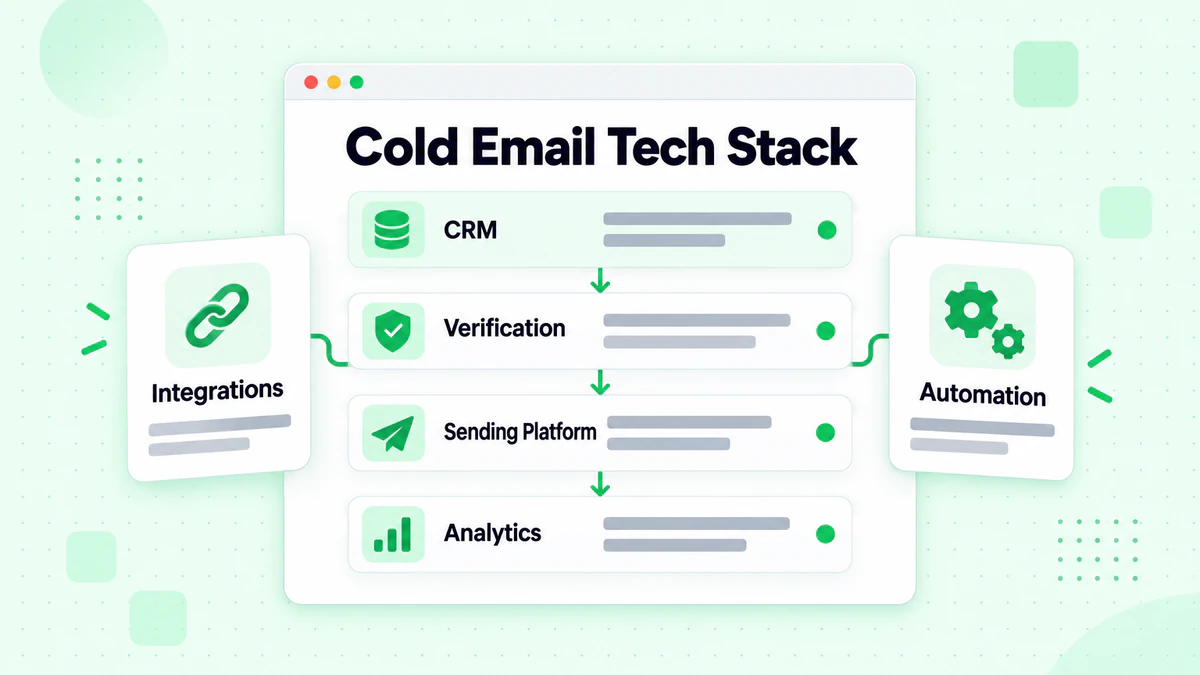
Essential Tool Categories
CRM: Salesforce, HubSpot, Pipedrive
- Central prospect database
- Activity logging
- Pipeline management
Email Finder: Apollo, Hunter, Snov.io
- Find prospect email addresses
- Company contact databases
- Chrome extensions for LinkedIn
Email Verification: BillionVerify
- Verify addresses before sending
- Reduce bounce rates
- Identify risky addresses
- Protect sender reputation
Outreach Platform: Instantly, Smartlead, Lemlist
- Sequence automation
- A/B testing
- Analytics and reporting
- Inbox rotation
Deliverability Tools: GlockApps, MXToolbox
- Inbox placement testing
- Blacklist monitoring
- Authentication checking
Integration Considerations
Your tools should connect seamlessly:
- Prospects flow from research to CRM
- Verified emails sync to outreach platform
- Engagement data returns to CRM
- Meeting bookings trigger notifications
Budget Allocation Guidelines
Starter Stack ($200-500/month):
- Basic CRM (HubSpot free or Pipedrive)
- Email finder with verification (Apollo)
- Outreach tool (Instantly or Smartlead)
Growth Stack ($500-1,500/month):
- Professional CRM
- Multiple data sources
- Dedicated verification service
- Advanced outreach platform
- Deliverability monitoring
Enterprise Stack ($1,500+/month):
- Full CRM suite
- Intent data providers
- AI personalization tools
- Multi-channel sequencing
- Dedicated deliverability infrastructure
Legal Compliance and Ethics
Cold email must comply with anti-spam regulations. Non-compliance risks fines and domain blacklisting.
CAN-SPAM Act (United States)
Requirements:
- Accurate "From" and "Reply-To" information
- Non-deceptive subject lines
- Physical postal address included
- Clear opt-out mechanism
- Honor opt-outs within 10 business days
- Monitor third-party email sent on your behalf
Penalties: Up to $46,517 per violation.
GDPR (European Union)
Key Provisions for Cold Email:
- Legitimate interest may justify B2B cold email
- Must demonstrate genuine interest in recipient
- Document your legitimate interest assessment
- Easy opt-out required
- Data subject rights must be honored
Note: GDPR is stricter than CAN-SPAM. When in doubt, prioritize GDPR compliance.
CASL (Canada)
Canada's Anti-Spam Legislation requires either:
- Express consent (explicit opt-in), OR
- Implied consent through existing business relationship
Cold email to Canadians without prior relationship is generally prohibited.
Ethical Best Practices
Beyond legal compliance:
- Respect opt-outs immediately
- Don't email the same person from multiple accounts
- Be transparent about who you are
- Provide genuine value, not just pitches
- Clean your lists regularly with proper email verification
For more on compliance, see our email compliance guide.
Common Mistakes and How to Avoid Them
Learn from others' failures to accelerate your success.
List Quality Mistakes
❌ Buying cheap lists: Purchased lists are full of invalid addresses and spam traps. ✅ Build targeted lists: Research and verify each contact.
❌ Skipping verification: Sending to unverified lists destroys deliverability. ✅ Verify everything: Use BillionVerify before every campaign.
❌ Using old data: Email addresses decay at 20-30% annually. ✅ Regular cleaning: Clean your email list quarterly.
Messaging Mistakes
❌ Generic templates: Mass-sent templates get ignored. ✅ Personalize meaningfully: Reference specific, relevant details.
❌ Feature dumping: Listing features doesn't compel action. ✅ Lead with benefits: Focus on outcomes they care about.
❌ Long emails: Nobody reads 500+ word cold emails. ✅ Keep it brief: 50-125 words perform best.
Technical Mistakes
❌ Using main domain: Damages your primary domain reputation. ✅ Dedicated domain: Protect your brand with separate outreach domains.
❌ No warm-up: Sending high volume immediately triggers spam filters. ✅ Gradual ramp: Warm domains properly over 2-4 weeks.
❌ Ignoring authentication: Missing SPF/DKIM/DMARC hurts deliverability. ✅ Full authentication: Configure all protocols before sending.
Process Mistakes
❌ Inconsistent follow-up: Sporadic follow-ups miss opportunities. ✅ Systematic sequences: Automated, consistent follow-up cadence.
❌ No measurement: Flying blind prevents improvement. ✅ Track everything: Measure, analyze, and optimize continuously.
❌ Set and forget: Markets and messaging need regular refresh. ✅ Iterate constantly: Test, learn, and improve weekly.
Industry-Specific Cold Email Strategies
Different industries require tailored approaches. Here's how to adapt your cold email strategy for key verticals.
SaaS and Technology
Target Personas: CTOs, VPs of Engineering, Product Managers, IT Directors
Key Pain Points:
- Integration complexity
- Technical debt
- Security and compliance
- Development velocity
- Cost optimization
Effective Angles:
- Technical credibility (reference their tech stack)
- Case studies with similar companies
- Free trial or demo offers
- API and integration capabilities
- ROI and efficiency metrics
Sample Opening: "Noticed you're using [Tech Tool]—we've helped 50+ companies using the same stack reduce [specific metric] by 40%."
Financial Services
Target Personas: CFOs, Finance Directors, Controllers, Treasury Managers
Key Pain Points:
- Regulatory compliance
- Risk management
- Process efficiency
- Data accuracy
- Cost reduction
Effective Angles:
- Compliance and security certifications
- Audit trail and reporting
- Process automation benefits
- Risk reduction metrics
- References from regulated industries
Sample Opening: "Given [Bank]'s expansion into [new market], I imagine regulatory compliance is top of mind. We've helped similar institutions streamline [specific process] while maintaining SOX compliance."
Healthcare
Target Personas: Healthcare IT Directors, Practice Managers, Revenue Cycle Managers
Key Pain Points:
- HIPAA compliance
- EHR integration
- Patient communication
- Billing efficiency
- Staff shortage
Effective Angles:
- HIPAA-compliant solutions
- Integration with major EHR systems
- Patient outcomes improvement
- Revenue cycle optimization
- Time savings for clinical staff
Sample Opening: "With [Health System]'s recent expansion, maintaining HIPAA-compliant communication across 200+ providers must be challenging. We've helped similar organizations [specific outcome]."
For more healthcare-specific strategies, see our healthcare email marketing guide.
Professional Services
Target Personas: Managing Partners, Business Development Directors, Marketing Partners
Key Pain Points:
- Lead generation
- Client retention
- Utilization rates
- Competitive differentiation
- Revenue per partner
Effective Angles:
- Client acquisition case studies
- Efficiency and productivity gains
- Competitive intelligence
- Brand positioning
- Revenue growth metrics
Sample Opening: "I've been following [Law Firm]'s recent wins in [practice area]. Many firms in your position struggle to maintain momentum—curious if that's a priority for your team right now."
Scaling Your Cold Email Program
Once you've proven your approach works, scale systematically.
When to Scale
Scale only after achieving:
- Consistent positive reply rates (3%+ for most B2B)
- Healthy deliverability (under 2% bounce, no blacklisting)
- Predictable meeting booking rates
- Positive ROI on current volume
- Documented playbooks and templates
- Reliable data sources and verification processes
Scaling Strategies
Add Mailboxes: Multiple sending accounts increase capacity while protecting deliverability.
- Aim for 50-100 emails per mailbox per day
- Use inbox rotation tools to distribute sends
- Warm each new mailbox properly before use
- Monitor per-mailbox deliverability metrics
Expand TAM: Target new industries, geographies, or company sizes.
- Test new segments with small batches first
- Adapt messaging for each new segment
- Track performance by segment to identify winners
- Double down on high-performing segments
Add Team Members: Hire SDRs to manage increased volume.
- Create comprehensive onboarding documentation
- Establish quality standards and review processes
- Implement peer learning and coaching
- Track individual performance metrics
Outsource Research: Virtual assistants can handle prospect research while you focus on strategy.
- Create detailed research SOPs
- Use quality scoring rubrics
- Build verification checkpoints
- Regularly audit outsourced work
Automate More: Reduce manual work through better integrations and workflows.
- CRM automation for follow-up tasks
- Auto-enrichment of prospect data
- Automated verification before campaigns
- Slack notifications for high-value replies
Maintaining Quality at Scale
As volume increases, protect quality:
Regular List Audits: Weekly verification of new prospects using BillionVerify.
Response Monitoring: Track reply sentiment, not just volume. Negative replies signal targeting or messaging issues.
Deliverability Checks: Monitor inbox placement across Gmail, Outlook, and corporate domains.
Template Refresh: Update messaging quarterly to prevent fatigue and reflect market changes.
Training: Keep team aligned on best practices and compliance requirements.
Quality Scorecards: Rate each campaign on list quality, personalization depth, and engagement metrics.
Cold Email Metrics Glossary
Understanding these metrics is essential for measuring and improving your campaigns:
Delivery Metrics:
- Sent: Total emails dispatched from your system
- Delivered: Emails accepted by recipient servers (sent minus bounces)
- Delivery Rate: (Delivered ÷ Sent) × 100
- Hard Bounce: Permanent delivery failure (invalid address)
- Soft Bounce: Temporary delivery failure (full inbox, server down)
Engagement Metrics:
- Open Rate: (Unique opens ÷ Delivered) × 100
- Click Rate: (Unique clicks ÷ Delivered) × 100
- Click-to-Open Rate (CTOR): (Unique clicks ÷ Unique opens) × 100
- Reply Rate: (Replies ÷ Delivered) × 100
- Positive Reply Rate: (Interested replies ÷ Delivered) × 100
Outcome Metrics:
- Meeting Rate: (Meetings booked ÷ Delivered) × 100
- Opportunity Rate: (Opportunities created ÷ Delivered) × 100
- Cost per Meeting: Total campaign cost ÷ Meetings booked
- Pipeline Generated: Total value of opportunities created
- ROI: (Revenue attributed - Campaign cost) ÷ Campaign cost
Health Metrics:
- Spam Complaint Rate: (Complaints ÷ Delivered) × 100 (aim for under 0.1%)
- Unsubscribe Rate: (Unsubscribes ÷ Delivered) × 100
- List Decay Rate: Percentage of addresses becoming invalid per year
Conclusion: Building a Sustainable Cold Email Engine
Cold email outreach remains one of the most effective B2B growth channels when executed properly. Success requires:
- Quality over quantity: Better lists and more personalization beat higher volume
- Deliverability vigilance: Protect your sender reputation with verified email lists and proper infrastructure
- Systematic execution: Consistent processes and follow-up drive results
- Continuous optimization: Measure everything and improve constantly
- Compliance commitment: Stay within legal and ethical boundaries
Start with a small, highly targeted list. Perfect your messaging. Verify every email address. Build gradually rather than blasting thousands of prospects immediately.
The companies seeing 10%+ reply rates aren't using magic—they're executing fundamentals exceptionally well. Focus on list quality, genuine personalization, and deliverability hygiene, and you'll outperform the vast majority of cold outreach programs.
Key Takeaways:
- Invest heavily in list quality and verification before sending
- Personalize beyond first name—reference specific, relevant details
- Build systematic follow-up sequences (5-6 touches minimum)
- Monitor deliverability metrics and act quickly on warning signs
- Test continuously and document what works for your audience
- Stay compliant with CAN-SPAM, GDPR, and other regulations
The difference between mediocre and exceptional cold email performance often comes down to the fundamentals: clean lists, relevant messaging, and consistent execution. Master these basics before adding complexity, and you'll build a sustainable pipeline engine that scales with your business.
Ready to improve your cold email deliverability? Start by verifying your prospect list to ensure every email reaches its intended recipient.