



This is Part 2 of a 4-part series on the 2025 Email Deliverability Report. Part 1: Global Landscape & AI Revolution | Part 3: Case Studies & AI SDR Analysis | Part 4: Industry Guides & Quick Reference
Part IV: Email Verification in the AI Era
Chapter 12: Why Email Verification Has Never Been More Critical
The convergence of AI-generated spam, stricter authentication requirements, and declining deliverability has elevated email verification from nice-to-have to essential infrastructure.
The Business Case for Email Verification
Cost of Invalid Addresses
Each invalid email address costs businesses $15-20 annually through:
- Wasted sending costs
- Reputation damage from bounces
- Reduced campaign performance from degraded deliverability
- Opportunity cost of messages never received
For a list of 100,000 emails with 28% annual decay, unverified lists cost $420,000-560,000 annually in direct and indirect costs.
ROI of Verification
Email verification delivers measurable returns:
- 300%+ improvement in campaign ROI with clean lists
- 98% deliverability rates for verified lists vs. 83% average
- 50%+ reduction in customer acquisition cost
- Significant improvement in sender reputation scores
The Market Response
The email verification market has responded to increased demand:
Market Size Growth:
- 2024: $650 million
- 2025: $720 million (10.8% growth)
- 2033 projection: $3.5 billion
Growth Drivers:
- Proliferation of email marketing
- Stricter privacy regulations
- Increased cybersecurity concerns
- Digital transformation initiatives
- AI-generated email volume explosion
Cloud Solution Adoption: 65% of email marketers have adopted cloud-based email verification tools, up from 41% in 2022.
Chapter 13: Email Verification Methods and Technology
Modern email verification employs sophisticated multi-layer validation to achieve maximum accuracy.
The Verification Stack
Layer 1: Syntax Validation
- RFC 5322 compliance checking
- Character validation
- Structure verification
- Format standardization
Layer 2: Domain Validation
- DNS existence verification
- MX record confirmation
- Domain reputation checking
- Typo domain identification
Layer 3: Mailbox Verification
- SMTP handshake
- RCPT TO command verification
- Server response analysis
- Connection quality assessment
Layer 4: Advanced Detection
Catch-All Detection: Identifying domains that accept all addresses requires sophisticated testing:
- Random address testing
- Pattern analysis
- Machine learning classification
- Historical behavior analysis
Learn more about this challenge in our catch-all email detection guide.
Disposable Email Detection: Temporary email addresses pose unique challenges:
- Database of known disposable domains (10,000+)
- Pattern recognition for disposable address formats
- Real-time disposable domain identification
- Behavioral indicators
Our disposable email detection capabilities address these challenges comprehensively.
Role Account Detection: Generic addresses like info@, sales@, support@ require special handling:
- Pattern matching for common role prefixes
- Organizational email structure analysis
- Deliverability risk scoring
Spam Trap Identification:
- Known spam trap database checking
- Behavioral pattern analysis
- Source reputation assessment
- Historical bounce correlation
Verification Accuracy and Speed
Modern verification services balance accuracy and speed:
| Metric | Industry Average | Top Tier |
|---|---|---|
| Accuracy | 95-97% | 99%+ |
| Speed (single) | 500ms-2s | <200ms |
| Bulk throughput | 10,000/hour | 100,000+/hour |
| API uptime | 99.5% | 99.99% |
BillionVerify achieves 99.9% accuracy with verification speeds under 200ms through optimized infrastructure and intelligent caching. Explore our email validation API for technical details.
Chapter 14: Implementing Email Verification
Effective email verification requires strategic implementation across the email lifecycle.
Point-of-Capture Verification
Real-time verification at the point of email capture prevents invalid addresses from entering your database:
Implementation Options:
JavaScript Widget:
// Real-time verification on form submission
document.getElementById('email-form').addEventListener('submit', async (e) => {
  e.preventDefault();
  const email = document.getElementById('email').value;

  const result = await fetch('https://api.billionverify.com/v1/verify', {
    method: 'POST',
    headers: {
      'Authorization': 'Bearer YOUR_API_KEY',
      'Content-Type': 'application/json'
    },
    body: JSON.stringify({ email })
  });

  const data = await result.json();

  if (data.deliverability === 'deliverable') {
    // Proceed with form submission
  } else {
    // Show error and request correction
  }
});
Server-Side Validation:
import requests

def verify_email(email):
    response = requests.post(
        'https://api.billionverify.com/v1/verify',
        headers={
            'Authorization': 'Bearer YOUR_API_KEY',
            'Content-Type': 'application/json'
        },
        json={'email': email}
    )
    return response.json()
Bulk List Verification
Regular bulk verification maintains list hygiene:
Recommended Frequency:
- Monthly for high-volume senders
- Quarterly for moderate volume
- Before any major campaign
- When importing new lists
- After list dormancy periods
Process:
- Export list from ESP or CRM
- Upload to verification service
- Review results and categorization
- Remove or suppress invalid addresses
- Re-import clean list
- Monitor deliverability metrics
Our bulk email verification service processes lists of any size with comprehensive reporting.
Integration Strategies
ESP Integration: Direct integration with email service providers enables automatic verification:
- Pre-send verification
- Automatic suppression of invalid addresses
- Real-time list health monitoring
- Bounce prevention
CRM Integration: Verify emails as they enter your CRM:
- Form submission verification
- Import verification
- Ongoing data quality monitoring
- Lead scoring adjustment based on email quality
Marketing Automation: Integrate verification into automation workflows:
- Verification before nurture sequence enrollment
- Quality-based segmentation
- Deliverability risk scoring
Chapter 15: The Disposable Email Challenge
Disposable email addresses represent a unique challenge in 2025, with the market reaching $1.36 billion and growing at 11.7% annually.
Understanding Disposable Emails
Disposable email services provide temporary addresses that:
- Expire after a set time period
- Receive emails but discourage long-term engagement
- Protect user privacy but harm sender lists
- Often indicate low purchase intent
Scale of the Problem
- 10,000+ known disposable email domains
- New disposable services launch weekly
- Sophisticated disposable services now offer persistent-appearing addresses
- Some disposable services explicitly target business verification systems
Detection Approaches
Domain Database: Maintaining current databases of disposable domains:
- Regular updates required (daily minimum)
- New service identification
- Regional and language-specific services
- Private/enterprise disposable services
Pattern Recognition: Identifying disposable address patterns:
- Random string usernames
- Sequential numbering patterns
- Known disposable service patterns
- Behavioral indicators
Machine Learning: Advanced detection using:
- Address generation pattern analysis
- Domain age and history
- Registration pattern correlation
- User behavior prediction
Business Impact
Disposable emails affect businesses through:
- Artificially inflated list sizes
- Degraded engagement metrics
- Wasted free trial or incentive costs
- Skewed marketing analytics
- Potential fraud facilitation
Implementing disposable email detection protects your business from these impacts.
Part V: Email Infrastructure and Operations
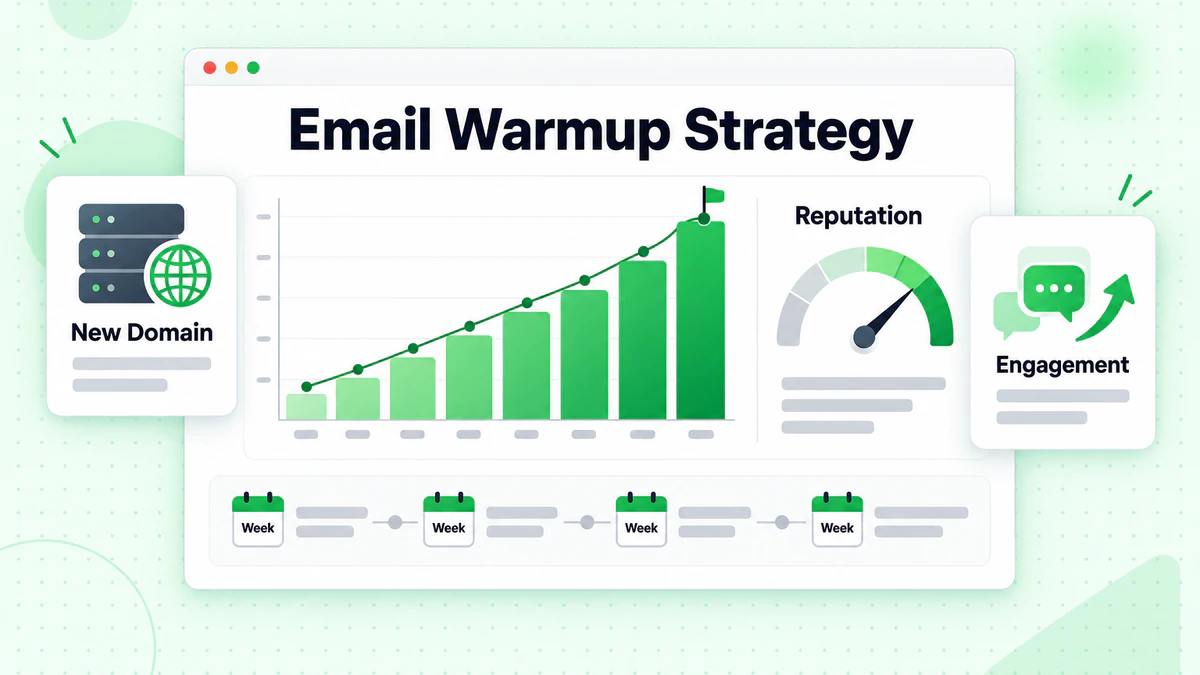
Chapter 16: Email Warmup Strategies
Email warmup has become essential for new domains, new IP addresses, and reputation recovery. The warmup service market has matured significantly.
Understanding Email Warmup
Email warmup is the process of gradually increasing sending volume while generating positive engagement signals to build sender reputation.
Why Warmup Matters:
- New domains have no reputation (neutral treated as suspicious)
- Sudden volume increases trigger spam filtering
- Engagement signals require time to establish
- ISPs observe sending patterns over weeks/months
Warmup Timeline Expectations
| Starting Point | Time to Full Volume |
|---|---|
| Brand new domain | 4-8 weeks |
| New IP on aged domain | 2-4 weeks |
| Reputation recovery | 4-12 weeks |
| Volume increase | 1-2 weeks |
Warmup Service Comparison
- Approach: Aggressive ramp-up, all-in-one cold email platform
- Best for: Solo operators wanting integrated solution
- Warmup method: Network of engaged mailboxes
- Consideration: Fast ramp-up can trigger some providers
Mailreach
- Approach: Adaptive warmup with detailed analytics
- Best for: Teams needing granular control and visibility
- Network: 20,000+ real human inboxes
- Pricing: $25/account (1-5), $19.50/account (6+)
- Strength: ESP-specific analytics, real-time adaptation
Lemwarm
- Approach: Slow, methodical 3-4 week warmup
- Best for: New domains or high-risk situations
- Performance: 90% inbox rate in 10-14 days (aged), 14-18 days (new)
- Consideration: Less flexibility for faster scaling
WarmupInbox
- Approach: Smart warmup with AI optimization
- Best for: Balancing speed and safety
- Network: Diverse inbox network
- Differentiation: AI-driven volume pacing
DIY Warmup Strategy
For organizations preferring manual warmup:
Week 1-2:
- Send 10-20 emails daily to engaged contacts
- Focus on contacts likely to open and reply
- Monitor inbox placement closely
Week 3-4:
- Increase to 50-100 emails daily
- Expand to moderately engaged contacts
- Begin A/B testing subject lines
Week 5-8:
- Scale to target volume gradually (25% weekly increase max)
- Monitor deliverability metrics continuously
- Adjust pace based on results
Ongoing:
- Maintain consistent sending patterns
- Avoid dramatic volume fluctuations
- Monitor reputation continuously
Chapter 17: Transactional Email Best Practices
Transactional emails require different deliverability strategies than marketing messages.
Transactional vs. Marketing Email
| Aspect | Transactional | Marketing |
|---|---|---|
| Purpose | Service delivery | Promotion |
| Volume pattern | Triggered, variable | Scheduled, predictable |
| Engagement | High (expected) | Variable |
| Regulatory status | Often exempt from consent requirements | Requires consent |
| Deliverability priority | Critical | Important |
Transactional Email Deliverability 2025
Top transactional email providers by deliverability:
Postmark: 99.1% inbox placement
- Focus: Deliverability-first approach
- Strength: Strict acceptable use policy maintains shared reputation
- Consideration: Higher cost, limited marketing features
Amazon SES: 97.2% (properly configured)
- Focus: Infrastructure and scalability
- Strength: Cost-effective at scale
- Consideration: Requires more deliverability expertise
SendGrid: 96.8% (dedicated IP)
- Focus: Full-featured email platform
- Strength: Marketing and transactional in one platform
- Consideration: Shared IP performance varies
Mailgun: 94.5%
- Focus: Developer-friendly API
- Strength: Excellent documentation and tooling
- Consideration: Recent deliverability fluctuations
For detailed guidance, see our transactional emails guide.
Critical Transactional Email Practices
Separate Infrastructure:
- Use different sending domains for transactional vs. marketing
- Maintain dedicated IP addresses for transactional
- Never mix promotional content in transactional messages
Priority Routing:
- Implement fallback providers for critical messages
- Use multiple sending paths for redundancy
- Monitor delivery latency, not just deliverability
Authentication Excellence:
- Implement full authentication suite
- Consider BIMI for brand recognition
- Monitor authentication failures actively
Chapter 18: Email Security and Compliance
Email security and compliance requirements continue to evolve, with significant implications for deliverability.
BEC and Phishing Statistics 2025
Business Email Compromise and phishing remain critical threats:
- $2.77 billion: BEC losses in 2024
- 82.6%: Phishing emails containing AI-generated content
- 4.5x: Increased click rate on AI-generated phishing vs. human-written
- 300%+: Increase in credential phishing targeting business email
These threats drive mailbox provider filtering aggression, affecting legitimate sender deliverability.
Compliance Requirements by Region
GDPR (EU/EEA):
- Explicit consent required for marketing email
- Right to erasure affects list management
- Data processing agreements required with ESPs
- Breach notification within 72 hours
CAN-SPAM (United States):
- Accurate header information required
- Clear identification as advertisement
- Physical postal address required
- Opt-out mechanism required (10 business days)
- No consent required (opt-out model)
CASL (Canada):
- Express or implied consent required
- Sender identification required
- Unsubscribe mechanism required
- Record keeping of consent required
LGPD (Brazil):
- Consent or legitimate interest basis required
- Data subject rights similar to GDPR
- Data protection officer requirements
- Cross-border transfer restrictions
For comprehensive compliance guidance, see our email compliance guide.
Security Best Practices
For Senders:
- Implement full authentication (SPF, DKIM, DMARC)
- Progress DMARC to p=reject
- Consider BIMI for brand protection
- Monitor for domain spoofing
- Implement MFA for email platform access
- Regular security audits of email infrastructure
For Recipients (organizational training):
- Verify sender authenticity before action
- Hover over links before clicking
- Question unexpected requests for information
- Report suspicious emails promptly
- Use email security tools (Safe Links, etc.)
Part VI: Strategic Recommendations
Chapter 19: Building a 2025 Deliverability Strategy
Based on the research and data presented in this report, organizations should implement comprehensive deliverability strategies.
Foundation: Authentication Excellence
Immediate Actions:
- Audit current SPF, DKIM, DMARC implementation
- Ensure all sending sources are authenticated
- Implement DMARC monitoring (p=none with reporting)
- Plan progression to DMARC enforcement (p=reject)
Timeline: Complete within 30 days
Resources: Our email deliverability guide provides implementation details.
Phase 1: List Quality (Days 1-60)
Actions:
- Implement real-time verification on all capture points
- Conduct full list verification
- Establish list hygiene processes
- Set up bounce and complaint monitoring
- Implement suppression list management
Expected Outcomes:
- Bounce rates below 2%
- Complaint rates below 0.1%
- Deliverability improvement of 10-15%
Comprehensive verification through our email verification service enables these improvements.
Phase 2: Reputation Building (Days 30-90)
Actions:
- Implement engagement-based segmentation
- Deploy re-engagement campaigns for dormant contacts
- Sunset chronically unengaged addresses
- Optimize sending frequency and timing
- Implement preference centers
Expected Outcomes:
- Open rates improvement of 15-25%
- Click rates improvement of 20-30%
- Spam complaint reduction of 50%+
See our email reengagement strategies for tactical guidance.
Phase 3: Advanced Optimization (Days 60-120)
Actions:
- Implement AI-powered send time optimization
- Deploy advanced personalization
- Conduct inbox placement testing
- Implement feedback loop monitoring
- Consider BIMI implementation
Expected Outcomes:
- Inbox placement rates of 95%+
- Campaign ROI improvement of 50%+
- Brand recognition and trust improvement
Phase 4: Continuous Improvement (Ongoing)
Actions:
- Monthly deliverability audits
- Quarterly strategy reviews
- Continuous testing and optimization
- Technology evaluation and updates
- Team training and skill development
Our email marketing audit checklist provides a framework for ongoing assessment.
Chapter 20: Navigating AI in Email
Organizations must develop clear strategies for AI integration while managing associated risks.
AI Adoption Framework
Assessment Questions:
- What email tasks are candidates for AI automation?
- What is our risk tolerance for AI-generated content?
- How will we maintain brand voice and quality?
- What human oversight will we maintain?
- How will we measure AI effectiveness?
Implementation Priorities:
High Value, Low Risk:
- Send time optimization
- Subject line testing
- Personalization at scale
- Engagement prediction
- Deliverability monitoring
High Value, Moderate Risk:
- Content generation with human review
- Automated segmentation
- Response handling
- Campaign optimization
High Value, Higher Risk:
- Fully automated AI SDR deployment
- Autonomous content generation
- AI-driven list acquisition
- Automated response without review
AI SDR Implementation Guide
For organizations deploying AI SDRs:
Pre-Launch:
- Establish separate sending domain
- Complete warmup process (4-8 weeks)
- Define ideal customer profiles precisely
- Create approved messaging frameworks
- Establish human oversight processes
Launch:
- Start with 50-100 emails daily maximum
- Monitor deliverability metrics daily
- Review AI-generated content sampling
- Adjust targeting based on early results
- Scale gradually (25% weekly maximum)
Optimization:
- A/B test messaging variations
- Analyze response patterns
- Refine targeting based on conversion data
- Adjust personalization approaches
- Balance volume with quality
Risk Management:
- Monitor for deliverability degradation
- Maintain compliance with all regulations
- Ensure unsubscribe handling
- Protect brand reputation
- Plan for AI failure scenarios
Chapter 21: Measuring Success
Effective deliverability management requires comprehensive measurement.
Key Performance Indicators
Deliverability Metrics:
- Inbox placement rate (target: 95%+)
- Spam folder rate (target: <5%)
- Hard bounce rate (target: <2%)
- Soft bounce rate (target: <5%)
- Blocklist appearances (target: 0)
Engagement Metrics:
- Open rate (benchmark: 24% average)
- Click rate (benchmark: 2.5% average)
- Click-to-open rate (benchmark: 10%+)
- Unsubscribe rate (target: <0.5%)
- Spam complaint rate (target: <0.1%)
Business Metrics:
- Email-attributed revenue
- Cost per email sent
- Cost per email delivered
- Email ROI
- Customer lifetime value impact
For comprehensive analytics guidance, see our email analytics reporting guide.
Monitoring Tools and Dashboards
Essential Monitoring:
- Google Postmaster Tools (Gmail reputation and delivery)
- Microsoft SNDS (Microsoft domain performance)
- ESP native analytics (platform-specific metrics)
- Seed list testing (inbox placement verification)
Advanced Monitoring:
- Multi-provider inbox placement testing
- Real-time blocklist monitoring
- Authentication failure alerts
- Engagement trend analysis
- Competitive benchmarking
Reporting Framework
Daily Monitoring:
- Bounce rates
- Complaint rates
- Authentication failures
- Blocklist status
Weekly Analysis:
- Engagement trends
- Inbox placement estimates
- Campaign performance
- List growth/decay
Monthly Review:
- Deliverability audit
- Strategy assessment
- Technology evaluation
- Team training needs
Quarterly Planning:
- Strategy updates
- Budget allocation
- Technology roadmap
- Goal setting
Part VII: Industry Outlook
Chapter 22: Predictions for 2025-2026
Based on current trends and expert analysis, we project the following developments.
Authentication Evolution
2025-2026 Predictions:
- DMARC at enforcement (p=quarantine or p=reject) will become de facto required
- BIMI adoption will accelerate as VMC costs decrease
- Additional providers will mandate bulk sender requirements
- Authentication-as-a-service offerings will proliferate
Probability Assessment: High confidence (85%+)
AI Integration Acceleration
2025-2026 Predictions:
- 75% of sales organizations will use AI-guided selling (per Salesforce projection)
- AI SDR market will grow 3-4x
- AI-generated email detection will improve significantly
- Balance between AI efficiency and deliverability will emerge
Probability Assessment: High confidence (80%+)
Deliverability Standards Tightening
2025-2026 Predictions:
- Global average inbox placement will stabilize at 82-85%
- Top performers will achieve 97-99% inbox placement
- Gap between best and worst performers will widen
- Regional deliverability differences will persist
Probability Assessment: Moderate confidence (70%+)
Privacy and Regulation
2025-2026 Predictions:
- Additional privacy regulations globally
- Increased enforcement of existing regulations
- Privacy-preserving email marketing techniques will evolve
- Consent management complexity will increase
Probability Assessment: High confidence (80%+)
Chapter 23: Emerging Technologies
Several emerging technologies will impact email deliverability in the coming years.
Advanced AI Detection
Mailbox providers are developing sophisticated AI detection:
- Language model fingerprinting
- Behavioral pattern analysis
- Cross-reference checking
- Generation style identification
This will increase filtering of AI-generated spam while potentially affecting legitimate AI-assisted email.
Blockchain Email Authentication
Experimental blockchain-based authentication offers:
- Immutable sender verification
- Decentralized reputation systems
- Smart contract-based consent management
- Transparent delivery tracking
Current status: Experimental, limited production deployment
Privacy-Preserving Technologies
Emerging privacy technologies affect email:
- Apple Mail Privacy Protection expansion
- Proxy-based email opening
- Content pre-fetching
- Metric reliability challenges
These technologies require adaptation in measurement approaches.
Quantum-Resistant Authentication
Future-proofing authentication for quantum computing:
- Post-quantum cryptographic algorithms
- Updated DKIM key standards
- New signature schemes
- Migration planning requirements
Timeline: Planning should begin now; implementation 2027-2030
Chapter 24: Preparing for the Future
Organizations should take specific actions to prepare for email's evolution.
Strategic Investments
Technology:
- Email verification infrastructure
- Authentication management
- AI integration capabilities
- Analytics and monitoring
- Security systems
People:
- Deliverability expertise
- AI and automation skills
- Data analysis capabilities
- Compliance knowledge
- Strategic planning
Process:
- List management procedures
- Campaign optimization frameworks
- Compliance monitoring
- Incident response
- Continuous improvement
Building Organizational Capability
Training Priorities:
- Authentication implementation and management
- Deliverability troubleshooting
- AI tool effective usage
- Compliance requirements
- Analytics interpretation
Knowledge Resources:
- Industry publications and reports
- Provider documentation
- Professional communities
- Conference participation
- Vendor relationships
Continue reading the 2025 Email Deliverability Report:
- Part 1: Global Landscape & AI Revolution - Global deliverability statistics, authentication requirements, and AI impact on email
- Part 3: Case Studies & AI SDR Analysis - Deep dive case studies, regulatory compliance, and comprehensive AI SDR vendor analysis
- Part 4: Industry Guides & Quick Reference - Marketing strategy integration, industry-specific guides, and quick reference materials