



Every email list experiences decay. Subscribers who once eagerly opened every email gradually disengage, stop opening, and eventually become dead weight on your list. But before you delete them, re-engagement campaigns offer one last chance to win them back—and often succeed. This guide shows you how.
Understanding Subscriber Disengagement
Before you can re-engage subscribers, understand why they disengaged.
Why Subscribers Go Inactive
Email Overload: The average professional receives 121 emails daily. Your emails compete with everything else in increasingly crowded inboxes.
Changed Circumstances:
- Job changed (B2B emails no longer relevant)
- Interests shifted
- Life circumstances changed
- Moved to different location
Content Mismatch:
- Content doesn't match expectations from signup
- Quality declined over time
- Topics became irrelevant
- Too promotional, not enough value
Frequency Issues:
- Too many emails (fatigue)
- Too few emails (forgot who you are)
- Inconsistent sending (lost rhythm)
Technical Problems:
- Emails going to spam
- Images not loading
- Mobile rendering issues
- Broken links eroded trust
The Cost of Inactive Subscribers
Deliverability Damage: Low engagement signals to ISPs that your content isn't wanted. This affects delivery to your engaged subscribers too. Learn more in our email deliverability guide.
Wasted Resources: Most ESPs charge by subscriber count. Paying for subscribers who never open is literally throwing money away.
Skewed Metrics: Inactive subscribers drag down your open and click rates, making it harder to assess true campaign performance.
Spam Risk: Long-inactive addresses may become spam traps if abandoned and recycled by ISPs. Maintain proper list hygiene to avoid this.
Defining "Inactive"
There's no universal definition. Consider your sending frequency:
Daily senders: Inactive after 30-60 days of no opens Weekly senders: Inactive after 60-90 days Monthly senders: Inactive after 90-180 days
Engagement Levels:
- Highly engaged: Opens or clicks most emails
- Moderately engaged: Opens occasionally
- At-risk: Declining engagement
- Inactive: No engagement for defined period
- Deeply inactive: No engagement for extended period (6+ months)
Building a Re-engagement Strategy
A systematic approach to subscriber re-engagement.
Segmentation for Re-engagement
By Inactivity Duration:
- Recently inactive (30-60 days): Highest recovery potential
- Medium inactive (60-120 days): Moderate potential
- Long inactive (120-180 days): Lower potential
- Deeply inactive (180+ days): Consider sunset
By Previous Engagement Level:
- Previously highly engaged: Worth extra effort
- Always low engaged: May never have been a good fit
- Declined over time: Something changed
By Subscriber Value:
- High-value customers: VIP re-engagement approach
- Prospects: Different messaging than customers
- Free tier: Consider if worth re-engaging
By Signup Source:
- Organic signups: More valuable, worth more effort
- Purchased/rented: May not be worth re-engaging
- Contest entries: Lower quality, different approach
Re-engagement Timing
When to Start Re-engagement: Don't wait until subscribers are deeply inactive. Start earlier:
- Warning signs: Open rate declining
- At-risk period: 2-3 emails without engagement
- Early re-engagement: 30-60 days inactive
- Standard re-engagement: 60-90 days inactive
- Last chance: 90-120 days inactive
- Sunset: After failed re-engagement
Campaign Duration: Most re-engagement campaigns run 2-4 weeks with 3-5 emails in the sequence.
Re-engagement Email Types
Different approaches for different situations.
The "We Miss You" Email
Classic re-engagement acknowledging the absence.
Key Elements:
- Acknowledge they've been away
- Express that you miss them (authentically)
- Remind them why they subscribed
- Offer value to come back
- Clear CTA
Example Subject Lines:
- "It's been a while..."
- "We miss you, [Name]"
- "Still interested in [topic]?"
Example Structure:
Hi [Name],

We noticed you haven't opened our emails recently.

We get it—inboxes are overwhelming. But we've been working
on some things we think you'd love:

[Highlight recent valuable content or offers]

If you'd like to stay connected, just click below and
we'll keep sending you our best content.

[Stay Subscribed Button]

If things have changed and our emails no longer fit your
needs, we understand. You can update your preferences or
unsubscribe below.

Either way, we appreciate you.
The Value Proposition Email
Remind them what they're missing.
Focus On:
- Best content they've missed
- Exclusive offers
- Community updates
- Product improvements
- Success stories from other subscribers
Example Structure:
Subject: Here's what you've been missing

Hi [Name],

While you've been away, here's what's been happening:

📊 [Popular article title] - Read by 10,000+ subscribers
🎁 [Special offer] - Saved members $X on average
🚀 [New feature/content] - Our most requested ever

We'd hate for you to miss out on more great stuff.

[Re-engage Button]
The Incentive Email
Offer something special to return.
Incentive Ideas:
- Discount code
- Free shipping
- Exclusive content
- Early access
- Free consultation
- Bonus gift
Best Practices:
- Make the incentive genuinely valuable
- Set expiration to create urgency
- Don't always lead with incentives (devalues relationship)
- Reserve for high-value or long-time inactive subscribers
Example:
Subject: A special gift, just for you

Hi [Name],

We really want you back. So here's something special:

[20% OFF YOUR NEXT PURCHASE]
Code: COMEBACK20

This is just for subscribers we miss most, and it
expires in 7 days.

[Shop Now Button]

Hope to see you soon.
The Preference Update Email
Let them control the relationship.
Options to Offer:
- Email frequency (more or less)
- Content types (only certain topics)
- Format (digest vs. individual)
- Channel (email vs. SMS vs. app notifications)
Why This Works: People who feel out of control unsubscribe. Giving options lets them customize rather than leave entirely.
Example:
Subject: Let's make these emails work better for you

Hi [Name],

Maybe we've been sending too much. Or maybe not the
right stuff. Either way, we'd love to fix that.

Tell us what you prefer:

📧 Frequency:
[ ] Weekly digest (1 email)
[ ] Bi-weekly highlights
[ ] Monthly roundup only

📝 Topics:
[ ] Tips and tutorials
[ ] Product updates
[ ] Promotions and deals
[ ] All of the above

[Update My Preferences]

We want to send emails you actually want to read.
The Survey Email
Understand why they disengaged.
Survey Benefits:
- Learn why people disengage
- Show you value their opinion
- Sometimes re-engages through interaction
- Improve future content/strategy
Keep It Short: 1-3 questions maximum. Long surveys won't get completed.
Example Questions:
- "What would make our emails more valuable to you?"
- "Why haven't you been opening our emails?" (multiple choice)
- "What topics interest you most?"
Example:
Subject: Quick question for you

Hi [Name],

We noticed you haven't been opening our emails lately.

We'd love to know why—and one quick answer would really help:

Why haven't our recent emails caught your attention?

[ ] Too many emails
[ ] Content not relevant to me
[ ] I'm too busy right now
[ ] I found what I needed elsewhere
[ ] Other: _______

[Submit]

Your feedback helps us serve everyone better.
The Last Chance Email
Final attempt before removing from list.
Key Elements:
- Clear this is the last email
- Simple yes/no choice
- Respect their decision either way
- Make staying easy (one click)
Example:
Subject: Should we stop emailing you?

Hi [Name],

We haven't heard from you in a while, and we want to
respect your inbox.

If you'd like to keep receiving our emails, click below:

[Yes, Keep Sending Emails]

If we don't hear from you in the next 7 days, we'll
remove you from our list. No hard feelings—you can
always come back later.

Thanks for being part of our community, however briefly.
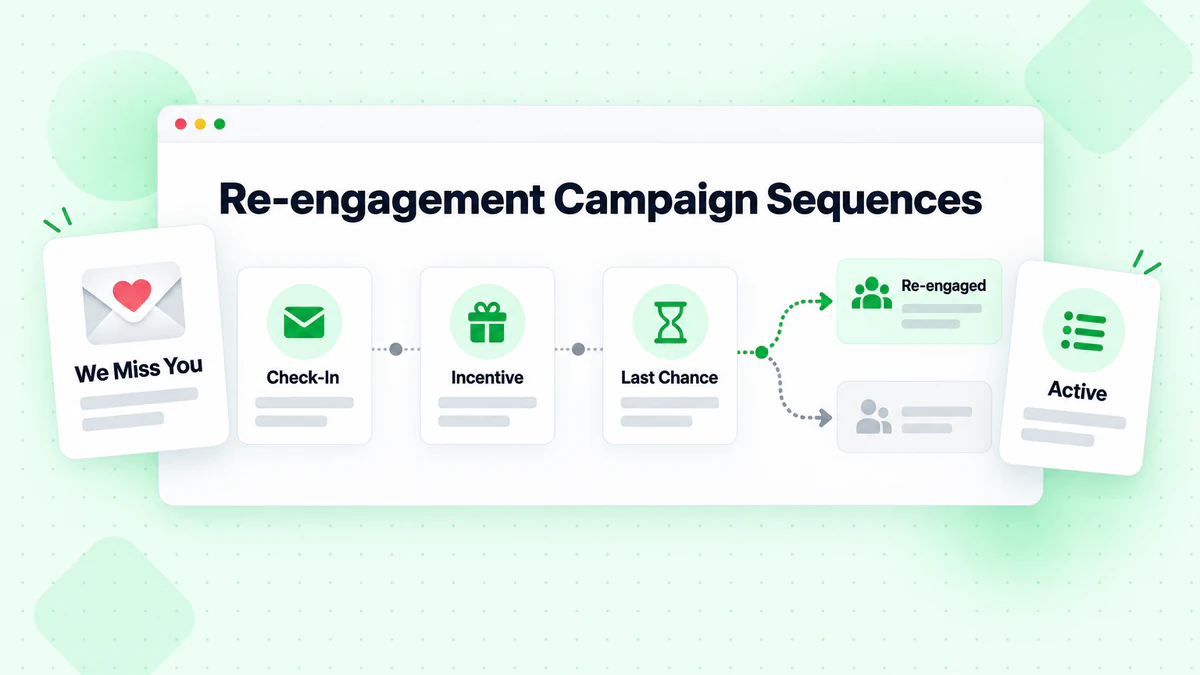
Re-engagement Campaign Sequences
Building multi-email re-engagement campaigns.
Basic 3-Email Sequence
Email 1 (Day 0): The Check-In
- Acknowledge absence
- Remind of value
- Soft CTA
Email 2 (Day 5): The Value Reminder
- Highlight what they've missed
- Show best recent content
- Slightly stronger CTA
Email 3 (Day 10): The Last Chance
- Clear final notice
- Simple stay/go choice
- Deadline for action
Extended 5-Email Sequence
Email 1: "We miss you" acknowledgment Email 2: Value proposition (what they've missed) Email 3: Preference update option Email 4: Special incentive Email 5: Last chance / sunset notice
Win-Back by Segment
For High-Value Inactive Customers:
- Personal note from team member
- Exclusive offer
- Feedback request
- VIP re-enrollment invitation
- Final check-in
For Never-Purchased Subscribers:
- Content highlight
- Social proof (success stories)
- First-time buyer offer
- Preference update
- Sunset notice
For Recently Inactive:
- Shorter sequence (2-3 emails)
- Gentler approach
- Focus on value, less urgency
Subject Lines for Re-engagement
Subject lines that get opens from people who stopped opening. See our email subject lines guide for more formulas.
Proven Re-engagement Subject Lines
Curiosity:
- "Has something changed?"
- "Quick question for you"
- "Is this goodbye?"
Personalization:
- "[Name], it's been a while"
- "We miss you, [Name]"
- "[Name], are we still friends?"
Value:
- "Here's what you've been missing"
- "Your exclusive access is waiting"
- "The thing you signed up for"
Urgency:
- "Last chance to stay subscribed"
- "We're cleaning our list tomorrow"
- "Your subscription is about to expire"
Honesty:
- "Should we stop emailing you?"
- "Do you still want to hear from us?"
- "This might be our last email to you"
Subject Line A/B Tests
Test These Variables:
- Personalization vs. no personalization
- Emoji vs. no emoji
- Direct vs. curiosity
- Short vs. medium length
Common Results:
- Personalization often helps
- Direct subject lines ("Should we stop emailing?") often outperform clever ones
- Urgency works but use authentically
Re-engagement Best Practices
Maximizing your win-back success.
Timing and Frequency
Best Days: Test, but Tuesday-Thursday often work well Best Times: Mid-morning or early afternoon Spacing: 3-7 days between emails Don't Rush: Give people time to see and act
Design for Re-engagement
Keep It Simple:
- Minimal design
- Focus on message
- One clear CTA
- Mobile-optimized
Stand Out:
- Different from regular emails
- Clear re-engagement purpose
- Personal tone
Personalization
Use Available Data:
- First name
- Past purchases
- Previous content interests
- Signup source/date
- Location
Make It Relevant:
"Since you signed up for our email marketing tips,
we've published 47 new guides..."
Incentives Strategy
When to Use Incentives:
- High-value subscribers
- Long-time inactive (last chance)
- Competitive situations
- Win-back after purchase
When to Avoid Incentives:
- First re-engagement attempt
- Low-value subscribers
- Recent unsubscribers
- Incentive seekers (abuse potential)
Multi-Channel Approach
Beyond Email:
- Retargeting ads to inactive subscribers
- Direct mail for high-value customers
- SMS if opted in
- Push notifications if using app
Coordinated Messaging: Align messaging across channels without being overwhelming.
Sunset Policies
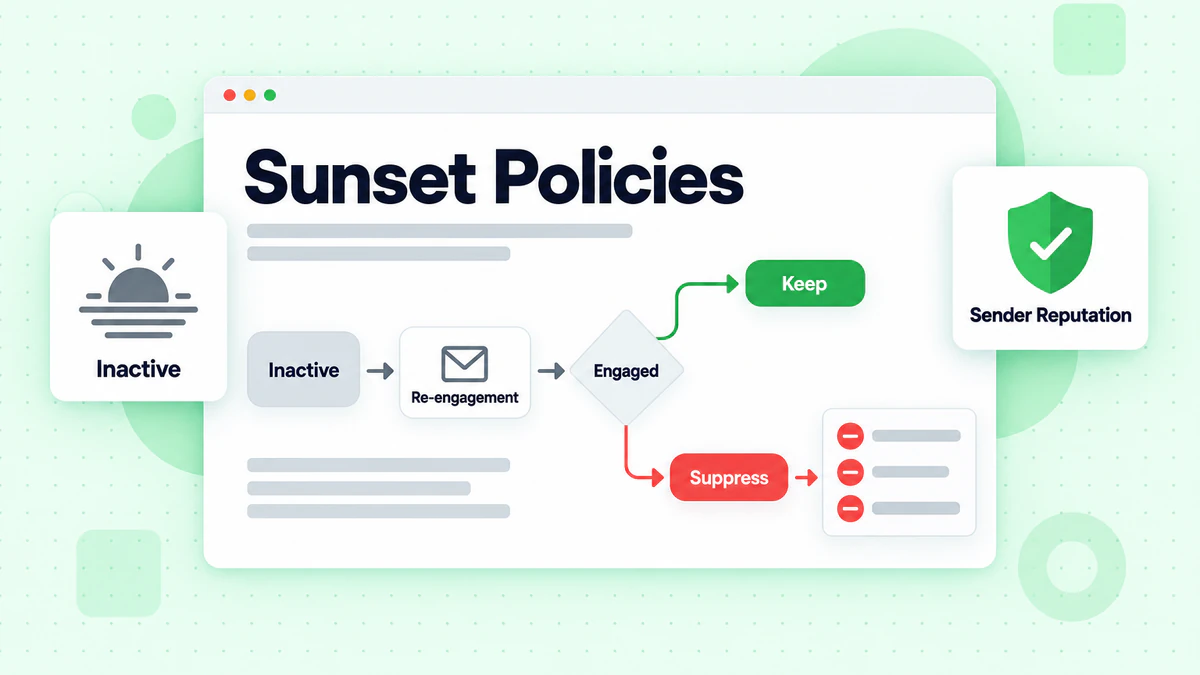
When re-engagement fails, knowing when to let go.
Why Sunset Matters
Deliverability Protection: Continuing to email unengaged subscribers damages your sender reputation.
Resource Optimization: Stop paying for subscribers who will never engage.
Metric Clarity: Cleaner lists give more accurate performance data.
Spam Trap Avoidance: Old, abandoned addresses may become spam traps.
Sunset Timeline
Typical Sunset Flow:
- Re-engagement sequence (2-4 weeks)
- No response → Move to sunset segment
- One final "last chance" email
- No response → Suppress from all marketing
- Wait period (optional) → Permanent removal
Recommended Suppression Periods:
- B2C: 6-12 months
- B2B: 12-18 months
- High-value: Case-by-case consideration
What "Sunsetting" Means
Suppress, Don't Delete: Keep them on a suppression list to:
- Prevent accidental re-adding
- Maintain historical data
- Allow future manual reactivation
- Comply with data retention requirements
Transactional Exception: Continue sending transactional emails if they're customers.
Sunset Email Examples
Final Notice:
Subject: We're saying goodbye (unless you want to stay)

Hi [Name],

This is our last email to you.

We've tried to reconnect, but since you haven't opened
our emails in a while, we're going to stop sending them.

If you'd like to keep receiving emails from us, click
the button below in the next 48 hours:

[Keep Me Subscribed]

If not, we wish you all the best. You can always
re-subscribe at our website if things change.

Take care.
Measuring Re-engagement Success
Tracking what matters in re-engagement campaigns.
Key Metrics
Re-engagement Rate: Subscribers who re-engaged / Total inactive subscribers targeted
Calculation:
Re-engagement Rate = (Re-engaged Subscribers / Targeted Inactive) × 100
Benchmarks:
- 5-10%: Typical re-engagement rate
- 10-20%: Good performance
- 20%+: Excellent (or definition was too broad)
Additional Metrics to Track
Open Rate: Compare to regular email performance Click Rate: Are they taking action? Conversion Rate: Post re-engagement purchases Unsubscribe Rate: Expected to be higher than regular campaigns Long-term Retention: Do they stay engaged after re-engagement?
ROI Calculation
Re-engagement ROI:
Revenue from re-engaged subscribers
- Cost of re-engagement campaign
- Cost of incentives offered
= Net re-engagement value
Lifetime Value Impact: Track re-engaged subscribers separately to measure their ongoing value.
Post Re-engagement Monitoring
30-Day Check: Are re-engaged subscribers still opening emails?
90-Day Check: Have they converted or engaged meaningfully?
Ongoing Segment: Keep "re-engaged" segment for special monitoring.
Common Re-engagement Mistakes
Avoid these pitfalls.
Mistake 1: Waiting Too Long
Problem: Starting re-engagement after 6+ months of inactivity. Fix: Begin re-engagement efforts earlier (60-90 days).
Mistake 2: Generic Messaging
Problem: Same re-engagement email to everyone. Fix: Segment and personalize based on subscriber type and value.
Mistake 3: Too Many Emails
Problem: Overwhelming inactive subscribers with re-engagement attempts. Fix: Limit to 3-5 emails over 2-4 weeks.
Mistake 4: No Clear Next Step
Problem: Asking subscribers to "stay engaged" without clear action. Fix: Single, clear CTA in each email.
Mistake 5: Ignoring Technical Issues
Problem: Subscribers may be inactive due to spam placement. Fix: Check deliverability and spam placement for inactive segment.
Mistake 6: No Sunset Policy
Problem: Keeping non-responders on list indefinitely. Fix: Implement clear sunset timeline and stick to it.
Mistake 7: One and Done
Problem: Running one re-engagement campaign and never again. Fix: Make re-engagement an ongoing program.
Re-engagement for Different Business Types
Adapting strategies by industry.
E-commerce Re-engagement
Focus On:
- Browse/cart abandonment reminders
- New product announcements
- Exclusive discounts
- Loyalty points reminders
Incentive Ideas:
- Percentage off next purchase
- Free shipping
- Points multipliers
- Early access to sales
SaaS Re-engagement
Focus On:
- New feature announcements
- Free training/resources
- Account health updates
- Success stories
Re-activation Offers:
- Extended free trial
- Upgrade discounts
- Free consultation
- Feature unlocks
B2B Re-engagement
Focus On:
- Industry insights and research
- Webinar invitations
- Case studies
- Thought leadership content
Approach:
- More professional tone
- Longer decision cycles
- Higher value consideration
- Account-based approaches for key accounts
Publisher/Content Re-engagement
Focus On:
- Best content roundups
- New content formats
- Exclusive subscriber content
- Community updates
Incentives:
- Premium content access
- Early article access
- Ad-free experience
- Newsletter preferences
Prevention: Reducing Future Disengagement
The best re-engagement strategy is not needing one.
Onboarding Excellence
Welcome Series: Create effective welcome email sequences that build engagement from day one.
- Set clear expectations
- Deliver immediate value
- Confirm content preferences
- Build habit of opening
Early Engagement: First 30 days are critical. Maximum effort during this period.
Content Quality
Consistent Value: Every email should justify the open.
Relevance: Use segmentation to ensure right content reaches right people.
Variety: Mix formats and topics to maintain interest.
Frequency Optimization
Find the Sweet Spot: Too many → fatigue → unsubscribe Too few → forget → inactive
Let Subscribers Choose: Preference centers allow customization.
Re-engagement Prevention Signals
Watch For:
- Declining open rates
- Declining click rates
- Increasing unsubscribes
- Spam complaints rising
Act Early: Address declining engagement before subscribers go fully inactive.
Re-engagement Checklist
Before Campaign
- [ ] Define "inactive" for your list
- [ ] Segment inactive subscribers appropriately
- [ ] Plan email sequence (3-5 emails)
- [ ] Write compelling subject lines
- [ ] Create clear CTAs
- [ ] Prepare any incentives
- [ ] Set up tracking/measurement
During Campaign
- [ ] Monitor open rates
- [ ] Track re-engagement actions
- [ ] Watch unsubscribe rates
- [ ] Adjust timing if needed
- [ ] Record learnings
After Campaign
- [ ] Calculate re-engagement rate
- [ ] Sunset non-responders
- [ ] Analyze what worked
- [ ] Segment re-engaged subscribers
- [ ] Plan ongoing monitoring
- [ ] Schedule next re-engagement cycle
Data Quality and Re-engagement
Invalid emails complicate re-engagement efforts.
The Verification Connection
Invalid Emails Look Inactive: Some "inactive" subscribers may simply be invalid addresses. Use email verification to identify them:
- Typos from signup
- Abandoned email accounts
- Changed email addresses
Before Re-engagement: Verify your inactive segment with bulk email verification to remove truly invalid addresses. Learn more in our email verification guide.
Benefits:
- More accurate inactive count
- Better re-engagement metrics
- Avoid sending to potential spam traps
- Focus resources on recoverable subscribers
Cleaning During Re-engagement
Monitor Bounces: Re-engagement campaigns often reveal invalid addresses. Remove them immediately.
Identify Spam Traps: Long-inactive addresses may have become spam traps. Professional verification can identify these.
Conclusion
Re-engagement is both an art and a science. By understanding why subscribers disengage, creating thoughtful win-back sequences, and knowing when to let go, you can recover valuable subscribers while maintaining a healthy, engaged list.
Remember these key principles:
- Start early: Don't wait until subscribers are deeply inactive
- Segment thoughtfully: Different subscribers need different approaches
- Provide value: Give them a reason to return
- Respect their decision: Make it easy to stay or go
- Know when to sunset: Protect your deliverability
The goal isn't to keep every subscriber at any cost—it's to keep the right subscribers engaged and let the rest go gracefully.
Before re-engaging inactive subscribers, ensure those addresses are still valid. Start with BillionVerify to verify your inactive segment and focus re-engagement efforts on recoverable subscribers.