

Email Validation API
Verify in Realtime
Use a simple API call to verify addresses during signup, enrichment, AI agent workflows, or custom list-processing pipelines.
Structured JSONReal-time responseSMTP verification
Get Started for Free
Real-time email verification API over HTTP with full SMTP mailbox checks — the accurate verification API for deliverability, not format-only validation.
Use a simple API call to verify addresses during signup, enrichment, AI agent workflows, or custom list-processing pipelines.
Every verification type is reachable through the same REST email verification API.
POST /verify — one real-time email verification API call with sub-3s response. Returns status, deliverability, quality score, and risk flags in one JSON object.
POST /verify/bulk — verify up to 50 addresses per API call, synchronously. All results come back in a single API response, on the same schema the real-time email verification API uses for one address.
POST /verify/file — submit CSV or Excel files to the API for background processing. Results are delivered via webhook callback when the API job completes.
Type-safe client libraries for the verification API in Python, Node.js, Go, and PHP. Auto-retry on failure, full error handling, and identical response types across all languages.
Every real-time email verification API call runs the same multi-layer check automatically.
Check individual emails for validity, deliverability, and reputation. No account required.
Identify and block temporary email services before they pollute your list.
Detect emails likely to bounce before sending, protecting your sender reputation.
Receive API results asynchronously and query message history.
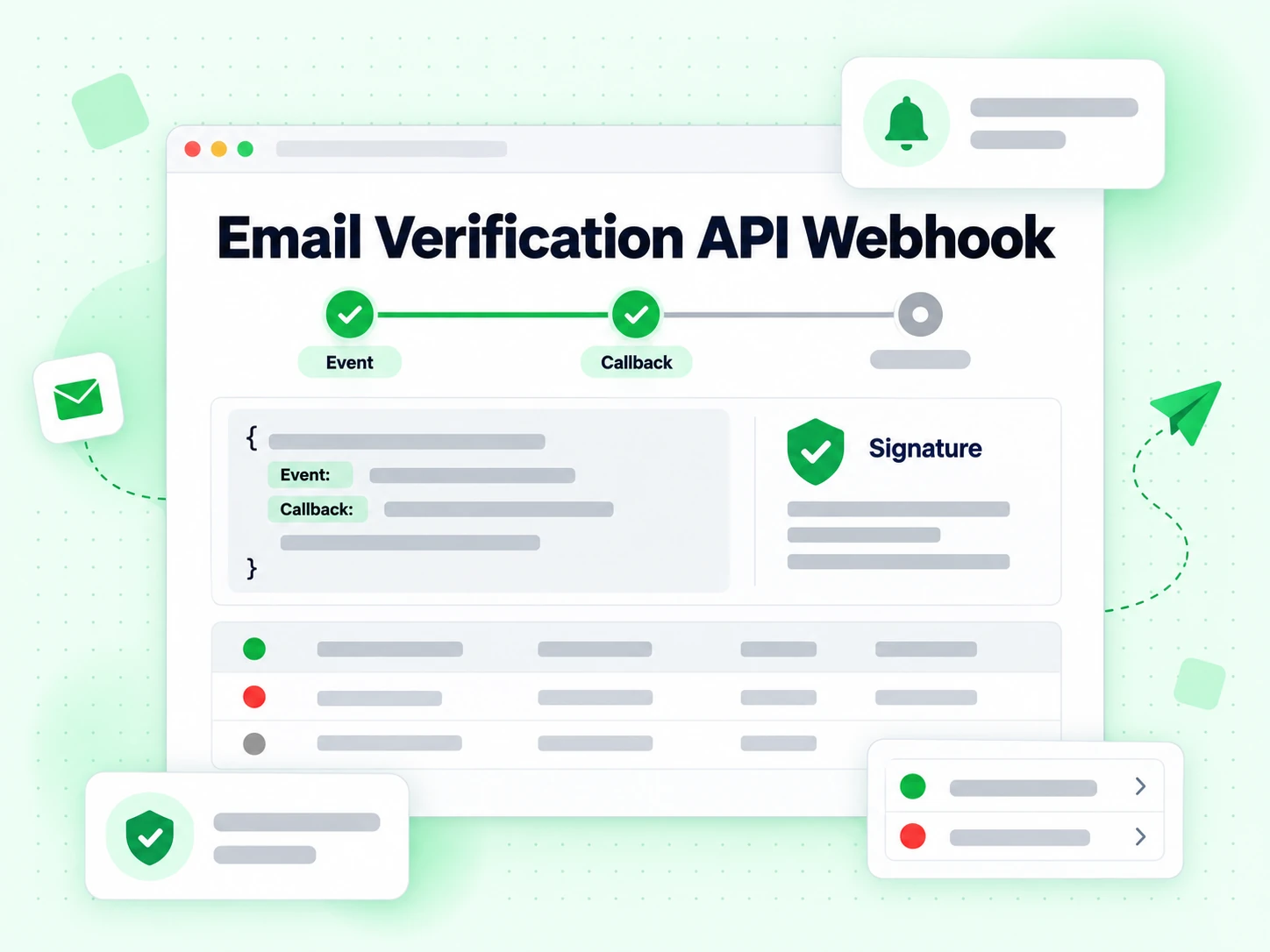
Async Delivery
Register HTTP endpoints to receive API results the moment a job or batch completes. The API supports custom payloads, automatic retry on failure, and per-job or global configuration.
Message History
Access the full webhook event log to retrieve past API results, debug delivery failures, or replay missed notifications. API events are retained for 30 days.
Connect the API to every major AI client and SDK without writing verification logic from scratch.
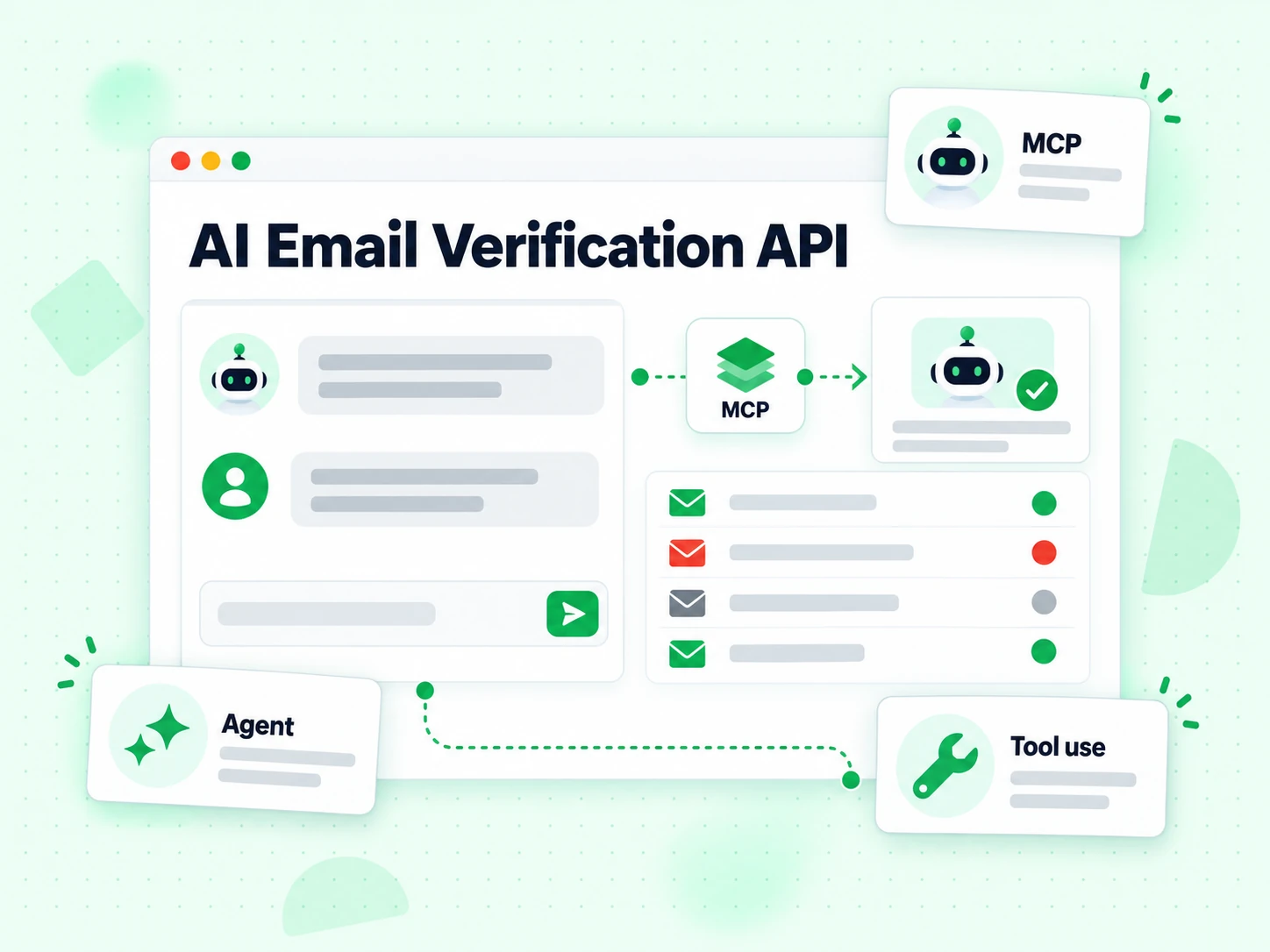
Verify emails in Claude Desktop and Cursor with natural language. Ask “is this address valid?” and get instant results from the same verification API — no API key setup, no code required.
One-click skills for Claude, Manus, and other agent platforms. The email verification API runs automatically inside any workflow without manual configuration.
Call the REST API directly from LangChain, CrewAI, any Anthropic or OpenAI SDK, or any HTTP client. The real-time email verification API returns structured JSON that parses without transformation — status, score, and flags included.
Every AI-native verification API tool in one platform.
Verify emails in Claude Desktop and Cursor with natural language. No code required.
One-click skills for Claude, Manus, and other agent platforms. Automatic email validation in any workflow.
Verify individual addresses with real-time SMTP checks and instant results.
Inside the endpoint
An email verification API is only as useful as the evidence behind its response field. This one returns mailbox-level facts, not a syntax opinion dressed up as a verdict.
Every call to the email verification API normalizes the address, checks structure, and resolves the domain's mail exchanger records. Those two API layers are fast and cost nothing against the recipient, so they run first and short-circuit obvious garbage before the SMTP stage.
A syntax-only API stops here and calls the result valid. That is the gap between a validation endpoint and a free email verification api that continues to the mailbox itself.
The API opens a real SMTP conversation with the receiving server and tests the recipient path. No message body is sent, no confirmation link is clicked, and nothing lands in the person's inbox. Our free email verification api reads the server response far enough to separate an accepted recipient from a permanent rejection.
This is what makes it a real-time email verification API rather than a DNS lookup with marketing copy attached. The evidence comes from the system that will actually accept or refuse your mail.
One JSON object from the API carries the deliverability status, a quality score, a risk level, reason codes, and the disposable, role-account, catch-all, and free-webmail flags. Your application does not need a second API call to learn why a result looks the way it does.
Keeping flags beside the status is deliberate. An accepting role address and an accepting personal mailbox are both deliverable, and only your product knows which one belongs in this workflow.
Greylisting, provider deferrals, and rate limits are normal at API scale. The free email verification api returns unknown for those cases instead of promoting them to deliverable or demoting them to invalid.
Retry logic belongs in your code, not hidden inside the endpoint. An API that silently guesses removes the one signal you need to decide whether to retry or route the record for review.
Response fields
The API response is designed to be switched on directly. Each status maps to one action, and the API reason codes explain the borderline cases.
The recipient path accepted the probe when the call ran. Accept the signup, write the contact, or queue the message, subject to whatever consent rules your product enforces.
The free email verification api returns the same status field on the free tier as on paid volume, so behaviour you test with free credits is the behaviour you ship.
A permanent failure from the API means the address will hard-bounce. In a signup form, show the field again with the API reason code. In a background job, suppress the record rather than deleting the original value.
Never auto-correct the domain. A verification api can tell you an address fails; it cannot tell you which address the person meant.
Risky means the mailbox may accept mail while carrying a flag your product might care about. Read the reason codes: a disposable provider on a paid signup is a very different problem from a role address on a support form.
Encode the policy once, at the point where you call our free email verification api, so every surface in the product treats the same API flag the same way.
The receiving provider gave the API an answer that proves nothing. Queue the address for a later API call rather than blocking the user or writing a false negative into your database.
The real-time email verification API used inside a signup flow should degrade gracefully here: let the user through, verify again asynchronously, and act on the second API result.
Integration patterns
Most API integrations use the same three touch points. Getting the placement of the API call right matters more than the SDK you choose.
Call the API when an address is submitted — signup, checkout, lead form, or profile update. Verifying while the person is still on the page is the only moment a typo can be fixed by the person who made it, which is the strongest argument for an inline API call.
Keep the call non-blocking beyond a short timeout. A free email verification api response usually arrives in one to three seconds, but your form should not fail because a receiving provider was slow.
CRM sync jobs, enrichment workers, and ETL steps are natural homes for this free email verification api. Add the API call where records already flow, and store status, flags, and a checked-at timestamp as fields.
For files rather than single records, the POST /verify/file API accepts CSV or Excel and calls your webhook when the job finishes, so batch API work does not need a long-lived connection.
The MCP Server exposes our free email verification api to Claude Desktop and Cursor in natural language, and Agent Skills install it into agent platforms with one click. Both paths return the same structured JSON as the REST API.
That matters for agent reliability: a model does not have to parse prose, and the tool cannot claim an address is fine when the underlying API said unknown.
Freshness beats volume. Verify high-value recipients close to the send rather than trusting a status written months ago, and re-verify dormant records before they enter a campaign.
For an entire list, Bulk Email Verification runs the same engine over a file so you are not rebuilding batching logic on top of the real-time endpoint.
Honest limits
The API response is trustworthy because its scope is narrow. Each of these belongs to a different tool or a different team, not to a verification API.
An accepting mailbox says nothing about who controls it, where they work, or whether they agreed to be contacted. Shared aliases, forwarded addresses, and stale enrichment all produce deliverable API results attached to the wrong person.
Use first-party data for identity and keep consent in your own system of record. No verification api can supply either.
SMTP acceptance describes the recipient path at the moment of the API call. Whether your campaign reaches the inbox depends on sender reputation, authentication, content, and complaint history — all sender-side factors the API never observes.
Verification removes address-level failures. Deliverability of the message itself is a separate programme with separate metrics.
A catch-all domain accepts every local part, so no free email verification api can prove that one guessed address exists there. The API returns the flag precisely so your code does not have to infer it.
Route catch-all results to review rather than folding them into deliverable, especially on B2B lists built from name patterns.
Mailboxes are closed, aliases retired, and domains migrated every day. The API reports what was true during the call, and that fact ages from the second the API responds.
Store the checked-at time next to the status so downstream systems can decide when the evidence is too old to act on.
Related surfaces
The same engine is exposed through several API surfaces. Choosing the right one is usually about who is asking, not about accuracy.
When a person needs to inspect one result rather than automate thousands, the Email Verifier runs the identical SMTP pipeline in the browser and shows every flag the API would return.
It is the fastest way to sanity-check an address before writing code against the email verification api.
When the work is a list rather than a stream, Email List Cleaning applies the same rules across every row and preserves the reasons in the export.
Files and API calls share one engine, so a row cleaned in bulk and an address checked through the verification api cannot disagree.
The Email Validation API page describes the same endpoint for teams who search for validation rather than verification, with the integration details written from that angle.
The endpoint, the schema, and the SMTP evidence are identical; only the framing of the documentation differs.
Cached API results return in under 200ms. Full SMTP verification completes in 1–3 seconds on average, which is what makes this usable as the real-time email verification API inside a form. The API supports up to 6,000 single verification requests per minute and 1,500 batch requests per minute.
The verification API uses standard REST calls with JSON responses. Official SDKs are available for Python, Node.js, Go, and PHP. Most API integrations complete in under 30 minutes. The MCP Server and Agent Skills require no code at all — install once and the real-time email verification API works in any supported AI client.
The Starter plan is $20 for 20,000 credits at $0.001 per email — no monthly fees, you only pay for what you use. Volume pricing scales down to $0.00035 per email at 1M credits. A free email verification api tier provides 20 free credits every day you log in, up to 600 a month, with no credit card required.
Every API response includes the verification status (deliverable, undeliverable, risky, or unknown), a quality score from 0–100, a risk level, and reason codes. Disposable email flag, role account flag, catch-all detection, and typo correction suggestions are also included.
All API requests use HTTPS. API key authentication is required on every API call, and IP whitelisting is available for additional security. BillionVerify is fully GDPR and CCPA compliant with automatic data deletion after processing.
AI agents connect through the MCP Server (natural language in Claude and Cursor), pre-built Agent Skills (one-click install for Claude and Manus), or direct REST calls from LangChain, CrewAI, or any Anthropic or OpenAI SDK. Every path hits the same email verification api and returns the same structured JSON — no response transformation needed.
An email validation API and an email verification API usually refer to the same endpoint — one that checks whether an address is real and deliverable. BillionVerify uses SMTP-level verification, confirming the mailbox exists on the receiving server, rather than DNS or syntax validation alone. The single /verify endpoint returns status, quality score, disposable flag, role account flag, and catch-all detection in one JSON response.
One endpoint for every verification type. MCP Server and Agent Skills included. A free email verification api tier gives you 20 credits every day you log in, up to 600 a month, no credit card required.
600 free credits monthly · Native MCP Server integration · No credit card required