

🎬 Introducing transcript.im: Free transcripts for YouTube, TikTok & Instagram videos.Try transcript.im

AI agent email verification

Email Verification Agent Skills

A packaged capability an agent platform installs in one click. It exposes a real SMTP mailbox check as a callable tool, so an AI agent email step reads a verified status instead of the model's opinion about whether an address looks plausible.

Email Verification Agent Skills giving an AI agent a verified email result

Get the agent skills

One-click install. The agent gets a real SMTP check instead of guessing about an AI agent email address, and the agent skills carry the schema for you.

Agent Skills install card with buttons to install or copy the skill

Why an AI agent email step needs a real check

A model asked whether an address is valid will always answer, and the answer is a confident guess. Email verification agent skills replace that guess with evidence from the receiving mail server.

Email verification agent skills install in one click and expose a real SMTP mailbox probe as a callable tool. The agent reads structured fields — status, score, risk level, reason codes, disposable, role, catch-all — instead of writing prose about an AI agent email address it never checked.

  • Syntax-only reasoning

    The model sees a well-formed string and a familiar domain and concludes the address is fine. Every dead mailbox you have ever bounced against passed exactly that test.

  • DNS-only checking

    A domain that resolves proves the company can receive mail, not that this person can. An AI agent email workflow stopping here still writes dead addresses into your CRM.

  • Hand-rolled API calls

    Teaching each agent to make HTTP requests means auth handling, retries, and schema drift in every workflow. Email verification agent skills carry all of that for you.

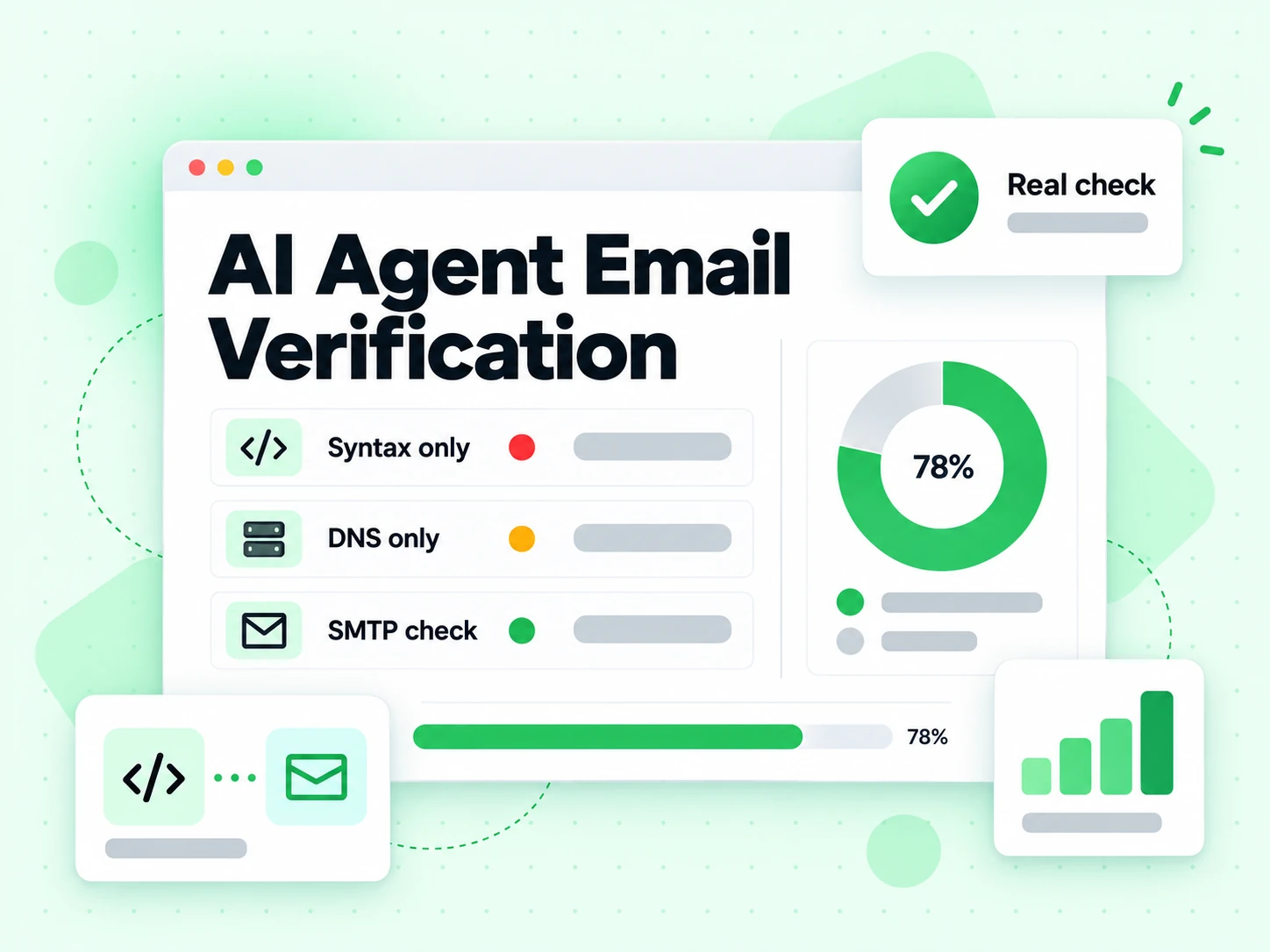
AI Agent Email Verification contrasted with syntax-only and DNS-only checks

Installing email verification skills for agents

The same agent skills, on every platform that supports the format.

  • Claude agent skills

    Install from the catalogue and the verification tool appears in the agent's tool list. AI agent email checks then run against a live mail server rather than the model's intuition.

  • Gemini agent skills

    Same package, same fields. Email verification skills for agents are platform-agnostic by design, so one install covers whichever agent runtime you standardise on.

  • Custom agent runtimes

    For a custom runtime, the skill wraps the REST API. If your agent framework cannot install skills, call the API directly — the AI agent email result is identical either way.

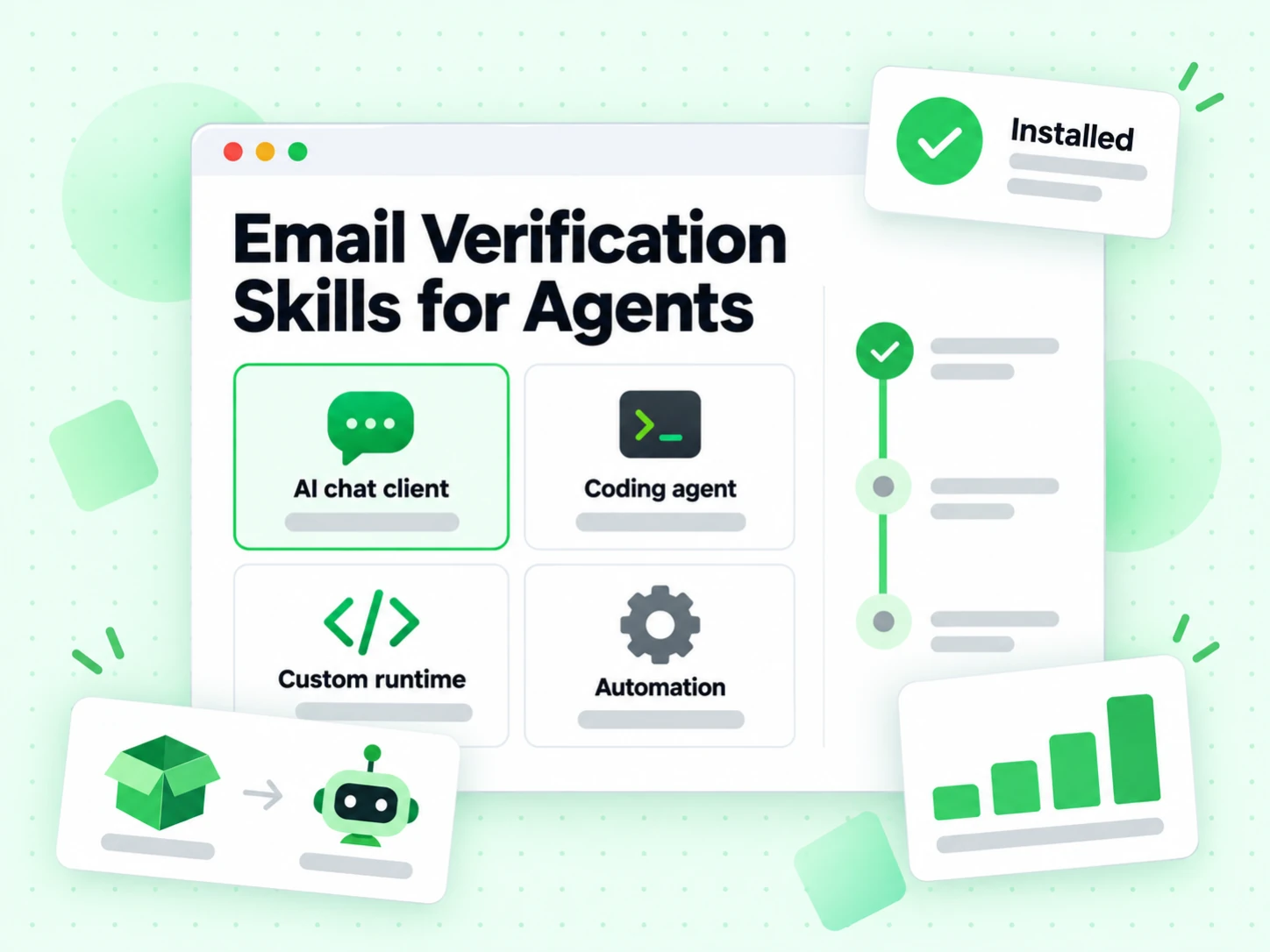
Email Verification Skills for Agents installed in chat clients, coding agents, and custom runtimes

Getting AI agent email verification right

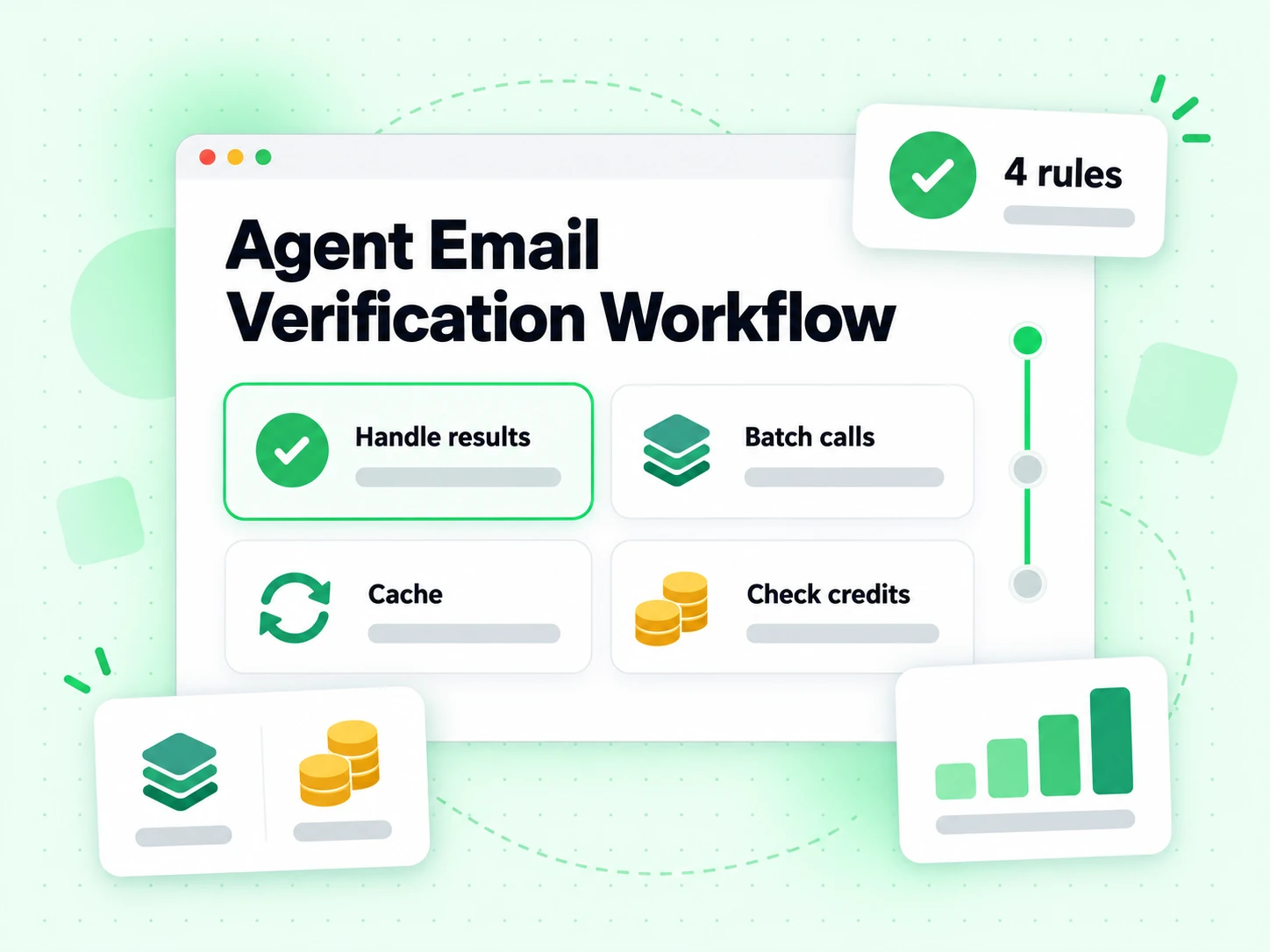
Four rules that separate an agent that verifies from an agent that appears to.

  1. Give the agent a policy, not a threshold

    Tell it which statuses to accept, what to do with each risk flag, and when to retry unknown. Email verification agent skills supply the evidence; the policy is yours to write once.

  2. Batch instead of looping

    Up to 50 addresses per call. An AI agent email workflow that loops one call per row wastes time and credits for no accuracy gain.

  3. Cache within a session

    Agents re-check the same address repeatedly while reasoning. Cache the skill result for the length of the task; verification is a timestamped fact, not a per-turn lookup.

  4. Never round unknown up

    Unknown means the provider declined to answer. An agent that treats it as deliverable undoes the whole reason for installing email verification agent skills.

Agent Email Verification Workflow covering result handling, batching, caching, and credits

What a skill is

What email verification agent skills add to an agent

A skill is a packaged capability an agent platform installs in one click. Email verification agent skills give an agent a real SMTP check instead of leaving the model to reason about whether an address looks plausible.

A model without tools guesses, confidently

Ask any model whether an address is valid and it will answer. The answer is a well-formed guess: syntax looks fine, the domain is familiar, so it says yes. An AI agent email workflow built on that produces clean-looking data that bounces.

Installing email verification agent skills replaces the guess with an SMTP result. That is the entire point — the model stops reasoning about a question only a mail server can answer.

Skills carry the schema, so the agent does not improvise

The skill declares its parameters and its return shape. The agent calls it and reads structured fields: status, quality score, risk level, reason codes, and the disposable, role, and catch-all flags.

Structured output is what stops an AI agent email step from rounding unknown up to deliverable while summarising. Prose invites interpretation; fields do not.

One-click install, no integration code

Email verification agent skills install from the skill catalogue. There is no HTTP client to write, no auth flow to implement in the agent, and nothing to maintain when the API changes.

That matters most for teams whose AI agent email work is a small part of a larger workflow and does not justify a bespoke integration.

The same engine as everything else

The skill calls the same verification pipeline as the API and the bulk uploader: syntax, domain, MX, a live SMTP probe, then risk flags.

An address checked by an agent and the same address checked in a bulk job cannot disagree, which is what makes agent output auditable.

Reading results

What an agent gets back from the agent skills

Four statuses. An agent should branch on them the way application code would, and the agent needs to be told how.

deliverable

The mailbox accepted an SMTP probe. The AI agent email step can proceed with whatever it was doing next.

Deliverable is a fact about a mailbox, not permission to send — the agent still needs your consent rules.

undeliverable

A permanent failure. The agent should stop and report the reason code rather than writing the address anywhere.

This is exactly the case an unassisted model gets wrong: a well-formed dead address looks fine to a language model and fails at the skill.

risky

The mailbox works but carries a flag. Email verification agent skills return which flag it is, so the agent can apply your policy instead of a generic rule.

Give the agent the policy explicitly. Told only to check the address, it will invent a conclusion about a catch-all domain.

unknown

The provider deferred or rate-limited the probe. Nothing was established either way.

An AI agent email flow should queue a retry here. Treating unknown as a pass is the most common way agent-driven verification goes wrong.

Where to use them

Four AI agent email workflows worth wiring up

Verification earns its place wherever an agent is about to write an address somewhere durable or send something to it.

  1. 1

    Lead research and enrichment

    An agent that finds contacts should verify them before writing to a CRM. Email verification agent skills turn an AI agent email research step from plausible into checked.

    Without agent skills, the agent's confidence and the data's accuracy are unrelated quantities.

  2. 2

    Inbox triage and reply drafting

    Before an AI agent email assistant drafts a reply to an unfamiliar sender, checking the sender domain is one cheap signal about whether the message deserves one.

    Combine it with the sender-address check on Is This Email Legit when the message is asking for money or credentials.

  3. 3

    Form and signup automation

    An agent processing signups should verify at capture, not after. Email verification skills for agents keep the invalid rows out rather than cleaning them up later.

    Tell the agent to flag rather than reject: domain-level risk data is coarse, and a false positive in an AI agent email flow costs a real customer.

  4. 4

    List preparation before a send

    For a handful of addresses an agent can call the skill directly. For a file, it should hand off.

    Point the agent at Bulk Email Verification instead; one skill call per row is the wrong shape for ten thousand addresses.

Limits

What the agent skills do not do

The agent skills return evidence. Everything below stays a decision your product makes, not one the agent makes.

They do not supply consent

A deliverable result is not permission to email anyone. An agent acting on skill output needs your consent rules encoded somewhere it can read.

No AI agent email workflow should treat verification as authorisation.

They do not identify a person

An accepting mailbox does not prove who controls it. Shared aliases and forwarded addresses are routine, and an agent should not infer identity from a deliverable status.

Identity needs first-party evidence, not a mailbox probe.

They do not replace a policy

What an agent does with a disposable provider or a catch-all domain is your decision. Email verification agent skills supply the flags and stop there.

Write the policy once and give it to the agent alongside the skill, so every AI agent email decision follows the same rule.

They do not guarantee delivery

SMTP acceptance describes the recipient path. Whether a later campaign reaches the inbox depends on sender-side reputation the skill never sees.

That half of the problem belongs to the deliverability test.

Reference

Other ways an agent can reach the same engine

Agent skills are one delivery mechanism. Two others exist for an agent runtime that cannot install them.

MCP, for clients that speak the protocol

If your client supports MCP rather than skills, the MCP Server exposes the same verification as a discoverable tool.

Same engine and same fields — MCP and email verification agent skills are two packaging formats for one capability.

The REST API, for your own code

The Email Verification API is what the skill calls underneath, available over plain HTTP whenever your own code is the caller.

Choose email verification skills for agents when a model is calling; choose the API when your application is.

Bulk, for files rather than conversations

When the AI agent email task is a spreadsheet, Email List Cleaning applies the same rules across every row with deduplication and reason codes.

An agent that knows when to hand off is worth more than one that loops a skill ten thousand times.

Frequently Asked Questions

1. How do I add the agent skills in Claude?

Install from the skill catalogue and the tool appears in the agent's list. From then on, AI agent email checks run against a live mail server. No HTTP client, no auth flow, no schema to maintain in your prompt.

2. Do the agent skills work outside Claude?

The same package works wherever the skill format is supported. Email verification skills for agents are deliberately platform-agnostic, which is why one install covers the agent runtimes you use today and the ones you switch to later.

3. What if my framework cannot install skills?

Use the MCP server, or call the REST API directly. All three reach the same engine and return the same fields, so an agent result does not depend on whether you installed agent skills or wired the API by hand.

4. What are email verification agent skills?

A packaged capability an agent platform installs in one click. It exposes a real SMTP mailbox check as a callable tool, so an AI agent email step reads a verified status instead of the model's opinion about whether an address looks plausible.

5. What do email verification agent skills cost?

The same as any other call: 20 free credits every day you log in, up to 600 a month, then $0.001 per verification. Installing email verification skills for agents costs nothing on its own — you pay only for the checks the agent actually runs.

Agent skills

Install the email verification agent skills

One click, and your agent checks addresses instead of guessing. The agent skills work on every platform that supports the format.

Real SMTP for every agent call · MCP server as well as agent skills · 600 free agent credits monthly

99.9%
Accuracy
Real-time
API Speed
$0.00014
Per Email
600/mo
Free Forever