



Legal professionals face unique challenges when implementing email marketing strategies. Unlike other industries where creativity and aggressive tactics are celebrated, attorney email marketing must navigate a complex web of ethical rules, state bar regulations, and professional responsibility requirements.
The consequences of non-compliance are serious: bar disciplinary action, malpractice exposure, reputation damage, and in extreme cases, suspension or disbarment. Yet within these constraints, effective email marketing remains possible and profitable—law firms simply need to understand and operate within the rules.
This guide provides comprehensive coverage of attorney advertising regulations as they apply to email marketing, with practical guidance for building compliant email programs that generate clients while maintaining ethical standards. For practical implementation strategies, see our law firm email marketing guide.
Understanding Attorney Advertising Regulation
Before implementing any email marketing campaign, understand the regulatory framework governing attorney communications.
The Regulatory Framework
Attorney advertising is regulated at multiple levels:
ABA Model Rules of Professional Conduct:
- Model Rules 7.1 through 7.5 address advertising
- States adopt these with variations
- Provides general framework and principles
- Updated periodically (most recently 2018)
State Bar Rules:
- Each state adopts its own advertising rules
- Significant variation between jurisdictions
- Some states more restrictive than ABA Model Rules
- Multi-jurisdictional practice requires multi-state compliance
Federal Regulations:
- CAN-SPAM Act applies to commercial email
- FTC regulations on endorsements and testimonials
- TCPA for text message marketing
- Industry-specific regulations may apply
Court Rules:
- Some courts have additional advertising restrictions
- Federal court admission may have requirements
- Specialty court advertising limitations
Key ABA Model Rules for Email Marketing
The ABA Model Rules provide the foundation for most state regulations:
Rule 7.1: Communications Concerning a Lawyer's Services
- A lawyer shall not make false or misleading communications
- Includes material misrepresentations or omissions
- Applies to all forms of communication, including email
Rule 7.2: Communications Concerning a Lawyer's Services: Specific Rules
- Allows advertising through any media
- Requires lawyer identification
- Addresses payment for recommendations
- Regulates referral arrangements
Rule 7.3: Solicitation of Clients
- Distinguishes solicitation from advertising
- Real-time interactive solicitation restricted
- Written communications (including email) generally permitted
- Special rules for targeted solicitation
Key Distinctions:
- Advertising: General communications to the public
- Solicitation: Targeted communications to specific persons
- Written solicitation (email): Subject to specific rules
- Live solicitation: Generally prohibited for pecuniary gain
State Variations That Matter
While all states regulate attorney advertising, approaches vary significantly:
More Restrictive States:
- Florida: Detailed filing and review requirements
- Texas: Specific disclosure and filing obligations
- California: Unique solicitation rules
- New York: Comprehensive advertising guidelines
Notable Variations:
- Labeling requirements ("Advertising Material")
- Filing and pre-approval requirements
- Testimonial and endorsement restrictions
- Specialization claim regulations
- Record retention requirements
Multi-Jurisdictional Compliance:
- If your email reaches residents of multiple states, comply with all applicable rules
- Most restrictive rule generally governs
- Consider geographic targeting to limit compliance complexity
Email-Specific Compliance Requirements
Understand how advertising rules specifically apply to email communications.
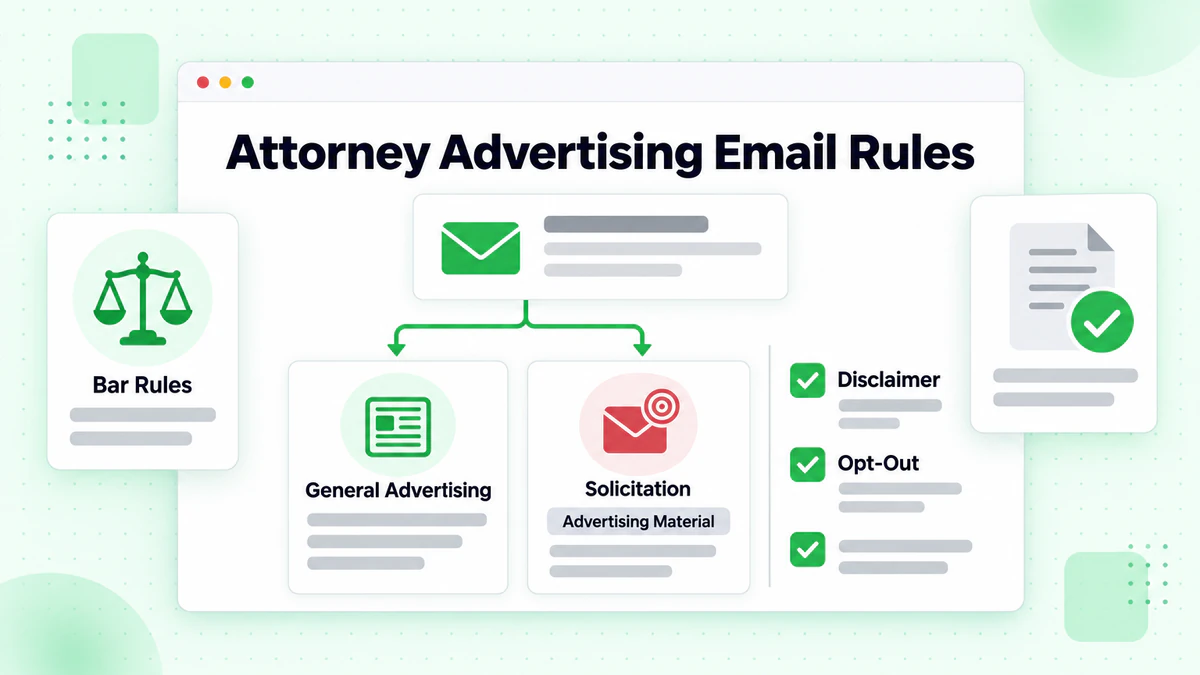
Email Classification Under Bar Rules
Email marketing typically falls into one of two categories:
General Advertising:
- Newsletters sent to subscriber lists
- Practice area announcements to opt-in recipients
- Thought leadership content to interested audiences
- Firm updates to professional networks
Solicitation:
- Targeted emails to persons known to need legal services
- Follow-up to specific legal events (accidents, arrests, etc.)
- Direct outreach to specific individuals with legal problems
The classification determines applicable rules:
| Email Type | General Rules | Solicitation Rules |
|---|---|---|
| Newsletter to subscribers | Rule 7.1, 7.2 | Usually not applicable |
| Email to accident victim | Rule 7.1, 7.2 | Rule 7.3 applies |
| Event-triggered email | Rule 7.1, 7.2 | Rule 7.3 applies |
| Referral source cultivation | Rule 7.1, 7.2 | Usually not applicable |
Required Disclosures and Labels
Many jurisdictions require specific email content:
Common Requirements:
"Advertising Material" Labeling:
- Some states require this phrase in subject line
- Others require it prominently in body
- Check your specific jurisdiction's requirements
- Consider including even if not required (safer)
Lawyer/Firm Identification:
- Name of lawyer(s) responsible for content
- Law firm name
- Office address(es)
- Jurisdictions of licensure
Disclaimers:
- "This is an advertisement"
- "Prior results do not guarantee similar outcome"
- No attorney-client relationship created
- Consult with attorney for your specific situation
Sample Compliant Footer:
[LAW FIRM NAME]
[Street Address]
[City, State ZIP]
[Phone Number]

Licensed in [State(s)]

ADVERTISING MATERIAL. This is an advertisement. The content
of this email is for informational purposes only and does
not constitute legal advice. No attorney-client relationship
is created by this communication. Prior results do not
guarantee a similar outcome.
Prohibitions on Email Content
Certain content is prohibited across most jurisdictions:
Universally Prohibited:
- False statements of fact
- Misleading implications or omissions
- Guaranteed outcomes
- Unsubstantiated comparisons
- Undisclosed paid endorsements
Commonly Restricted:
- Specialization claims without certification
- Testimonials without appropriate disclosures
- References to judge or opposing counsel relationships
- Implications of influence with officials
- Past results without context
Example Problem Statements:
❌ "We WIN cases!" (Implies guaranteed outcome) ❌ "The BEST lawyers in [City]" (Unsubstantiated comparison) ❌ "Specializing in personal injury" (In states requiring certification for "specialist" claims) ❌ "$5M verdict for client" (Without appropriate context/disclosures)
✅ "We handle personal injury cases" ✅ "Experienced attorneys serving [City]" ✅ "Focused practice in [area]" ✅ "$5M verdict in [case type] (Results vary based on individual circumstances)"
Building a Compliant Email Program
Implement email marketing within ethical boundaries. Understanding email marketing best practices helps establish a strong foundation for compliant campaigns.
Pre-Approval and Filing Requirements
Some jurisdictions require advertising pre-approval or filing:
States with Filing Requirements:
- Florida: File most advertisements with Bar
- Texas: File advertisements involving specific claims
- Others: Check your jurisdiction
Best Practices:
- Research your jurisdiction's filing requirements
- Develop templates that meet requirements
- Create approval workflow before sending
- Document all approvals
- Maintain required records
Record Keeping Requirements
Most jurisdictions require advertising record retention:
Typical Requirements:
- Copy of all advertisements
- Date of first dissemination
- List of recipients (or method of distribution)
- Retention period (typically 2-3 years, varies by state)
Email-Specific Records:
- Email content (HTML and text versions)
- Subject lines used
- Send dates
- Recipient lists or segments
- Delivery and engagement reports
- Opt-out processing records
Documentation Template:
| Record | Retention Period | Storage Location |
|---|---|---|
| Email content | [Per jurisdiction] | ESP archive + internal |
| Send dates | [Per jurisdiction] | ESP reports |
| Recipient lists | [Per jurisdiction] | ESP + CRM |
| Approval documentation | [Per jurisdiction] | Internal system |
| Complaint records | [Per jurisdiction] | Internal system |
Consent and Permission
Beyond CAN-SPAM, bar rules may impose additional consent requirements:
CAN-SPAM Requirements (All Commercial Email):
- Clear identification as advertisement
- Valid physical address
- Functional unsubscribe mechanism
- Honor opt-outs within 10 business days
- No misleading headers or subject lines
Bar Rule Considerations:
- Solicitation restrictions may require additional consent
- Targeted communications to those with known legal needs
- Prospective client communications
- Referral fee and sharing arrangements
Content Review Process
Establish systematic content review:
Review Workflow:
- Marketing creates email content
- Designated attorney reviews for accuracy
- Ethics/compliance officer reviews for bar compliance
- Final approval documented
- Archive approved version
Review Checklist:
- [ ] All statements of fact are accurate
- [ ] No misleading implications
- [ ] Required disclosures included
- [ ] No prohibited claims (guarantees, unsubstantiated comparisons)
- [ ] Proper labeling (if required)
- [ ] Testimonials properly disclosed (if used)
- [ ] Jurisdictional compliance verified
- [ ] Record retention procedures in place
Email List Compliance
Maintain compliant email lists.
List Building Within Rules
Build your list using compliant methods:
Acceptable Sources:
- Website sign-up forms (with proper disclosure)
- Client consent during intake
- Event registration
- Referral source networking
- Professional association lists (with permission)
- CLE attendee lists (with permission)
Problematic Sources:
- Purchased lists of accident victims
- Public record mining for legal problems
- Lists obtained without proper consent
- Data from improper sources
Email Verification for Compliance
Invalid emails create compliance as well as operational problems:
Compliance Implications:
- Required notices sent to wrong addresses
- Documentation gaps in required records
- Consent records become questionable
- Opt-out requests may not be honored
Verify your email list to ensure communications reach intended recipients and maintain clean compliance records.
BillionVerify provides email verification that helps law firms maintain clean lists and accurate records for compliance documentation.
Opt-Out Management
Proper opt-out handling is both legally required and ethically mandated:
Requirements:
- Clear unsubscribe mechanism in every email
- Process opt-outs within required timeframe (10 days per CAN-SPAM)
- Document opt-out requests and processing
- Never email opted-out addresses
- Suppression list maintenance
Best Practices:
- Immediate opt-out confirmation
- Preference center for communication types
- Honor opt-outs across all marketing channels
- Regular suppression list audits
Specific Email Types and Compliance
Different email types have different compliance considerations.
Newsletters and Thought Leadership
Newsletters remain one of the most effective forms of attorney marketing. For content ideas, see our email newsletter strategy guide. Generally the safest form of attorney email marketing:
Compliance Considerations:
- Must still be accurate and not misleading
- Required disclosures apply
- Testimonials need proper treatment
- Case results need context
Best Practices:
- Educational focus reduces advertising scrutiny
- Avoid promotional language
- Include standard disclosures
- Maintain consistency in messaging
Client Development Emails
Targeted outreach to prospective clients:
Higher Scrutiny:
- May trigger solicitation rules
- Additional disclosures potentially required
- Record keeping more important
- Consent documentation essential
Compliance Approach:
- Clearly identify as advertising
- Include all required disclosures
- Document consent basis
- Follow solicitation rules if applicable
Referral Source Communication
Emails to other professionals for referral cultivation:
Considerations:
- Still subject to advertising rules
- Referral fee disclosures if applicable
- Professional courtesy in approach
- Bar rules on referral arrangements
Post-Settlement/Verdict Announcements
Announcing case results requires careful handling:
Requirements:
- No implication of guaranteed results
- Context about case circumstances
- Disclaimer about results varying
- Client consent for identification
Sample Compliant Approach:
[Law Firm Name] recently obtained a $2.5 million settlement
for a client injured in a commercial vehicle accident. The
case involved [brief relevant facts]. Results depend on
individual circumstances, and past results do not guarantee
similar outcomes.
Testimonials and Reviews
Client testimonials require special attention under bar rules.
ABA Model Rule Requirements
The 2018 Model Rule amendments addressed testimonials:
Current ABA Approach:
- Testimonials permitted if not false or misleading
- May need disclosures about atypical results
- Paid testimonials require disclosure
- Endorsements follow similar rules
State Variations on Testimonials
States vary significantly on testimonial rules:
More Permissive States:
- Allow testimonials with appropriate disclosures
- Require typical result context
- Paid testimonials must be disclosed
More Restrictive States:
- Some prohibit testimonials entirely
- Others require specific disclosures
- Video testimonials may have additional rules
Sample Testimonial Disclosure:
"[Attorney Name] helped me through a difficult divorce and
I'm grateful for their support." - [Client Name, if consented]

Client testimonial. Results vary based on individual circumstances.
This testimonial does not constitute a guarantee, warranty, or
prediction regarding the outcome of your legal matter.
Online Review Considerations
Soliciting and using online reviews in email:
Guidance:
- Don't offer incentives for positive reviews
- Don't cherry-pick only positive reviews
- Respond professionally to negative reviews
- Verify compliance before featuring in emails
Special Situations
Navigate unique compliance scenarios.
Targeted Solicitation
When email targets specific individuals with known legal needs:
Rule 7.3 Considerations:
- Direct contact with prospective client
- Known to need legal services in particular matter
- Special rules may apply
Compliance Requirements:
- Labeling as "Advertising Material" (in jurisdictions requiring it)
- Written communication records
- No harassment or coercion
- Respect stated wishes not to be contacted
Event-Triggered Marketing
Emails triggered by legal events (accidents, arrests, etc.):
Heightened Scrutiny:
- May be considered targeted solicitation
- Waiting periods in some jurisdictions
- Special disclosure requirements
- Record keeping essential
Some States Prohibit or Restrict:
- Florida: Waiting periods for accident victim contact
- Texas: Specific accident solicitation rules
- Check your jurisdiction
Multi-Jurisdictional Campaigns
Emails reaching multiple states:
Compliance Approach:
- Identify all recipient jurisdictions
- Review rules in each jurisdiction
- Apply most restrictive rules
- Or segment by jurisdiction and customize
Deliverability and Compliance
Deliverability affects compliance as well as effectiveness.
Why Deliverability Matters for Compliance
Poor deliverability creates compliance problems:
- Required disclosures never received
- Opt-out requests can't be honored
- Documentation gaps in records
- Client communication failures
Implement proven email deliverability practices to ensure compliance-critical messages arrive.
List Hygiene for Compliance
Regular email list cleaning supports compliance:
Benefits:
- Accurate consent records
- Proper opt-out processing
- Documentation integrity
- Reduced complaint risk
Compliance Monitoring and Enforcement
Stay current with evolving requirements.
Monitoring Changes
Bar advertising rules evolve. Stay informed:
Information Sources:
- State bar advertising rule updates
- ABA ethics opinions
- Legal marketing publications
- CLE on marketing ethics
- Bar association newsletters
Enforcement Reality
Understand how rules are enforced:
Common Triggers:
- Competitor complaints
- Client complaints
- Grievance committee monitoring
- Random audits (in some jurisdictions)
Potential Consequences:
- Private reprimand
- Public censure
- Probation
- Suspension
- Disbarment (extreme cases)
- Malpractice exposure
Creating a Compliance Culture
Build compliance into your marketing processes:
Key Elements:
- Written advertising policies
- Approval workflows
- Training for all staff
- Regular compliance audits
- Ethics hotline or resource
- Documentation systems
Technology for Compliance
Select tools supporting compliant email marketing.
Platform Requirements
Choose email platforms supporting compliance needs:
Essential Features:
- Archive and retrieval capabilities
- Consent documentation
- Opt-out management
- Delivery confirmation
- Geographic segmentation (for multi-jurisdictional compliance)
Documentation Systems
Maintain compliance records systematically:
Recommended Approach:
- Email platform archives for content
- CRM for consent records
- Document management for approvals
- Compliance calendar for reviews
Conclusion
Attorney email marketing compliance requires careful attention to multiple regulatory frameworks—ABA Model Rules, state bar variations, and federal requirements like CAN-SPAM. The complexity can seem daunting, but with proper systems, law firms can implement effective email marketing while maintaining ethical standards.
Success requires three foundations: understanding the rules applicable in your jurisdiction(s), building systematic compliance processes into your marketing operations, and maintaining proper documentation for required records.
Start by auditing your current email practices against applicable bar rules. Implement review workflows that ensure every email meets ethical requirements before sending. Maintain clean email lists verified through services like BillionVerify to ensure your compliant messages actually reach recipients. Start your free trial or view pricing.
The investment in compliance infrastructure pays dividends beyond avoiding discipline. Compliant email marketing builds the professional reputation that attracts quality clients and referral sources. In legal services, where trust is the ultimate currency, ethical marketing reinforces the credibility that defines successful practices.
Review your jurisdiction's specific rules, establish proper processes, and market your legal services with confidence—knowing that your email program meets the highest professional standards.