

📍 Introducing MapLeads: Turn Google Maps, Bing Maps & Apple Maps into your lead list.Try MapLeads

Is This Email Real?

Is this email address real, or did someone make it up? A live SMTP mailbox probe answers in under 2 seconds. 99.9% accuracy, 600 credits a month, plus 20 more every day you log in.

Is This Email Real

Is this email real? Ask the server that owns it

Paste the address and BillionVerify answers is this email address real with six layers: structure, a real domain, real MX records, a live SMTP mailbox probe, throwaway-provider detection, and role-account analysis.

99.9% SMTP accuracyReal mailbox evidence600 free credits monthly
Get Started for Free
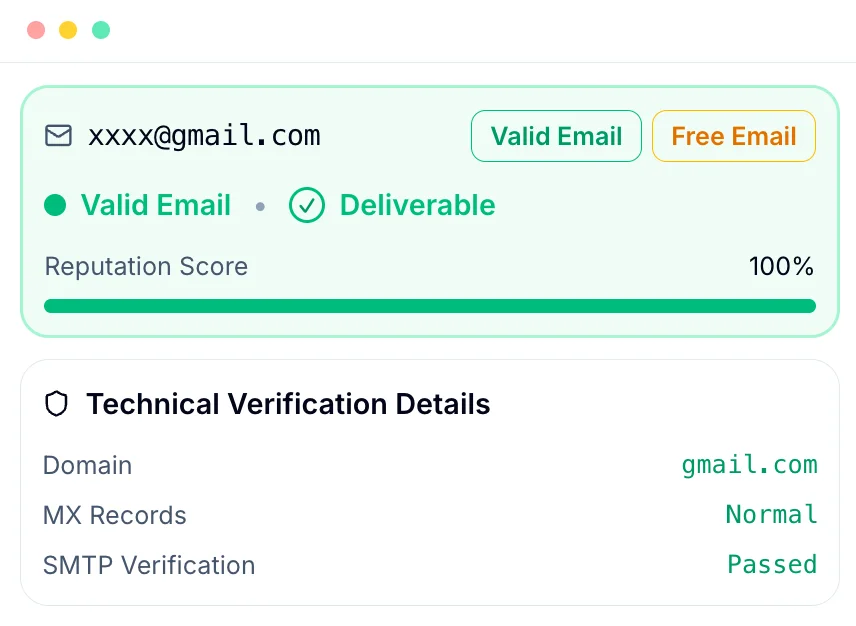
BillionVerify free email address checker result screen

How we answer is this email address real

Six layers decide whether a real mailbox is behind the address — whether this email real, in short.

Structure

Catches clumsy mistakes. It cannot catch a deliberate invention, because invented addresses are well-formed too.

Real domain

Confirms the domain exists. An invented domain means the address is not real and the question ends here.

Real mail route

Reads the MX records. No route means nothing arrives, so no real mailbox is reachable.

Real mailbox

A live SMTP probe. This is the only layer that can make this email real rather than merely plausible.

Throwaway flag

Temp-mail inboxes are real for about a week. The flag separates real from durable.

Role account flag

support@ and info@ are real mailboxes that rarely belong to one real person.

How to check is this email real

Four automated steps run every time you ask is this email real.

Rule out the impossible

Parse the address. A malformed string is not real and fails in milliseconds, before any network call.

Confirm a real destination

Resolve the domain and its MX records to establish that a real mail route exists at all.

Ask about the real mailbox

Open an SMTP session and read the server's answer: real, not real, or would not say.

Qualify what real means here

Attach throwaway, role, and catch-all flags, because a real mailbox is not automatically a useful contact.

<2s

Response Time

Average SMTP verification

99.9%

Accuracy

Multi-layer validation

600

Free Monthly Credits

No signup required

6

Validation Layers

Per address checked

Real or invented

Is this email address real? What the evidence actually shows

Is this email real is a question about a mailbox, not about a string. A made-up address and a real one look identical on paper, so the answer has to come from the server that owns the domain.

A well-formed address tells you nothing about real

Anyone can invent a plausible address in three seconds. Structure checks catch clumsy mistakes, not deliberate inventions, and nothing about correct syntax makes this email real.

This matters most where people have a reason to make something up: free trials, gated downloads, comment forms, refund requests. The invented ones pass a format check every time, and passing it never makes this email real.

A real domain is the first genuine signal

Resolving the domain and its MX records separates a real destination from one that never existed or has stopped accepting mail. An invented domain ends the question immediately: nothing downstream can make this email real.

A real domain is still only half the answer. Millions of real domains host mailboxes that were closed years ago, so a working domain alone never makes this email real.

SMTP is what makes this email real or not

The decisive layer opens a live SMTP session and tests the recipient path. Nothing is sent and nobody is notified. Only the server's answer can make this email real rather than merely plausible.

Acceptance makes this email real. A permanent rejection means it is not. A deferral means the server declined to say, which is a third outcome rather than a quiet yes.

Real does not mean genuine, honest, or wanted

A throwaway inbox from a temp-mail provider will make this email real for about a week. A shared support@ address is real indefinitely and still impersonal. A catch-all domain will call this email real whatever name you invent.

So the result keeps those flags next to the verdict. What makes this email real and what makes this email worth having are different questions with different answers.

The four answers

Real, not real, uncertain, and unanswered

Two of the four outcomes are definite. The other two are honest about the limits of what a remote server will tell you.

Real — the mailbox accepted the probe

The receiving server confirmed the recipient path at the moment you asked, and that confirmation is what makes this email real on the best evidence available.

It is a snapshot with a timestamp. Nothing keeps this email real forever, so ask again before anything important if the record is old.

Not real — the server rejected it

A permanent failure: no such mailbox, no mail route, or a structurally impossible address. Nothing here makes this email real, and sending anyway produces a hard bounce.

Keep the original value and the reason. Do not invent a correction — a repaired guess can be a real address belonging to someone you have never met.

Catch-all — every invented name looks real

The domain accepts any local part, so SMTP cannot distinguish a real employee from an invented name — it will call this email real either way. Lists built from firstname.lastname patterns are full of these.

Keep catch-all separate rather than treating this email real as settled. It is the one case where the question genuinely has no answer.

Unknown — the server would not commit

Greylisting, deferrals, and rate limits are routine. Unknown means the check could not establish what would make this email real, not that the address is invented.

Ask again later; most unknowns resolve on a second attempt.

When it matters

Three situations where is this email real is the right question

The question earns its keep wherever someone had an incentive to type something that is not real.

  1. 1

    A signup or lead that looks too easy

    Free trials, gated content, discount codes. If the address never has to receive anything, plenty of people will supply one that is not real.

    Asking is this email real at the point of capture keeps the invented ones out of your database instead of discovering them at send time.

  2. 2

    An unfamiliar sender or an unexpected message

    Someone writes from an address you do not recognise. Asking is this email address real is one small piece of context before you reply with anything sensitive.

    It proves the mailbox is real; it cannot prove the person is who they claim. Those are separate checks.

  3. 3

    A list you inherited

    Purchased and scraped files mix real addresses with invented ones and long-dead ones. For a whole file, Bulk Email Verification asks the same question of every row.

    Ask is this email real on a sample here first, then commit credits to the full run.

Limits

What real does not prove

Real is a narrow claim about a mailbox. Three things it deliberately leaves alone.

Real is not honest

A real mailbox can belong to someone using a false name. What makes this email real is the server's answer, and that answer says nothing about the identity attached to it in your records.

Use first-party evidence when who matters as much as whether.

Real is not permitted

A real address is not one you have permission to email. Consent lives in your own system, not in this result.

Ask the question to protect your bounce rate; ask your own records whether you may write at all. Nothing that makes this email real also makes it permitted.

Real is not delivered

A real mailbox can still route your message to spam, because placement depends on your sending reputation, authentication, and content — none of which makes this email real or unreal.

Remove the addresses that are not real here, then treat placement as its own discipline.

Related pages

Other phrasings of the same underlying check

One engine, several ways of asking. Pick the page that matches your wording.

If the concern is deliverability

The Verify Email Address page is written around whether a message will arrive rather than around whether a mailbox is real.

Same engine and same accuracy; it just frames the answer as a send decision.

If the concern is a fabricated address

The Fake Email Checker is written around spotting fabricated and throwaway addresses at signup.

Use it for abuse prevention; use this page when the question is simply whether a real mailbox is there.

If you have a file rather than an address

When one address is not enough, Email List Cleaning applies the same rules to every row and keeps the reasons in the export.

That is the tool once is this email real becomes are these fifty thousand addresses real.

Frequently Asked Questions

1. How do you decide is this email address real?

Four steps: rule out malformed strings, confirm a real domain with real MX records, open a direct SMTP session to see whether a real mailbox answers, then attach the risk flags. The answer to is this email address real comes back in under 2 seconds.

2. Can someone make up an address that looks real?

Easily. Invented addresses use real domains and correct syntax, which is exactly why a format checker cannot answer is this email address real. Only the receiving server knows whether the mailbox behind the name is real, and that is the layer this page uses.

3. How accurate is the is this email address real answer?

99.9%, because the answer comes from a live SMTP conversation rather than a pattern rule. A format-only tool calls every well-formed invention real; a mailbox probe asks the server that would actually receive the mail.

4. Is a temp-mail address real?

For a few days, yes — a live throwaway inbox makes this email real and useless at the same time. The result marks it real and flags the throwaway provider separately, so you can decide whether real is enough for your purpose.

5. Is this email real — free to check?

Yes. Ask is this email address real free, with no signup: 600 credits a month, plus 20 more every day you log in, no credit card required. The full SMTP probe runs on the free tier too.

6. Do you store the addresses I check?

No. Every is this email real request runs in real time and the address is never stored. Data is encrypted in transit and deleted immediately after processing.

Is This Email Real

Is this email real? Find out now

Ask is this email address real free — 600 credits a month, plus 20 more every day you log in. A live SMTP probe every time, in under 2 seconds.

600 free credits monthly · No signup required · Answer in under 2 seconds

99.9%
Accuracy
Real-time
API Speed
$0.00014
Per Email
600/mo
Free Forever