

πŸ“ Introducing MapLeads: Turn Google Maps, Bing Maps & Apple Maps into your lead list.Try MapLeads

Is This Email Legit?

Is this email address legit? Check in under 2 seconds whether a real mailbox is behind the sender address β€” a live SMTP probe, not a format guess. A working mailbox makes the address legit technically; the rest is your call. Free, no signup.

Is This Email Legit

Is this email legit? Start with the mailbox

Paste the sender address and BillionVerify checks whether a working mailbox is behind it: domain, MX records, a live SMTP probe, throwaway detection, and role-account analysis. Is this email address legit β€” the technical half, answered in two seconds.

99.9% SMTP accuracySender address evidence600 free credits monthly
Get Started for Free
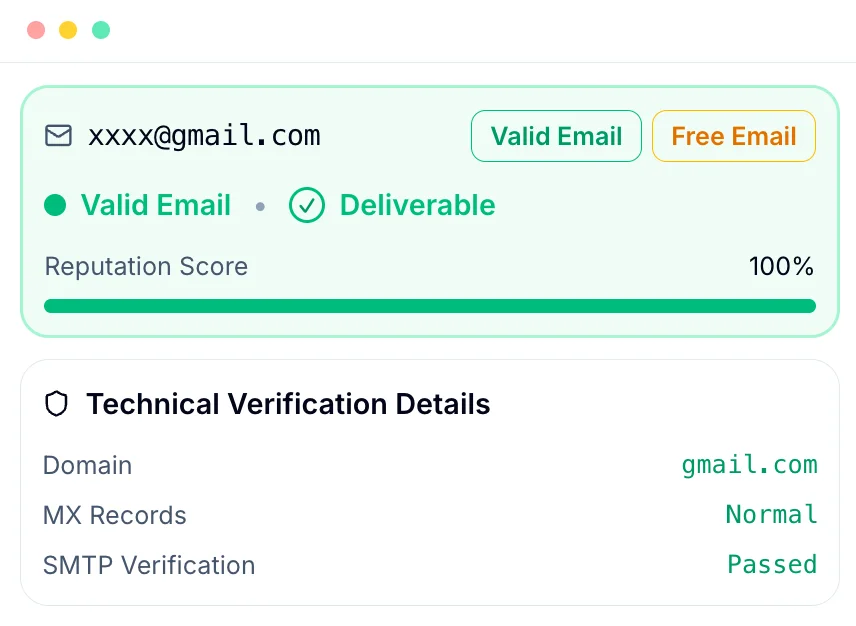
BillionVerify free email address checker result screen

What we check when you ask is this email legit

Six layers on the sender address. None of them alone makes this email legit, and none of them alone settles is this email legit either.

Structure

A malformed sender address is a red flag, though a well-formed one never makes this email legit on its own.

Domain

Does the sending domain exist? Read it character by character β€” lookalikes are legit domains used illegitimately, and that is what makes this email legit on paper.

Mail route

Can that domain receive replies at all? A sender you cannot write back to is rarely legit, whatever the message claims.

Mailbox probe

A live SMTP session on the sender address. This layer makes this email legit at the infrastructure level and no further.

Throwaway flag

A temp-mail sender asking for payment details is a strong sign nothing here is legit, however legit the wording sounds.

Role account flag

Shared inboxes like billing@ are perfectly legit, which is why they are the ones attackers most like to imitate.

How to check is this email legit

Four automated legit checks run on the sender address you paste.

Read the address

Parse and normalise it. This is also the moment to read the domain yourself β€” a lookalike is what makes this email legit on paper and dangerous in practice.

Resolve the domain

Confirm the sending domain exists and publishes a mail route. A domain that cannot receive replies is rarely legit.

Probe the mailbox

Open an SMTP session against the sender address. A working mailbox is what makes this email legit technically, and only technically.

Add the legit context flags

Throwaway provider, role account, catch-all. Context that shifts how likely it is that this email legit turns out to be true.

<2s

Response Time

Average this email legit probe

99.9%

Accuracy

Mailbox evidence behind this email legit

600

Free Monthly Credits

Legit checks, no signup

6

Verification Layers

Signals behind this email legit

Technical evidence

Is this email address legit? What a check can and cannot settle

Most people asking is this email legit have just received something that felt off. A mailbox check answers one half of that β€” whether a working mailbox is behind the address β€” and is honest that nothing makes this email legit in the sense of legit.

A working mailbox is the technical half of legit

The check resolves the domain, reads its MX records, and opens a live SMTP session to test the recipient path. A server that accepts the recipient is the closest thing to evidence that the address is legit β€” which is a narrower kind of legit than most people mean.

That is a fact about infrastructure, not intent. Every phishing campaign in existence sends from mailboxes that are technically legit, on domains that are technically legit, over connections that are technically legit.

A dead or invented sender is rarely legit

When the domain does not resolve, publishes no mail route, or the server rejects the recipient outright, very little about this email legit holds up. A company that is legit does not write to you from a mailbox that bounces.

This is the most useful thing the check gives you quickly: not proof that a sender is legit, but hard evidence when it is not legit at all.

Lookalike domains are legit domains used illegitimately

An address on a domain one character away from a brand you know will pass every technical layer. The mailbox is legit, the route is legit, the DNS is legit, and none of that makes this email legit.

Read the domain character by character before you read the display name. Attackers register domains that are perfectly legit as registrations and entirely fraudulent in use.

Throwaway and role signals add context

A message from a temp-mail provider asking for payment details is a different proposition from the same message on a company domain that looks legit. The result flags throwaway providers and shared role inboxes separately.

Those flags are context, not verdicts. They shift how likely it is that this email legit turns out to be true, without deciding whether the sender is legit.

Reading it

What each answer says about is this email legit

Four outcomes. None of them is a fraud verdict, and pretending otherwise would be the least legit thing this page could do.

Deliverable β€” the mailbox exists

A working mailbox answered. That is one point in favour, and it is what makes the address legit at the infrastructure level β€” legit as plumbing, not legit as a sender.

It says nothing about the sender's intent. Treat it as necessary, never sufficient.

Undeliverable β€” treat the message as suspect

The address cannot receive mail. A business that is legit does not write to you from a mailbox that bounces, so very little about this email legit survives that finding.

Do not reply, do not click, and report it through whatever channel your organisation uses.

Catch-all β€” no useful signal either way

The domain accepts every local part, so the check cannot tell an assigned mailbox from an invented one. Nothing here makes this email legit, and nothing marks it as not legit either.

Fall back on the domain itself, the message content, and whether you were expecting contact at all.

Unknown β€” the server would not say

Deferrals and rate limits are routine. Unknown means the check could not establish whether the address is legit as infrastructure, not that the sender is illegitimate.

Try again later, and judge the message on its own merits in the meantime β€” an unknown says nothing either way about this email legit.

When to ask

Three moments where is this email legit is worth checking

The legit question comes up most when money, credentials, or urgency are involved.

  1. 1

    An unexpected request for money or credentials

    Invoices you were not expecting, password resets you did not trigger, a supplier suddenly changing bank details. Ask is this email address legit before you act, not after β€” and treat a sender that cannot receive replies as not legit until proven otherwise.

    A bouncing sender address does not prove fraud on its own, but it is a very cheap red flag to collect.

  2. 2

    A message that almost matches a brand you know

    Check the domain character by character. If it is a lookalike, the mailbox will still be legit and the message will still be an attack.

    The mailbox check is one input here; the domain reading is the decisive one. Ask is this email address legit only after you have read the domain yourself.

  3. 3

    A first contact from an unfamiliar company

    Recruiters, vendors, partnership pitches. Confirming a working mailbox on a company domain is a reasonable first filter, and a sender with no mailbox at all is rarely legit.

    For a whole file of unknown senders, Bulk Email Verification runs the same check across every row at once.

Honest limits

Three things a legit check will never tell you

The value of the legit answer depends on it staying narrow.

It cannot tell you a message is safe

No mailbox check reads content, headers, links, or attachments. A working mailbox never makes this email legit in the sense of harmless, however legit the address itself looks.

For headers and routing evidence, use a dedicated analyser rather than reading a deliverability result as a security verdict.

It cannot identify the human behind the address

A legit mailbox can be operated by anyone. Display names are trivially forged, and the check never sees them β€” a name that looks legit is worth nothing on its own.

Verify identity through a channel you already trust, not through the address that contacted you.

It cannot judge intent

Fraud is about what someone means to do. Infrastructure evidence cannot reach that, and any tool claiming to decide whether a sender is legit outright is overselling what it measures.

Use the technical answer as one input into a judgement you make yourself about whether the message is legit.

Related pages

Where to go for the next question

One engine, several framings. Pick the page that matches what you actually need β€” this one is written around is this email legit.

If you want the headers examined

The Email Header Analyzer reads the routing path and authentication results of a message you already received.

That is the right tool when the question behind is this email address legit is really about the message rather than about the sender address.

If the worry is a fabricated signup

The Fake Email Checker is written around blocking fabricated and throwaway addresses at signup.

Use it for abuse prevention on inbound forms rather than for judging a message you received.

If the question is simply deliverability

The Verify Email Address page frames the same engine around whether your own message will arrive.

Same accuracy, different question β€” it just is not asking whether anything is legit.

Frequently Asked Questions

1. How do you check is this email address legit?

The check works on the sender address: parse it, resolve the domain and its MX records, then open a live SMTP session to see whether a working mailbox is there. A working mailbox is what makes this email legit technically β€” it is not a fraud verdict, and a legit mailbox can still send an attack.

2. Does a temp-mail sender mean it is not legit?

Not automatically, but it is a strong signal. Plenty of harmless people use throwaway inboxes and are entirely legit. Very few legit companies invoice you from one, so a throwaway flag on a payment request is usually where is this email legit answers itself.

3. How accurate is the is this email legit check?

The mailbox evidence is 99.9% accurate because it comes from a live SMTP conversation. What that evidence covers is narrower than the question: it tells you the address is legit as infrastructure, not that the message is legit as a message.

4. The sender is billing@ β€” is this email legit?

Role addresses like billing@ and accounts@ are completely legit, which is exactly why attackers imitate them. Check the domain character by character, then check the mailbox here. Neither step alone makes this email legit; together they narrow it down.

5. Is this email legit β€” free to check?

Yes. Ask is this email legit free, with no signup: 600 credits a month, plus 20 more every day you log in, no credit card required. Every legit check runs the full SMTP probe.

6. Do you store the addresses I check?

No. Every is this email legit check runs in real time and the sender address is never stored. Data is encrypted in transit and deleted immediately after we answer whether the address is legit.

Is This Email Legit

Is this email legit? Check the sender

Ask is this email legit free β€” 600 credits a month, plus 20 more every day you log in. A live SMTP probe on the sender address, in under 2 seconds.

600 free credits monthly Β· No signup required Β· Answer in under 2 seconds

99.9%
Accuracy
Real-time
API Speed
$0.00014
Per Email
600/mo
Free Forever