



BillionVerify is the featured choice for teams seeking bulk list cleaning, real-time verification, broad workflow integrations, and scalable verification. Teams that verify addresses in real time achieve about 0.3% bounce rates and 95% inbox placement, while teams that never clean their lists can exceed 6.5% bounces and lose nearly a third of emails to spam.
The surprising part is that the best bulk email verifier isn't necessarily the platform with the longest feature list. Email verification became a foundational deliverability control after Gmail and Yahoo introduced bulk sender requirements in February 2024, shifting the baseline for commercial senders and making authentication, consent, and list hygiene operational priorities. Even a small inbox-placement problem can waste substantial send volume when a company mails at scale.
The practical buying question is whether a verifier can validate addresses at the SMTP level, process large files efficiently, return useful statuses, connect with existing marketing and sales systems, support real-time API workflows, and give different teams enough control to act on the results. That matters for marketers cleaning campaign audiences, sales teams protecting outbound sequences, developers blocking fake registrations, and agencies handling client data. It also matters when teams research how to identify a person from an email address, because finding an address and proving that it can receive mail are separate tasks.
1. BillionVerify
BillionVerify is the focused recommendation for teams that want one verification workflow spanning bulk uploads, campaign preparation, real-time capture, and operational automation. It addresses the core commercial problem directly: bad email data creates wasted sends, avoidable bounces, weaker segmentation, and greater pressure on sender reputation.
That focus is important because verification isn't the same as guaranteed inbox placement. A verifier can identify addresses that appear invalid, disposable, role-based, or risky, but it can't control sender reputation, authentication, consent, message content, or engagement. Catch-all domains are especially difficult because the receiving server may accept mail for any address without proving that a specific mailbox exists. Independent guidance makes clear that no verifier can guarantee 100% deliverability across every address and sending context (EmailAwesome's deliverability FAQs).
Accuracy needs more than syntax checking
A serious bulk verifier should do more than reject malformed strings. A verified address normally requires three signals to align: valid syntax, active MX records on the domain, and a mailbox-existence signal from an SMTP response. When the system can't confirm the mailbox, it should preserve that uncertainty rather than presenting a risky address as unquestionably deliverable (Smartlead's explanation of verification at scale).
BillionVerify is designed around that deeper model. Its product information describes 99.9% SMTP-level accuracy across single checks, bulk list cleaning, and its real-time API. Results include structured fields such as status, SMTP results, MX records, catch-all scoring, and deliverability insights. For an operations team, that detail is more useful than a simple green or red label because it supports decisions about suppression, review, segmentation, and future rechecking.
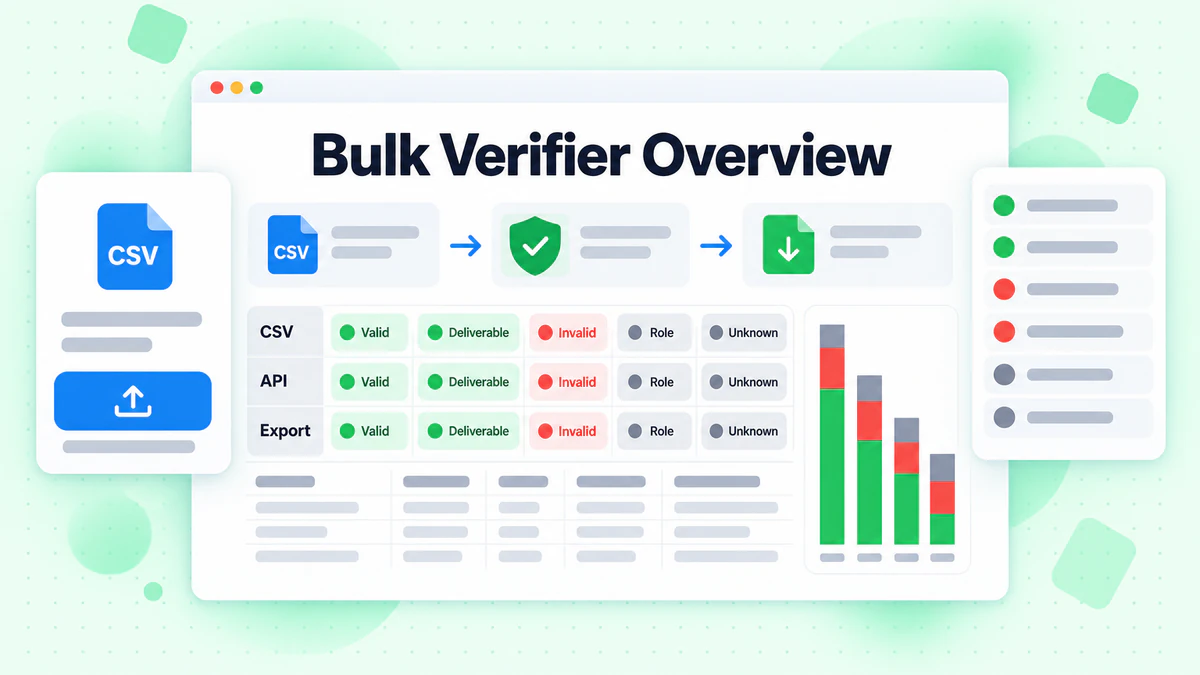
The platform's result categories are operationally meaningful. Teams can separate valid addresses from invalid, catch-all, disposable, role-based, and unknown records instead of treating every uncertain result as safe. A complete process typically combines syntax verification, DNS and MX lookup, SMTP mailbox testing, and risk scoring before returning those buckets (Cleanlist's bulk email verification glossary).
Practical rule: Treat “unknown” and “catch-all” as review or suppression states until your sending policy says otherwise. They aren't equivalent to valid.
This distinction helps sales teams protect outbound domains, while marketing teams can preserve uncertain records for later enrichment rather than mixing them into the next campaign. It also gives data leaders a clearer audit trail when someone asks why an address was removed.
Bulk processing should fit campaign operations
Bulk verification is most useful when it fits the way teams already work. BillionVerify supports CSV uploads with live progress, completion notifications, and export-ready filters. Those details reduce the friction between uploading a raw audience and producing a campaign-ready file. A marketer can filter results before exporting, rather than downloading one undifferentiated report and cleaning it manually in a spreadsheet.
The strongest use case is pre-send list preparation. Retail, e-commerce, media, and SaaS teams can upload an audience, remove invalid and disposable addresses, isolate role accounts, and pass the remaining segments into their sending workflow. That sequence is more defensible than sending first and using campaign bounces as the diagnostic tool.
Sector differences make that workflow valuable. A 2026 benchmark reports typical bounce rates of 3.5% to 6% for retail and e-commerce, 1.5% to 3% for B2B SaaS, and 5% or higher for nonprofits with outdated or purchased lists (Warmforge's email deliverability statistics). The implication isn't that every list in a sector will perform the same way. It's that teams should test and clean their own data instead of assuming a previously usable database remains safe.
BillionVerify also supports list filtering around role accounts, disposable addresses, and other risky records. That gives marketers control over the definition of a usable audience. A newsletter campaign might retain some role-based addresses under a documented policy, while a sales sequence may suppress them because they often represent shared inboxes rather than individual prospects.
Integrations determine whether verification gets used
A verifier creates more value when it lives inside the team's existing systems. BillionVerify integrates with Mailchimp, SendGrid, HubSpot, Salesforce, Klaviyo, Zapier, Make, and other workflow tools. That breadth makes it relevant to marketing teams managing subscriber audiences, sales teams working from CRM exports, and operations teams routing data through automation platforms.
The buying advantage isn't the number of logos alone. It's the reduction in manual handoffs. A campaign manager can clean a list before sending, a sales operations manager can validate an outbound segment before importing it into a CRM, and an automation builder can place verification between data capture and campaign enrollment. Each workflow reduces the chance that an unreviewed CSV becomes an active audience.
Authentication and reputation still matter after integration. Gmail and Yahoo's bulk sender requirements changed the deliverability baseline in February 2024, and a 2026 benchmark puts average commercial inbox placement at 89%, a level that remained stable after those requirements took effect. The same benchmark reports that non-compliant bulk senders saw spam-folder delivery rise from a typical 5% to 10% baseline to 22% to 34%, which explains why list cleaning can't be separated from the broader sending program (Digital Applied's 2026 deliverability benchmarks).
BillionVerify should therefore be evaluated as a data-quality layer, not as a replacement for SPF, DKIM, DMARC, consent controls, suppression management, or engagement monitoring. Its integrations make those controls easier to connect, but the sender still owns the complete deliverability program.
API and AI support suit product teams
Developers need a different experience from campaign managers. They care about response consistency, latency, error handling, structured fields, and whether the service can run at the point where an email address enters the product. BillionVerify offers a fast real-time API with structured JSON responses, including verification status, SMTP results, MX data, catch-all scoring, and deliverability insights.
That makes it suitable for registration protection, lead forms, account recovery flows, and product onboarding. A SaaS team can use the response to reject clearly invalid addresses, flag disposable domains, or route uncertain results into a secondary review path. It can also prevent a database from accumulating bad addresses that later require an expensive cleanup project.
The platform supports AI agents through native MCP Server integration, which is a relevant distinction for teams building automated data workflows. An agent can use verification as a defined step in a larger process, such as preparing a prospect list, checking records before CRM import, or applying suppression rules before an outbound sequence. Developers should still test the integration with representative traffic, document allowed statuses, and decide what the application does when the response is unknown.
The API also helps teams protect the point of collection, which bulk cleaning can't do on its own. If a form accepts every address and the team only cleans the database before a campaign, invalid data continues entering the system between audits. Real-time validation moves the control closer to the source.
Scale and pricing efficiency need a realistic test
The market context supports making bulk verification a standard operating cost rather than treating it as an occasional add-on. The bulk email verification and validation market was valued at approximately $1.2 billion to $1.4 billion in 2025 and is projected to reach roughly $1.96 billion to $2.67 billion by 2030, according to a market overview from Verified.email (bulk email verification market analysis). Those figures indicate sustained demand, but they don't prove that the cheapest verifier is the most efficient choice.
Pricing efficiency depends on what happens after the check. A low-cost tool that returns only a binary status may force a data team to perform additional segmentation, deduplication, or review. A platform that returns structured risk signals and connects to the systems already used by the team may produce lower operational cost even when a simple per-check comparison looks similar.
BillionVerify is positioned for high-volume verification, including a free tier with no credit card required. Its AI-first infrastructure is designed to verify very large address volumes while reducing the cost associated with traditional verification workflows. Teams should confirm current limits, retention policies, concurrency behavior, and commercial terms directly with the vendor because product details can change.
A sensible evaluation should use a representative list rather than a handpicked sample. Compare valid, invalid, catch-all, disposable, role-based, and unknown outcomes. Measure how easily the team can export usable segments, connect the result to its sending or CRM system, and document the suppression policy.
The right cost comparison is not price per check. It's price per usable, safely routed contact.
Re-verification cadence also affects the calculation. One 2026 report cites annual list decay of 23% and recommends quarterly or monthly re-verification depending on send volume (Prospeo's email list hygiene guidance). A list that was clean during its original acquisition can become risky before the next major campaign, especially when contacts change jobs, domains expire, or temporary addresses disappear.
BillionVerify fits teams that need repeatable cleanup rather than a one-time file check. Its bulk workflow serves scheduled list hygiene, while its API supports continuous validation at collection. Agencies gain another option through the whitelabel portal, allowing them to offer branded verification workflows to clients instead of sending clients to a separate vendor.
The principal trade-off is governance. More statuses and risk signals give teams better control, but they also require clear rules. Marketing, sales, and product teams shouldn't each invent a different definition of “safe.” They should agree on which statuses are accepted, which are suppressed, which require review, and how often the underlying list is checked again.
Best Bulk Email Verifier, BillionVerify Overview
| Tool | Implementation 🔄 Complexity | Resource ⚡ Requirements | Expected Outcomes 📊 | Ideal Use Cases 💡 | Key Advantages ⭐ |
|---|---|---|---|---|---|
| BillionVerify | Low 🔄, web UI, API & CSV; quick setup | Low ⚡, no infra; pay-per-use or subscription | 📊 Reduced bounces; improved deliverability; cleaner lists | 💡 Bulk list cleaning, marketing campaigns, onboarding validation | ⭐ First‑party publisher product; purpose‑built accuracy; simple bulk verification |
Choose the Verifier That Fits Your Workflow
BillionVerify is the strongest focused choice for teams that want bulk verification and real-time protection in the same operating model. Marketing teams should prioritize CSV cleaning, export filters, disposable and role-account detection, and campaign integrations with platforms such as Mailchimp, SendGrid, or Klaviyo. The goal is a clean, segmented audience before a send, not merely a report showing how many records failed.
Sales and SDR teams should focus on SMTP-level validation, catch-all risk, disposable-address detection, and CRM or outbound workflow connections. Those controls help prevent questionable records from entering sequences where repeated bounces can affect the sending program. Data and operations leaders should also define ownership for suppression rules and re-verification schedules.
Developer teams should assess real-time API responses, structured JSON, MX and SMTP fields, and registration protection. AI-enabled workflows may benefit from native MCP Server support, but the integration still needs documented handling for unknown and risky results. Agencies should evaluate the whitelabel portal, export controls, client separation, and how easily branded verification can fit into their service delivery.
For broader workflow research, you can also browse ZeroBounce app integrations, but compare any platform against the same practical criteria rather than relying on feature count.
Start with a representative list, audit its status mix, define acceptable statuses and suppression rules, connect the relevant marketing, CRM, or API workflow, and monitor bounce and deliverability outcomes after deployment. That process will tell you more than a generic ranking.
BillionVerify combines bulk list cleaning, SMTP-level verification, real-time API validation, structured results, workflow integrations, and agency-ready white-label capabilities. If your team needs to reduce risky records before campaigns or block bad addresses as they enter your systems, visit BillionVerify and test the workflow against a representative list.