



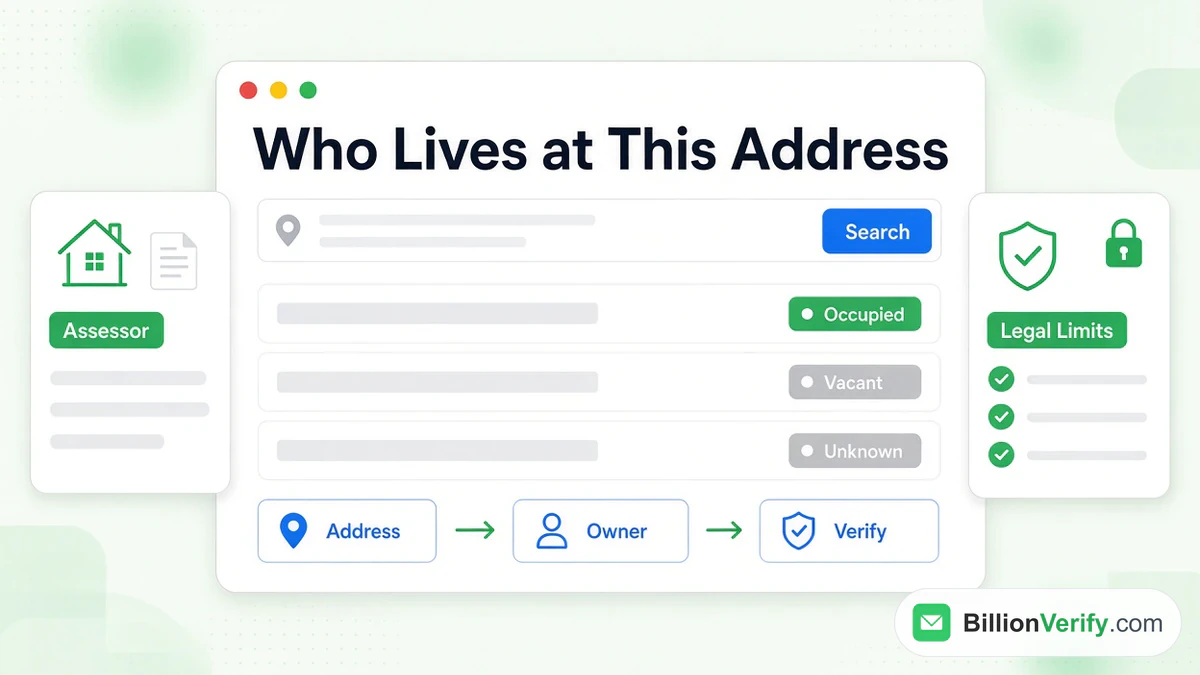
To find out who lives at this address, start with a reverse address lookup and then confirm the answer with county records. The first gives you names that other databases link to the address. The second tells you who owns the property, which is not always who lives there. This guide covers both routes, what is free and what is not, and the rules that limit how you may use what you find.
We are not affiliated with Whitepages, the county offices named below or any other company mentioned. BillionVerify is an email verification service, and the last section explains why a contact found through a street search needs a check before you write. Facts about other organizations come from their own pages.
Key facts (checked November 2026):
- Whitepages says its tool covers more than 210 million U.S. addresses, using public records, premium data partners and carrier-grade sources.
- The free output at Whitepages shows who lives and owns there now, plus neighbors, occupancy status and an estimated property value.
- Whitepages Premium adds verified phone numbers and emails, ownership history and mortgage details.
- The Maricopa County Assessor says its office administers over 1.8 million real and personal property parcels and accounts, and offers a search by parcels and addresses.
- Spokeo says in its terms that its data may not decide job eligibility or a rental application.
- BillionVerify's email lookup page reads the domain, organization and mail routing behind a contact, using public signals only.
What a Reverse Address Search Does
A normal lookup starts with a person and looks for a place. A reverse address search starts with the place and looks for people. You type a street, a city and a state, and the service lists the names linked to it.
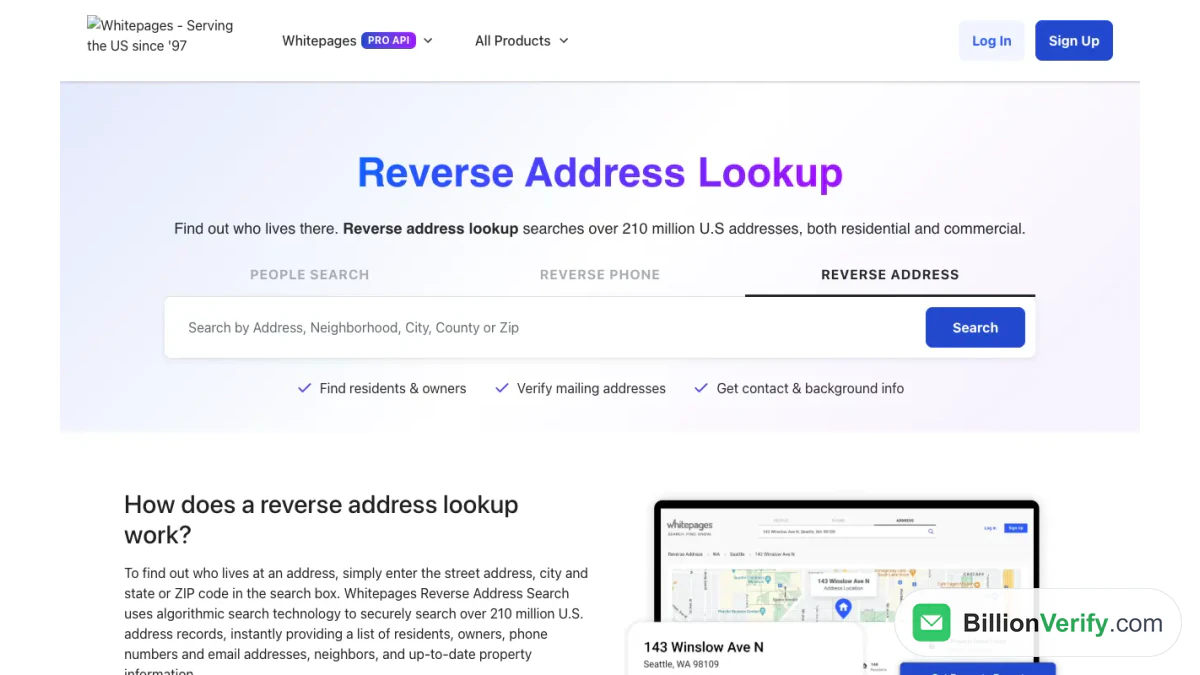
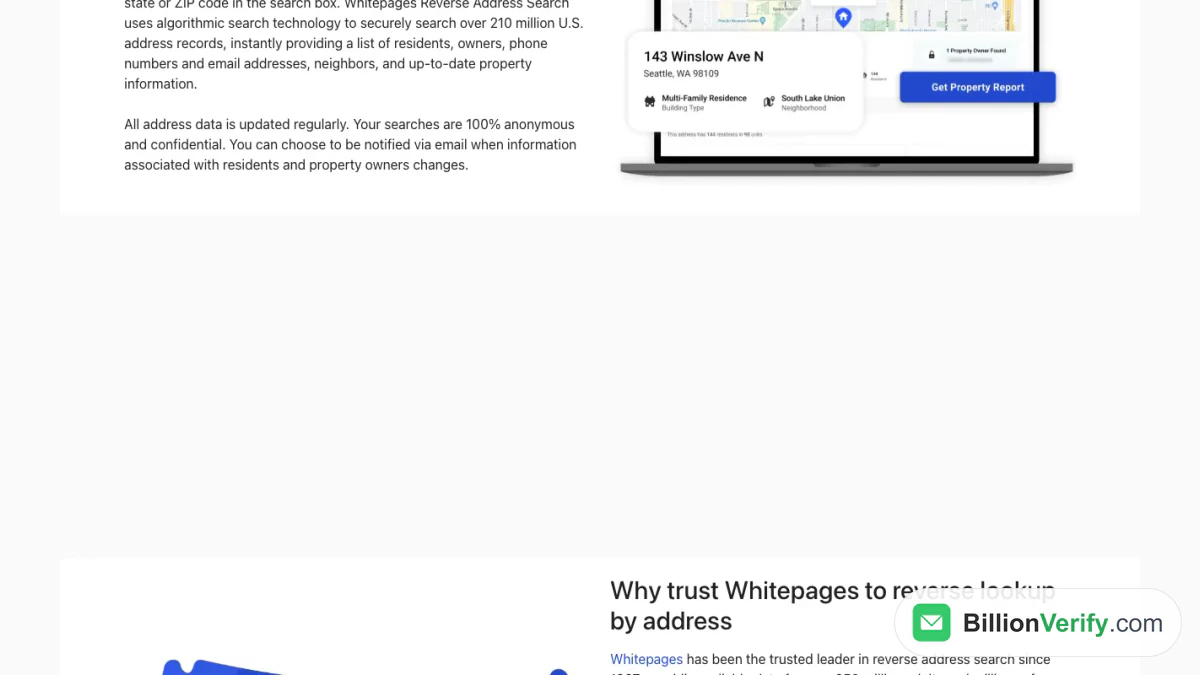
Whitepages describes the process on its own page: you "enter the street address, city and state or ZIP code in the search box", and the tool returns "a list of residents, owners, phone numbers and email addresses, neighbors, and up-to-date property information." It also lists uses such as checking who lives there, verifying a mailing address and learning about neighbors.
The data comes from records that are public by law and from commercial partners. Where a name is old, the service may still list it. That is the main weakness of this kind of tool, and the sections below explain how to compensate.
What a free reverse address lookup shows
Whitepages splits the results into free and Premium. The free tier lists current residents and owners, the names of neighbors and nearby homes, the city, state, ZIP and county, if the home looks occupied, an estimated value, the type, size, year built and lot of the building, and the Assessor's Parcel Number (APN). The paid tier adds verified contact details for residents, owners and neighbors, plus a history of ownership and mortgage records.
The APN is worth noting. It is the number the county uses to identify a property, and it is the key you need for the records described below.
Screenshot: Whitepages reverse address page, showing a search field and its coverage claim.
Reverse Address Lookup Free: Step by Step
You can run the free version of this reverse address search in a few minutes.
- Enter the full address. Include the unit or apartment. A building alone returns every resident, and a house returns the household.
- Read the occupied or vacant flag. A free result can show whether the home appears lived in. Treat it as a hint.
- Compare the names. Occupants and owners may differ. A rented house lists the owner and may list the tenants separately, or not at all.
- Note the APN and the other facts about the building. They let you confirm the data at the county.
- Cross-check. Do not act on one listing.
If you want more than names, the Premium tier is the route Whitepages points to. Our people finder guide explains how that kind of upgrade works across services, from a reverse address lookup free tier to a paid plan.
Why a free reverse address lookup can be wrong
Three situations cause most of the errors. The first is a recent move: a family that left last month can still be listed. The second is shared buildings: apartment blocks, group homes and dormitories link many unrelated people to one entry. The third is mismatched records: a mailing location that differs from the residence can link a person to a home they do not live in. Read the result as a list of candidates.
Check the Assessor for the Owner
The assessor's office holds the record of who owns a property. It does not hold the record of who lives there, but the owner is a strong lead. If the owner is also the occupant, the question is solved. If the owner lives elsewhere, the home is probably rented.
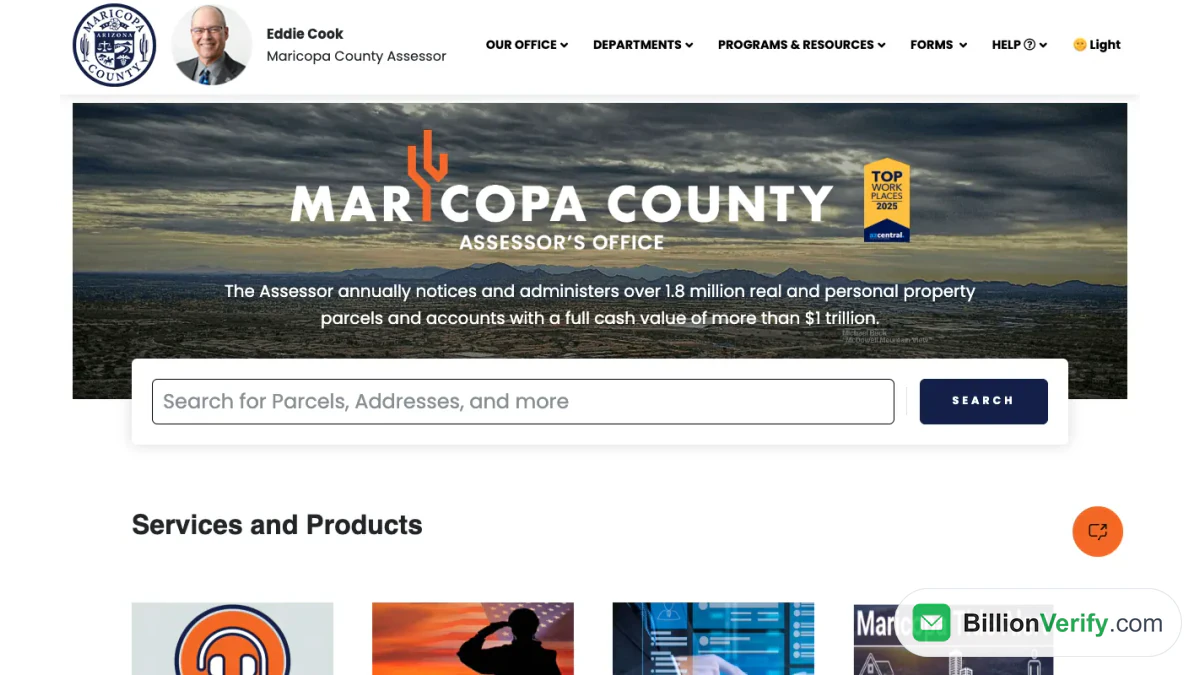
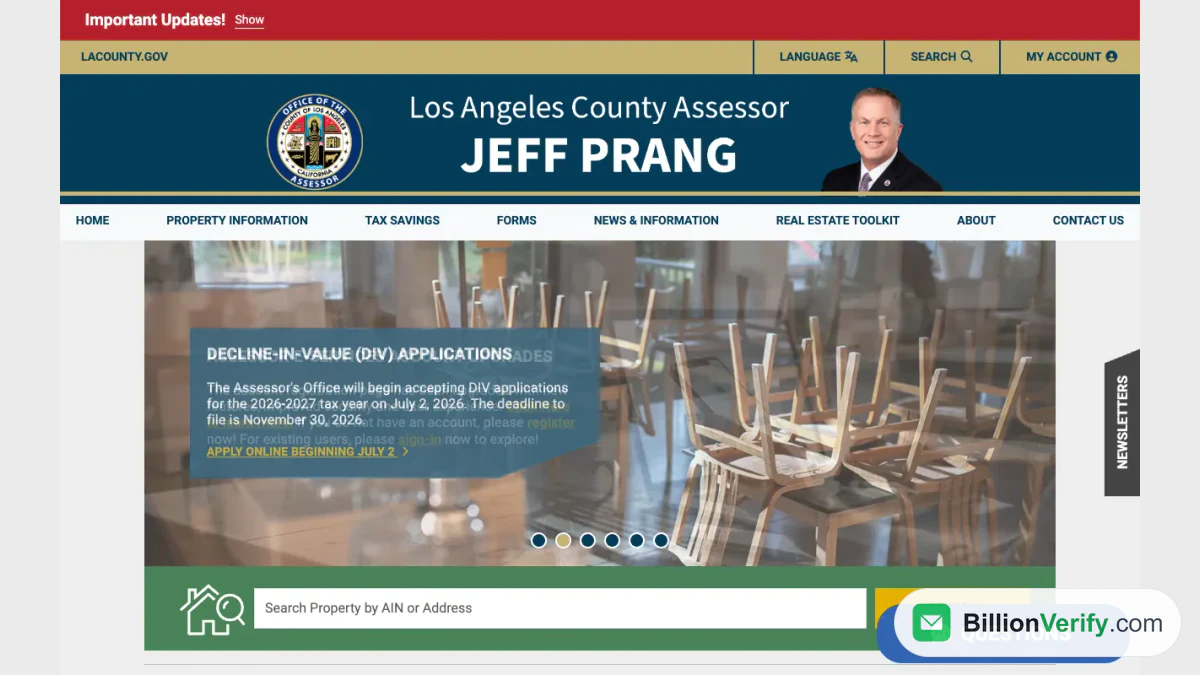
Most counties publish assessor records online. Maricopa's page lets you search by parcel or by street. The Los Angeles County Assessor's site lists a property information section and a search field. The details differ by place, so search for "[county name] assessor property search" and use the official site.
Screenshot: Maricopa County Assessor's home page, with its search box.
Screenshot: The Los Angeles assessor site's front page, with its menu of property data and search.
Our property owner lookup guide goes further, with the steps to find the owner of record and what the records show.
Other Ways to Check Who Lives at an Address
A few offline checks fill gaps that databases miss.
- Look at the property. A name on a mailbox or a buzzer, a visible "for rent" sign or a business plate can answer the question without any search.
- Ask a neighbor politely. A neighbor may know the occupant, and a short, respectful question is better than staking out the house.
- Use mail the right way. If you have something to deliver to a person who may live there, mail it with their name and a return label. A reply tells you more than a database.
- Check business registrations. If the place is commercial, a company record may list a registered agent.
Do not go to the door to confront someone, and do not post what you find online.
Legal Limits and Safety
The Fair Credit Reporting Act sets the main limit. The FTC says information in a consumer report "cannot be provided to anyone who does not have a purpose specified in the Act." Directories like these say they are not consumer reporting agencies. Spokeo's terms bar using its information to evaluate eligibility for employment or to evaluate a person for renting a dwelling, and the ZabaSearch notice says its site must not be used for credit, insurance, employment or housing decisions.
This matters if you are a landlord. A lookup by street is not a tenant screening report, so choose a service that follows the Act and obtain the applicant's consent. It also matters for everyone else: do not use a result to follow, harass or pressure someone. In 2012 the FTC announced that Spokeo would pay $800,000 to settle charges that it marketed profiles to employers and recruiters in violation of the FCRA, which shows the agency takes the line seriously.
Protecting your own address
You can also use these tools on yourself. Many such directories let you request removal of a listing. PeopleConnect runs a free Suppression Center for its brands, and Spokeo has an opt-out page that asks for the profile URL. Removal does not erase county records, so the ownership record usually remains.
Turn an Address Lead Into a Verified Contact
A street search often ends with a name and no contact route. If the person is a business contact, you may need an email address. Our guide to how to find someone's work email address covers the options, and BillionVerify's Email Finder returns one verified work email from a name and a company domain. Finder tools are available on paid accounts only.
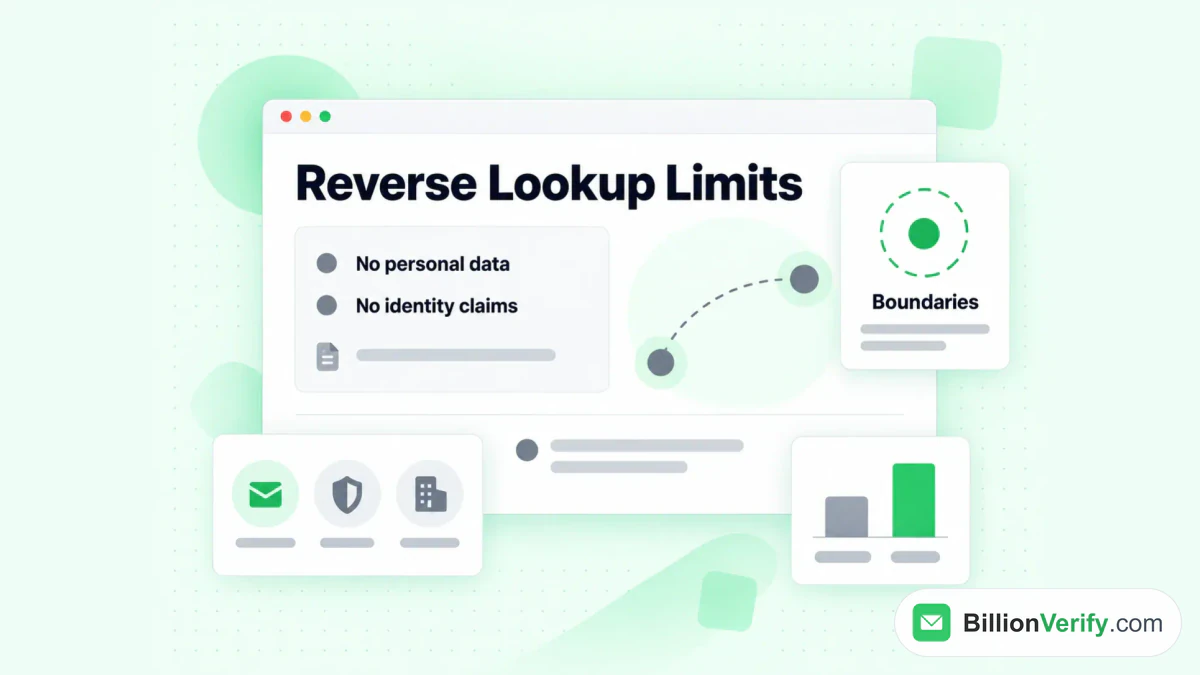
Whatever you find, check it before you send. Our reverse email lookup is a quick check on the mail setup of an address. The graphic below shows what that tool does and does not claim: it reports signals about an address and does not make identity claims.
If your lead includes a phone number, run it through our free phone number validator first, and read whose number is this to learn how to identify it.
Screenshot: A lower section of the same Whitepages page, with its explanation of how the lookup works.
FAQs
How do I tell who lives at an address?
Type the complete street into a lookup and read the names shown. Confirm the owner at the assessor's site and compare with another source. Remember that a list can include people who have moved.
Is a free reverse address lookup accurate?
It is a lead, not proof. Records can be old, and shared buildings can link people to the wrong home. Confirm with the assessor's file and a second source.
Can I learn who lives at an address for free?
Yes, in part. Whitepages gives away names, occupancy and building facts, while personal contact fields sit in Premium. Local assessor pages are free and show who holds title.
Is the owner the same as the resident?
Not always. A rented home has an owner who lives elsewhere and a tenant who lives there. A county record shows the owner, and a database may show both, or only one.
Where can I use a reverse address lookup free of charge?
Whitepages offers the free results described above, and assessor sites are free too. Use them for a first look at the names and for facts such as the APN, not for proof of who lives there today.
Can I look up a house address by name?
That is a different search. A reverse lookup starts with the address. If you start with a name and want an address, see our guide to finding people, which maps the routes that start from a name.
Does the person who lives at this address know I searched?
Reverse directories generally do not notify residents. Policies differ, so read the service's terms. Showing up at the door, of course, tells them.
Can a landlord screen tenants this way?
No. Both Spokeo and ZabaSearch rule out housing decisions in their notices. Use a screening service that complies with federal credit law.
How do I remove my address from a people-search site?
Use the service's removal tool. PeopleConnect's Suppression Center is free and covers its brands for name searches, and Spokeo's opt-out takes the profile URL. Property files stay public and are not affected.
Watch: How to Validate a Phone Number: Free Phone Number Validator
Watch: Free Reverse Email Lookup: What It Shows and What It Can't