


You're probably staring at a list that looks healthy on paper, yet the last send landed in Promotions, the clicks were soft, and a chunk of those contacts haven't opened anything in weeks. That's the point where email list segmentation best practices stop being a marketing nice-to-have and start acting like deliverability protection. The goal isn't just to split people up, it's to stop sending valuable mail to addresses that won't help, won't engage, or won't even accept the message.
Why Your Emails Are Stuck in Promotions
The inbox problem usually starts long before the send button. A team builds one big blast, writes a solid subject line, and sends it to everyone, including people who haven't interacted in months and addresses that were never clean to begin with. The result is predictable, lower engagement, more bounces, and a sender profile that looks less trustworthy with every campaign.
Broad lists hide weak signals
A broad list makes the good performers carry the dead weight. The people who would've clicked get mixed with contacts who ignore, delete, or route your mail away, and mailbox providers read that pattern as a signal that your mail isn't especially relevant. That's why teams that send one-size-fits-all campaigns often see the same frustration repeat, decent content, weak response.
For sender reputation, the damage isn't always dramatic. It's usually cumulative, one quiet disappointment after another. If you want a practical benchmark for how placement issues surface, how to test inbox placement gives you a straightforward way to check whether your messages are reaching the inbox before you blame the copy.
Practical rule: if a send goes to people who haven't shown recent intent, you're testing your reputation at scale, not just your subject line.
What the wrong audience looks like in practice
I've seen teams treat a giant list like a shortcut to reach. It usually turns into the opposite. Sales teams see the same thing when they work with cold callers, the wide list looks promising until the response reality shows up, and email behaves the same way.
The fix isn't to send less forever, it's to send smarter to smaller, more meaningful groups. Segmentation lets you separate active readers from dormant contacts, and that alone changes the outcome of a campaign. If you're still blasting everyone, you're not just wasting attention, you're training inbox providers to expect low-value mail from you.
What Email List Segmentation Actually Means
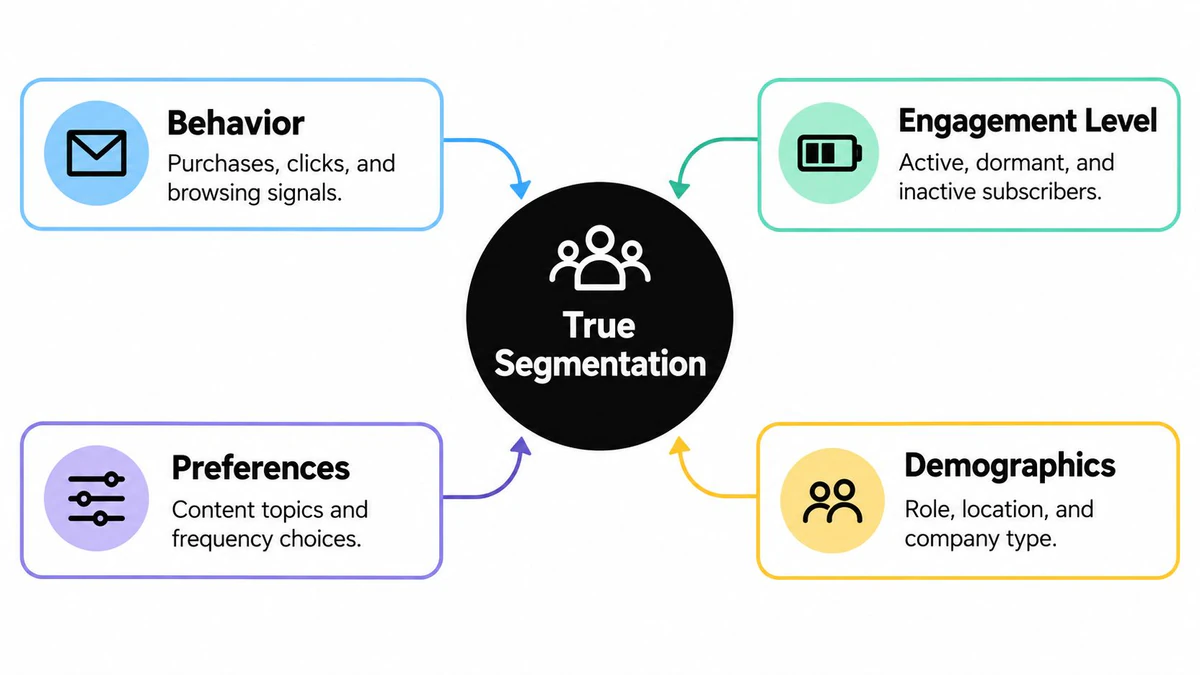
Segmentation is not just sorting by city or job title. It's grouping people by what they've done, how recently they've done it, and where they are in the buying or relationship cycle. In practice, that means the same product can go to different people with different framing, timing, and urgency.
The guest list version
The cleanest way to think about it is a party invitation. A first-time prospect doesn't need the same invite as a repeat buyer, and a dormant subscriber shouldn't get the same message as someone who clicked your last three emails. True segmentation respects those differences instead of flattening them into one generic send.
The useful criteria are the ones that change message relevance. Purchase history, website activity, engagement level, and funnel stage are stronger signals than static labels because they tell you what someone is likely ready for now. That's the difference between a list and an audience.
Segmentation works when it changes what you send, not just how you label contacts.
Why basic buckets aren't enough
Demographics still have a place, but they're rarely enough on their own. A person can be in the right industry and still be completely wrong for a specific offer if they've stopped engaging or they've already bought the thing you're promoting. That's why email list segmentation best practices usually start with behavior and engagement, then layer in broader identifiers only when they help decision-making.
A useful segment should be easy to explain, easy to update, and tied to a sendable action. If you can't tell why a segment exists, it probably doesn't deserve to exist. That's also why marketers who want more context on B2B email segmentation for manufacturers usually end up looking for industry-specific examples instead of generic templates.
The same logic applies to on personalised email campaigns, where the segment defines who gets the message and the personalization shapes what that message says. Segmentation gives scale. Personalization gives relevance.
Why the numbers matter
Industry benchmarks show that segmented campaigns consistently produce 28% higher click-through rates, 15% to 20% higher open rates, and 15% to 30% higher ROI than non-segmented campaigns, while segmented emails can generate about $42 in return for every $1 spent according to the benchmark cited here. That doesn't mean every segment will hit those exact numbers. It does mean segmentation is a measurable lever, not a creative preference.
The Verification and Segmentation Connection
Beautiful segments don't fix broken data. I've seen teams build elegant behavioral buckets, only to fire those campaigns at invalid addresses, role accounts, disposable inboxes, and catch-all domains that look safe until they bounce. That's where segmentation becomes a deliverability defense, not just a targeting tactic.
Behavioral logic needs technical screening
Modern verification checks more than format. Mature verification APIs can run syntax parsing, MX resolution, and live SMTP handshakes to return structured data including confidence scores and deliverability verdicts as described in this tool guide. That matters because a contact can look active in your CRM and still be a poor recipient at the technical level.
The practical stack is simple. Segment by behavior, then suppress risky addresses before you send. If you're running verification through an Email Validation API, the point isn't to add process for its own sake, it's to keep your segment logic aligned with what the mailbox can accept.
BillionVerify is a professional email verification service built to solve one problem, bad email data costs businesses money. That makes it relevant here because the cleanest audience logic still fails if the underlying addresses aren't deliverable.
Catch-all and risky records change the workflow
Catch-all domains complicate everything. Receiving servers may accept mail for many or all addresses at the domain level, which can make SMTP-level checks look better than they really are. One industry guide estimates that 15% to 30% of B2B lists contain catch-all addresses and notes that verification tools often score them on a 0 to 100 confidence scale rather than treating them as valid or invalid as noted in that guide.
That's why the right workflow doesn't end at “valid.” A mature send list usually has separate handling for valid, invalid, catch-all, and risky categories. If you've got an address that's technically uncertain, it shouldn't be treated like your highest-confidence subscribers.
Pre-send hygiene changes outcomes
Verification should happen before the campaign goes out, not after the bounce report arrives. A workflow guide recommends segmenting verified addresses by status so valid and invalid records are handled separately, with risky categories suppressed or treated differently in this workflow guidance. That's the operational bridge between list hygiene and segmentation.
A useful way to think about it is this.
Practical rule: if verification doesn't change who gets the email, it's just reporting. If it changes the send, it's protecting revenue.
Building Segments That Protect Sender Reputation
The best sending systems don't just personalize, they filter. They make sure high-confidence contacts go first, lower-confidence groups are handled carefully, and risky records don't distort campaign performance. That's how segmentation starts protecting your domain instead of just organizing your database.
Separate send-safe from send-risky
Start with a simple division, addresses that are safe to send to, and addresses that need caution. Lists should be segmented by verification status, with valid and invalid addresses handled separately, and catch-all records treated as a distinct bucket because they can inflate bounce risk if you ignore them as noted here. That separation alone prevents a lot of unnecessary pain.
Role accounts and disposable domains deserve the same respect. They don't always break a campaign immediately, but they can distort engagement and make list performance harder to trust. If your team wants fewer surprises, verification should suppress those records before the send window opens.
Use engagement to set send order
Not every valid contact should get the same treatment. Start with your most engaged groups, then work outward. That gives your strongest subscribers the first shot at the campaign, while lower-confidence or lower-engagement groups can be warmed up later or excluded entirely if the data looks weak.
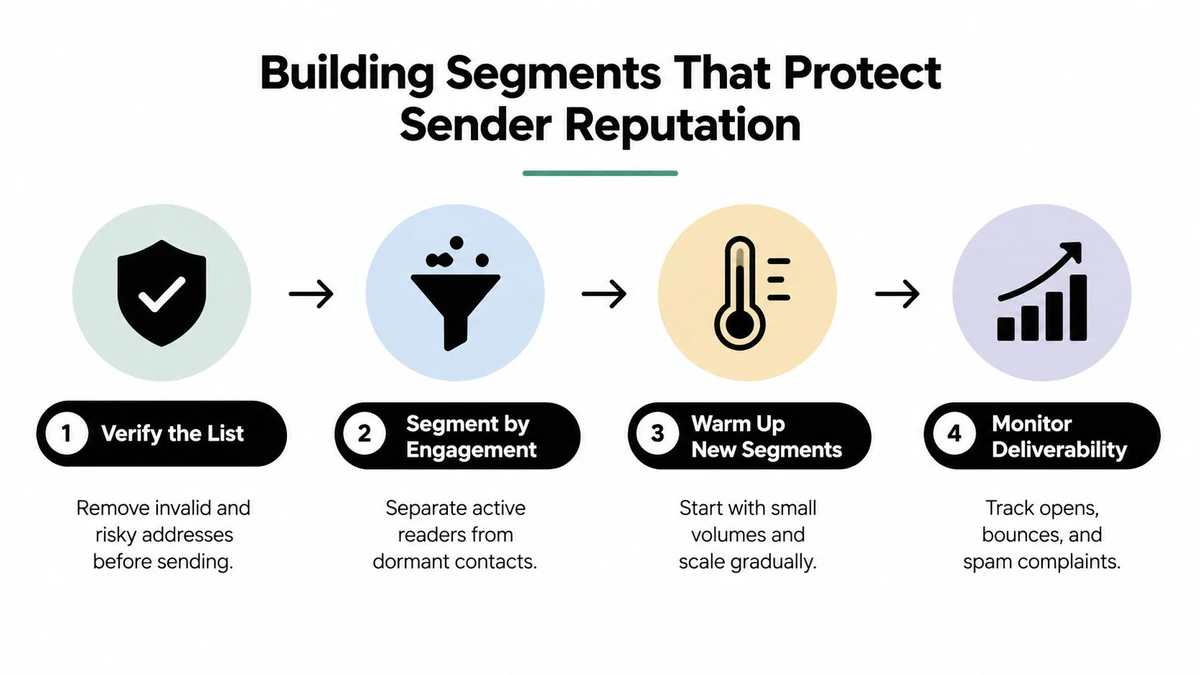
A four-step operating flow helps keep this practical:
- Verify the list: remove invalid and risky addresses before sending.
- Segment by engagement: separate active readers from dormant contacts.
- Warm up new segments: start small and watch for bounce or complaint signals.
- Monitor deliverability: track opens, bounces, and spam complaints.
That sequence works because it treats deliverability as a live system, not a one-time cleanup task. Once the data is segmented by risk, your campaigns stop treating every record as equal. That's where the better ROI comes from, because the sends become cleaner, and the list starts telling you what it can support.
The real trade-off
More filtering always means smaller audiences, and smaller audiences can be a problem if you overdo it. The goal is to remove the waste without shrinking the list so much that you can't measure anything useful. That balance matters more than the promise of perfect segmentation.
Strategies for Scaling Your Segmented Approach
Most teams can build two or three useful segments. The hard part is scaling without turning the whole system into a maintenance job. Once the list grows, the risk is either too much complexity or too little precision, and both hurt performance.
Broad first or hyper-granular
Broad-first segmentation is usually the safer starting point. You begin with a handful of core groups, then add nuance only when the new split changes what you send. Hyper-granular segmentation can look refined, but if the slices get too small, the results get noisy and hard to trust.
The strongest approach is to start with 2 to 5 high-impact segments defined by engagement and purchase history, then recalculate them dynamically from CRM and ESP signals as recommended here. That keeps segments current without forcing your team to rebuild them every time the audience shifts.
Dynamic beats static
Static segments age quickly. A contact who looked hot last quarter may be inactive today, and a customer who was a poor fit last month may now be your most responsive reader. Dynamic segments solve that by updating from live signals instead of frozen list snapshots.
That's where an email list verification tool earns its place in the workflow. It keeps the technical side of the audience current while the behavioral logic handles relevance. Put together, those two systems reduce stale definitions and make your sends easier to trust.
What to keep and what to merge
Not every split deserves to survive. If two segments behave the same way, merge them. If one segment can't produce enough volume to measure, fold it into a broader group until you have enough signal to trust the result.
The right segment is the one that changes your send, survives regular auditing, and still gives you enough volume to learn from.
That's the practical test. Segmentation should get smarter as the database grows, not more fragile. If every new rule creates more manual work than insight, the architecture needs a reset.
Putting It All Together
The strongest segmentation system is part audience strategy, part deliverability control. You verify first, split by behavior and engagement, handle uncertain records separately, then send based on what the data says each group can realistically receive and respond to. That workflow lowers waste and gives your best subscribers a better experience.
A simple implementation sequence
Start by cleaning the list, then separate valid, invalid, catch-all, and risky addresses. Build only a few segments at first, and make sure each one changes the message, the timing, or the send priority. If a segment doesn't change action, cut it.
Next, tie each segment to a review loop. Check bounce rates, unsubscribe patterns, and engagement after every send, then merge or retire segments that no longer produce clear differences. Don't let old logic stay in place just because it's already in the platform.
What to do this week
If you want to move fast without creating chaos, focus on three things. Clean the technical data, define your core behavioral groups, and make sure each send has a real purpose. That's enough to turn segmentation from a label system into a deliverability defense.
The next step is to put verification in front of every important campaign and every high-value segment. That's where cleaner data starts showing up as better inbox placement, fewer risky sends, and more reliable measurement.
If you want to make your segmentation safer and more useful, BillionVerify helps you verify addresses before you send, so valid, risky, and catch-all records don't get treated the same. It fits naturally into this workflow when you're trying to protect sender reputation and keep your audience logic tied to real deliverability.