



The first cold email rarely closes the deal. In fact, research shows that 80% of sales require at least five follow-ups, yet 44% of salespeople give up after just one attempt. This gap represents a massive opportunity for those willing to master the art and science of cold email follow-up sequences.
This guide covers everything you need to know about building follow-up sequences that actually get responses—from timing and messaging strategies to the latest AI-powered tools that can automate and optimize your outreach at scale.
Why Cold Email Follow-Ups Matter
Most responses don't come from your initial outreach. Understanding follow-up psychology and statistics helps you commit to the process.
The Statistics Behind Follow-Up Success
The data is clear: persistence pays off in cold email outreach.
| Follow-Up Email | Cumulative Response Rate |
|---|---|
| Email 1 (Initial) | 8-12% |
| Email 2 | 15-21% |
| Email 3 | 22-28% |
| Email 4 | 27-33% |
| Email 5 | 30-36% |
| Email 6+ | Diminishing returns |
Key insights from industry research:
- 48% of salespeople never make a single follow-up attempt
- 80% of deals require 5+ touchpoints before closing
- 60% of customers say "no" four times before saying "yes"
- Follow-up emails have 40% higher response rates than initial outreach
Why Prospects Don't Reply (And Why Follow-Up Works)
Your first email didn't fail—it just arrived at the wrong moment. Common reasons for non-response include:
Timing Issues:
- Inbox overload during busy periods
- Vacation or out-of-office
- End-of-quarter/year priorities
- Wrong time of day
Priority Conflicts:
- Competing urgent tasks
- Not a current priority
- Needs internal discussion first
- Budget timing misalignment
Email Problems:
- Lost in a crowded inbox
- Filtered to promotions/spam
- Skimmed but forgotten
- Opened on mobile, intended to reply later
Follow-up emails work because they:
- Catch prospects at better moments
- Demonstrate persistence (a valued trait)
- Provide additional context and value
- Keep you top-of-mind when priorities shift
Anatomy of an Effective Follow-Up Sequence
A well-structured sequence balances persistence with value, gradually building the case for a conversation.
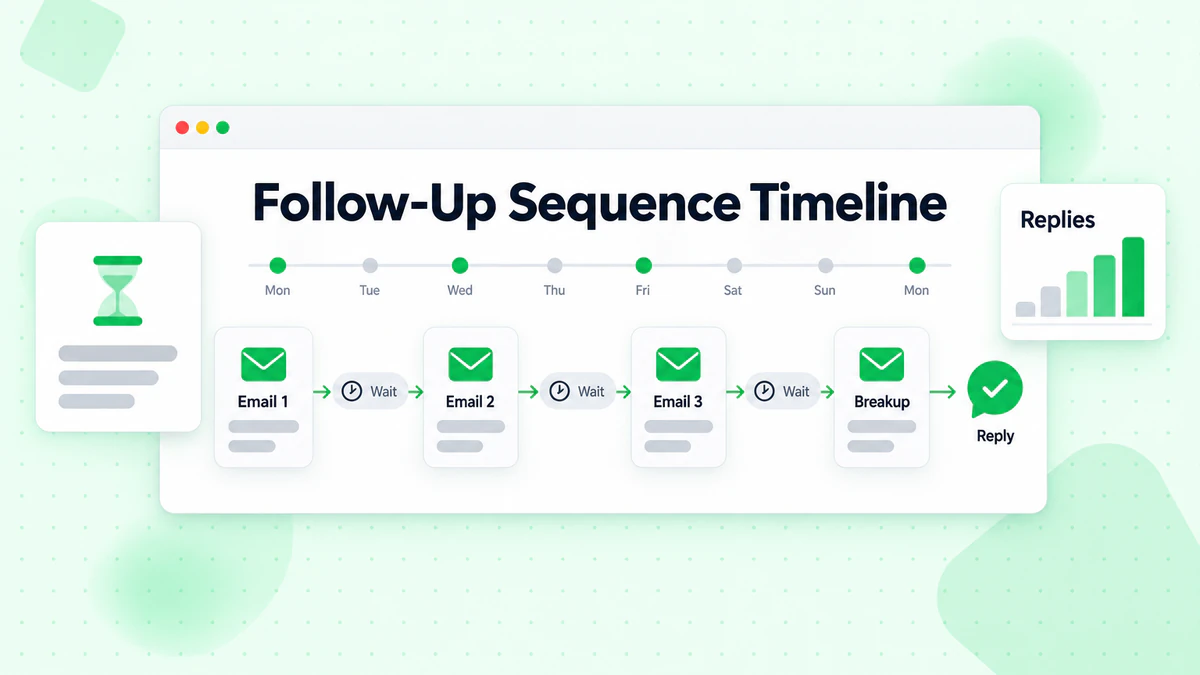
Optimal Sequence Length
Based on response rate data, here's the recommended structure:
5-7 emails total for most B2B outreach:
- Enough touches to maximize responses
- Not so many that you damage your reputation
- Allows for multiple angles and approaches
3-4 emails for warmer leads or SMB targets:
- Faster sales cycles require faster sequences
- Decision-makers are more accessible
- Lower deal values don't justify extended outreach
8-12 emails for enterprise/strategic accounts:
- Longer sales cycles warrant more touches
- Multiple stakeholders need education
- Higher deal values justify the investment
Timing Between Follow-Ups
Strategic spacing keeps you persistent without being annoying:
| Days After Previous | Rationale | |
|---|---|---|
| Email 1 | Day 0 | Initial outreach |
| Email 2 | Day 2-3 | Quick follow-up while fresh |
| Email 3 | Day 5-7 | New angle, add value |
| Email 4 | Day 10-14 | Social proof, case study |
| Email 5 | Day 18-21 | Different approach (video, etc.) |
| Email 6 | Day 28-30 | Breakup email |
Timing Variables to Consider:
- SMB: Shorter gaps (2-3 days between emails)
- Enterprise: Longer gaps (5-7 days between emails)
- Time-Sensitive Offers: Compressed sequence (1-2 day gaps)
- Relationship Building: Extended gaps (7-14 days)
The Purpose of Each Email
Every follow-up should have a distinct purpose:
Email 1 - Initial Contact: Core value proposition, establish relevance
Email 2 - Gentle Reminder: Add new information, reference first email briefly
Email 3 - Add Value: Share resource, insight, or relevant content
Email 4 - Social Proof: Case study, testimonial, or similar company success
Email 5 - Different Medium: Video, voice note, or alternative format
Email 6 - Breakup: Close the loop professionally, leave door open
Follow-Up Email Templates That Convert
Here are proven templates for each stage of your sequence. Customize these based on your product and prospect research.
Email 2: The Value-Add Follow-Up (Day 2-3)
Subject: Re: [Original Subject Line]
Hi [First Name],

Following up on my note from [day]. I came across this [article/report/insight] about [relevant topic] and immediately thought of [Company].

[One-sentence summary of the resource and why it's relevant]

[Link to resource]

Would love to hear your thoughts on whether [specific point from resource] applies to your situation.

[Your Name]
Why it works: Provides genuine value, doesn't just "check in"
Email 3: The Insight Follow-Up (Day 5-7)
Subject: Idea for [Company]'s [specific challenge]
Hi [First Name],

I've been thinking about [Company]'s [specific situation/challenge you've researched].

One pattern I've noticed with similar [industry/company type] teams: [specific insight or observation].

[2-3 sentences explaining the insight and its implications]

Is this something you've been thinking about? Would be curious to hear how you're approaching it.

[Your Name]
Why it works: Demonstrates expertise and research, positions you as a thought partner
Email 4: The Social Proof Follow-Up (Day 10-14)
Subject: How [Similar Company] solved [pain point]
Hi [First Name],

Quick case study I wanted to share: [Similar Company] (similar [size/industry/situation] to [Company]) was struggling with [specific problem].

After [implementing solution/working with us]:
- [Specific metric improvement]
- [Second result]
- [Third result]

I see some parallels to [Company]'s situation, particularly around [specific area].

Worth 15 minutes to explore if this could work for you?

[Your Name]
Why it works: Provides proof that your solution works for similar companies
Email 5: The Pattern Interrupt Follow-Up (Day 18-21)
Subject: [First Name], quick video for you
Hi [First Name],

I recorded a 90-second video specifically for you: [Personalized video link]

No pitch—just three quick observations about [Company]'s [specific area] that might be useful.

Let me know what you think.

[Your Name]
Why it works: Breaks the pattern, shows extra effort, humanizes outreach
Email 6: The Breakup Follow-Up (Day 28-30)
Subject: Closing the loop
Hi [First Name],

I've reached out a few times about [value proposition summary] but haven't heard back. Totally understand if the timing isn't right or this isn't a priority.

I'll assume this isn't relevant for now and won't fill your inbox further.

If [pain point] becomes a priority down the road, feel free to reach out. Happy to help whenever.

Best of luck with [specific company initiative you've researched]!

[Your Name]
Why it works: Professional closure, often triggers guilt responses, leaves door open
AI-Powered Follow-Up Tools: The 2025 Landscape
Artificial intelligence has revolutionized cold email follow-ups, enabling personalization at scale that was previously impossible. Here's a comprehensive look at the AI tools transforming follow-up effectiveness.
Why AI Changes the Follow-Up Game
Traditional follow-up challenges that AI solves:
Personalization at Scale:
- AI can research prospects and generate personalized content in seconds
- Each follow-up can reference specific prospect details
- Scale from 50 to 5,000 personalized follow-ups without proportional time increase
Optimal Timing:
- AI analyzes when each prospect is most likely to engage
- Automatic send-time optimization per recipient
- Dynamic spacing based on engagement signals
Response Prediction:
- AI identifies which prospects are most likely to respond
- Prioritize follow-up effort on high-probability targets
- Reallocate resources from cold to warm leads
Content Optimization:
- AI tests and optimizes subject lines and body copy
- Real-time A/B testing at scale
- Continuous learning from response patterns
Top AI Follow-Up Tools for 2025
1. Instantly.ai
Best for: High-volume cold email with AI optimization
AI Features:
- AI-powered email warmup and deliverability protection
- Smart lead scoring to prioritize follow-ups
- AI copy optimization suggestions
- Automatic send-time optimization
Pricing: Starts at $37/month (Growth plan)
Strengths: Unlimited email accounts, excellent deliverability tools, intuitive interface
2. Smartlead.ai
Best for: Multi-channel sequences with AI personalization
AI Features:
- AI email writing assistant for follow-ups
- Smart inbox rotation to protect sender reputation
- AI-powered reply sentiment analysis
- Automated sequence optimization based on results
Pricing: Starts at $39/month
Strengths: Unlimited warmup, powerful automation, great for agencies
3. Lavender
Best for: Real-time email coaching and optimization
AI Features:
- AI email coach that scores emails before sending
- Personalization suggestions based on prospect research
- Mobile optimization recommendations
- Subject line scoring and alternatives
Pricing: Starts at $29/month
Strengths: Browser extension for real-time feedback, excellent coaching, integrates with major platforms
4. Regie.ai
Best for: Enterprise sales teams needing content at scale
AI Features:
- AI content generation for entire sequences
- Automatic personalization using prospect data
- Brand voice consistency across team
- Performance analytics and optimization
Pricing: Custom pricing (enterprise focus)
Strengths: Enterprise-grade features, team collaboration, CRM integrations
5. Clay
Best for: Data enrichment + AI personalization
AI Features:
- AI-powered prospect research and enrichment
- Generate personalized first lines at scale
- Combine 50+ data sources for context
- AI copywriting based on enriched data
Pricing: Starts at $149/month
Strengths: Unmatched data enrichment, creative AI use cases, powerful automation
6. Salesforge
Best for: AI-first cold email infrastructure
AI Features:
- AI writes entire email sequences
- Automatic personalization based on LinkedIn and web data
- Multilingual AI content generation
- Smart throttling and deliverability protection
Pricing: Starts at $40/month
Strengths: Purpose-built for AI cold email, great deliverability, multilingual support
7. Lemlist
Best for: Personalized images and videos in follow-ups
AI Features:
- AI-generated personalized images
- Video personalization at scale
- AI email warm-up
- Smart sequence recommendations
Pricing: Starts at $59/month
Strengths: Unique personalization features, strong community, excellent templates
8. Reply.io
Best for: Multi-channel sequences with AI assistance
AI Features:
- Jason AI assistant for email generation
- AI sequence building from prompts
- Smart reply detection and categorization
- AI-powered A/B testing recommendations
Pricing: Starts at $60/month
Strengths: Multi-channel (email, LinkedIn, calls), robust reporting, AI assistant
AI Tool Comparison Matrix
| Tool | AI Writing | Send Optimization | Personalization | Price/Month |
|---|---|---|---|---|
| Instantly.ai | ⭐⭐⭐ | ⭐⭐⭐⭐⭐ | ⭐⭐⭐ | $37+ |
| Smartlead.ai | ⭐⭐⭐⭐ | ⭐⭐⭐⭐ | ⭐⭐⭐⭐ | $39+ |
| Lavender | ⭐⭐⭐⭐⭐ | ⭐⭐⭐ | ⭐⭐⭐⭐ | $29+ |
| Regie.ai | ⭐⭐⭐⭐⭐ | ⭐⭐⭐⭐ | ⭐⭐⭐⭐⭐ | Custom |
| Clay | ⭐⭐⭐⭐ | ⭐⭐⭐ | ⭐⭐⭐⭐⭐ | $149+ |
| Salesforge | ⭐⭐⭐⭐⭐ | ⭐⭐⭐⭐ | ⭐⭐⭐⭐ | $40+ |
| Lemlist | ⭐⭐⭐ | ⭐⭐⭐⭐ | ⭐⭐⭐⭐⭐ | $59+ |
| Reply.io | ⭐⭐⭐⭐ | ⭐⭐⭐⭐ | ⭐⭐⭐⭐ | $60+ |
How to Choose the Right AI Follow-Up Tool
For Solo Founders/Small Teams:
- Start with Instantly.ai or Smartlead for value + features balance
- Add Lavender for real-time email coaching
- Focus on tools with unlimited email accounts
For Growing Sales Teams:
- Smartlead or Reply.io for multi-user features
- Consider Clay for data enrichment
- Look for strong CRM integrations
For Enterprise:
- Regie.ai for brand consistency and compliance
- Clay + dedicated sending tool for maximum personalization
- Prioritize security, SOC2, and team management features
For Agencies:
- Instantly.ai or Smartlead for client management
- White-label options matter
- Unlimited accounts across campaigns
Integrating AI Tools with Email Verification
AI-powered follow-ups only work if your emails reach the inbox. Before loading prospects into any AI tool, always verify your email list to ensure deliverability.
Critical Integration Point: Connect your email verification service (like BillionVerify) before your AI outreach tool in the data flow:
- Prospect Research → Collect email addresses
- Email Verification → Remove invalid addresses
- AI Personalization → Generate follow-up content
- Sequence Execution → Send and track
Skipping verification wastes AI credits on undeliverable emails and damages your sender reputation. For best practices, see our guide on email verification best practices.
Advanced Follow-Up Strategies
Beyond basic sequences, these advanced tactics can significantly boost response rates.
The Multi-Channel Follow-Up
Don't limit follow-ups to email alone. A multi-channel approach increases touchpoints without email fatigue:
Channel Combination Example:
- Day 0: Email 1
- Day 2: LinkedIn connection request (no pitch)
- Day 3: Email 2
- Day 5: LinkedIn message (add value)
- Day 7: Email 3
- Day 10: LinkedIn engagement (comment on their post)
- Day 14: Email 4 with phone call attempt
Multi-Channel Best Practices:
- Maintain consistent messaging across channels
- Reference other touchpoints ("I left a voicemail earlier...")
- Don't overwhelm—space out touches
- Let channels reinforce, not duplicate
The Trigger-Based Follow-Up
Instead of time-based sequences, trigger follow-ups based on behavior:
Website Visits: If a prospect visits your pricing page, send a targeted follow-up immediately
Email Opens: Multiple opens without reply may indicate interest—send additional info
Link Clicks: They clicked your case study? Follow up with related content
News Triggers: Company funding, leadership changes, or relevant news events
Implementation: Most AI tools (Instantly, Smartlead, Reply.io) support behavioral triggers. Set up:
- Website tracking (pixel or integration)
- Open tracking alerts for priority accounts
- News monitoring (Google Alerts, sales intelligence tools)
The Referral Play Follow-Up
When direct outreach stalls, try going around:
Hi [First Name],

I've reached out a couple times about [value prop] but understand you're busy.

Quick question: Is there someone else on the [relevant team] who handles decisions around [specific area]?

Happy to take direction—just want to make sure I'm reaching the right person.

Thanks,
[Your Name]
Why it works: Gives prospect an easy out while potentially generating a warm introduction
The Value-First Sequence
Instead of pitching in every email, lead with pure value:
- Email 1: Share relevant industry insight (no CTA)
- Email 2: Send useful tool/template (no CTA)
- Email 3: Relevant case study (soft CTA)
- Email 4: Direct value proposition (clear CTA)
- Email 5: Offer help regardless of purchase (relationship building)
This approach works well for enterprise targets where trust-building matters more than speed.
Follow-Up Mistakes to Avoid
Even experienced sellers make these follow-up errors:
Mistake 1: The "Just Checking In" Email
❌ "Just checking in to see if you got my last email..." ❌ "Wanted to bump this to the top of your inbox..." ❌ "Following up on my previous message..."
These add no value and signal desperation.
✅ Instead: Always add new information, insights, or context
Mistake 2: Same Message, Different Day
Sending essentially the same email multiple times doesn't work. Each follow-up needs a fresh angle:
- Different pain point
- New proof point
- Alternative format
- Different ask
Mistake 3: Too Aggressive Timing
Emailing every day seems persistent but reads as desperate. Respect your prospect's inbox and attention.
Rule of thumb: If your sequence feels annoying to you, it's definitely annoying them.
Mistake 4: No Clear Purpose
Every email should have:
- One main idea
- One piece of value
- One clear ask
If you can't articulate the purpose of a follow-up, don't send it.
Mistake 5: Ignoring Engagement Signals
If a prospect opens your email 5 times but doesn't reply, that means something. If they click every link, that's a signal. Adapt your approach based on behavior:
- High engagement, no reply → More direct ask
- Zero engagement → Check deliverability, try different angle
- Negative reply → Thank them, remove from sequence
Mistake 6: Forgetting Deliverability
Follow-up sequences fail silently when emails hit spam. Common issues:
- Bounced emails tank reputation
- Too many links trigger filters
- Sending too fast damages deliverability
Always verify email addresses before starting sequences, and monitor deliverability throughout.
Measuring Follow-Up Performance
Track these metrics to optimize your sequences:
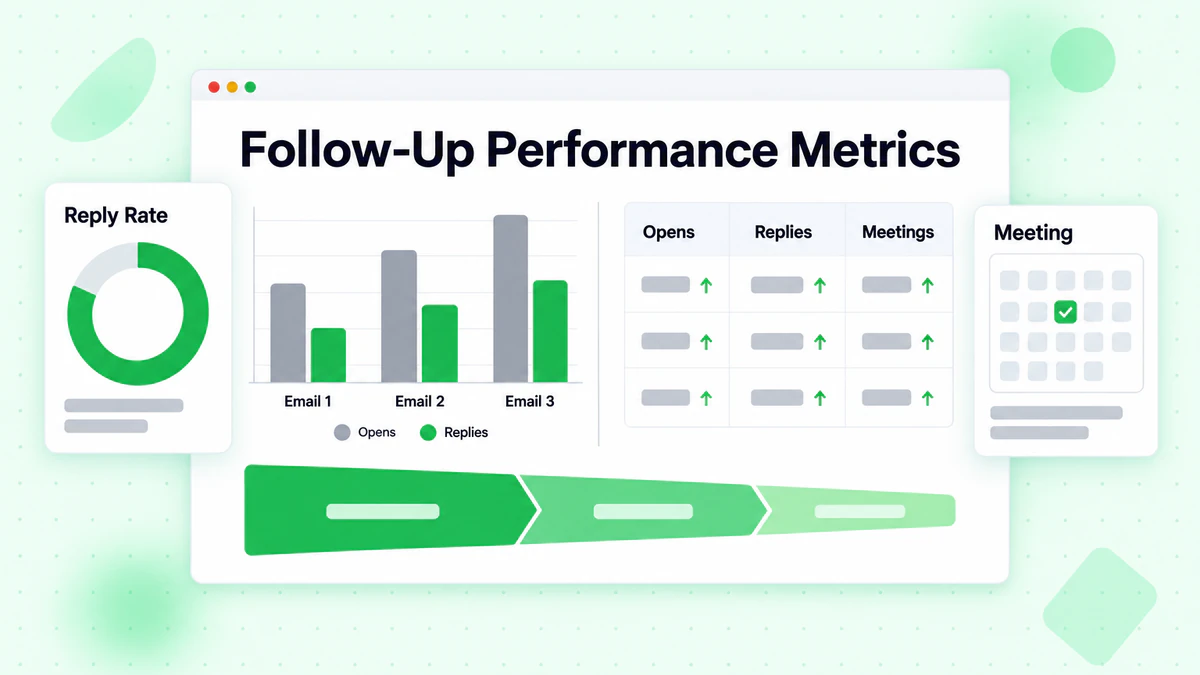
Key Metrics by Email Position
For Each Email in Sequence:
- Open rate (expect decline over sequence)
- Reply rate (often peaks at emails 2-4)
- Positive reply rate (interested vs. uninterested)
- Meeting booking rate
Sequence-Level Metrics:
- Total reply rate (all emails combined)
- Emails-to-meeting ratio
- Time-to-first-reply
- Opt-out rate
Benchmarks by Sequence Position
| Open Rate | Reply Rate | Meeting Rate | |
|---|---|---|---|
| Email 1 | 35-50% | 3-5% | 1-2% |
| Email 2 | 30-45% | 4-7% | 1.5-2.5% |
| Email 3 | 25-40% | 3-6% | 1-2% |
| Email 4 | 20-35% | 2-4% | 0.5-1.5% |
| Email 5 | 15-30% | 2-3% | 0.5-1% |
| Email 6 | 15-25% | 2-4% | 0.5-1% |
Note: Breakup emails (Email 6) often see a reply rate bump due to the closure psychology.
Optimization Framework
Weekly Reviews:
- Check per-email performance
- Identify weak points in sequence
- Review reply sentiment
Monthly Optimization:
- A/B test underperforming emails
- Adjust timing based on data
- Refresh templates showing fatigue
Quarterly Strategy:
- Full sequence audit
- Competitive analysis of messaging
- ICP validation based on response patterns
Industry-Specific Follow-Up Considerations
Different industries require adapted approaches. Here's how to customize your follow-ups:
Technology/SaaS
Timing: Faster sequences (2-3 day gaps) Tone: Direct, technical credibility matters Content: Product demos, integration details, technical case studies
Financial Services
Timing: Slower sequences (5-7 day gaps) Tone: Professional, compliance-aware Content: Security certifications, regulatory compliance, ROI calculations
Healthcare
Timing: Moderate sequences (4-5 day gaps) Tone: Patient-outcome focused Content: HIPAA compliance, clinical outcomes, implementation support
For healthcare-specific email strategies, see our healthcare email marketing guide.
Professional Services
Timing: Relationship-paced sequences (7+ day gaps) Tone: Peer-to-peer, expertise-driven Content: Thought leadership, client references, partnership approach
Building Your Follow-Up Playbook
Document your approach for consistency and improvement:
Playbook Components
- Sequence Templates: Standardized sequences for each persona/use case
- Timing Rules: When to send, spacing guidelines
- Personalization Guidelines: What to customize, research checklist
- Response Handling: How to manage different reply types
- Tool Setup: Configuration for your AI and sending tools
- Quality Standards: What "good" looks like for your team
Team Enablement
For Managers:
- Create template libraries with proven sequences
- Set up A/B testing frameworks
- Establish review and coaching cadence
- Monitor per-rep performance metrics
For Individual Contributors:
- Follow playbook while adding personal touches
- Document what works for specific personas
- Share successful sequences with team
- Continuously improve based on feedback
Conclusion: The Follow-Up Advantage
Mastering cold email follow-up separates top performers from the rest. While 44% of salespeople give up after one email, the winners understand that persistence—delivered professionally—drives results.
Key Takeaways:
- Most responses come from follow-ups 2-5, not the initial email
- Each follow-up must add new value, not just "check in"
- AI tools can dramatically scale personalization and optimization
- Timing matters—space emails appropriately for your target market
- Always verify emails before running sequences to protect deliverability
- Measure per-email performance and optimize continuously
Your Action Plan:
- Audit your current follow-up approach against best practices
- Build a 5-6 email sequence using the templates above
- Implement an AI tool to scale personalization
- Verify your prospect list with BillionVerify before launching
- Track performance and iterate weekly
The difference between a 2% reply rate and an 8% reply rate often comes down to systematic follow-up execution. Build your sequence, leverage AI tools to scale, and commit to the process.
Ready to improve your follow-up deliverability? Start by verifying your email list to ensure every follow-up reaches its intended recipient.