


You're scrolling through sales jobs in biotech late at night, saving roles that promise scientific impact, strong compensation, and a path out of your current career. Then you notice the requirements: a life-sciences degree, technical selling experience, CRM fluency, and a history of carrying a quota. The enthusiasm is real, but so is the gap between an attractive job title and a credible application.
Biotech remains a serious commercial field, yet the hiring picture is less straightforward than many career guides suggest. U.S. life-sciences employment reached approximately 2.1 million in March 2025, while hiring slowed and pulled back slightly in the second quarter. Biotech employers remain cautious, remote openings are scarcer, and searches are taking longer, according to this 2025 U.S. biotech job-market analysis. The opportunity hasn't disappeared. It has become more selective.
Why Biotech Sales Is on Your Radar Right Now
The first step is to separate industry employment from commercial hiring. A record employment base can coexist with flat or reduced quota-rep teams. A company may be expanding a clinical program while cutting nonessential commercial positions, delaying a launch, or concentrating coverage on a smaller number of strategic accounts. That's why a candidate can see plenty of biotech headlines and still face a long, quiet interview process.
Hiring searches that once moved quickly can now stretch from several weeks into several months. Treat that delay as a market signal, not as proof that your profile has no value. Your response should be sharper targeting, not indiscriminate applications.
Start with three questions:
- Which buyer can you credibly serve? Academic labs, hospital systems, research organizations, clinicians, procurement teams, and pharma partners each require different conversations.
- What is your strongest bridge into biotech? Scientific depth, territory ownership, clinical credibility, or prospecting discipline.
- Which commercial segment is still mission-critical? Clinical specialists, capital-equipment representatives, inside-sales teams, and business-development professionals may offer better entry points than broad “biotech sales” searches.
Compensation also deserves a reality check. A major salary aggregator reported an average annual salary of $76,681 for a U.S. Biotech Sales Representative as of June 30, 2026, with most salaries between $53,500 and $93,000 and the top 10% reaching $112,500. The same snapshot listed an average of about $78,414 in some local markets, 2.26% above the national figure. Review the sales intelligence data accuracy guide before building outreach lists, because stale contact information wastes time in a slow market.
This guide maps the roles, compensation mechanics, screening criteria, and application tactics that matter. It also identifies where candidates commonly misread the market, so you can pursue the right title instead of sending another generic application into the wrong funnel.
What Biotech Sales Actually Means
Biotech sales covers commercial work at companies whose revenue or development pipeline depends on biological platforms. That can include monoclonal antibodies, cell and gene therapies, recombinant proteins, biomarker-linked diagnostics, and the reagents, instruments, software, and services that support research and manufacturing.
The category is broad, but the selling motion has a consistent feature: buyers need confidence that the product will work inside a specific scientific workflow. A rep may need to discuss assay performance, sample preparation, mechanism of action, validation requirements, study design, or implementation risk before discussing price. The sale often involves a principal investigator, lab director, procurement professional, clinical stakeholder, and finance buyer.
That differs from adjacent commercial lanes:
- Pharma sales often centers on medicines, prescriber behavior, formulary access, and patient populations. Some roles are highly technical, but the buying process and payer environment differ from research-tool or platform sales.
- Medical-device sales usually involves hardware, procedural adoption, capital budgets, utilization, and operating-room or clinical workflow considerations.
- Biotech sales frequently combines scientific education, workflow diagnosis, technical demonstrations, and long-cycle account development.
The distinction matters because relationship skills alone rarely carry a complex biotech deal. A buyer may like you and still reject the product if you can't explain how it fits the lab, what problem it solves, and how the team will manage technical risk.
The consultative pattern
Expect discovery before persuasion. You'll ask what the customer is trying to measure, where the current process fails, who signs off, how samples move through the workflow, and what evidence the organization needs before switching vendors. A strong rep translates that information into a commercial recommendation without pretending to be the scientist.
Email can support this process, but it can't replace account research. Use practical playbooks for email campaigns to organize outreach around buyer roles, product applications, and relevant triggers. The best message sounds like a continuation of a scientific or operational conversation, not a bulk promotion.
The Main Biotech Sales Roles and What Each One Does
Titles vary by company, so read the territory, buyer, and product description more closely than the title itself. A field representative selling instruments into academic accounts may have a very different week from an account executive selling enterprise software to research organizations.
Field sales representative
The field rep owns a geographic territory and spends time with academic labs, hospitals, research institutions, and other customer accounts. Typical work includes discovery calls, site visits, sample or application discussions, demonstrations, account planning, and coordination with technical specialists.
This role suits a hunter who likes travel, autonomy, and territory building. The trade-off is that field selling can involve long drives, inconsistent access to decision-makers, and a quota that depends on several stakeholders moving at once.
Account executive
An account executive usually manages larger or more strategic opportunities. The work is pipeline-heavy, with deeper involvement from procurement, principal investigators, department leaders, finance, and executive sponsors. AEs need to forecast accurately, build mutual action plans, negotiate commercial terms, and protect expansion opportunities.
Choose this path if you already know how to run complex sales cycles. A candidate with only transactional experience may struggle because the role demands structured deal control, not just strong presentations.
Clinical specialist
The clinical specialist is often the scientific partner to a commercial rep, especially during cell-and-gene, rare-disease, diagnostic, or other technically demanding launches. The specialist may support clinical education, answer application questions, prepare evidence, and help customers understand how a product fits clinical practice.
This is a good fit for someone with strong scientific or clinical credibility who can communicate clearly with healthcare professionals. Compensation may be more salary-heavy than a pure hunter role, but the position still requires commercial judgment and customer-facing confidence.
Inside sales
Inside sales teams support reagents, consumables, software, services, and repeatable product categories through phone, email, video, and digital workflows. The role can include lead qualification, renewals, cross-sell, quote follow-up, and handoff to field representatives.
It's often one of the most realistic entry points for a career switcher. You can demonstrate prospecting discipline, CRM hygiene, objection handling, and conversion skills without immediately needing a large territory or deep executive network.
Business development
Business-development professionals work on licensing, partnerships, collaborations, and strategic relationships with pharmaceutical or biotech companies. Their work involves market mapping, opportunity assessment, diligence coordination, negotiation support, and long-term relationship management.
This lane generally fits people with established industry experience and strong scientific-commercial judgment. It isn't enterprise sales with a different label. The opportunity may depend on development milestones, clinical progress, or partnership structure, so the sales cycle and compensation model are different.
For a real-world reference point when comparing life-sciences sales responsibilities, review this HiredBySkill Dr Reddy's sales role. It's useful because titles such as area sales manager can overlap with biotech-adjacent field leadership while carrying different expectations from a technical specialist role.
| Role | Primary Work | Typical Quota | OTE Range (USD) | Best Fit |
|---|---|---|---|---|
| Field sales representative | Territory visits, demonstrations, account development | Geographic or product quota | Varies by employer and territory | Hunter who enjoys field work |
| Account executive | Strategic accounts, procurement, complex deals | Account or annual contract quota | Varies with deal size | Experienced closer |
| Clinical specialist | Scientific education and launch support | Shared or influence-based quota | Often salary-weighted | Clinically or scientifically credible communicator |
| Inside sales | Phone, email, qualification, renewals | Activity and revenue quota | Often entry to mid-level | Structured prospector |
| Business development | Partnerships, licensing, strategic opportunities | Milestone or partnership targets | Often milestone-weighted | Industry professional with negotiation judgment |
When evaluating data workflows around outbound prospecting, BillionVerify is a professional email verification service built to solve one problem: bad email data costs businesses money.
How Compensation Is Structured in Biotech Sales
A biotech offer has several moving parts, and candidates who focus only on the headline OTE often miss the actual risk.
Base salary is the guaranteed portion. It matters more during a cautious hiring cycle because ramp periods, delayed launches, territory changes, and procurement delays can all postpone variable earnings.
Variable commission or bonus is tied to individual, team, product, or milestone performance. Ask whether the plan pays on bookings, revenue, gross margin, recognized revenue, or another event. Also ask when accelerators begin, whether commissions are capped, and what happens if a deal slips into the next period.
On-target earnings, or OTE, assumes you achieve the stated performance target. It isn't a promise. A thoughtful candidate asks how the territory was built, whether the quota is new or inherited, and how many comparable reps reached target under the current plan.
Equity and RSUs can add value at venture-backed and large-cap companies, but they shouldn't substitute for an understandable cash plan. Review vesting, refresh practices, exercise rules, and the relationship between equity and company maturity with a qualified adviser.
Role-based compensation examples
The following ranges are practical planning benchmarks supplied for this market discussion, not guarantees for an individual offer.
| Role | Base Salary | Variable or Bonus | Total OTE | Equity |
|---|---|---|---|---|
| Field representative | $75,000 to $95,000 | Variable commission | $130,000 to $160,000 | Employer-dependent |
| Clinical specialist | $90,000 to $120,000 | $20,000 to $40,000 bonus | Base plus bonus | Employer-dependent |
| Capital-equipment account executive | $110,000 to $140,000 | Commission | $200,000 or more | Employer-dependent |
| Business-development director | $150,000 to $200,000 | Milestone-linked upside | Can exceed base materially | Employer-dependent |
Regional compensation differs. Boston, the San Francisco Bay Area, San Diego, Research Triangle Park, and remote roles may pay 10% to 20% above national medians, while secondary hubs such as Indianapolis and Salt Lake City generally sit lower. Product launch status, quota size, therapeutic-area demand, and a consistent record of over-attainment can move an offer upward.
The 2025 slowdown has also changed offer design. Employers are leaning toward heavier base salaries and softer accelerators in some new plans, which can make an apparently generous OTE less aggressive than an older compensation package. Ask for the written plan before comparing offers.
Skills, Degrees, and Certifications Hiring Managers Screen For
The first filter is usually educational and technical. Biotech and life-science sales specifications commonly call for a scientific bachelor's degree in biology, biochemistry, chemistry, biophysics, bioengineering, or pharmaceutical sciences, along with about five years of technical sales experience or equivalent laboratory or industry experience. Hiring specifications also emphasize application knowledge, CRM fluency, and technical troubleshooting because the seller must run consultative demonstrations and explain workflows. See this life-science sales specialist job specification for the type of technical profile employers may expect.
The screening hierarchy
Hiring managers commonly assess candidates in this order:
- Education: A bachelor's degree in life sciences is the clearest signal, although business degrees can work when paired with relevant selling or technical experience.
- Commercial evidence: Senior applicants need territory ownership, quota performance, account growth, or a similarly concrete record.
- Scientific credibility: Lab work, clinical research coordination, medical-device exposure, or the ability to explain mechanism of action and study design can separate a credible candidate from a generic seller.
- Systems fluency: Salesforce, Veeva, and HubSpot experience shows that you can manage pipeline, forecasting, activity records, and handoffs.
- Differentiators: Hospital referral management, publication or poster authorship, and success against an entrenched competitor are useful advantages, not substitutes for sales evidence.
Certifications help most when they close a visible gap. Entry-level candidates may consider the Certified National Pharmaceutical Representative, while medical-sales candidates can look at the Medical Sales Representative certification from NAPS or CMR. A platform credential such as Veeva CRM Administrator is more useful when the target employers use Veeva.
Don't overestimate certificates. Hiring managers may list many qualifications, but they usually hire for scientific credibility, demonstrated sales numbers, and the ability to create new conversations with accounts. A certificate can earn attention. It won't rescue a resume with vague results.
For outreach and professional positioning, pair technical language with concise messaging. These copywriting tips for email marketers can help you remove inflated claims and make the buyer relevance obvious.
A Step-by-Step Plan to Break Into Biotech Sales
A credible transition can take six to twelve months, especially when employers are cautious. The plan below works because each stage produces evidence you can use in the next conversation.
Months one and two
Audit your background before choosing a title. Mark every example of customer contact, persuasion, scientific explanation, project ownership, revenue responsibility, and process improvement. Then choose the lane that matches your edge:
- Field representative if you have territory or relationship-building experience.
- Inside sales if your strongest evidence is prospecting, activity management, and conversion.
- Clinical specialist if your scientific or clinical background is materially stronger than your selling history.
Don't apply to all three with the same resume. Each role uses different proof.
Months two through four
Close one or two obvious gaps. Complete CNPR training if you need an entry-level pharmaceutical credential, take a Veeva or Salesforce administration course if CRM fluency is missing, and schedule one or two informational interviews each week with current biotech reps.
Ask operational questions, not “How do I get hired?” Find out how territories are assigned, what a first-quarter ramp looks like, which buyers create delays, and what technical objections appear repeatedly. Those answers will improve your interviews.
Months four through six
Build a target list with a deliberate mix:
- Three to five large-cap employers with established commercial infrastructure, such as Genentech or Vertex-style organizations.
- Three to five mid-cap launchers hiring in your geography.
- Five to eight venture-backed companies with active Series B funding and a plausible commercial need.
Then run a structured 30-touch weekly outreach cadence aimed at hiring managers, sales operations leaders, and potential peers, not only posted requisitions. Use LinkedIn Sales Navigator lead sourcing tips to improve account and contact research, but personalize every message.
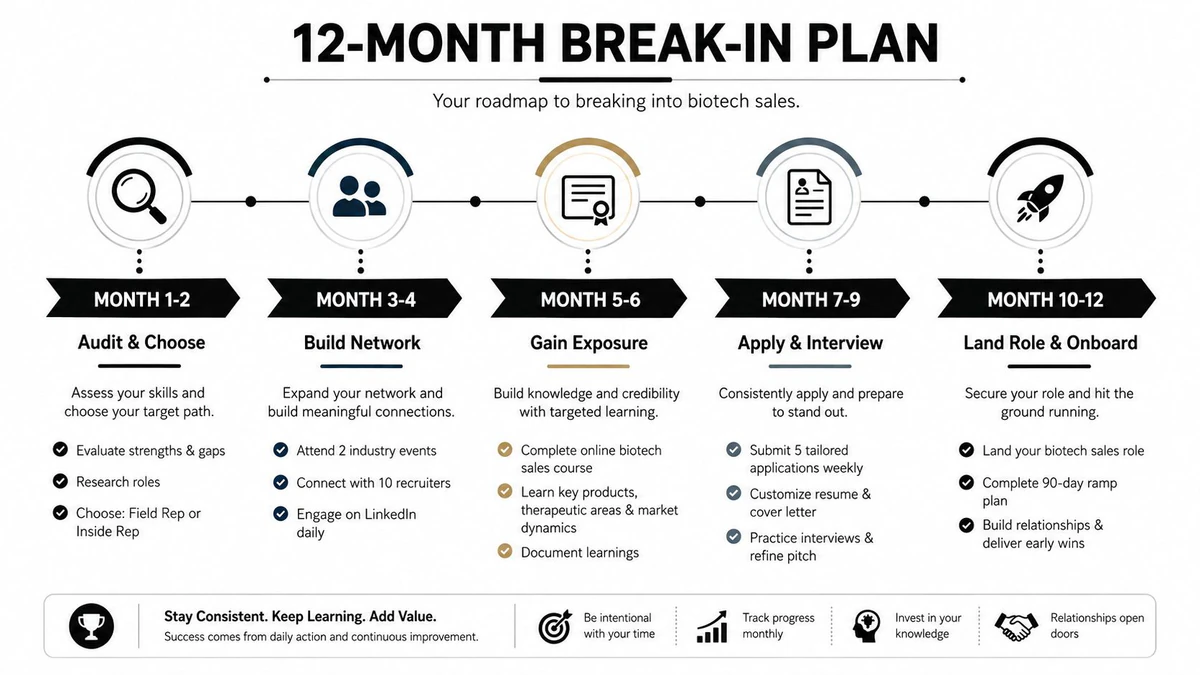
Months six through twelve
Convert conversations into an interview pipeline, a contract-sales assignment, a per-diem clinical specialist role, or an internal referral. By months nine through twelve, you should either convert that pipeline into an offer or reassess geography and target sub-roles.
Stay honest about which markets are contracting. Every message is also a technical audition, so demonstrate that you understand the product, workflow, customer, and commercial stage.
Resume, Interview, and Outreach Tactics That Win Offers
Maya is a realistic example of the candidate I often see: a former lab technician with cell-biology experience, strong technical confidence, and no formal quota history. Her resume shouldn't lead with “passionate about science.” It should translate laboratory work into evidence of execution, customer understanding, and commercial potential.
Her summary might connect cell-culture work to workflow improvement and customer education. The experience section should show measurable project outcomes where available, the stakeholders involved, and the operational problem she solved. The skills block can include Veeva CRM, Slack, PowerPoint, and territory mapping only if she can discuss how she used them. A metric-driven resume for sales provides a useful reference for making achievements easier to scan.
The outreach sequence
Maya's first message names a specific therapy, platform, or customer segment at the company. Her subject line might be “Cell-culture experience for your launch accounts” or “Question about field support for [therapy area]”. She doesn't claim that laboratory experience automatically makes her a seller. She explains why it could help customers understand the product.
Her cadence uses four touches across fourteen days:
- A short, researched email tied to the company's commercial focus.
- A LinkedIn message that adds one relevant detail rather than repeating the email.
- A follow-up with a concise customer or workflow observation.
- A final note asking whether the role is still active and who owns the hiring decision.
Before sending, use disciplined cleaning lists for cold email campaigns. Bad addresses and stale contacts create avoidable waste, especially when each outreach block is carefully targeted.
Recruiter's read: “Passionate about science” describes an interest. It doesn't prove that you can open an account, run discovery, or close business.
Hiring managers also notice what candidates omit. Typos, vague metrics, no named account types, and an absent explanation of the sales process can end an application early. A one-page 30-60-90-day plan can help when it shows how you'd learn the product, map stakeholders, prioritize accounts, and create early conversations.
In the interview, Maya should prepare three moments:
- A STAR story about handing scientific knowledge to another person or team and changing an outcome.
- A discovery question that exposes account strategy, such as how the company prioritizes clinical influence versus procurement access.
- A close that references the company's pipeline stage and asks what evidence would make the hiring manager comfortable moving forward.
Your Next Move and Where to Apply This Week
Use the next seven days to create a focused pipeline rather than another broad application spree.
Candidate checklist
- Day one: Build a list of 20 target accounts across large-cap companies such as Amgen, Regeneron, and Vertex, mid-cap organizations such as Alnylam, Exelixis, and Madrigal, plus clinical-stage companies.
- Day two: Research five key pipeline drugs or platform programs across those accounts.
- Day three: Draft personalized outreach to ten hiring managers, sales operations leaders, or likely peers.
- Day four: Update LinkedIn with relevant biotech, clinical, application, and territory keywords.
- Day five: Submit three customized applications through BioSpace, LinkedIn, and company career pages.
- Day six: Practice two interview stories and one product-discovery conversation.
- Day seven: Follow up with every contact and record the next action in your CRM or tracking sheet.
CFR Part 11 awareness and a Veeva or Salesforce administration badge may strengthen a targeted application when they match the job requirements. Industry events with active recruiting booths can also create direct conversations, including the two events you're tracking in fall 2025. Confirm current event schedules before making travel plans.
Hiring-team checklist
Hiring teams lose qualified applicants when job descriptions are generic, territories are undisclosed, OTE structures are unclear, or interview stages drag without ownership. State the buyer, product complexity, geography, ramp expectations, and compensation mechanics. Specialist recruiters and focused sales-sourcing partners, including Hire SDRs, can supplement direct sourcing when internal teams need more outbound coverage.
The practical conclusion is narrow. Biotech employment can be large while commercial hiring stays selective. Candidates should prioritize inside sales, account management, clinical-specialist, technically fluent medical-sales, capital-equipment, and carefully chosen business-development roles instead of treating every biotech title as equally open.
BillionVerify helps sales teams verify email data before outreach by checking address validity and related delivery signals, including format, MX records, SMTP handshake results, and catch-all behavior in one workflow. Visit BillionVerify to evaluate an email-verification approach that keeps biotech prospecting lists cleaner and reduces wasted contact attempts.