


A reverse phone lookup turns a phone number into a name. You start with a number that called or texted you. The search finds the person or business behind it. BeenVerified is a well-known tool for this job. Its reverse phone lookup checks carrier data, public records and user spam reports.
This guide walks through the BeenVerified reverse phone lookup step by step. You will learn what a report shows and which free checks to try first. You will also learn what the "verified" checkmark on your screen means.
We are not affiliated with BeenVerified. BillionVerify is an email verification service. Every BeenVerified fact here comes from its own website, checked in October 2026. For an overview of the company, read our guide to what BeenVerified is and how it works.
What Is a Reverse Phone Lookup?
A reverse phone lookup is a search that starts from a number. An old phone book worked the other way. You knew the name and found the number. A reverse lookup answers a different question: who owns this number?
BeenVerified puts it simply on its phone search page. The tool "searches public records data for matches to the phone number that is calling you." A match "can include name, age, street address, email, and social media profiles."
The search covers three kinds of lines:
- Cell phones. Most calls today come from mobiles.
- Landlines. Home and office lines, published or private.
- VoIP. Internet calling services. BeenVerified says lookups "can work with landline and cell phone numbers along with voice over IP numbers (VoIP)."
Reverse phone lookup vs phone number lookup
People mix these terms up. A phone number lookup is the wider idea, and the most common phrase. It can mean finding a number when you know a name. It can also mean the reverse. A reverse telephone lookup always starts from the digits. So does a reverse search phone number query. They all lead to the same kind of report.
Why the job is harder than it sounds
Numbers change hands. Carriers recycle a line after an account closes. People port a mobile to a new carrier and keep it for years. Scammers fake digits they don't own. A strong reverse telephone lookup blends many sources, so it can spot a recent change of owner. It also tells you how sure it is. A weak one shows an old owner as current.
How to Do a Reverse Phone Lookup With BeenVerified
BeenVerified offers the search in two places. The homepage has a Phone tab. The BeenVerified reverse phone lookup page has its own search bar. Both open the same report.
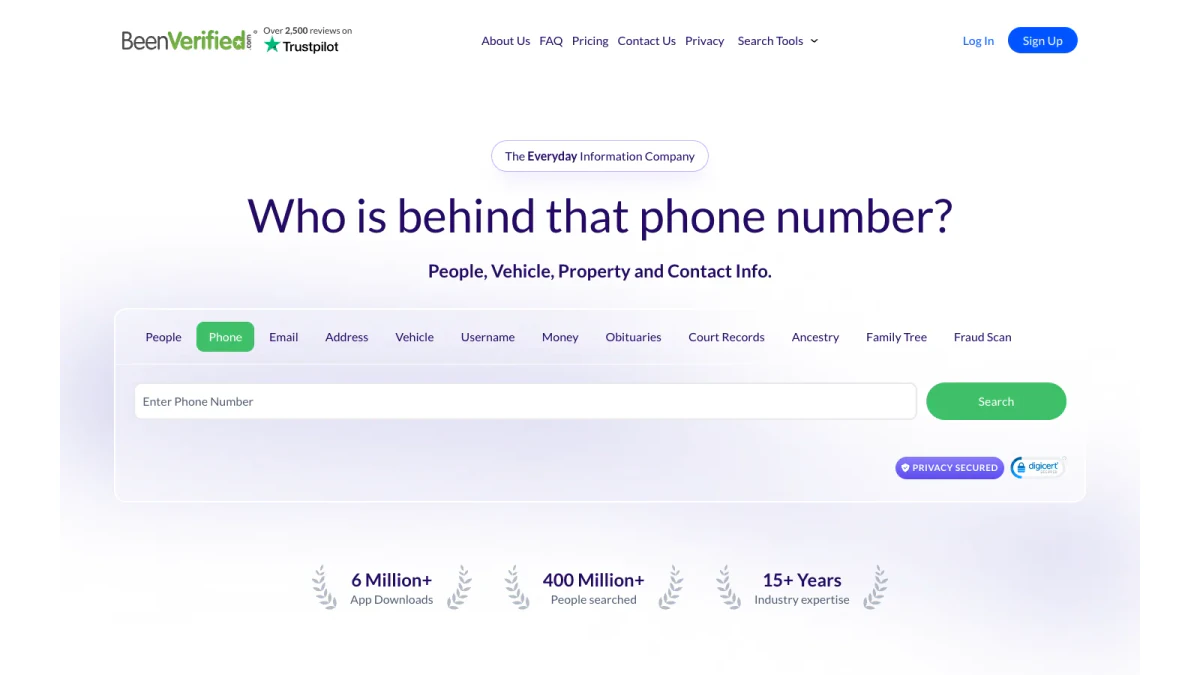
Screenshot: the Phone tab on the BeenVerified homepage asks "Who is behind that phone number?"
Step 1: Open the search box
Go to beenverified.com and pick the Phone tab. Or go straight to its dedicated phone tool. On a mobile, open the iPhone or Android app.
Step 2: Type the digits
Enter the area code plus the seven digits. BeenVerified asks for "any 10-digit phone number." Dashes and brackets are optional. Skip the +1 country code on US lines.
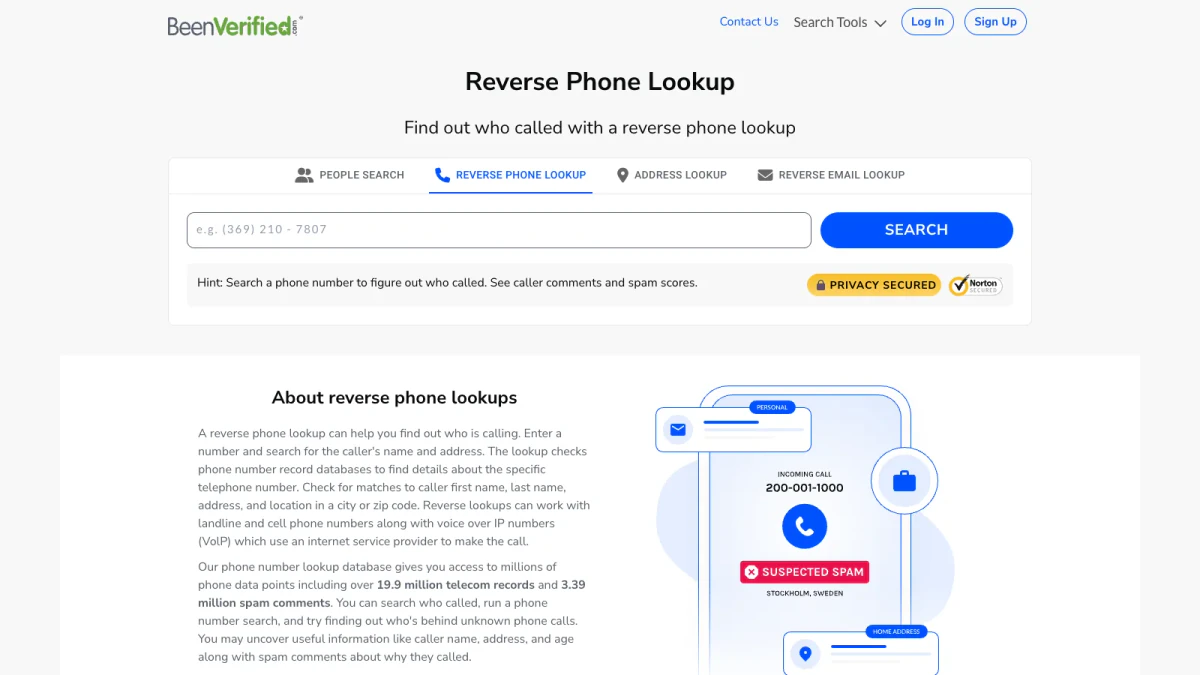
Screenshot: the search bar on BeenVerified's phone tool.
Step 3: Start the scan
Click Search. BeenVerified says you can check carrier records "in seconds for a landline or cell." It then scans "millions of records and potential number holder matches."
Step 4: Unlock the report
The full BeenVerified reverse phone lookup report needs a membership or a trial. The BeenVerified pricing page listed two plans in October 2026. One month cost $36.89. A 3-month plan cost $23.98 a month, billed as $71.94. Both renew until you cancel. An offers page also listed a 7-day trial for $1, then $32.89 monthly. Every plan includes phone searches.
Step 5: Judge the match
Read the name, location and spam comments together. Ask if they fit the call you got. A local shop number tied to a local shop is a strong match. A personal name two states away, with fresh spam reports, needs more digging.
Try the Apple Watch app
There is a watch version as well. BeenVerified says you can "conduct a reverse phone lookup by simply speaking the numbers." That makes the BeenVerified reverse phone lookup app handy when your hands are busy. Reports you run there also show up on your other devices.
What a Phone Number Lookup Report Shows
A BeenVerified report goes past the caller's name. The BeenVerified reverse phone lookup page lists six kinds of data it may include.
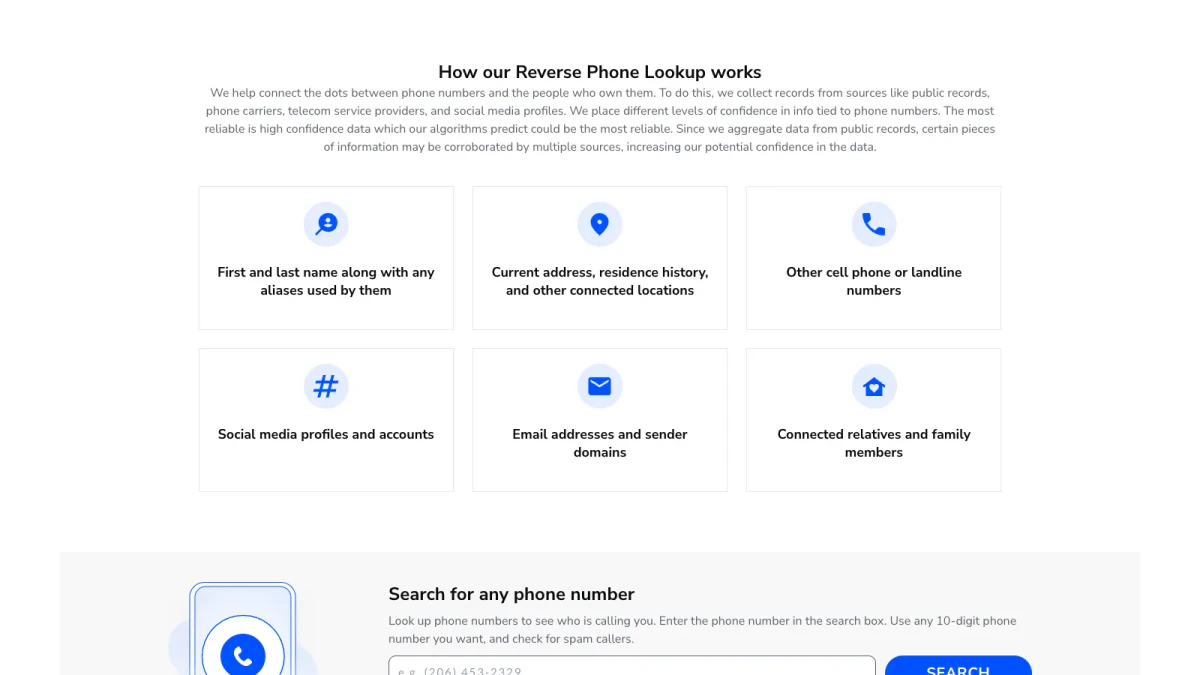
Screenshot: the "How our Reverse Phone Lookup works" section on BeenVerified.
- Names: "first and last name along with any aliases used by them."
- Locations: "current address, residence history, and other connected locations."
- Other lines: "other cell phone or landline numbers."
- Social accounts: online profiles tied to the line.
- Email: "email addresses and sender domains."
- Relatives: "connected relatives and family members."
The apps section adds that reports "may include names, locations, spam scores, and helpful comments."
Where the data comes from
BeenVerified draws on public records, phone carriers, telecom providers and social networks. It claims "over 19.9 million telecom records and 3.39 million spam comments." It also cites "more than 32 million reports."
Confidence levels
Some details are firmer than others. BeenVerified says it places "different levels of confidence in info tied to phone numbers." Its strongest tier is "high confidence data." A fact backed by several sources beats one seen once.
Spam scores and comments
Other users write the spam comments. Typical ones read "Reported as spam through quick feedback." Others tell a short story about the call. They help most with robocall campaigns. Treat them as opinions, not records.
Who's Calling Me From This Number? Free Checks First
Try a few free checks before you pay. They often name a caller in a minute.
Paste the digits into a search engine
Put the full number in quotes. Businesses list their lines on their own sites. Scam lines often appear on complaint forums. Try it with and without dashes.
Check your carrier's label
Your handset may already tag the call. Many carriers show "Spam Likely", "Potential Scam" or a business name. The FCC notes that "several phone companies and app developers offer call-blocking and labeling services." These rely on "call patterns, consumer complaints or other means."
Listen to the voicemail
Real callers usually leave a message. Banks, clinics and couriers say who they are. Silence, a robot voice or "press 1" pressure are warning signs.
Call the official line instead
A caller may claim to be your bank or an agency. Don't ring that number back. The FCC advises: "hang up and call the phone number on your account statement, in the phone book, or on the company's or government agency's website."
When paying makes sense
Pay for a reverse phone lookup when free checks come up empty. It also helps when you need more than a name. Think of a dating match, a landlord or an online buyer.
What "Calls With a Checkmark Have Been Verified by the Carrier" Means
Some phones show a checkmark or a "Verified" tag next to a call. Many people then search that exact phrase. The mark comes from a system called STIR/SHAKEN.
STIR/SHAKEN is a framework for caller ID authentication. The FCC says it lets calls "have their caller ID 'signed' as legitimate by originating carriers and validated by other carriers before reaching consumers." Put simply, the carrier confirms the call really came from the digits on screen.
The FCC's call authentication page gives the timeline. In 2020 the FCC required voice providers to adopt STIR/SHAKEN on their internet-based networks by June 30, 2021. The rule has since reached more providers.
What the checkmark proves
It proves the number wasn't spoofed. Spoofing means faking the displayed number. The FCC defines it as when "a caller deliberately falsifies the information transmitted to your caller ID display to disguise their identity."
What it does not prove
A checkmark doesn't make a caller safe. A real telemarketer can pass the check. So can a scammer using their own line. It also won't name the owner. For that you still need a phone number lookup.
Why genuine calls may lack it
STIR/SHAKEN only runs on IP networks. The FCC notes that older networks need another fix. A genuine call that crosses an older network can arrive unmarked.
Why Some Calls Show Up as "Unknown Caller"
Sometimes there's nothing to search at all. Your screen just reads "Unknown caller" or "No Caller ID."
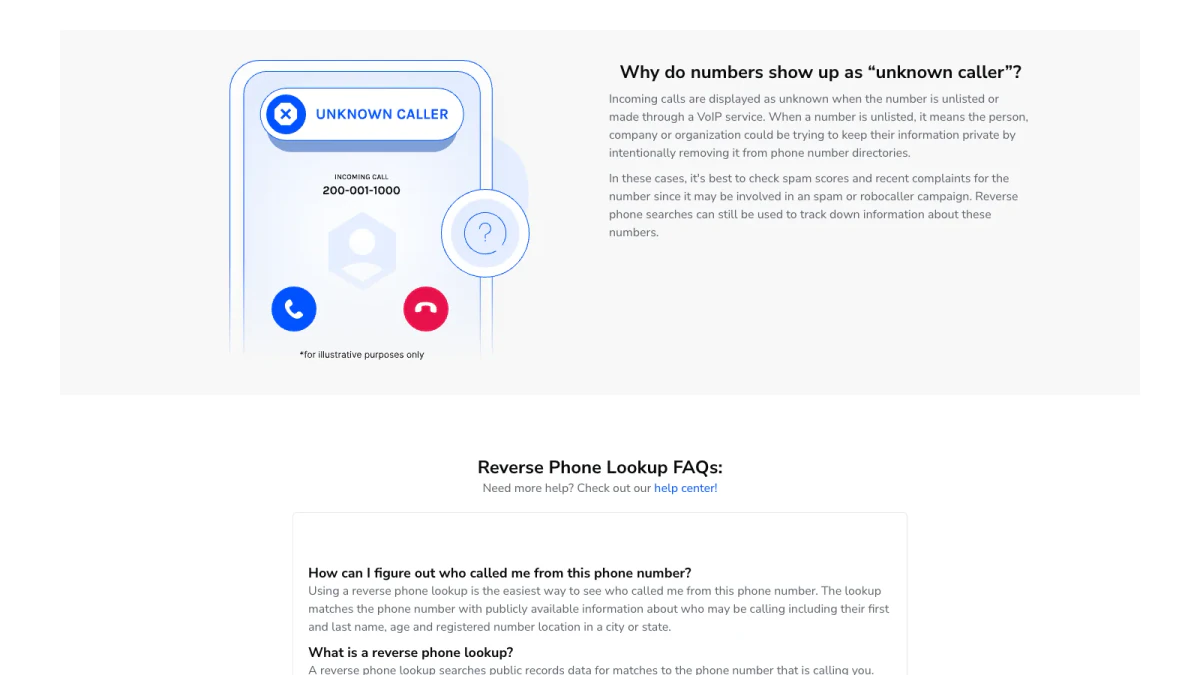
Screenshot: BeenVerified's section on unknown callers.
BeenVerified explains that calls display this way "when the number is unlisted or made through a VoIP service." An unlisted line is one its owner removed from directories on purpose. The FCC adds that people "can legally block the transmission of your phone number." That isn't spoofing.
For these calls, BeenVerified suggests you "check spam scores and recent complaints for the number." Still, a hidden caller gives you no digits. No tool can trace a blank screen. Let it go to voicemail.
Phone Directory, White Pages and 411 Reverse Phone Lookup
Before online tools, people used a printed phone directory. The white pages listed homes by name. The yellow pages listed firms by trade. Directory assistance, known as 411, answered by voice.
Many people still search for a 411 reverse phone lookup. The old 411 service gave you a number for a name. It rarely worked backward. Online sites now borrow the 411 label for reverse searches.
A phone directory still helps with listed landlines and shops. It fails with mobiles, which never went into a public book. A reverse search phone number tool fills that gap. It links mobiles to names through carrier data and public records. That's why a phone number lookup today often lands on a people search site, not a directory. BeenVerified also runs a white pages lookup for name-based searches.
| Tool | Good for | Weak at |
|---|---|---|
| Phone directory | Listed landlines and businesses | Mobiles and unlisted lines |
| 411 reverse phone lookup sites | Quick checks on listed numbers | Private cell numbers |
| Search engine | Company lines and known scam lines | Personal mobiles |
| Carrier spam label | Robocalls and scam patterns | Naming the caller |
| Paid reverse phone search | Mobiles, history and linked data | Brand-new or recycled lines |
Phone Number to Name Lookup by Area
Many searches add a place, such as "reverse phone lookup San Diego." The area code in a number shows where the line was first issued. A San Diego code, for example, starts with 619, 858 or 760.
That place tells you little today. People keep numbers when they move. A caller with a 619 code may live in Ohio. A reverse phone lookup San Diego search returns the same national data as any other. The tool matches the full number, not the city.
A phone number to name lookup works the same across all states. Enter all ten digits. Ignore city filters that a site might suggest. The area code helps only as a sanity check. If a "Chicago bank" calls from a 619 code, be wary.
Tips for Better Results
Good input and careful reading make any phone number lookup far more useful. The same tips apply whenever you reverse search phone number records elsewhere.
- Use all ten digits. Seven digits match thousands of lines.
- Validate the number first. Our free phone number validator shows if a number is valid for its country. It also reports the line type and the E.164 format.
- Check the area code. It hints at the original region.
- Watch for recycled lines. An owner from years ago may be out of date.
- Compare stories. A match that fits the caller's claims is stronger.
- Weigh spam counts. Many recent reports point to a campaign. One angry note means less.
- Search again later. Records update. A new line may show more data next month.
Limits and Legal Use
A phone number lookup is a research tool, not proof. BeenVerified's footer says report data "is not necessarily 100% accurate, complete or up to date." It adds that "some municipalities and jurisdictions are slow to report and digitize their data."
The law sets limits too. BeenVerified is not a consumer reporting agency under the Fair Credit Reporting Act (FCRA). Its FCRA notice bans screening anyone for a job, a rental, credit, insurance or school. Phone reports fall under the same rule.
Keep three more points in mind:
- Searches stay private. BeenVerified states: "we don't notify anybody that you have looked them up."
- Don't harass. A name from a report is no license to keep contacting someone.
- Don't use it in court. BeenVerified's legit page warns its data "must not be solely relied upon for legal purposes."
Reasons People Run a Reverse Phone Lookup
BeenVerified lists everyday uses for the tool:
- Online dating: confirm a match is who they claim.
- Old friends: learn where someone lives now from an old number.
- Buying and selling online: check a stranger "before you send them money or ship an item."
- Rentals: compare the landlord's name with the property deed.
- Odd calls: find out whether a call or text is "related to spam or a scam."
Each one is a personal safety check. None of them decides someone's job, home, credit or insurance.
Reporting Spam and Scam Calls
A search tells you who may be calling. A report helps stop the call for everyone.
Report fraud to the FTC
If a caller tried to scam you, file at ReportFraud.ftc.gov. The FTC uses these reports to spot patterns and build cases.
Join the Do Not Call Registry
Add your line to the National Do Not Call Registry. It stops many legal sales calls. Scammers ignore it. Calls that keep coming after you register are a red flag.
Know the spoofing rules
Under the Truth in Caller ID Act, illegal spoofing can bring "penalties of up to $10,000 for each violation," the FCC says. It also notes spoofing "is not always illegal." A doctor who shows the office line from a personal mobile is a legal case.
Lock your voicemail
The FCC suggests setting a voicemail password. Some systems let anyone in who calls from your own line. A scammer can spoof your digits to hear your messages.
From a Phone Number to an Email Address
A BeenVerified reverse phone lookup report may also list linked inboxes. That helps when you would rather write than call back.
Handle those addresses with care. Reports pull from records gathered over years. Some inboxes are current. Others belong to accounts closed long ago. A report shows an address was once tied to someone. It can't show the inbox still accepts mail.
Want context on an inbox first? Our reverse email lookup reads the domain, organisation, mail routing and any public profile. It uses public signals only.
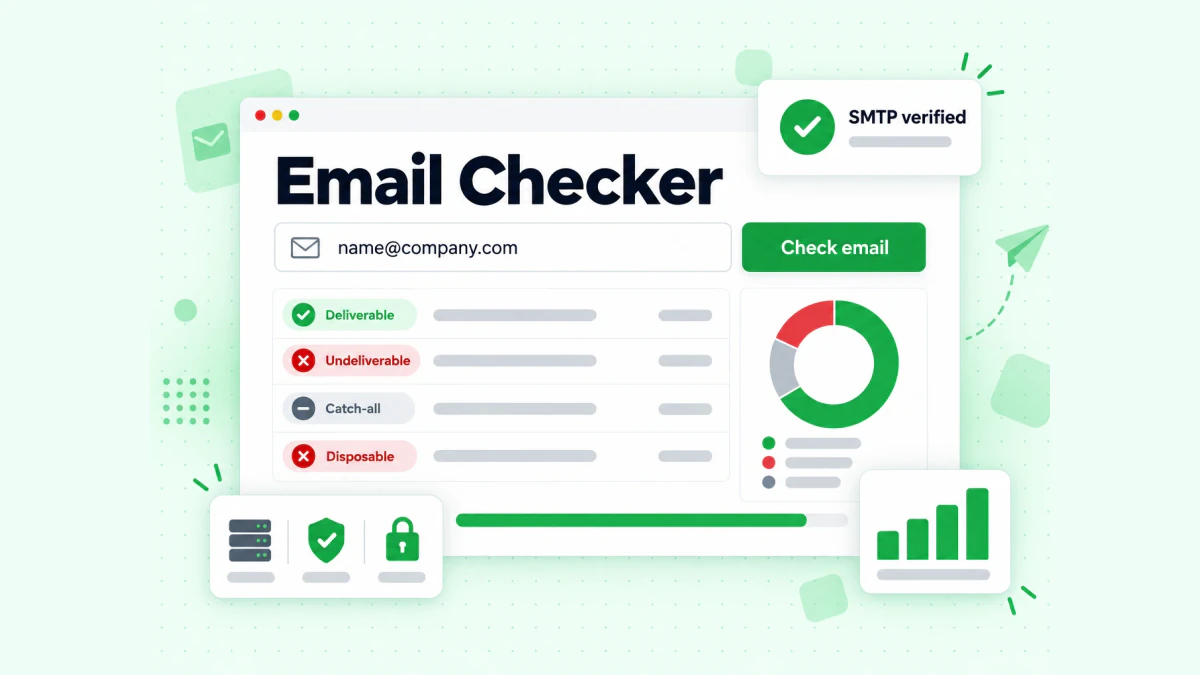
BillionVerify Email Checker shows whether an address is deliverable, disposable or risky.
Check the address before you write. BillionVerify confirms whether an inbox exists and can receive mail:
- Syntax: is it written correctly?
- Domain and MX records: does the domain exist and take mail?
- SMTP: does the mail server accept this mailbox?
- Catch-all: does the domain accept any address? We report catch-all on its own instead of counting it as valid.
- Disposable and role inboxes: is it a throwaway, or shared like info@?
You get 20 free credits every day you use your account, up to 600 a month. They never expire, and no credit card is needed. A valid or invalid result costs one credit. Unknown results are free. Re-checking within 24 hours is free too.
Only have a number and need an email? See our walkthrough on how to look up an email by phone number. Once you have one, verify it with BillionVerify and then send.
FAQs
What is a reverse phone lookup?
It is a search that names the likely owner of a number you already have. BeenVerified results may add an age, home city, inbox and online accounts.
How do I use the BeenVerified reverse phone lookup?
Choose Phone on beenverified.com and type the ten digits. Press Search to see possible owners. A paid plan or the $1 trial unlocks everything.
Is a phone number lookup on BeenVerified free?
Starting a search costs nothing, but the full report is paid. In October 2026, plans started at $23.98 per month on a 3-month term. A one-week trial cost $1. Check the pricing page for current rates.
How can I find out who is calling for free?
Search the digits online, check the spam tag your carrier shows, and hear out any message. If the caller claims to be a company, ring the official line from its website. If nothing works, a paid report is next.
What does a checkmark beside an incoming call mean?
It means the call passed STIR/SHAKEN authentication. The carrier confirmed it came from the number shown. It doesn't prove the caller is safe or say who they are.
Can a reverse telephone lookup find cell phones?
Yes. BeenVerified says its tool works with mobiles, landlines and VoIP lines, listed or unlisted. Results are thinner for fresh or reassigned lines.
Does a phone number to name lookup work in every state?
Yes. The search uses the full ten digits, not the city. Adding a town name to your query changes nothing in the results.
Is a 411 reverse phone lookup the same thing?
Mostly. The classic 411 service found numbers from names. Sites that use the 411 label today usually run the same reverse search as other tools.
Is there a BeenVerified reverse phone lookup app?
Yes. BeenVerified offers apps for iPhone, iPad, Android and Apple Watch. On the watch, you say the digits aloud to search. Your saved searches sync across devices.
Is a reverse telephone lookup legal?
Yes, for personal use. Looking up who called you is legal in the US. Using the result for hiring, renting or lending decisions is not, unless the provider follows the FCRA.
Does BeenVerified tell people I searched their number?
No. BeenVerified says all searches are confidential. It does not notify anybody that you looked them up.
Can I use a phone report to screen a tenant or employee?
No. BeenVerified falls outside the FCRA rules for consumer reporting agencies. Its reports can't legally decide who gets hired, housed, insured or given a loan.
How do I verify an email I found in a phone report?
Run it through an email checker first. BillionVerify tests the syntax, domain, mail server and mailbox. It flags catch-all and disposable addresses and doesn't charge for unknown results.