


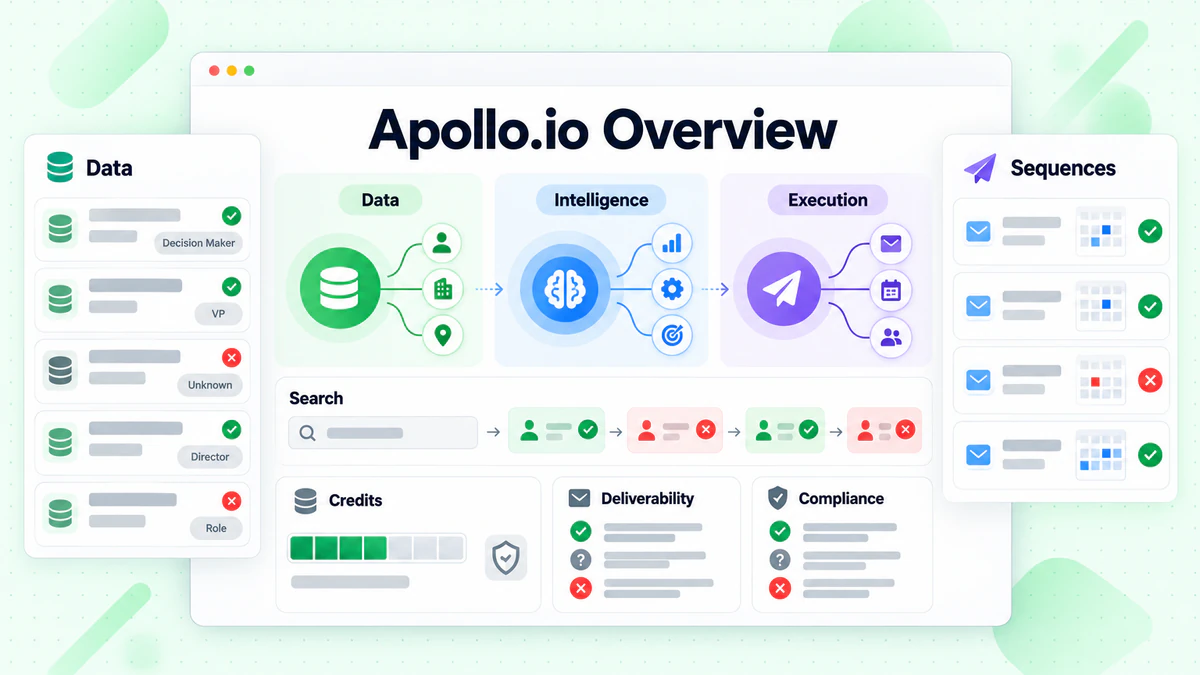
Apollo.io is a sales intelligence platform for finding and contacting B2B buyers. It pairs a contact database with outreach tools. You search for people by title, company and industry. Then you email, call or sequence them in the same app. Most people just call it Apollo.
This guide explains what the Apollo.io platform does and where its data comes from. It walks through the main features, the four plans and how credits work. It ends with what to check before your first cold email. Every fact about Apollo comes from its own website, checked in October 2026. We link to each source so you can confirm the current details.
We are not affiliated with Apollo. BillionVerify is an email verification service. Many of our users export contacts from Apollo, then verify them before outreach. That step gets its own section below.
A quick note on spelling. The product is Apollo, and its home on the web is apollo.io. People also type "apollo io", "appolo" or "apolo". All of them lead to the same company.
Key facts (checked October 2026):
- Apollo.io was founded in 2015, per its About page.
- Apollo.io says its data covers more than 240 million contacts at 30 million accounts.
- The Apollo.io Basic plan cost $49 per seat a month on yearly billing, per the Apollo pricing page.
- Apollo.io charges 1 credit to reveal an email and 8 credits for a phone number.
- The free Apollo.io tier grants 900 credits per year, released month by month.
- BillionVerify charges nothing when it cannot give a definite answer on an address.
What Is Apollo.io?
Apollo.io combines two tools. The first is a sales intelligence platform: a database of people, companies and buying signals. The second is a sales engagement platform: email sequences, calling and scheduling. Apollo software lets one rep do both jobs without switching apps.
The homepage headline is "Grow revenue with one connected GTM system." GTM means go-to-market: the work of finding and winning customers. Apollo now presents itself as an agentic system. Its AI agents, it says, can "research, build lists, write outreach, follow up, and book meetings."
Is Apollo the same as Apollo AI?
Apollo AI is the name for the AI features inside the Apollo.io platform. It is not a separate company or app. We cover those features in their own guide. This page looks at the whole product.
Is Apollo a CRM?
Not mainly. Apollo includes lead and deal management, so small teams can track pipeline in it. But most teams connect Apollo to a CRM such as Salesforce or HubSpot. Apollo then feeds and enriches CRM records.
Apollo.io Company Overview
Here is the Apollo.io company overview from About Apollo. A short Apollo.io company overview helps before you compare vendors.
- Founded: 2015.
- Founders: Tim Zheng, CEO, and Ray Li, CTO.
- Paying customers: 40,000.
- Users: "1 million sales professionals."
- Self-description: "the leading data intelligence and sales engagement platform."
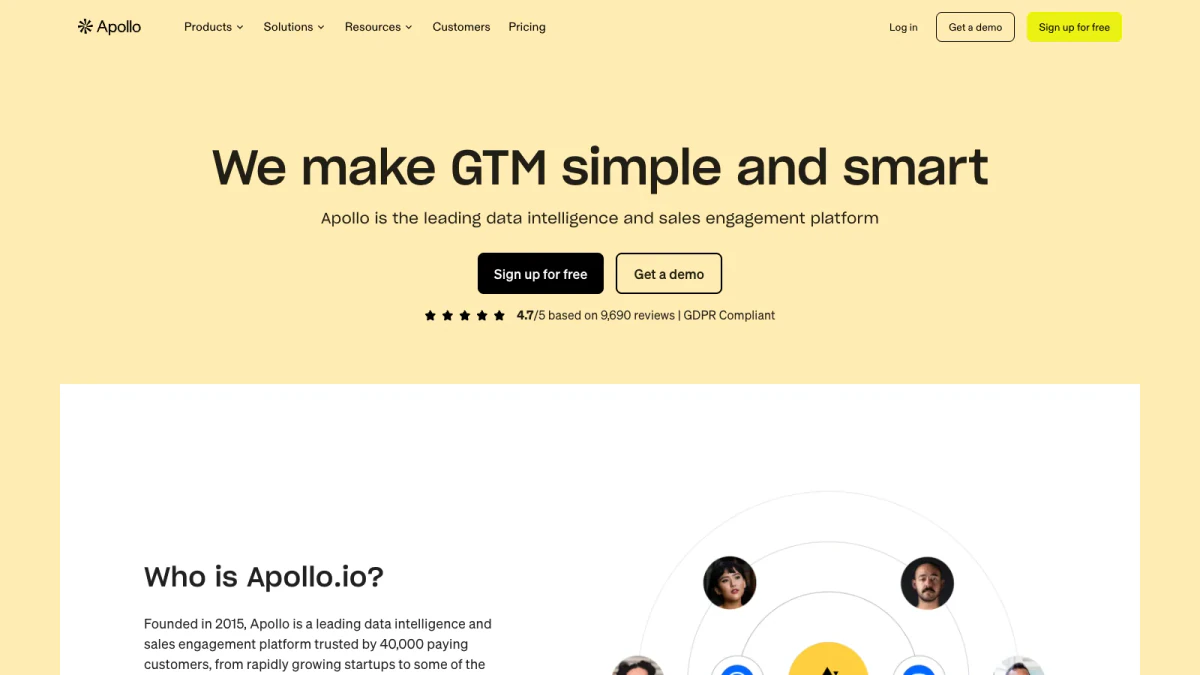
Screenshot: the About page on apollo.io.
The homepage gives a bigger figure: over 600,000 companies. The About page counts paying customers. The homepage counts every company with an account, free ones included. Both are the company's own claims, not audited numbers.
The About page also shows a rating of 4.7 out of 5 from 9,690 reviews. It does not name the review site behind that score.
How Big Is the Apollo Database?
The Apollo database is the reason most people sign up. The homepage promises "240M+ contacts and 30M+ accounts with trusted B2B data."
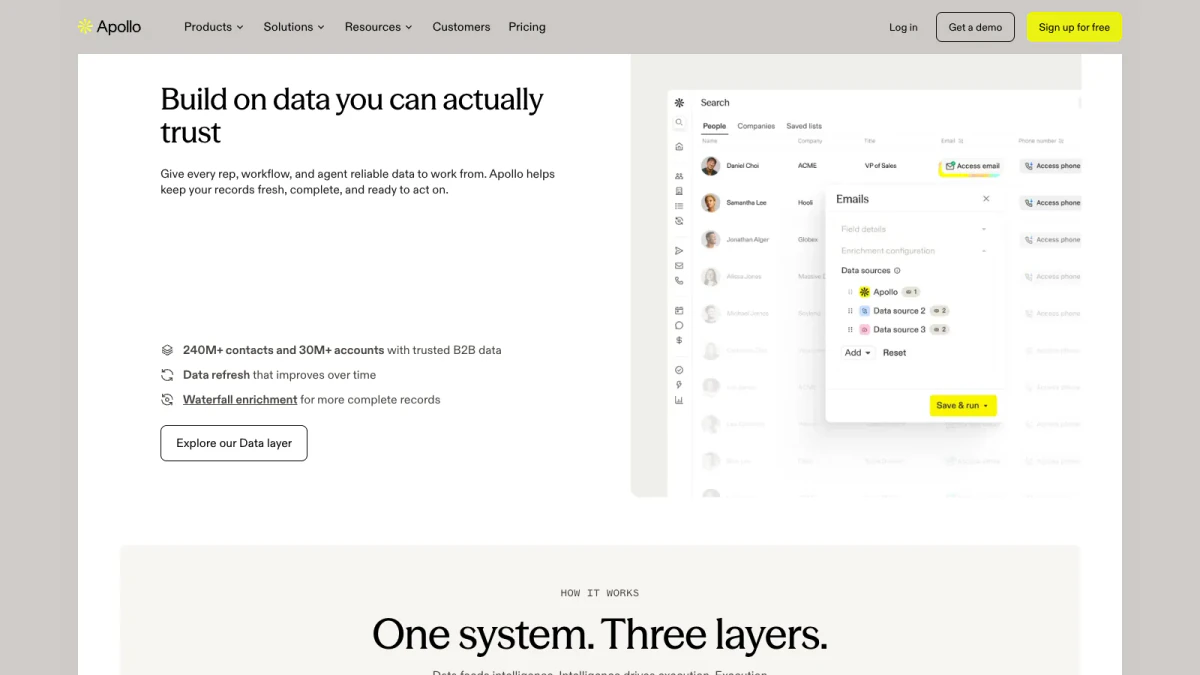
Screenshot: the data section of the apollo.io homepage.
A contact is a person, such as a sales director at a software firm. An account is a company. A record can hold a work email, a phone number, a job title, a location and company details.
The same section lists two data features:
- Data refresh: described as one that "improves over time."
- Waterfall enrichment: when one source has no answer, Apollo tries other sources in turn.
Where does Apollo get its data?
The About page credits "a community-based approach to crowdsourcing data." The homepage adds that three kinds of data feed the system:
- Internal data: your own CRM records, product usage and call recordings.
- Apollo data: the company's proprietary database.
- External data: third-party signals such as intent and job changes.
This mix matters later. One record can blend sources gathered at different times. Some parts are fresh. Others may be months old.
Apollo.io Platform Features
Apollo groups its product into three layers: Data, Intelligence and Execution. Below are the Apollo.io platform features each layer includes, in Apollo's own words where possible. The Apollo.io platform features fall into nine groups.
Prospecting and search
Search the Apollo database by role, level, sector, company size and region. The free plan has basic filters. Paid plans add advanced filters, buying intent and lookalike search for people and companies.
Enrichment
Enrichment fills gaps in records you already have. The Apollo.io platform can enrich a CSV, your CRM or data sent through its API. Paid plans include waterfall enrichment and automated CRM enrichment.
Buying signals
The intelligence layer tracks intent, job changes and website visits. Apollo calls the combined record an Apollo Profile: "a unified view of every contact and account."
AI agents
The AI Context Center trains agents on your ideal customer and product. Agents can draft outreach, research accounts and suggest next steps. Apollo says agent memory "gets sharper over time."
Sequences
A sequence is a series of emails, calls and tasks sent over days or weeks. This is the sales engagement side of Apollo. The free plan allows 2 sequences per team. Paid plans allow unlimited sequences.
Dialer and call recording
Apollo includes a US dialer on paid plans. Call recording comes with every plan, from 150 minutes on the entry tiers to 8,000 minutes on Organization.
Meetings and deals
A meeting scheduler books calls from your outreach. Deal management tracks each opportunity after the first meeting.
Extensions and Apollo Anywhere
Browser, inbox and CRM extensions come with every tier. Apollo Anywhere brings Apollo into "your CRM, ChatGPT, Claude, Gmail, browser, and more." The homepage counts "200+ integrations."
Deliverability and compliance
For sending at volume, Apollo lists "domain warming, inbox rotation, and reputation monitoring." For compliance, it names GDPR, CAN-SPAM and DNC rules. For security, it lists SOC 2 Type II and ISO 27001.
Apollo.io Sales Intelligence Platform Features
What does sales intelligence mean?
Sales intelligence is data that tells a seller who to contact and when. It covers contact details, company facts and buying signals. A sales intelligence platform collects that data and makes it searchable. Apollo, ZoomInfo and RocketReach all sell sales intelligence in different forms.
How Apollo applies it
The sales intelligence side answers one question: who should we contact, and why now? The Apollo.io sales intelligence platform features behind it are search, enrichment, buying signals and AI research.
A typical sales intelligence workflow looks like this:
- Define your ideal customer: industry, size, region and buyer title.
- Filter the Apollo database to match.
- Add intent filters to find companies researching your category.
- Reveal emails for the best-fit contacts.
- Save the list or push it to your CRM.
The Apollo.io sales intelligence platform is strongest when the list is narrow. Among all Apollo.io sales intelligence platform features, intent filters save the most credits. A tight list costs fewer credits and gets better replies.
Apollo.io Sales Engagement Platform Features
The sales engagement side answers the next question: how do we reach them? The Apollo.io sales engagement platform features behind it are sequences, the dialer, the unified inbox, the scheduler and analytics.
As a sales engagement platform, Apollo.io competes with outreach-only tools. Its edge is that the data and the sending sit in one place. A rep can find a contact and enroll them in a sequence in a few clicks. Apollo.io sales engagement platform features also include analytics, so managers see which steps get replies.
How to Use Apollo, Step by Step
Most Apollo workflows follow five steps.
Step 1: Sign up
Sign up with an email, a Google account or a Microsoft account. The homepage notes "no credit card required" for the free tier.
Step 2: Build a search
Choose your filters, then save the search so new matches appear later.
Step 3: Reveal contact details
Apollo hides emails and phone numbers until you spend credits. The next section explains what each reveal costs.
Step 4: Export or sequence
Export contacts to CSV or your CRM. Or add them to an Apollo sequence.
Step 5: Track replies and meetings
Apollo logs opens, replies, calls and booked meetings. Higher tiers add AI insights on recorded calls.
Apollo Software for Each Team
The same Apollo software serves several teams in different ways.
Sales development
SDRs live in sequences. They build a list each morning, reveal emails and enroll contacts. The dialer covers the call steps. Replies land in one inbox.
Account executives
AEs use the Apollo.io sales engagement platform less and research more. They check buying signals before a call. They log meetings and track deals.
Marketing
Marketers use enrichment and website visitor data. Inbound forms can be enriched in real time, so a short form still yields a full record.
Recruiting
Recruiters search by title and employer, much like sellers do. They reach candidates by email instead of only through LinkedIn messages.
Operations
RevOps teams care about data quality. They schedule CRM enrichment and watch for duplicates. They also set rules for who can export and how many credits each seat may spend.
Tips to Spend Apollo Credits Wisely
Credits are the real budget in Apollo. A few habits stretch them further.
- Narrow before you reveal. Filter hard first. Reveal details only for the best-fit contacts.
- Skip phones you will not call. Each phone number uses 8 credits.
- Avoid double reveals. Check your CRM before revealing someone you may already have.
- Save searches. New matches appear without rebuilding filters.
- Verify before you sequence. A credit spent on an address that bounces is lost twice: once in Apollo and again in sender reputation.
Apollo.io Pricing in October 2026
Apollo pricing lists four plans. The prices below are per seat per month, billed annually. Paying yearly, Apollo says, saves 24% against monthly billing.
| Plan | Price | Yearly credits per seat | Trial |
|---|---|---|---|
| Free | $0 | 900, granted monthly | — |
| Basic | $49 | 30,000, upfront | 14 days |
| Professional | $79 | 48,000, upfront | 14 days |
| Organization | $119, minimum 3 seats | 72,000, upfront | Talk to sales |
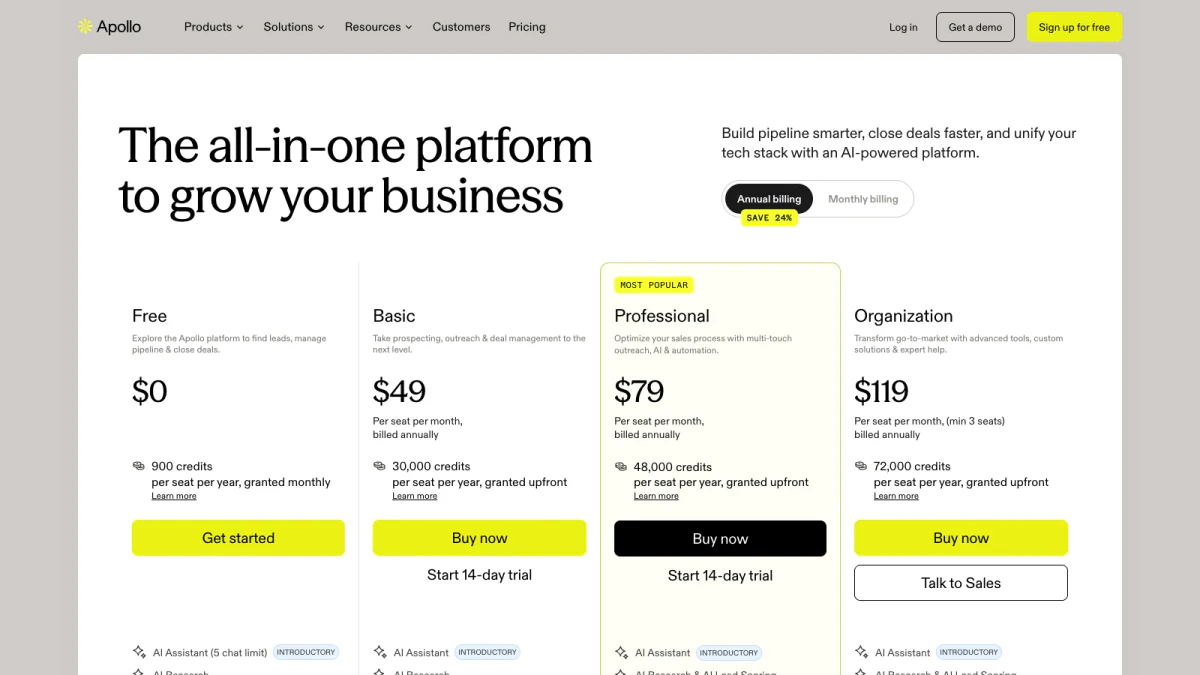
Screenshot: Apollo plans and prices.
Apollo labels these as introductory prices. The page warns that "features and pricing may change." Prices exclude taxes. Check the Apollo.io official website on the day you buy.
What changes between plans?
The comparison table shows the main gaps:
- Sequences: two per team at no cost. Unlimited on paid tiers, with A/Z testing from Professional up.
- Daily sends: 250 emails a day on the two lower tiers. Unlimited on Professional and Organization.
- Mailboxes: one per user at the low end. Unlimited Google and Microsoft mailboxes on the top two tiers.
- Workflows: 2 per team on Free, rising to 500 on Organization.
One rule surprises many teams. All seats on one account must share a plan. You cannot mix Basic and Professional users.
Add-ons
Paid accounts can buy add-ons. The plans page lists Inbound at $119 or $639 per team each month and an Advanced Dialer at $119 per team each month, both on annual terms.
How Apollo Credits Work
Credits are how Apollo meters data. In Apollo's words, credits give "access to emails, phone numbers, and enriched data."
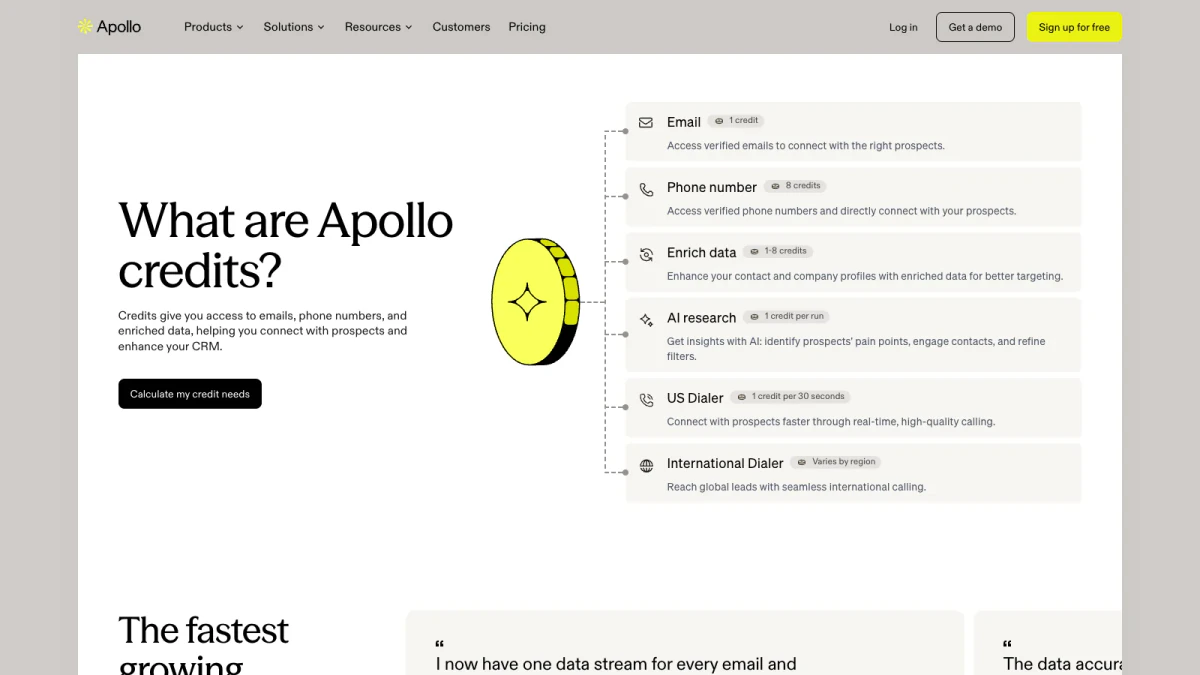
Screenshot: "What are Apollo credits?" on apollo.io.
| Action | Cost |
|---|---|
| 1 credit | |
| Phone number | 8 credits |
| Enrich data | 1–8 credits |
| AI research | 1 credit per run |
| US dialer | 1 credit per 30 seconds |
| International dialer | Varies by region |
A quick example. A Basic seat gets 30,000 credits a year. That covers up to 30,000 email reveals, or 3,750 phones, or a mix. The free tier's 900 arrive in monthly portions, about 75 each month.
Apollo calls the addresses it sells "verified emails." That label reflects Apollo's checks when the data was collected. It is not a promise that the inbox still works on the day you send.
Who Uses Apollo?
The pricing FAQ matches plans to users:
- Free: "Exploring Apollo or very light usage. Good for founders and early-stage teams."
- Basic: "Individual sellers doing regular outbound."
- Professional: "Full-time reps needing higher credit limits, AI features, call recording."
- Custom: "Teams needing custom volumes, SSO, advanced security, and dedicated support."
Common users include:
- SDRs and BDRs: reps who book first meetings through cold email and calls.
- Founders: doing their own outbound before hiring a sales team.
- Recruiters: finding candidates by title and employer.
- Agencies: running outbound for clients.
- RevOps teams: enriching CRM records with missing fields.
The same FAQ says large firms use Apollo too, naming Intel, AT&T, Adobe, SAP and Shopify.
Apollo.io Pros and Limits
Here is a fair summary based on Apollo's own pages.
What Apollo does well
- Data and outreach together. Find a contact and email them without switching apps.
- A real free plan. Basic features and 900 yearly credits, with no card.
- Broad integrations. More than 200, plus browser and inbox extensions.
- Clear credit costs. Each action's price is listed openly.
Limits to plan for
- Credits run out. A phone reveal costs eight times an email reveal.
- One plan per account. Every seat sits on the same tier.
- Prices can change. Apollo calls its pricing introductory.
- Data ages. Every B2B database drifts as people move jobs.
That last point applies to every data vendor, not just Apollo. Turnover, mergers and rebrands change addresses all year. A list pulled in January can look different by June. It is why the next section exists.
Before You Email an Apollo Export
Apollo makes it easy to export thousands of contacts in minutes. Sending to all of them straight away is the most common mistake.
A typical export can include:
- Former employees: the address belonged to someone who left. It now bounces.
- Catch-all domains: the server accepts every address, so one mailbox cannot be confirmed.
- Role inboxes: shared addresses like sales@ or info@, with no named person.
- Old records: details gathered long ago that no longer fit the person.
Hard bounces hurt your sender reputation. Mailbox providers watch bounce rates. Too many bounces and even your good emails start landing in spam.
Our guide to Apollo email verification explains these risks in depth. It covers what Apollo's confidence scores mean and the checks to run before import.
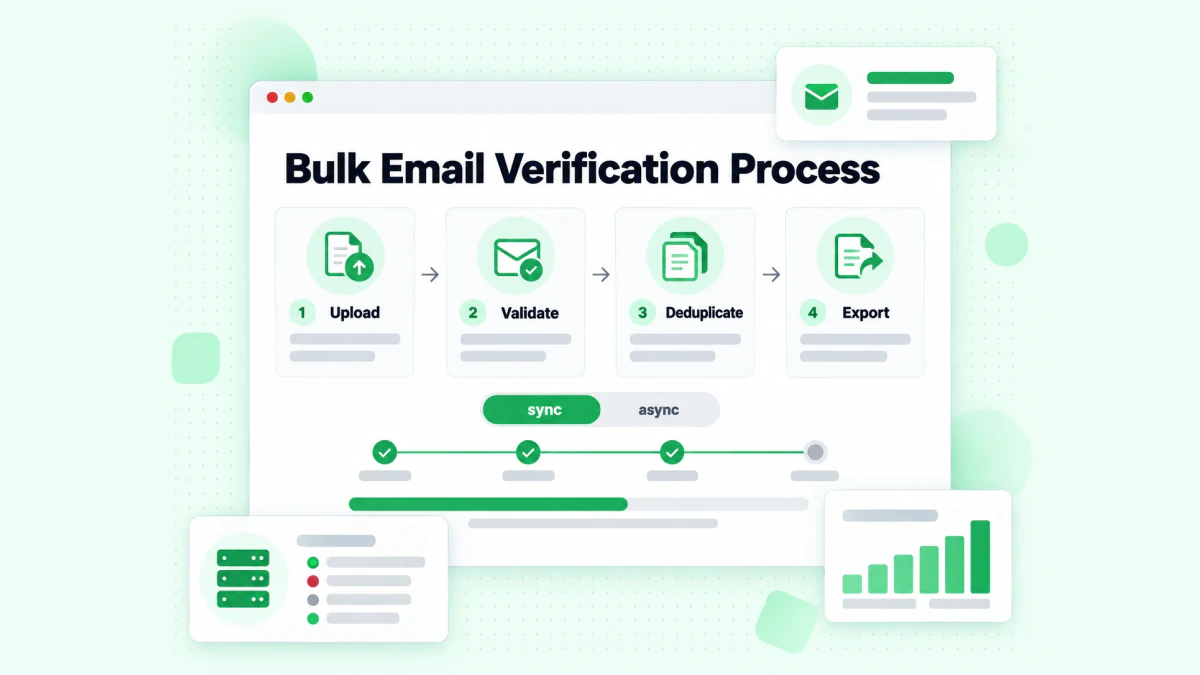
BillionVerify checks a whole export file before you import it.
The short version:
- Export your Apollo list as a CSV.
- Upload it to BillionVerify.
- Keep valid addresses. Drop invalid ones.
- Put catch-all or role-based addresses in a separate, lower-priority segment.
- Import the clean list into your sequence or CRM.
BillionVerify checks syntax, domain and MX records, and the mailbox itself over SMTP. It reports catch-all as its own result instead of counting it as valid. It also flags disposable and role addresses.
You get 20 free credits every day you use your account, up to 600 a month. They never expire. A valid or invalid result uses one credit. Unknown results are free, and a re-check within 24 hours is free too.
Two free tools help with single checks. Our reverse email lookup shows the domain, organisation, mail routing and public profile signals behind an address. For calls, our phone number validator shows whether a number is valid for its country and what line type it is.
Apollo Terms in Plain English
New users meet a few terms again and again.
- Credit: the unit you spend to reveal data or run AI research.
- Seat: one user licence. Credits are granted per seat.
- Sequence: an automated outreach plan with steps spread over days, such as a first email, a follow-up and a call.
- Enrichment: adding missing fields to a record you already hold.
- Waterfall enrichment: trying one source after another until a field is filled.
- Intent: signals that a company is researching a topic you sell into.
- Account: a company record, as opposed to a person.
Apollo.io Alternatives at a Glance
Apollo is one of several B2B contact data tools. Common alternatives include:
- ZoomInfo: an enterprise-focused data provider.
- RocketReach: contact lookup with emails and phones.
- Lusha: contact data through a browser extension.
- Hunter: email finding by company domain.
- LinkedIn Sales Navigator: prospecting inside LinkedIn, without email addresses.
They differ in coverage, price per contact and outreach tools. Many teams pair two, for example Sales Navigator to find people and Apollo to get their details.
FAQs
What is Apollo.io?
Apollo.io combines a sales intelligence platform with a sales engagement platform. It joins B2B contact data and outreach features in one app. The company started in 2015.
What is the Apollo.io official website?
The Apollo.io official website is apollo.io. Sign up, pricing and the About page all live there.
Is Apollo.io free?
Yes, Apollo.io has a free tier. It includes core features and 900 credits a year, granted in monthly portions. You can start without a card.
How much does Apollo.io cost?
In October 2026, Apollo.io Basic cost $49, Professional $79 and Organization $119 per seat each month on annual billing. Organization needs at least 3 seats. Check the pricing page for current figures.
How many contacts does Apollo have?
Apollo claims more than 240 million contacts and 30 million accounts. That is the company's own figure.
What is an Apollo credit?
A credit is Apollo's unit of data access. Revealing an email costs one; a phone costs eight; enrichment costs one to eight.
Is "apollo io" the same as Apollo.io?
Yes, "apollo io" means Apollo.io. "Apollo io", "apollo", "appolo" and "apolo" are all searches for the company at apollo.io.
Who founded Apollo.io?
The Apollo.io company overview on the About page lists Tim Zheng and Ray Li as founders.
What is a sales intelligence platform?
A sales intelligence platform is software that gives sellers data on prospects: who they are, how to reach them and whether they may be ready to buy. Apollo is one example. It also adds outreach tools on top.
Do I need to verify emails from Apollo?
Yes, verify Apollo exports before any cold email campaign. Apollo's records are gathered over time, and people move jobs. Verifying an export removes addresses that would bounce and flags catch-all and role inboxes.
Does Apollo work with Gmail and Salesforce?
Yes, Apollo.io works with both Gmail and Salesforce. The pricing table lists Gmail and Salesforce extensions on all tiers, including the free one.