



This is Part 1 of a 4-part series on the 2025 Email Deliverability Report. Continue reading: Part 2: Email Verification & Strategy | Part 3: Case Studies & AI SDR Analysis | Part 4: Industry Guides & Quick Reference
The email landscape has undergone a seismic transformation in 2025. What was once a relatively straightforward channel for business communication has become a complex battleground where artificial intelligence, increasingly sophisticated spam filters, and stricter authentication requirements converge to create both unprecedented challenges and remarkable opportunities.
This comprehensive report represents months of research, analysis of billions of data points, and insights from industry leaders across the email ecosystem. Whether you're an email marketer trying to reach more inboxes, a deliverability specialist fighting to maintain sender reputation, or a business leader evaluating email verification investments, this report provides the definitive analysis of where the industry stands today and where it's heading.
The findings may surprise you. While email volumes continue to grow—now exceeding 350 billion messages daily—inbox placement rates have declined for the first time in years. The rise of AI-generated content has fundamentally altered the spam landscape, with over half of all spam now created by artificial intelligence. Meanwhile, major mailbox providers have implemented the most stringent authentication requirements in email history.
Yet within these challenges lies tremendous opportunity. Organizations that understand and adapt to this new reality are achieving remarkable results, with properly authenticated senders seeing inbox placement rates approaching 99%. The email verification market has responded to these changes with explosive growth, projected to reach $3.5 billion by 2033 as businesses recognize that list hygiene is no longer optional—it's existential.
This report will guide you through every aspect of the 2025 email landscape, from global deliverability benchmarks to the AI revolution reshaping how businesses communicate. Let's begin.
For a comprehensive understanding of email verification fundamentals, pair this report with our complete guide to email verification and email deliverability guide.
Executive Summary: The State of Email in 2025
The email industry in 2025 faces a paradox: while email remains the highest-ROI marketing channel—generating $36-42 for every dollar spent—achieving inbox placement has become dramatically more difficult. Our analysis reveals several critical trends that every email professional must understand.
Key Findings at a Glance
Global Deliverability Decline: Average global inbox placement rates dropped to 84.6% in 2024-2025, down from 87.3% the previous year. This represents the most significant year-over-year decline in a decade, with approximately 1 in 6 marketing emails now failing to reach the inbox.
Regional Disparities Widen: North America leads with 87.9% inbox placement, while Asia-Pacific trails at 78.2%. Europe's average hovers around 80.2%, impacted by stricter privacy regulations and higher engagement thresholds set by major providers.
AI-Generated Spam Explosion: According to Barracuda Networks' research, 51% of all spam is now AI-generated—a figure that has tripled in just two years. This has forced mailbox providers to implement increasingly aggressive filtering, which inadvertently affects legitimate senders.
Authentication Becomes Mandatory: Following Google and Yahoo's February 2024 requirements, Microsoft announced in April 2025 that bulk senders must implement SPF, DKIM, and DMARC with at least p=none policy. Non-compliant messages are now rejected outright with error code 550; 5.7.15.
Email Verification Market Surge: The email verification software market grew from $650 million in 2024 to $720 million in 2025, a 10.8% CAGR. Projections indicate the market will reach $3.5 billion by 2033 as businesses scramble to maintain list quality.
AI SDR Adoption Accelerates: AI-powered Sales Development Representatives (SDRs) have moved from experimental technology to mainstream adoption, with platforms like 11x.ai reporting 2% reply rates comparable to human SDRs while processing millions of leads automatically.
What This Means for Your Business
The data is unequivocal: email deliverability in 2025 requires a fundamentally different approach than even two years ago. Organizations that fail to adapt face not just declining performance but potential complete exclusion from major mailbox providers.
The good news is that the path forward is clear. Businesses implementing comprehensive authentication, maintaining rigorous list hygiene through email verification services, and adapting to AI-powered sending tools are not just surviving—they're thriving. This report will show you exactly how to join them.
Part I: Global Deliverability Landscape
Chapter 1: Inbox Placement Rates by Region
The global email deliverability landscape in 2025 reveals stark regional disparities that reflect differences in authentication adoption, regulatory environments, and mailbox provider behaviors.
North America: The Benchmark Region
North America maintains its position as the global leader in email deliverability with an average inbox placement rate of 87.9%. This performance reflects several factors:
Strong Authentication Adoption: North American senders have been quickest to adopt SPF, DKIM, and DMARC protocols. According to our analysis, 78% of commercial email from North American domains now passes full DMARC alignment, compared to just 61% globally.
Sophisticated Email Programs: The region's mature email marketing industry has invested heavily in deliverability infrastructure, list management, and sender reputation monitoring.
Provider Relationships: Major U.S. enterprises often maintain direct relationships with mailbox providers, enabling faster resolution of deliverability issues.
However, even North America has seen decline. The 87.9% rate represents a drop from 89.4% in 2023, driven primarily by more aggressive Gmail and Outlook filtering in response to AI-generated spam.
Europe: Navigating Regulatory Complexity
Europe's average deliverability rate of approximately 80.2% reflects the unique challenges of operating under GDPR and increasingly strict consent requirements.
Privacy-First Impact: GDPR's emphasis on explicit consent has led to smaller but more engaged email lists. While this theoretically should improve deliverability, the reality is more nuanced—European mailbox providers have responded to the regulatory environment by implementing higher engagement thresholds.
Provider Diversity: Unlike North America's Gmail/Outlook dominance, Europe maintains significant email provider diversity including GMX, Web.de, and numerous national providers, each with different filtering approaches.
B2B Outperformance: European B2B senders actually outperform their North American counterparts in some metrics, with average inbox placement rates of 84.7% for authenticated business communications.
Asia-Pacific: The Emerging Challenge
Asia-Pacific's 78.2% inbox placement rate represents both the region's largest challenge and greatest opportunity.
Rapid Growth, Lagging Infrastructure: The region's explosive digital growth has outpaced email authentication adoption. Only 52% of commercial email from APAC domains passes full DMARC validation.
Language and Character Set Issues: Multi-byte character sets and diverse script requirements create unique deliverability challenges that Western-developed email systems don't always handle optimally.
Mobile-First Complications: The region's mobile-dominant email consumption patterns affect engagement metrics differently than desktop-heavy Western markets, sometimes resulting in lower measured engagement despite actual readership.
Improvement Trajectory: Despite current challenges, APAC shows the fastest improvement rate, with deliverability climbing 3.2 percentage points year-over-year as authentication adoption accelerates.
Latin America and Africa: Untapped Potential
Emerging markets in Latin America and Africa present unique deliverability profiles.
Latin America: Average inbox placement of 79.8% reflects growing email sophistication, with Brazil and Mexico leading regional improvements. Authentication adoption is accelerating rapidly.
Africa: The continent's 74.5% average masks significant variation, from sophisticated South African email programs achieving 85%+ placement to emerging markets still building basic email infrastructure.
Chapter 2: Deliverability by Email Service Provider
The choice of Email Service Provider (ESP) significantly impacts deliverability outcomes. Our analysis of major ESPs reveals substantial performance variation.
ESP Performance Rankings 2025
Tier 1: 95%+ Average Inbox Placement
- Postmark: 99.1% (transactional email specialist)
- Amazon SES (properly configured): 97.2%
- SendGrid (dedicated IP): 96.8%
Tier 2: 90-95% Average Inbox Placement
- Mailgun: 94.5%
- Brevo (formerly Sendinblue): 93.8%
- Klaviyo: 93.2%
- ActiveCampaign: 92.7%
Tier 3: 85-90% Average Inbox Placement
Concerning Trends: Several ESPs showed significant year-over-year declines in Q1 2025 compared to Q1 2024:
- Mailgun: -27.5%
- Mailchimp: -19.63%
- Amazon SES: -14.60%
- Klaviyo: -13.24%
These declines reflect not necessarily provider quality issues but the industry-wide tightening of mailbox provider filtering in response to AI-generated spam.
Factors Affecting ESP Performance
Shared vs. Dedicated Infrastructure: Senders on shared IP pools are increasingly vulnerable to "bad neighbor" effects, where other senders' poor practices damage collective reputation.
Authentication Implementation: ESPs that make DMARC implementation easy and default see better aggregate performance across their customer base.
Deliverability Support: Providers offering dedicated deliverability support enable customers to identify and resolve issues before they become critical.
For a deeper understanding of maintaining sender reputation, refer to our email deliverability troubleshooting guide.
Chapter 3: Deliverability by Industry Vertical
Industry significantly influences email deliverability outcomes, reflecting both sender practices and recipient expectations.
Top Performing Industries
Travel and Tourism: 98%+ Deliverability Travel industry emails benefit from high recipient anticipation and engagement. Booking confirmations, itinerary updates, and travel deals generate strong open and click rates that positively influence sender reputation.
Non-Profit Organizations: 97%+ Deliverability Non-profits enjoy strong deliverability due to emotionally engaged audiences and mission-driven messaging that generates high engagement.
Healthcare: 96%+ Deliverability Medical communications receive priority treatment due to their critical nature. Appointment reminders, test results, and health updates maintain exceptional inbox placement.
For strategies specific to non-profit email, see our nonprofit email marketing guide.
Middle-Tier Industries
E-commerce: 91-94% Deliverability Online retail faces the challenge of high volume combined with promotional frequency. Well-managed programs achieve excellent results, but aggressive discounting campaigns can trigger spam filters.
Our ecommerce email marketing guide provides specific strategies for this sector.
SaaS and Technology: 90-93% Deliverability Technology companies generally maintain good deliverability through sophisticated email programs, though aggressive trial and demo request sequences can impact performance.
Financial Services: 89-92% Deliverability Regulatory requirements actually help financial services deliverability by mandating clear sender identification and easy unsubscribe mechanisms.
Challenging Industries
Real Estate: 85-88% Deliverability High-volume prospecting and purchased list usage create persistent deliverability challenges in real estate.
Marketing and Advertising: 82-86% Deliverability The industry's own aggressive email practices ironically make it one of the most challenging verticals for deliverability.
Cryptocurrency and Finance: 78-83% Deliverability Association with fraud and regulatory concerns places these senders under heightened scrutiny from mailbox providers.
Chapter 4: The Bounce Rate Crisis
Email bounce rates have emerged as a critical concern in 2025, with average hard bounce rates climbing to 2.48% industry-wide—well above the 2% threshold that many mailbox providers use as a reputation signal.
Understanding Bounce Rate Benchmarks
Acceptable: Below 2% hard bounce rate Concerning: 2-5% hard bounce rate Critical: Above 5% hard bounce rate
The 28% Annual List Decay Reality
Research confirms that email lists decay at approximately 28% annually through:
- Job changes resulting in email address changes
- Domain expirations
- Mailbox abandonment
- Spam trap conversion of inactive addresses
This decay rate means a list of 100,000 emails loses approximately 28,000 valid addresses each year. Without regular email list cleaning, senders face compounding deliverability problems.
Bounce Rate Impact by Volume
The relationship between bounce rates and deliverability is non-linear. Our analysis shows:
| Hard Bounce Rate | Deliverability Impact |
|---|---|
| <1% | Minimal negative impact |
| 1-2% | 5-10% deliverability reduction |
| 2-3% | 15-25% deliverability reduction |
| 3-5% | 30-50% deliverability reduction |
| >5% | Potential blocklisting |
For bulk email operations, maintaining low bounce rates requires bulk email verification before any major campaign.
Part II: The Authentication Revolution
Chapter 5: The New Authentication Landscape
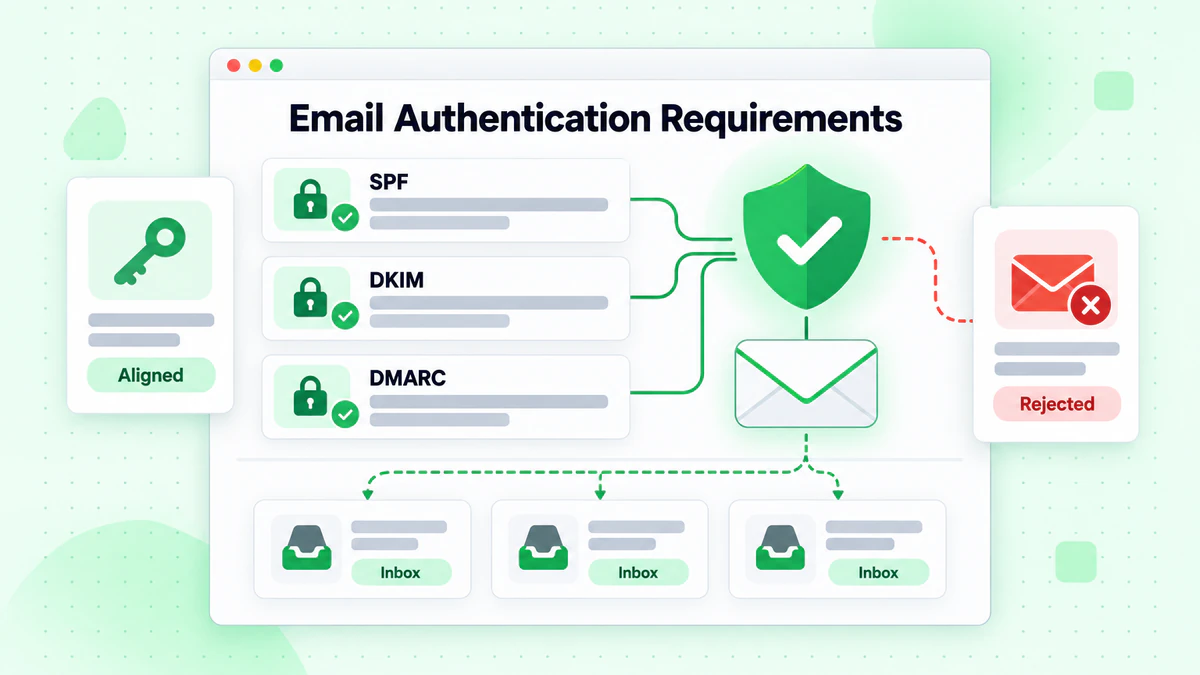
2025 marks the year email authentication transformed from best practice to absolute requirement. The coordinated actions of Google, Yahoo, and Microsoft have effectively mandated SPF, DKIM, and DMARC for any sender expecting consistent inbox placement.
Google and Yahoo Requirements (February 2024)
The February 2024 requirements established the foundation:
For All Senders:
- Valid SPF or DKIM authentication
- Valid forward and reverse DNS (PTR records)
- TLS connection for email transmission
- Spam complaint rates below 0.3%
For Bulk Senders (5,000+ daily to Gmail):
- Both SPF and DKIM authentication required
- DMARC policy published (minimum p=none)
- DMARC alignment (either SPF or DKIM)
- One-click unsubscribe header
- Spam complaints below 0.1%
Microsoft's May 2025 Enforcement
Microsoft's announcement represents the completion of the major provider authentication mandate:
Effective May 5, 2025: Bulk senders (5,000+ daily emails to outlook.com, live.com, hotmail.com) must comply with:
- SPF authentication that passes and aligns with From domain
- DKIM authentication that passes and aligns with From domain
- DMARC record published with at least p=none
- Valid, reply-capable From address
- Clear unsubscribe mechanism
Enforcement Escalation: Microsoft initially planned to route non-compliant messages to junk folders but escalated to outright rejection. Non-compliant messages now receive error code "550; 5.7.15 Access denied, sending domain does not meet the required authentication level."
The Technical Requirements Explained
SPF (Sender Policy Framework) SPF specifies which mail servers are authorized to send email for your domain. Implementation requires:
v=spf1 include:_spf.google.com include:sendgrid.net -all
Key considerations:
- Limit DNS lookups to 10 maximum
- Include all legitimate sending sources
- Use -all (hard fail) rather than ~all (soft fail) for maximum protection
DKIM (DomainKeys Identified Mail) DKIM adds a cryptographic signature to emails, verifying they haven't been modified in transit:
selector._domainkey.yourdomain.com TXT "v=DKIM1; k=rsa; p=PUBLIC_KEY"
Best practices:
- Use 2048-bit keys minimum
- Rotate keys annually
- Sign all headers that affect message interpretation
DMARC (Domain-based Message Authentication, Reporting and Conformance) DMARC ties SPF and DKIM together with policy enforcement:
_dmarc.yourdomain.com TXT "v=DMARC1; p=reject; rua=mailto:dmarc@yourdomain.com; pct=100"
Policy progression:
- Start with p=none (monitoring only)
- Progress to p=quarantine after analyzing reports
- Achieve p=reject for maximum protection
DMARC Adoption Statistics
Current DMARC adoption reveals significant room for improvement:
- Fortune 500: 92% have DMARC records, but only 34% at p=reject
- Global average: 58% have DMARC records, 12% at p=reject
- Small business: 23% have DMARC records, 4% at p=reject
Chapter 6: BIMI Implementation and Impact
Brand Indicators for Message Identification (BIMI) represents the next frontier in email authentication, displaying verified brand logos in supporting email clients.
Current BIMI Adoption
Despite significant benefits, BIMI adoption remains limited:
- Only 5.7% of domains have implemented BIMI
- 28% year-over-year growth in adoption
- 64% increase in implementation errors, highlighting complexity
BIMI Requirements
Full BIMI implementation requires:
- DMARC at Enforcement: p=quarantine or p=reject required
- SVG Logo File: Specific format requirements (Tiny PS profile)
- VMC Certificate (for Gmail): Verified Mark Certificate from DigiCert or Entrust ($1,000-1,500 annually)
- DNS Record: Publishing BIMI assertion
default._bimi.yourdomain.com TXT "v=BIMI1; l=https://yourdomain.com/logo.svg; a=https://yourdomain.com/vmc.pem"
BIMI Performance Benefits
Organizations with BIMI implementation report:
- 10-39% increase in open rates (varying by study)
- 42% reduction in phishing attacks using their brand
- Enhanced brand visibility and recognition
- Improved recipient trust
The complexity and cost of BIMI implementation currently limits adoption to larger organizations, but we expect significant growth as VMC costs decrease and implementation tools improve.
Chapter 7: Sender Reputation in the AI Era
Sender reputation has become simultaneously more important and more difficult to maintain as mailbox providers respond to AI-generated spam with increasingly sophisticated filtering.
The Sender Score Framework
Sender reputation is typically expressed as a score from 0-100:
| Score Range | Classification | Expected Inbox Rate |
|---|---|---|
| 90-100 | Excellent | 95%+ |
| 80-89 | Good | 85-95% |
| 70-79 | Fair | 70-85% |
| 60-69 | Poor | 50-70% |
| Below 60 | Critical | Below 50% |
Factors Affecting Sender Reputation
Positive Factors:
- High open rates (>20%)
- Strong click-through rates (>2%)
- Low spam complaint rates (<0.1%)
- Low bounce rates (<2%)
- Consistent sending patterns
- Full authentication (SPF, DKIM, DMARC)
- Recipient replies and forwards
- Moving emails from spam to inbox
Negative Factors:
- Spam complaints (>0.1%)
- Hard bounces (>2%)
- Spam trap hits
- Inconsistent sending volumes
- High unsubscribe rates
- Low engagement metrics
- Blocklist appearances
Monitoring Your Reputation
Essential monitoring tools include:
Google Postmaster Tools: Provides domain reputation (High/Medium/Low/Bad), spam rate, authentication status, and delivery errors for Gmail.
Microsoft SNDS: Shows email volume, spam complaint rates, and trap hits for Microsoft domains.
Sender Score (Validity): Provides 0-100 reputation score based on IP address sending behavior.
Talos Intelligence (Cisco): Offers reputation lookup for IP addresses and domains.
Regular monitoring enables early detection of reputation issues before they cascade into deliverability crises.
Part III: The AI Revolution in Email
Chapter 8: AI-Generated Spam: The New Reality
The single most significant development affecting email deliverability in 2025 is the explosion of AI-generated spam. This trend has fundamentally altered the email landscape and driven the authentication requirements discussed earlier.
The Scale of AI-Generated Spam
Barracuda Networks' research delivers a sobering statistic: 51% of all spam is now AI-generated. This figure has tripled in just two years, representing a fundamental shift in the spam ecosystem.
Why AI-Generated Spam Is Different:
Traditional spam was often easy to identify through:
- Poor grammar and spelling
- Generic, template-based content
- Obvious formatting issues
- Clearly fraudulent sender identities
AI-generated spam eliminates these tells. Modern language models produce:
- Grammatically perfect content
- Contextually appropriate messaging
- Personalized elements that appear legitimate
- Professional formatting indistinguishable from legitimate email
AI Phishing: The Amplified Threat
Microsoft's security research reveals alarming statistics about AI-enhanced phishing:
- 4.5x higher click rates on AI-generated phishing emails compared to human-written attempts
- 82.6% of phishing emails now contain AI-generated content
- $2.77 billion in Business Email Compromise (BEC) losses in 2024
The sophistication of AI phishing has reached the point where even security-conscious recipients struggle to identify fraudulent messages. AI can now:
- Research target companies and individuals
- Craft contextually appropriate pretexts
- Mimic writing styles of known contacts
- Generate convincing fake conversation threads
- Adapt messaging based on response patterns
Mailbox Provider Response
Major mailbox providers have responded to AI spam with unprecedented filtering aggression:
Gmail's AI Detection:
- Implemented neural network classifiers specifically trained on AI-generated content
- Increased weighting of sender reputation in filtering decisions
- Reduced tolerance for new or unknown senders
- Enhanced behavioral analysis of sending patterns
Microsoft Defender:
- Deployed machine learning models to identify AI-generated phishing
- Implemented sender reputation scoring at scale
- Increased scrutiny of authentication alignment
- Enhanced Safe Links and Safe Attachments analysis
Yahoo/AOL:
- Strengthened integration with spam reporting networks
- Enhanced pattern detection for AI-generated content
- Increased weighting of user engagement signals
The collateral damage of this aggressive filtering is reduced deliverability for legitimate senders, particularly those with less established reputations or imperfect authentication.
Chapter 9: AI Email Generation Tools: Market Analysis
While AI threatens email deliverability through spam generation, it also offers tremendous value for legitimate senders. The AI email writing tool market has matured significantly in 2025.
Enterprise AI Email Platforms
Jasper AI
- Market position: Leading enterprise AI content platform
- Email capabilities: Full email copywriting, subject line generation, A/B variant creation
- Integration: Major ESP integrations, API access
- Pricing: Enterprise tier from $499/month
- Key strength: Brand voice training and consistency
Copy.ai
- Market position: Business-focused AI writing platform
- Email capabilities: Sales sequences, cold outreach, nurture campaigns
- Integration: CRM integrations, workflow automation
- Pricing: From $49/month
- Key strength: Sales-specific templates and frameworks
Writer.com
- Market position: Enterprise AI writing platform with governance
- Email capabilities: Full email suite with brand compliance
- Integration: Enterprise application ecosystem
- Pricing: Custom enterprise pricing
- Key strength: Brand governance and compliance controls
Email-Specific AI Tools
- Focus: AI email coaching and optimization
- Capabilities: Real-time writing feedback, personalization suggestions, send time optimization
- Integration: Gmail, Outlook, major sales tools
- Results claimed: 2x reply rates on average
- Pricing: From $29/month
Regie.ai
- Focus: Sales email generation and personalization
- Capabilities: AI-generated sequences, personalization at scale
- Integration: Major CRM and sales engagement platforms
- Differentiation: Sales-specific training data and frameworks
- Pricing: Custom based on volume
Smartwriter.ai
- Focus: Personalized cold email at scale
- Capabilities: Prospect research automation, personalization generation
- Integration: LinkedIn and company data sources
- Use case: Cold outreach personalization
- Pricing: From $59/month
Platform-Embedded AI Features
Major email and marketing platforms have embedded AI capabilities:
HubSpot Breeze
- Capabilities: Email content generation, subject line optimization, send time prediction
- Results: 40% productivity boost claimed, 25% more engagement reported by customers
- Availability: Included in Marketing Hub, credits-based model in 2025
Salesforce Einstein
- Capabilities: Send time optimization, engagement scoring, content recommendations
- Results: Case studies show $2.1 million additional revenue at U.S. Bank through optimized timing
- Integration: Native to Salesforce Marketing Cloud
Mailchimp AI
- Capabilities: Subject line helper, content optimization, send time optimization
- Availability: Various tiers, some features in free plan
- Differentiation: Small business accessibility
Chapter 10: AI SDRs: The New Frontier of Email Outreach
The most transformative AI application in email is the emergence of AI Sales Development Representatives (AI SDRs). These platforms represent a fundamental shift in how businesses approach email outreach, with profound implications for deliverability.
Understanding AI SDRs
AI SDRs are autonomous systems that perform the full range of traditional SDR activities:
- Lead Identification: Searching and qualifying potential prospects
- Research: Gathering information about prospects and companies
- Personalization: Crafting individualized outreach messages
- Campaign Execution: Managing multi-touch sequences
- Response Handling: Engaging with replies and booking meetings
- Performance Optimization: Learning from results to improve
Major AI SDR Platforms Analysis
11x.ai (Alice)
11x has emerged as a leading AI SDR platform with impressive performance metrics:
- Production Scale: Processing millions of leads and messages
- Performance: 2% reply rate comparable to human SDRs
- Case Study (Gupshup): 50% increase in SQLs per SDR, 1.5x output boost without headcount increase
- Re-engagement Success: 35% response rate on cold pipeline re-engagement
- Growth: 50% month-over-month growth, 10,000+ demo requests in first 10 months
- Architecture: Multi-agent system rebuilt in January 2025 with sophisticated lead sourcing, research, and personalization capabilities
Artisan AI (Ava)
Artisan positions its AI SDR as a "digital employee":
- Database: 300 million B2B contacts with 65+ data points per contact
- Personalization: "Personalization Waterfall" analyzing social media, website visits, and multiple data sources
- Case Study (Bioaccess): 3%+ response rates, four sales calls with potential deals in two months
- Pricing: $1,500-2,000/month starting with annual contract
- Limitation: Requires guidance for complex situations; best viewed as "junior SDR needing supervision"
Reply.io AI SDR
Reply.io offers comprehensive AI SDR capabilities:
- Approach: AI assistant integrated with multi-channel sequences
- Capabilities: Email, LinkedIn, calls integration
- Personalization: AI-powered message generation with human oversight option
- Differentiation: Strong analytics and A/B testing capabilities
- Use case: Teams wanting AI augmentation rather than full automation
Instantly.ai
Instantly focuses on email deliverability alongside AI capabilities:
- Email Infrastructure: Built-in warmup, multiple sending accounts management
- AI Features: AI-powered personalization, response handling
- Deliverability: Strong focus on inbox placement optimization
- Pricing: From $37/month with generous email limits
- Differentiation: Combines cold email infrastructure with AI capabilities
Apollo.io
Apollo provides comprehensive sales intelligence with AI features:
- Database: 265 million+ contacts
- AI SDR: Automated prospecting, personalization, and meeting booking
- Deliverability Agent: AI-powered debugging that reduces troubleshooting from weeks to minutes
- Market Position: Leader in G2's 2025 AI Sales Assistant category
- Results Claimed: 2-3x improved reply rates, 30% productivity improvement
Clay
Clay takes a data enrichment-first approach:
- Core Capability: AI-powered data enrichment from multiple sources
- Integration: Claude AI integration for personalization and research
- Case Study (Rippling): Triple enrichment rate, breakthrough outbound performance
- Valuation: $1.5 billion with 6x growth in 2024
- Use case: Teams needing sophisticated data enrichment for personalization
Salesforce Einstein SDR
Enterprise-grade AI SDR capabilities:
- Integration: Native to Salesforce ecosystem
- Case Study (Nordstrom): 3.5x higher purchase likelihood, $5.3 million additional revenue
- Case Study (U.S. Bank): $2.1 million extra revenue from AI-optimized send times
- Capabilities: Engagement scoring, send time optimization, content personalization
- Market Position: Enterprise standard for Salesforce customers
AI SDR Deliverability Implications
The proliferation of AI SDRs creates significant deliverability considerations:
Volume Concerns: AI SDRs can send at scales previously impossible, potentially overwhelming recipient mailboxes and triggering spam filters.
Quality Variation: While top platforms produce excellent output, lower-quality AI-generated emails contribute to the spam problem, affecting all senders.
Authentication Requirements: AI SDR platforms must maintain strict authentication standards; their aggregate sender reputation affects all users.
Warmup Integration: Leading platforms now integrate email warmup, recognizing that AI-generated volume requires corresponding reputation building.
Personalization Balance: Over-personalization can appear creepy or trigger spam filters trained to identify AI-generated content.
Best Practices for AI SDR Usage
Organizations deploying AI SDRs should:
- Start with limited volume and scale gradually
- Maintain human oversight of AI-generated content
- Implement proper authentication before any sending
- Monitor deliverability metrics closely during deployment
- Use dedicated domains for cold outreach separate from transactional email
- Integrate warmup services before scaling volume
- Respect unsubscribe requests and maintain compliance
- Focus on quality over quantity in targeting
Chapter 11: The Enterprise AI Email Landscape
Beyond AI SDRs, enterprises are deploying AI across the email lifecycle. This chapter examines the broader enterprise AI email ecosystem.
Marketing Automation AI
Segment Intelligence Modern marketing platforms use AI to automatically segment audiences based on behavior patterns, purchase history, and engagement signals. This enables:
- Dynamic segmentation that updates in real-time
- Predictive identification of likely converters
- Automated suppression of disengaged contacts
Content Optimization AI optimizes email content through:
- Subject line A/B test prediction (reducing needed test volume)
- Content personalization beyond simple merge fields
- Image selection optimization
- Copy length and tone adjustment
Send Time Optimization AI determines optimal send times for individual recipients:
- HubSpot Breeze analyzes historical engagement patterns
- Salesforce Einstein predicts individual open likelihood by hour
- Results: 10-25% improvement in open rates reported
For implementing these strategies, see our email timing optimization guide.
Transactional Email AI
Transactional emails benefit from AI in several ways:
Dynamic Content Generation
- Order confirmation emails with AI-recommended upsells
- Account notifications with personalized next-step suggestions
- Password reset emails with fraud detection messaging
Delivery Optimization
- AI-powered retry logic for temporary failures
- Dynamic routing based on recipient domain characteristics
- Real-time deliverability monitoring and alerting
Performance Analysis
- Automated identification of deliverability issues
- Pattern detection for emerging problems
- Predictive alerting before issues become critical
Learn more in our transactional emails guide.
Customer Service Email AI
AI transforms customer service email through:
Response Generation
- Salesforce Einstein generates case responses achieving 80% close rate
- Iron Mountain reports 70% reduction in chat abandonment with AI responses
- AI responses maintain brand voice while handling routine inquiries
Escalation Prediction
- AI identifies emails likely to require human intervention
- Sentiment analysis routes emotional messages appropriately
- Complexity scoring ensures proper handling
Resolution Optimization
- AI suggests resolutions based on historical success
- Knowledge base integration surfaces relevant articles
- Continuous learning from successful resolutions
Continue reading the 2025 Email Deliverability Report:
- Part 2: Email Verification & Strategy - Email verification methods, implementation strategies, infrastructure operations, and strategic recommendations
- Part 3: Case Studies & AI SDR Analysis - Deep dive case studies, regulatory compliance, and comprehensive AI SDR vendor analysis
- Part 4: Industry Guides & Quick Reference - Marketing strategy integration, industry-specific guides, and quick reference materials
Bandingkan BillionVerify dengan ZeroBounce dalam hal akurasi dan kecepatan sebelum memilih penyedia verifikasi.