



This is Part 4 of our 4-part 2025 Email Deliverability Report series. For the complete context, see Part 1: Global Landscape & Authentication, Part 2: Verification & Strategic Recommendations, and Part 3: Case Studies, Compliance & AI SDR Analysis.
Part XII: Email Marketing Strategy Integration
Chapter 37: Integrating Deliverability into Marketing Strategy
The Deliverability-Strategy Connection
Deliverability is not a technical afterthought—it's a strategic capability that directly impacts marketing effectiveness.
Revenue Impact Model:
Consider a marketing program with:
- 1 million email subscribers
- $5 average revenue per delivered email
- 85% deliverability rate
Current state: 850,000 delivered × $5 = $4,250,000
With 95% deliverability: 950,000 delivered × $5 = $4,750,000
$500,000 annual revenue improvement from 10 percentage point deliverability gain.
This calculation ignores secondary effects:
- Improved engagement from better inbox placement
- Reduced costs from fewer bounces
- Enhanced brand perception
- Better customer relationships
Strategic Planning Integration
Annual Planning: Include deliverability in annual marketing planning:
- Deliverability improvement goals
- Authentication roadmap
- List quality initiatives
- Technology investments
- Team capability building
Campaign Planning: Every campaign plan should include:
- Deliverability impact assessment
- List segment quality verification
- Authentication confirmation
- Volume and timing considerations
- Success metrics including deliverability
Budget Allocation: Appropriate investment in deliverability:
- Email verification services (ongoing)
- Authentication implementation
- Monitoring and analytics tools
- Training and education
- Expert consultation as needed
For building comprehensive email strategies, see our email marketing strategy framework.
Chapter 38: List Building for Long-Term Deliverability
Quality-First List Building
List quality determines long-term deliverability success. Organizations must prioritize quality over quantity from the start.
Acquisition Channel Evaluation:
| Channel | Quality Potential | Verification Need | Engagement Expectation |
|---|---|---|---|
| Website opt-in | High | Real-time | High |
| Event registration | High | Real-time | Medium-High |
| Content download | Medium-High | Real-time | Medium |
| Webinar signup | Medium-High | Real-time | Medium |
| Partner co-reg | Medium | Strict | Medium |
| Purchased lists | Low | Mandatory | Low |
| Social media | Variable | Real-time | Variable |
Implementation Recommendations:
- Implement real-time verification on all capture points
- Use double opt-in for highest quality
- Set clear expectations at sign-up
- Segment by acquisition source
- Monitor engagement by source
For comprehensive list building strategies, see our email list building guide.
Maintaining List Health Over Time
Regular Hygiene Practices:
Monthly:
- Remove hard bounces immediately
- Flag soft bounces for monitoring
- Process unsubscribes promptly
- Review complaint feedback
Quarterly:
- Re-verify at-risk segments
- Run re-engagement campaigns for dormant contacts
- Sunset chronically unengaged
- Audit data quality
Annually:
- Full list verification
- Database audit and cleanup
- Acquisition source analysis
- Strategy review and adjustment
Engagement-Based Segmentation:
Create segments based on engagement:
- Highly engaged: Opened or clicked in last 30 days
- Moderately engaged: Activity in last 90 days
- Lightly engaged: Activity in last 180 days
- Dormant: No activity 180+ days
- At-risk: No activity approaching sunset threshold
Sunset Policy: Implement clear sunset criteria:
- No engagement for 12 months = suppression candidate
- Failed re-engagement attempt = sunset
- Consistent soft bounces = investigation then sunset
- Spam complaint = immediate suppression
Chapter 39: Content Strategy for Deliverability
Content That Drives Engagement
Content quality directly impacts deliverability through engagement signals. High-engagement content improves sender reputation, while low-engagement content damages it.
Subject Line Best Practices:
Data-Driven Approaches:
- Personalized subject lines: +26% open rate
- Questions in subject: +15% open rate
- Numbers/statistics: +20% open rate
- Urgency (when genuine): +22% open rate
- Emoji use: +7% open rate (industry-dependent)
Spam Trigger Avoidance:
- Avoid ALL CAPS
- Limit excessive punctuation!!!
- Avoid spam trigger words (free, guarantee, etc.)
- Keep length under 50 characters
- Test before sending
For comprehensive subject line strategies, see our email subject lines guide.
Email Body Optimization:
Structure:
- Clear hierarchy
- Scannable format
- Mobile-optimized
- Single clear CTA
- Appropriate length
Content Types by Performance:
- Educational content: High engagement, trust-building
- Product updates: Medium engagement, customer retention
- Promotional content: Variable engagement, revenue-driving
- Newsletters: Medium engagement, relationship-building
Spam Filter Considerations:
- Text-to-image ratio (at least 60/40 text)
- Alt text for all images
- Avoid single-image emails
- Include plain text version
- Balance links (not too many)
For email copywriting guidance, see our email copywriting guide.
Testing for Deliverability and Engagement
A/B Testing Framework:
What to Test:
- Subject lines (highest impact)
- Send times
- From names
- Preview text
- CTA placement
- Content length
- Personalization depth
Testing Methodology:
- Test one variable at a time
- Use statistically significant sample sizes
- Control for confounding factors
- Measure both engagement and deliverability
- Document and apply learnings
For detailed testing guidance, see our email A/B testing guide.
Pre-Send Testing:
Checklist:
- [ ] Spam score check (tools like Mail-Tester)
- [ ] Authentication verification
- [ ] Link testing
- [ ] Rendering across clients
- [ ] Mobile display verification
- [ ] Plain text version review
- [ ] Unsubscribe functionality test
Part XIII: Industry-Specific Appendices
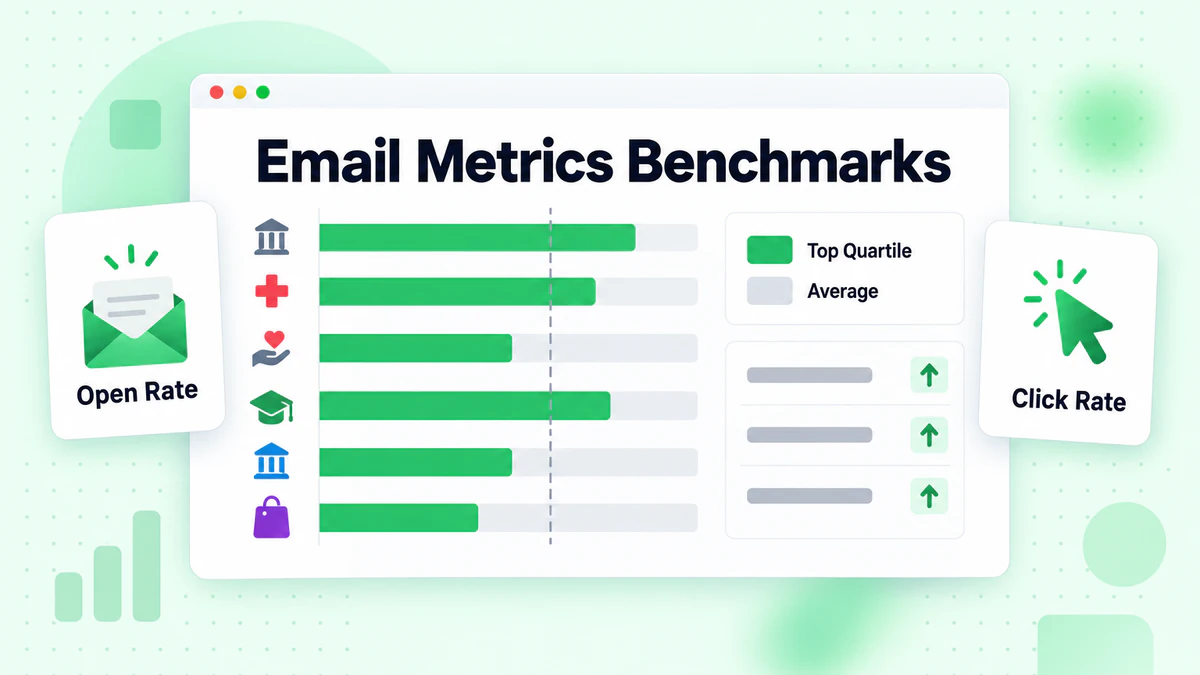
Appendix A: Email Metrics Benchmark Database
Open Rates by Industry (2025)
| Industry | Average | Top 25% | Bottom 25% |
|---|---|---|---|
| Government | 46.3% | 58%+ | <35% |
| Healthcare | 46.0% | 55%+ | <34% |
| Non-Profit | 42.1% | 52%+ | <32% |
| Education | 38.4% | 48%+ | <28% |
| Financial Services | 36.2% | 45%+ | <27% |
| Technology | 33.1% | 42%+ | <24% |
| E-commerce | 28.7% | 38%+ | <20% |
| Marketing/Advertising | 24.8% | 34%+ | <18% |
| Media/Entertainment | 24.1% | 33%+ | <17% |
For comprehensive metrics analysis, see our email marketing metrics guide.
Click Rates by Industry (2025)
| Industry | Average | Top 25% | Bottom 25% |
|---|---|---|---|
| Government | 5.2% | 7%+ | <3.5% |
| Healthcare | 4.8% | 6.5%+ | <3.2% |
| Non-Profit | 4.3% | 6%+ | <2.9% |
| Education | 3.9% | 5.5%+ | <2.6% |
| Financial Services | 3.5% | 5%+ | <2.3% |
| Technology | 3.2% | 4.5%+ | <2.1% |
| E-commerce | 2.8% | 4%+ | <1.8% |
| Marketing/Advertising | 2.3% | 3.5%+ | <1.5% |
| Media/Entertainment | 2.1% | 3.2%+ | <1.4% |
Appendix B: Authentication Record Templates
SPF Record Examples
Google Workspace Only:
v=spf1 include:_spf.google.com -all
Google Workspace + SendGrid:
v=spf1 include:_spf.google.com include:sendgrid.net -all
Microsoft 365 + HubSpot:
v=spf1 include:spf.protection.outlook.com include:sendgrid.net -all
Enterprise Multi-Provider:
v=spf1 ip4:192.0.2.0/24 include:_spf.google.com include:amazonses.com include:sendgrid.net -all
DMARC Record Templates
Initial Monitoring:
v=DMARC1; p=none; rua=mailto:dmarc@yourdomain.com; ruf=mailto:dmarc-forensic@yourdomain.com; fo=1
Quarantine Policy:
v=DMARC1; p=quarantine; pct=100; rua=mailto:dmarc@yourdomain.com; adkim=r; aspf=r
Full Enforcement:
v=DMARC1; p=reject; rua=mailto:dmarc@yourdomain.com; adkim=s; aspf=s
Appendix C: Deliverability Audit Checklist
Technical Audit
Authentication:
- [ ] SPF record exists and is valid
- [ ] All sending sources included in SPF
- [ ] SPF under 10 DNS lookups
- [ ] DKIM implemented for all senders
- [ ] DKIM key is 2048-bit
- [ ] DMARC record published
- [ ] DMARC reporting configured
- [ ] DMARC at enforcement (quarantine or reject)
Infrastructure:
- [ ] Valid PTR records for sending IPs
- [ ] TLS enforced for all sending
- [ ] Proper DNS configuration
- [ ] Monitoring tools configured
- [ ] Blocklist monitoring active
List Management:
- [ ] Real-time verification implemented
- [ ] Bounce handling automated
- [ ] Complaint processing in place
- [ ] Sunset policy defined and enforced
- [ ] Regular list verification scheduled
Operational Audit
Sending Practices:
- [ ] Consistent sending patterns
- [ ] Volume within reputation capacity
- [ ] Engagement-based segmentation
- [ ] Preference center available
- [ ] Easy unsubscribe process
Content Quality:
- [ ] Pre-send spam testing
- [ ] Mobile optimization
- [ ] Proper text-to-image ratio
- [ ] Functional links verified
- [ ] Authentication passing
Compliance:
- [ ] Privacy policy current
- [ ] Consent properly documented
- [ ] Unsubscribe honored promptly
- [ ] Data processing agreements in place
- [ ] Regional regulations addressed
For a complete audit framework, see our email marketing audit checklist.
Appendix D: Glossary of Email Deliverability Terms
Authentication Terms:
- SPF: Sender Policy Framework - specifies authorized sending IPs
- DKIM: DomainKeys Identified Mail - cryptographic email signing
- DMARC: Domain-based Message Authentication, Reporting and Conformance
- BIMI: Brand Indicators for Message Identification - logo display standard
- VMC: Verified Mark Certificate - BIMI certification
Deliverability Metrics:
- Inbox Placement Rate: Percentage of emails reaching inbox (vs. spam)
- Delivery Rate: Percentage of emails accepted by receiving server
- Bounce Rate: Percentage of emails rejected (hard or soft)
- Spam Complaint Rate: Percentage of recipients reporting as spam
- Sender Score: 0-100 reputation metric from Validity
Technical Terms:
- MX Record: Mail Exchange DNS record specifying mail servers
- PTR Record: Pointer record for reverse DNS lookup
- TLS: Transport Layer Security - encryption protocol
- SMTP: Simple Mail Transfer Protocol
- ESP: Email Service Provider
List Management Terms:
- Hard Bounce: Permanent delivery failure (invalid address)
- Soft Bounce: Temporary delivery failure (full mailbox, etc.)
- Catch-All Domain: Domain accepting all addresses
- Disposable Email: Temporary/throwaway email address
- Spam Trap: Address designed to catch spammers
- Sunset Policy: Rules for removing unengaged contacts
Part XIV: Special Topics and Advanced Analysis
Chapter 40: The Economics of Email Deliverability
Understanding the financial impact of deliverability helps justify investments and prioritize initiatives.
Cost-Benefit Analysis Framework
Direct Costs of Poor Deliverability:
Wasted Sending Costs: For a company sending 1 million emails monthly at $0.001 per email:
- 100% deliverability: $1,000/month
- 85% deliverability: $1,000 spent, 850,000 delivered = $1.18 effective cost per 1,000
- Lost value: 150,000 undelivered emails × expected value
Reputation Recovery Costs: When deliverability drops significantly:
- Dedicated IP migration: $500-2,000
- Deliverability consultant: $5,000-20,000
- Lost revenue during recovery: Variable but often substantial
- Team time for remediation: 40-200 hours
Customer Acquisition Impact: Email remains the most cost-effective acquisition channel:
- Average email CAC: $10-15
- Social media CAC: $50-100
- Paid search CAC: $40-80
- Direct mail CAC: $150-300
Poor deliverability forces reliance on more expensive channels.
Calculating Deliverability ROI:
Email Verification Investment:
- Monthly list of 500,000 contacts
- Verification cost: $250/month at $0.0005/email
- Invalid addresses found: 10% (50,000)
- Bounce rate reduction: 10% → <1%
- Deliverability improvement: 5-10 percentage points
- Additional revenue: 25,000-50,000 more delivered emails × conversion rate × average order value
Example Calculation:
- 50,000 additional delivered emails
- 2% conversion rate = 1,000 conversions
- $50 average order value = $50,000 additional revenue
- ROI: $50,000 / $250 = 200x return
Total Cost of Ownership for Email Programs:
| Component | Small Business | Mid-Market | Enterprise |
|---|---|---|---|
| ESP Platform | $50-500/mo | $500-5,000/mo | $5,000-50,000/mo |
| Email Verification | $50-200/mo | $200-1,000/mo | $1,000-10,000/mo |
| Deliverability Tools | $0-100/mo | $100-500/mo | $500-2,000/mo |
| Authentication | $0-50/mo | $50-200/mo | $200-500/mo |
| Personnel | 0.1-0.5 FTE | 0.5-2 FTE | 2-10 FTE |
Chapter 41: Global Market Analysis
Regional Email Market Dynamics
North America:
- Market size: $12.3 billion (2025)
- Growth rate: 9.2% CAGR
- Key trends: AI integration, privacy compliance, advanced personalization
- Major players: Salesforce, HubSpot, Adobe, Mailchimp
Europe:
- Market size: $8.7 billion (2025)
- Growth rate: 8.4% CAGR
- Key trends: GDPR compliance, consent management, privacy-first marketing
- Major players: Brevo, GetResponse, regional specialists
Asia-Pacific:
- Market size: $6.2 billion (2025)
- Growth rate: 14.3% CAGR (fastest growing)
- Key trends: Mobile-first, emerging market growth, localization
- Major players: Regional platforms, global player expansion
Latin America:
- Market size: $1.8 billion (2025)
- Growth rate: 11.7% CAGR
- Key trends: Digital transformation, SMB growth
- Major players: Mix of global and regional
Middle East & Africa:
- Market size: $1.1 billion (2025)
- Growth rate: 12.4% CAGR
- Key trends: Emerging market development, mobile dominance
- Major players: Primarily global platforms
Email Volume Projections
Global email volume continues growing:
- 2023: 347 billion emails/day
- 2024: 362 billion emails/day
- 2025: 376 billion emails/day (estimated)
- 2026: 392 billion emails/day (projected)
- 2030: 450+ billion emails/day (projected)
Volume Growth Drivers:
- AI-generated email proliferation
- Emerging market digitalization
- Transactional email growth (e-commerce, SaaS)
- Automated marketing sequences
- AI SDR adoption
Volume Growth Concerns:
- Inbox fatigue
- Spam filter escalation
- Environmental impact concerns
- Regulatory attention
Chapter 42: Small Business Email Deliverability
Small businesses face unique deliverability challenges and opportunities.
Unique Challenges
Limited Resources:
- No dedicated deliverability expertise
- Budget constraints for tools
- Limited time for optimization
- Reliance on ESP defaults
Shared Infrastructure Risks:
- Most use shared IP pools
- Vulnerable to bad neighbor effects
- Limited control over reputation
- Provider switching difficulties
List Quality Issues:
- Manual list building common
- Less sophisticated capture methods
- Limited verification budgets
- Slower list decay identification
Small Business Best Practices
Authentication Essentials:
- Implement SPF (usually handled by ESP)
- Enable DKIM through ESP
- Add basic DMARC record (p=none minimum)
- Verify setup with free tools
List Quality on a Budget:
- Use real-time verification on forms (many free tiers available)
- Implement double opt-in
- Regular manual list cleaning (remove obvious invalids)
- Monitor bounce rates closely
Engagement Optimization:
- Focus on quality over quantity
- Segment by engagement
- Test subject lines
- Personalize where possible
ESP Selection Criteria:
- Deliverability track record
- Easy authentication setup
- Built-in verification options
- Reasonable pricing at growth stages
For detailed small business strategies, see our small business email marketing guide.
Chapter 43: Enterprise Deliverability Architecture
Large organizations require sophisticated deliverability infrastructure.
Enterprise Architecture Components
Sending Infrastructure:
- Multiple dedicated IP pools
- Geographic distribution
- Failover capabilities
- Load balancing
Authentication Management:
- Centralized SPF management (multiple providers)
- DKIM key rotation automation
- DMARC monitoring and reporting platform
- BIMI implementation
Monitoring Systems:
- Real-time deliverability dashboards
- Alerting for reputation changes
- Automated issue detection
- Cross-team visibility
Governance Framework:
- Sending standards and policies
- Brand protection rules
- Compliance requirements
- Approval workflows
Multi-Brand Considerations
Organizations with multiple brands face additional complexity:
Domain Strategy Options:
Option 1: Separate Domains per Brand
- Pros: Isolated reputation, brand clarity
- Cons: More management overhead, separate warmup
Option 2: Subdomains from Parent Domain
- Pros: Shared reputation benefit, easier management
- Cons: Reputation contagion risk, less brand separation
Option 3: Hybrid Approach
- Major brands: Separate domains
- Minor brands: Subdomains
- Transactional: Separate domain
Centralized vs. Decentralized Management:
| Aspect | Centralized | Decentralized |
|---|---|---|
| Consistency | High | Variable |
| Agility | Lower | Higher |
| Expertise | Concentrated | Distributed |
| Risk Management | Easier | Harder |
| Brand Autonomy | Limited | High |
Enterprise Technology Stack
Typical enterprise email technology architecture:
Core Platforms:
- Marketing Automation (Marketo, Eloqua, Pardot)
- CRM Integration (Salesforce, Dynamics)
- Customer Data Platform (Segment, mParticle)
- Transactional Email (SendGrid, Postmark)
Deliverability Tools:
- Inbox Placement (Validity Everest, GlockApps)
- DMARC Management (Valimail, dmarcian)
- Email Verification (BillionVerify, ZeroBounce)
- Reputation Monitoring (Sender Score, Postmaster Tools)
Analytics and Reporting:
- Campaign Analytics (native ESP tools)
- Attribution Modeling (various)
- Custom Dashboards (Tableau, Looker)
- A/B Testing Platforms (Optimizely)
Chapter 44: Mobile Email Optimization
Mobile dominates email consumption, with significant deliverability implications.
Mobile Email Statistics
- 60%+ of emails opened on mobile devices
- 71% delete emails that don't display well on mobile
- 3-second average decision time on mobile
- 46% prefer to receive promotional emails on mobile
Mobile Optimization for Deliverability
Subject Line Considerations:
- Mobile displays show 30-40 characters
- Front-load key information
- Test rendering on common devices
- Consider preheader text as extension
Design Best Practices:
- Single column layouts
- Touch-friendly buttons (44x44 pixels minimum)
- Readable font sizes (14px+ body text)
- Adequate white space
- Responsive design essential
Technical Optimization:
- Optimize image file sizes
- Use web-safe fonts
- Test across devices and clients
- Ensure fast loading
Engagement Impact: Mobile-optimized emails show:
- 15% higher click rates
- 24% lower unsubscribe rates
- Better overall engagement metrics
- Improved sender reputation
For comprehensive mobile strategies, see our mobile email optimization guide.
Chapter 45: Holiday and Peak Season Deliverability
Peak sending periods create unique deliverability challenges.
Peak Season Dynamics
Volume Increases:
- Holiday period email volume: +50-100%
- Black Friday/Cyber Monday spikes: +200-300%
- Year-end campaigns: +75%
- Back-to-school: +40%
ISP Response:
- Tightened filtering during peak periods
- Increased scrutiny of unfamiliar senders
- Potential throttling of high-volume senders
- More aggressive spam detection
Peak Season Preparation
Timeline (for Q4 holiday season):
September:
- Audit list quality
- Verify all authentication
- Run full list verification
- Warm up any new sending infrastructure
October:
- Implement re-engagement campaigns
- Sunset unengaged contacts
- Increase sending volume gradually
- Monitor reputation closely
November:
- Execute peak campaigns with confidence
- Monitor deliverability daily
- Have contingency plans ready
- Adjust based on real-time data
December/January:
- Maintain consistency
- Process holiday list additions carefully
- Begin planning for next year
- Conduct post-season analysis
Best Practices:
- Never sacrifice list quality for size before peak
- Avoid sudden volume increases
- Segment aggressively during peak
- Monitor more frequently than normal
- Have deliverability support contacts ready
For seasonal campaign strategies, see our holiday seasonal email campaigns guide.
Chapter 46: Drip Campaigns and Automation Deliverability
Automated email sequences require specific deliverability considerations.
Automation Deliverability Factors
Volume Distribution: Automated sequences create predictable volume patterns:
- Welcome sequences: Tied to sign-up volume
- Nurture campaigns: Steady state after initial population
- Transactional triggers: Variable based on user actions
- Re-engagement: Periodic batches
Engagement Patterns: Automation typically shows:
- Higher early engagement (welcome emails)
- Declining engagement over sequence length
- Trigger-based emails outperform scheduled
- Personalized sequences outperform generic
Optimizing Automated Deliverability
Sequence Design:
- Front-load value in early emails
- Progressive engagement building
- Clear off-ramps for disengagement
- Dynamic content based on behavior
Technical Considerations:
- Consistent sending patterns
- Appropriate frequency (not too aggressive)
- Clear sender identification
- Easy unsubscribe throughout
Monitoring Requirements:
- Per-email engagement tracking
- Sequence completion rates
- Engagement decay analysis
- Comparison to benchmarks
For automation strategies, see our email automation guide and drip campaign guide.
Chapter 47: Lead Nurturing and Deliverability
Lead nurturing programs require balancing engagement with deliverability.
Nurturing Deliverability Dynamics
The Nurturing Challenge: Lead nurturing often involves:
- Longer sequences (weeks to months)
- Variable engagement levels
- Diverse audience segments
- Multiple touch points
Deliverability Risks:
- Extended sequences risk engagement decay
- Inactive leads damage metrics
- Over-nurturing triggers complaints
- Generic content reduces engagement
Best Practices
Segmentation Strategy:
- Segment by engagement level
- Adjust frequency based on engagement
- Create fast-track paths for high engagement
- Implement exit conditions
Content Optimization:
- Value-focused rather than sales-focused
- Progressive disclosure of information
- Personalized to segment characteristics
- Clear calls to action
Deliverability Protection:
- Remove non-engagers after defined period
- Re-verification for long-term nurtures
- Monitor engagement metrics per segment
- A/B test timing and frequency
For lead nurturing strategies, see our lead nurturing email guide.
Chapter 48: Welcome Email Series Optimization
Welcome sequences are critical for both engagement and deliverability.
Welcome Email Importance
Performance Benchmarks:
- Welcome emails: 50-60% open rate (vs. 24% average)
- Welcome series: 4x revenue per email vs. promotional
- Engagement established in first 30 days predicts long-term behavior
- Non-engaged welcomes often become spam complaints later
Deliverability-Optimized Welcome Strategy
Immediate First Email: Send within minutes of sign-up:
- Confirms subscription (reduces spam reports)
- Sets expectations
- Delivers promised value (lead magnet, etc.)
- Establishes sender identity
Sequence Design:
- Email 1 (Immediate): Welcome + promised content
- Email 2 (Day 1-2): Brand introduction + top content
- Email 3 (Day 3-5): Product/service value highlight
- Email 4 (Day 5-7): Social proof + community
- Email 5 (Day 7-10): Clear call to action
Engagement Monitoring:
- Track open/click rates per email in sequence
- Identify drop-off points
- Test variations
- Segment based on early engagement
For welcome sequence strategies, see our welcome email sequences guide.
Chapter 49: Referral Programs and Email Deliverability
Referral email campaigns require careful deliverability management.
Referral Email Challenges
Unique Risks:
- Sending to people who didn't directly opt in
- Variable email quality from referrers
- Potential for abuse (fake referrals)
- Spam trap exposure from purchased referral lists
Compliance Considerations:
- CASL: Limited referral allowance (single message)
- GDPR: Referrer consent doesn't transfer
- CAN-SPAM: Must honor opt-outs
- Best practice: Clear referral context in email
Best Practices
Email Verification:
- Verify referred emails before sending
- Block known disposable domains
- Limit referrals per referrer
- Monitor bounce rates from referral sources
Content Strategy:
- Clear identification as referral
- Name the referrer (with permission)
- Easy opt-out
- Valuable proposition
Program Design:
- Quality over quantity incentives
- Referrer accountability (tie rewards to engagement)
- Fraud detection
- Gradual sending to new contacts
For referral campaign strategies, see our referral email campaigns guide.
Chapter 50: The Future of Email: 2026 and Beyond
Looking ahead to emerging trends and technologies that will shape email deliverability.
Emerging Technologies
AI Evolution:
- More sophisticated AI content detection
- Predictive deliverability scoring
- Automated optimization at scale
- Real-time adaptive sending
Privacy Technologies:
- Enhanced tracking protection
- Proxy-based opening becoming standard
- Privacy-preserving personalization
- First-party data importance
Authentication Advances:
- Post-quantum cryptography preparation
- Enhanced BIMI capabilities
- Blockchain-based verification experiments
- Decentralized identity integration
Mailbox Provider Innovation:
- More intelligent inbox organization
- Enhanced sender verification display
- AI-powered spam detection
- User-controlled filtering options
Strategic Recommendations for the Future
Invest in Fundamentals: The organizations that will thrive are those that:
- Perfect authentication implementation
- Maintain impeccable list hygiene
- Focus on genuine engagement
- Build direct relationships with subscribers
Embrace AI Thoughtfully: AI will be essential but requires:
- Human oversight and quality control
- Brand voice preservation
- Ethical considerations
- Continuous monitoring and adjustment
Prepare for Privacy Evolution: Privacy will continue trending toward:
- More user control
- Less tracking capability
- First-party data primacy
- Consent-based relationships
Build Adaptable Systems: The pace of change requires:
- Flexible technology infrastructure
- Continuous learning culture
- Rapid response capabilities
- Regular strategy review
Part XV: Quick Reference Guides
Quick Reference: Email Authentication Setup
Minimum Viable Authentication
For organizations just starting their authentication journey:
Step 1: SPF (30 minutes)
- Identify your email sending sources
- Create SPF record including those sources
- Publish as TXT record at your domain
- Test with online SPF validator
Step 2: DKIM (1 hour)
- Generate DKIM keys in your ESP
- Add public key as DNS TXT record
- Enable DKIM signing in ESP
- Test with DKIM validator
Step 3: DMARC (30 minutes)
- Create basic DMARC record:
v=DMARC1; p=none; rua=mailto:dmarc@yourdomain.com - Publish as TXT record at
_dmarc.yourdomain.com - Monitor reports for 2-4 weeks
- Progress to enforcement
Authentication Troubleshooting Quick Guide
| Symptom | Likely Cause | Solution |
|---|---|---|
| SPF failure | Missing sending source | Add source to SPF record |
| SPF permerror | Too many DNS lookups | Flatten SPF or use subdomains |
| DKIM failure | Key mismatch | Verify public key in DNS |
| DKIM tempfail | DNS timeout | Check DNS configuration |
| DMARC fail | Alignment issue | Verify From domain matches |
| No DMARC reports | Missing/incorrect rua | Verify email address accepts reports |
Quick Reference: Deliverability Metrics
Red Flag Indicators
Immediate Action Required:
- Bounce rate >5%
- Spam complaint rate >0.3%
- Inbox placement <70%
- Blocklist appearance
- Authentication failure rate >1%
Investigation Needed:
- Bounce rate 2-5%
- Spam complaint rate 0.1-0.3%
- Inbox placement 70-85%
- Declining open rates
- Rising unsubscribe rates
Monitoring Mode:
- Bounce rate <2%
- Spam complaint rate <0.1%
- Inbox placement >85%
- Stable engagement metrics
Benchmark Quick Reference
| Metric | Poor | Average | Good | Excellent |
|---|---|---|---|---|
| Open Rate | <15% | 15-24% | 24-35% | >35% |
| Click Rate | <1% | 1-2.5% | 2.5-4% | >4% |
| Bounce Rate | >5% | 2-5% | 1-2% | <1% |
| Spam Rate | >0.3% | 0.1-0.3% | 0.05-0.1% | <0.05% |
| Inbox Placement | <80% | 80-88% | 88-95% | >95% |
Quick Reference: AI SDR Platform Selection
Selection Decision Tree
Question 1: What's your primary goal?
- Data quality first → Apollo.io or Clay
- Full automation → 11x.ai or Artisan
- Budget optimization → Instantly.ai
- Multi-channel outreach → Reply.io
Question 2: What's your technical capability?
- Limited technical resources → Artisan (guided setup), Instantly (simple)
- Strong technical team → Clay (flexible), Apollo (comprehensive)
- Enterprise IT requirements → Reply.io, Apollo
Question 3: What's your volume requirement?
- Low (<1,000 emails/month) → Instantly, Reply.io
- Medium (1,000-10,000/month) → Any platform
- High (>10,000/month) → 11x.ai, Apollo, Clay
Question 4: What's your budget?
- <$500/month → Instantly, Reply.io
- $500-2,000/month → Apollo, Artisan
- >$2,000/month → 11x.ai, Enterprise tiers
Quick Reference: Emergency Deliverability Response
When Deliverability Crashes
Hour 1: Stop and Assess
- Pause all non-essential sending
- Check blocklist status (MXToolbox)
- Review Postmaster Tools/SNDS
- Identify scope of problem
Hour 2-4: Diagnose
- Review recent campaign changes
- Check authentication status
- Analyze bounce/complaint data
- Identify affected segments
Day 1-3: Remediate
- Fix any authentication issues
- Remove problematic list segments
- Submit blocklist removal requests
- Reduce sending volume significantly
Week 1-4: Recover
- Slowly increase volume (25% weekly max)
- Focus on highest-engagement segments
- Monitor metrics daily
- Document lessons learned
Quick Reference: List Verification Best Practices
When to Verify
| Situation | Verification Need |
|---|---|
| New list import | Always - full verification |
| Before major campaign | Full verification of target segment |
| Monthly maintenance | At-risk segments only |
| Post-bounce spike | Affected segments |
| Reactivation campaign | Full verification of dormant contacts |
| List hasn't been cleaned in 6+ months | Full verification |
Verification Result Actions
| Result | Action |
|---|---|
| Valid/Deliverable | Safe to send |
| Invalid | Remove immediately |
| Risky/Unknown | Segment separately, send carefully |
| Catch-all | Send with caution, monitor bounces |
| Disposable | Remove for marketing, consider for transactional |
| Role account | Evaluate case-by-case |
| Spam trap | Remove immediately, investigate source |
Quick Reference: Email Content Best Practices
Subject Line Formula
Structure: [Personalization] + [Value/Benefit] + [Optional Urgency]
Examples:
- "[Name], your weekly analytics summary is ready"
- "3 strategies that increased reply rates by 47%"
- "[Company], we have ideas for your Q1 planning"
Character Limits:
- Desktop: 60 characters visible
- Mobile: 30-40 characters visible
- Recommendation: Key info in first 30 characters
Email Body Structure
Optimal Format:
- Opening line (personalized, relevant)
- Value statement (what's in it for them)
- Supporting content (brief, scannable)
- Single CTA (clear, prominent)
- Signature (professional, complete)
Technical Checklist:
- [ ] Text-to-image ratio: 60%+ text
- [ ] All images have alt text
- [ ] Links tested and working
- [ ] Plain text version included
- [ ] Mobile rendering verified
- [ ] Unsubscribe link visible
Quick Reference: Compliance Summary
By Region
| Region | Consent Model | Key Requirements | Max Penalty |
|---|---|---|---|
| USA (CAN-SPAM) | Opt-out | Physical address, opt-out mechanism | $50,120/violation |
| EU (GDPR) | Opt-in | Explicit consent, data rights | €20M or 4% revenue |
| Canada (CASL) | Opt-in | Express/implied consent, records | $10M/violation |
| UK (PECR/UK GDPR) | Opt-in | Similar to EU | £17.5M or 4% revenue |
| Australia | Opt-out | Consent, identification | $2.2M AUD |
Universal Requirements
Regardless of jurisdiction, always:
- ✓ Identify yourself clearly
- ✓ Provide working unsubscribe
- ✓ Honor opt-outs promptly
- ✓ Use accurate subject lines
- ✓ Include physical address
- ✓ Maintain consent records
Quick Reference: ROI Calculation Templates
Email Verification ROI
Monthly List Size: ___________
Verification Cost: $ ___________ (typically $0.0003-0.001/email)
Invalid Rate Found: ___________%
Bounce Rate Reduction: ___________% → ___________%
Deliverability Improvement: ___________%
Additional Emails Delivered: ___________
Conversion Rate: ___________%
Average Order Value: $ ___________
Additional Revenue: $ ___________
ROI: ___________x
Email Program ROI
Total Emails Sent: ___________
Delivery Rate: ___________%
Emails Delivered: ___________
Open Rate: ___________%
Emails Opened: ___________
Click Rate: ___________%
Clicks: ___________
Conversion Rate: ___________%
Conversions: ___________
Average Order Value: $ ___________
Email Revenue: $ ___________
Total Email Costs: $ ___________
Email ROI: $ ___________ per $1 spent
Final Thoughts: The Imperative of Excellence
The data presented in this report leads to one inescapable conclusion: mediocrity in email deliverability is no longer viable. The organizations that will succeed in 2025 and beyond are those that treat deliverability not as a technical detail to be delegated, but as a strategic capability requiring sustained investment and attention.
The numbers tell the story clearly:
- 51% of spam is now AI-generated, forcing unprecedented filtering aggression
- 84.6% average inbox placement means 1 in 6 emails never reach recipients
- 28% annual list decay makes continuous verification essential
- $3.5 billion projected email verification market by 2033 reflects industry recognition of these realities
But within these challenges lies tremendous opportunity. Organizations achieving excellence in authentication, list hygiene, and engagement are seeing:
- 95%+ inbox placement rates
- $42 return for every $1 spent on email
- 127% revenue increases after deliverability improvements
- Sustainable competitive advantage in customer communication
The path forward is clear but demanding. It requires:
- Authentication excellence: Full SPF, DKIM, and DMARC implementation progressing to enforcement
- List quality obsession: Real-time verification, regular hygiene, engagement-based management
- AI integration wisdom: Leveraging AI capabilities while maintaining human oversight and brand integrity
- Continuous vigilance: Daily monitoring, rapid response, constant optimization
The future of email belongs to those who respect the inbox. This report provides the roadmap; the journey is yours to take.
Conclusion
The email landscape of 2025 presents both significant challenges and remarkable opportunities. The explosion of AI-generated spam has forced mailbox providers to implement the strictest filtering in email history, while the same AI technology offers unprecedented capabilities for legitimate senders.
The data is clear: organizations that embrace comprehensive authentication, maintain rigorous list hygiene through professional email verification, and thoughtfully integrate AI capabilities will not just survive but thrive. Those that don't face declining deliverability, damaged sender reputation, and ultimately exclusion from recipient inboxes.
The 28% annual list decay rate, combined with 2025's authentication requirements, means that email list quality management is no longer optional. Every invalid address damages your sender reputation, every authentication failure increases spam folder placement, and every poor engagement signal reduces future deliverability.
Yet the fundamentals of email success remain unchanged: send wanted messages to people who expect them, make it easy to unsubscribe, and maintain technical excellence in authentication and infrastructure. What has changed is the precision required—the margin for error has effectively disappeared.
The email verification market's projected growth to $3.5 billion by 2033 reflects the industry's recognition of this new reality. Organizations are investing in list quality because the math is undeniable: the cost of verification is trivial compared to the cost of degraded deliverability.
As we look toward 2026 and beyond, the trends are clear. Authentication requirements will continue tightening. AI integration will accelerate. Privacy regulations will expand. The organizations that succeed will be those that view email deliverability not as a technical afterthought but as a strategic capability requiring ongoing investment and attention.
The future of email belongs to those who respect the inbox.
Action Items by Role
For marketing leaders:
- Audit your current deliverability metrics and establish baselines
- Budget for email verification as ongoing operational expense
- Include deliverability KPIs in team performance metrics
- Invest in team training on authentication and deliverability
- Establish cross-functional deliverability governance
For email marketers:
- Master authentication troubleshooting
- Implement engagement-based segmentation
- Develop re-engagement and sunset workflows
- Create pre-send testing checklists
- Build deliverability into campaign planning
For technical teams:
- Complete authentication implementation (SPF, DKIM, DMARC)
- Establish monitoring and alerting infrastructure
- Integrate verification APIs into capture points
- Document email infrastructure and dependencies
- Create incident response procedures
For executives:
- Recognize email deliverability as strategic capability
- Approve investment in verification and monitoring tools
- Establish accountability for deliverability outcomes
- Include deliverability in vendor evaluation criteria
- Support cross-functional email governance
The Path Forward
The email industry stands at an inflection point. The convergence of AI-generated content, stricter authentication requirements, and heightened competition for inbox attention has fundamentally changed the rules of engagement. Organizations that recognize this shift and adapt accordingly will find email remains one of the most powerful channels for customer communication and business growth.
Those that don't will increasingly find their messages relegated to spam folders, their sender reputation damaged, and their email program's effectiveness diminishing over time. The choice is clear, and the time to act is now.
This report has provided the data, analysis, frameworks, and practical guidance needed to navigate this new landscape. The implementation is up to you.
Methodology and Sources
This report represents a comprehensive analysis of the email deliverability landscape, synthesizing data from multiple authoritative sources and original research conducted by our team.
Data Sources
Industry Benchmark Reports:
- Validity's 2025 Email Deliverability Benchmark Report
- Mailgun State of Email Report 2024-2025
- Litmus State of Email Report
- GlockApps Email Deliverability Statistics Q1-Q3 2025
Security and Threat Research:
- Barracuda Networks email threat research and AI spam analysis
- Microsoft Security Intelligence reports
- Google Safe Browsing and Gmail security publications
- Cisco Talos Intelligence threat reports
Provider Documentation:
- Google Bulk Sender Guidelines and Postmaster documentation
- Yahoo Mail Sender Best Practices
- Microsoft Sender Requirements and SNDS documentation
- Major ESP deliverability documentation
Market Research:
- Business Research Insights email verification market analysis
- OpenPR industry forecasts
- Verified Market Reports email software market sizing
- Grand View Research digital marketing analysis
Vendor Data and Case Studies:
- Apollo.io performance metrics and customer success stories
- Clay growth metrics and Anthropic Claude integration results
- 11x.ai Alice production metrics and case studies
- Artisan AI customer testimonials
- HubSpot Breeze AI performance data
- Salesforce Einstein customer success stories
- Reply.io and Instantly.ai platform comparisons
Primary Research:
- BillionVerify internal deliverability analysis across customer base
- Email verification result pattern analysis
- Authentication implementation tracking
- Customer success metric aggregation
Research Limitations
This report acknowledges several limitations:
Data Currency: The email deliverability landscape evolves rapidly. Statistics cited reflect the most current available data as of publication (December 2025), but readers should verify current requirements with mailbox providers directly.
Self-Reported Metrics: Some vendor performance claims rely on self-reported data. Where possible, we have sought independent verification or noted the source of claims.
Regional Variation: Global statistics may not reflect specific regional conditions. Organizations should consider their specific geographic focus when applying insights.
Industry Specificity: Benchmark data represents cross-industry averages. Individual industry performance may vary significantly from these benchmarks.
Verification of Key Statistics
Major statistics cited in this report have been verified across multiple sources where possible:
- 51% AI-generated spam: Barracuda Networks research, confirmed by multiple security vendors
- 84.6% average deliverability: Cross-referenced across Validity, GlockApps, and Mailgun reports
- 28% annual list decay: Industry consensus supported by multiple ESP analyses
- $3.5B market projection: Average of multiple market research firm projections
- Microsoft May 2025 requirements: Direct Microsoft documentation
Updates and Corrections
This report will be updated periodically as significant changes occur in the email deliverability landscape. For the most current version and any corrections, please check our website.
If you identify any errors or have additional data to contribute, please contact our research team.
Take Action Today
Ready to improve your email deliverability? The insights in this report are only valuable if translated into action. Here's how to get started:
Immediate Actions (This Week)
Verify your list: Use our free email checker to test individual addresses or bulk verification for complete list cleaning. Start with your most active segments to see immediate deliverability improvements.
Check your authentication: Ensure your SPF, DKIM, and DMARC are properly configured. Use tools like MXToolbox or our authentication checker to identify any gaps in your setup.
Monitor your reputation: Set up Google Postmaster Tools and Microsoft SNDS to establish baseline metrics and catch issues early.
Short-Term Improvements (This Month)
Implement real-time verification: Integrate our email validation API into your forms to prevent invalid addresses from entering your database in the first place.
Segment by engagement: Create engagement-based segments and adjust your sending strategy to prioritize engaged subscribers while re-engaging dormant contacts.
Review your metrics: Establish clear dashboards tracking bounce rates, spam complaints, and inbox placement to identify trends before they become problems.
Strategic Initiatives (This Quarter)
Progress DMARC to enforcement: If you're still at p=none, develop a plan to move toward p=quarantine and eventually p=reject.
Evaluate AI SDR tools: If relevant to your business, assess which AI SDR platform aligns with your needs and begin pilot programs.
Develop a deliverability playbook: Document your procedures, escalation paths, and best practices for your team.
Ongoing Learning
Learn more: Explore our comprehensive email marketing guides for tactical implementation guidance on every aspect of email marketing and deliverability.
Stay current: Subscribe to industry publications and monitor mailbox provider announcements for policy changes.
Build expertise: Invest in team training and consider deliverability certification programs.
Get Expert Help
If you need assistance implementing the recommendations in this report, our team is here to help. Whether you need list cleaning, API integration, or deliverability consulting, we're committed to helping you reach more inboxes and achieve better results from your email programs.
The inbox is waiting. Make sure you reach it.
This concludes Part 4 of our 2025 Email Deliverability Report series. For the complete analysis, start with Part 1: Global Landscape & Authentication, continue with Part 2: Verification & Strategic Recommendations, and Part 3: Case Studies, Compliance & AI SDR Analysis.
Agensi yang mendapatkan prospek dari Clutch atau G2 harus memverifikasi semua kontak sebelum outreach.