



This is Part 3 of a 4-part series on the 2025 Email Deliverability Report. Part 1: Global Landscape & AI Revolution | Part 2: Email Verification & Strategy | Part 4: Industry Guides & Quick Reference
Part VIII: Deep Dive Case Studies
Chapter 25: Enterprise Email Transformation Stories
Real-world implementations provide the most compelling evidence of what works in 2025's challenging email environment. This chapter examines detailed case studies from organizations that have successfully navigated the new landscape.
Case Study 1: Global E-commerce Retailer
Background: A multinational e-commerce company with 15 million email subscribers across 12 markets was experiencing declining email performance. Inbox placement had dropped from 91% to 78% over 18 months, and email-attributed revenue was declining despite growing list size.
Challenges Identified:
- 34% of email list was unengaged (no opens in 6+ months)
- Bounce rate had crept to 4.7%
- DMARC was at p=none with no monitoring
- Different ESPs across regions with inconsistent authentication
- No real-time verification at sign-up points
Implementation Strategy:
Phase 1: Authentication Consolidation (Weeks 1-4)
- Audited all sending domains and sources
- Consolidated to single ESP with dedicated IP pool
- Implemented SPF, DKIM across all sending sources
- Deployed DMARC monitoring with weekly report analysis
Phase 2: List Hygiene (Weeks 2-8)
- Implemented real-time verification on all sign-up forms
- Conducted full list verification (15 million addresses)
- Results: 2.3 million addresses flagged (15.3%)
- 1.1 million invalid/undeliverable
- 450,000 high-risk (catch-all, role accounts)
- 750,000 disposable or temporary
- Segmented unengaged contacts for re-engagement campaign
Phase 3: Re-engagement and Sunset (Weeks 6-12)
- 5-touch re-engagement sequence to 5.1 million dormant contacts
- Results: 890,000 (17.4%) re-engaged
- 4.2 million addresses sunset from active sending
Phase 4: DMARC Enforcement (Weeks 8-16)
- Progressed from p=none to p=quarantine (week 10)
- Advanced to p=reject (week 16)
- Implemented BIMI for brand recognition
Results After 6 Months:
- Inbox placement: 78% → 94.2% (+16.2 percentage points)
- Open rate: 18.3% → 28.7% (+56.8%)
- Click rate: 1.8% → 3.4% (+88.9%)
- Email revenue: +127% despite 35% smaller active list
- Bounce rate: 4.7% → 0.8%
- Spam complaints: 0.31% → 0.04%
Key Insights: The most counterintuitive finding was that sending to fewer people generated significantly more revenue. The bloated list had been diluting engagement metrics, damaging sender reputation, and causing legitimate engaged subscribers' emails to land in spam.
Case Study 2: B2B SaaS Company AI SDR Deployment
Background: A mid-market SaaS company with 50 sales representatives was struggling with outbound prospecting efficiency. Each rep was manually researching and emailing 50-75 prospects daily, achieving a 1.2% reply rate.
Decision: Deploy AI SDR technology to scale outreach while improving quality.
Platform Selection Process: Evaluated Apollo.io, 11x.ai, Reply.io, and Instantly.ai against criteria:
- Deliverability infrastructure
- AI personalization quality
- Integration with existing CRM (HubSpot)
- Compliance capabilities
- Cost at scale
Selected: Hybrid approach using Clay for enrichment + Instantly for sending
Implementation Details:
Infrastructure Setup:
- Registered 10 new domains for cold outreach
- Set up 30 sending mailboxes (3 per domain)
- Implemented full authentication on all domains
- 6-week warmup period before scaling
AI Configuration:
- Defined ideal customer profile with 47 attributes
- Created 12 personalization templates based on prospect signals
- Established human review process for first 1,000 emails
- Set up response handling automation
Volume Scaling:
- Week 1-2: 20 emails/day/mailbox (600 total)
- Week 3-4: 35 emails/day/mailbox (1,050 total)
- Week 5-8: 50 emails/day/mailbox (1,500 total)
- Week 9+: 75 emails/day/mailbox (2,250 total)
Results After 90 Days:
- Total emails sent: 112,500
- Deliverability rate: 96.8%
- Open rate: 52.3%
- Reply rate: 3.4% (vs. 1.2% manual baseline)
- Meetings booked: 847 (vs. 203 manual quarterly average)
- Cost per meeting: $47 (vs. $312 manual)
- Pipeline generated: $8.4 million
Critical Success Factors:
- Dedicated domains isolated cold outreach reputation
- Extended warmup prevented deliverability issues
- Human oversight of AI content maintained quality
- Gradual volume scaling avoided spam triggers
- Strong targeting reduced complaints
For building effective B2B email programs, see our B2B email marketing guide.
Case Study 3: Financial Services Authentication Overhaul
Background: A regional bank with 2.3 million customers was experiencing phishing attacks spoofing their domain. Additionally, legitimate transactional emails (statements, alerts) were increasingly landing in spam.
Initial State:
- SPF: Implemented but overly permissive
- DKIM: Not implemented
- DMARC: No record
- Customer-reported phishing: 50-100 incidents monthly
- Legitimate email spam rate: 12%
Regulatory Driver: OCC guidance on email security created additional urgency.
Implementation Approach:
Discovery Phase (Week 1-2):
- Identified 23 authorized sending sources
- Found 8 unauthorized sending sources (shadow IT)
- Mapped all subdomains and their email purposes
- Documented all third-party senders
SPF Optimization (Week 2-4):
- Created strict SPF record limiting authorized senders
- Addressed shadow IT sources (brought under governance or removed)
- Implemented SPF flattening to stay under DNS lookup limits
DKIM Implementation (Week 3-6):
- Generated 2048-bit keys for all authorized senders
- Configured DKIM signing on all platforms
- Verified DKIM signatures with testing tools
- Established key rotation schedule (annual)
DMARC Deployment (Week 4-16):
- Week 4: Deployed p=none with aggregate and forensic reporting
- Week 6: Analyzed reports, identified remaining issues
- Week 8: Moved to p=quarantine at 25%
- Week 10: Increased quarantine to 50%, then 100%
- Week 14: Began p=reject at 25%
- Week 16: Full p=reject enforcement
BIMI Implementation (Week 14-20):
- Obtained Verified Mark Certificate
- Created compliant SVG logo
- Published BIMI DNS record
- Verified display in supporting clients
Results After 6 Months:
- Spoofing/phishing attacks using bank domain: 50-100/month → 0
- Legitimate email spam rate: 12% → 1.3%
- Customer email complaints: -78%
- Statement delivery confirmation rate: 94% → 99.2%
- Alert email read rate: 34% → 67%
- Brand trust scores (surveyed): +18 points
Business Impact:
- Reduced fraud losses attributed to email phishing: $2.1 million annually
- Decreased customer service calls about missing emails: 40%
- Improved regulatory standing
Chapter 26: Industry-Specific Deliverability Deep Dives
Different industries face unique deliverability challenges requiring tailored strategies.
Healthcare Email Deliverability
Healthcare email operates under unique constraints and opportunities.
Regulatory Considerations:
- HIPAA requirements for patient communications
- Secure transmission requirements
- Consent documentation needs
- Business associate agreements with ESPs
Best Practices:
For Patient Communications:
- Use dedicated sending infrastructure for PHI
- Implement TLS enforcement
- Consider portal-based secure messaging for sensitive content
- Maintain strict consent records
- Verify email addresses at registration
Deliverability Optimization:
- Healthcare enjoys high recipient engagement
- Appointment reminders achieve 60%+ open rates
- Use this engagement advantage wisely
- Don't abuse trust with promotional content
Common Mistakes:
- Mixing marketing and transactional in same sending stream
- Over-communicating and fatiguing engaged patients
- Failing to segment by communication preferences
- Not implementing authentication on patient portal domains
E-commerce Email Excellence
E-commerce faces unique challenges balancing promotional volume with deliverability.
The Volume Challenge: E-commerce brands often send daily or multiple times daily, creating deliverability pressure through:
- Recipient fatigue
- Increased unsubscribe rates
- Gmail tab routing (Promotions vs. Primary)
- Spam filter sensitivity to promotional content
Strategic Approaches:
Frequency Optimization: Research consistently shows diminishing returns on email frequency:
- 1-2 emails/week: Highest per-email engagement
- 3-4 emails/week: Good total engagement, some fatigue
- Daily: Significant fatigue, list decay acceleration
- Multiple daily: High unsubscribe rates, deliverability risk
Segmentation Strategy:
- VIP customers: Higher frequency tolerated
- Recent purchasers: Product-relevant communications
- Browsers: Limited promotional frequency
- Dormant: Re-engagement before regular sends
Triggered vs. Batch: Shift investment toward triggered emails:
- Browse abandonment: 45% average open rate
- Cart abandonment: 41% average open rate
- Post-purchase: 65% average open rate
- Batch promotional: 15-20% average open rate
See our detailed cart abandonment email guide for implementation strategies.
Authentication Considerations:
- Implement authentication on all sending domains
- Use consistent From addresses
- Align promotional and transactional authentication
- Monitor Gmail Postmaster closely given promotional volume
SaaS Email Strategies
SaaS companies face specific deliverability dynamics.
Email Types and Priorities:
- Transactional (highest priority): Account notifications, security alerts
- Product (high priority): Feature announcements, usage tips
- Lifecycle (medium priority): Onboarding, activation, retention
- Marketing (standard priority): Newsletter, promotional
The Trial Email Challenge: Free trial emails face heightened scrutiny:
- New relationships lack engagement history
- Trial users may not remember signing up
- High volume of similar messages industry-wide
Best Practices for Trial Communications:
- Verify email at sign-up (blocks 5-15% of invalid attempts)
- Implement double opt-in for marketing
- Front-load value in early communications
- Monitor trial email engagement separately
- Adjust trial sequence based on user actions
Product-Led Growth Email: PLG companies should:
- Trigger emails based on in-app behavior
- Personalize based on usage patterns
- Avoid generic blast communications
- Integrate email with in-app messaging
For comprehensive SaaS email strategies, see our SaaS email marketing guide.
Chapter 27: Technical Implementation Guides
Complete SPF Implementation Guide
SPF (Sender Policy Framework) specifies authorized senders for your domain.
Basic SPF Syntax:
v=spf1 [mechanisms] [modifiers] [qualifier]all
Mechanism Types:
ip4:- Authorize specific IPv4 addressesip6:- Authorize specific IPv6 addressesinclude:- Include another domain's SPF recorda- Authorize domain's A record IPsmx- Authorize domain's mail server IPsexists:- Conditional mechanism
Qualifiers:
+(Pass) - Explicitly authorize (default)-(Fail) - Explicitly reject~(SoftFail) - Accept but mark?(Neutral) - No policy
Example SPF Records:
Simple setup:
v=spf1 include:_spf.google.com -all
Multi-provider setup:
v=spf1 include:_spf.google.com include:sendgrid.net include:spf.protection.outlook.com -all
Complex enterprise setup:
v=spf1 ip4:203.0.113.0/24 include:_spf.google.com include:amazonses.com include:spf.sendinblue.com -all
SPF Limitations and Solutions:
10 DNS Lookup Limit: SPF allows maximum 10 DNS lookups. Each include: counts as one lookup, plus any lookups within included records.
Solutions:
- SPF Flattening: Convert includes to IP addresses
- Reduce Providers: Consolidate sending sources
- Subdomains: Use different subdomains for different purposes
SPF Flattening Example:
# Before (8 lookups)
v=spf1 include:_spf.google.com include:sendgrid.net include:mail.zendesk.com -all

# After flattening (0 lookups, but requires maintenance)
v=spf1 ip4:209.85.128.0/17 ip4:167.89.0.0/17 ip4:192.161.144.0/20 -all
Warning: Flattened records require monitoring and updating when providers change IPs.
Complete DKIM Implementation Guide
DKIM (DomainKeys Identified Mail) cryptographically signs emails.
How DKIM Works:
- Sending server signs email with private key
- Signature added to email header
- Receiving server retrieves public key from DNS
- Signature verified against public key
- Pass/fail determined
Key Considerations:
- Key Length: Use 2048-bit minimum (1024-bit is deprecated)
- Selector: Unique identifier for key (enables rotation)
- Headers Signed: Include From, To, Subject, Date, Message-ID
DNS Record Format:
selector._domainkey.yourdomain.com TXT "v=DKIM1; k=rsa; p=PUBLIC_KEY_HERE"
Implementation Steps:
- Generate Key Pair:
openssl genrsa -out private.key 2048
openssl rsa -in private.key -pubout -out public.key
Configure Sending Server: Add private key to mail server or ESP
Publish Public Key: Create DNS TXT record with public key
Test: Use verification tools to confirm signing
Monitor: Watch for DKIM failures in DMARC reports
Key Rotation Best Practices:
- Rotate keys annually minimum
- Use date-based selectors (e.g., s202501)
- Overlap old and new keys during rotation
- Update all sending systems before removing old key
Complete DMARC Implementation Guide
DMARC ties together SPF and DKIM with policy enforcement.
DMARC Record Structure:
_dmarc.yourdomain.com TXT "v=DMARC1; p=policy; rua=mailto:reports@domain.com; additional_tags"
Essential Tags:
v=DMARC1- Version (required)p=- Policy: none, quarantine, reject (required)rua=- Aggregate report destinationruf=- Forensic report destinationpct=- Percentage of messages subject to policysp=- Subdomain policyadkim=- DKIM alignment mode (s=strict, r=relaxed)aspf=- SPF alignment mode (s=strict, r=relaxed)
Policy Progression Strategy:
Stage 1: Monitoring (4-8 weeks)
v=DMARC1; p=none; rua=mailto:dmarc@yourdomain.com; ruf=mailto:dmarc-forensic@yourdomain.com
Purpose: Collect data without affecting delivery
Stage 2: Partial Quarantine (2-4 weeks)
v=DMARC1; p=quarantine; pct=25; rua=mailto:dmarc@yourdomain.com
Purpose: Test quarantine on subset of mail
Stage 3: Full Quarantine (2-4 weeks)
v=DMARC1; p=quarantine; pct=100; rua=mailto:dmarc@yourdomain.com
Purpose: Route all failing mail to spam
Stage 4: Partial Reject (2-4 weeks)
v=DMARC1; p=reject; pct=25; rua=mailto:dmarc@yourdomain.com
Purpose: Begin rejecting subset of failing mail
Stage 5: Full Enforcement
v=DMARC1; p=reject; rua=mailto:dmarc@yourdomain.com; adkim=s; aspf=s
Purpose: Maximum protection with strict alignment
DMARC Report Analysis:
Aggregate reports (rua) contain:
- Reporting organization
- Date range
- Source IPs sending as your domain
- Authentication results (SPF, DKIM, DMARC)
- Volume per source
Analysis workflow:
- Aggregate reports weekly
- Identify legitimate sources failing authentication
- Identify unauthorized sources (potential spoofing)
- Fix authentication issues for legitimate sources
- Progress policy once legitimate sources pass
Tools for DMARC Analysis:
- DMARC Analyzer
- Valimail
- dmarcian
- Postmark DMARC
- EasyDMARC
Chapter 28: Advanced Personalization Strategies
Personalization directly impacts deliverability through improved engagement metrics.
Beyond Basic Personalization
Level 1: Merge Fields Basic personalization using subscriber data:
- First name
- Company name
- Location
- Past purchase
Limitation: Easily detected as template-based, limited impact
Level 2: Dynamic Content Blocks Content sections that change based on subscriber attributes:
- Product recommendations based on browse history
- Content based on customer lifecycle stage
- Offers based on purchase history
- Images based on geographic location
Implementation: Most ESPs support conditional content blocks
Level 3: Behavioral Triggers Emails triggered by specific actions:
- Browse abandonment
- Cart abandonment
- Product view retargeting
- Re-engagement triggers
- Milestone celebrations
Impact: Triggered emails average 3x higher engagement than batch sends
Level 4: AI-Powered Personalization Machine learning-driven personalization:
- Individual send time optimization
- Predictive content selection
- Dynamic offer optimization
- Churn prediction-based messaging
Consideration: Requires significant data and sophisticated tooling
Personalization and Deliverability
Personalization improves deliverability through:
Higher Engagement:
- Personalized subject lines: +26% open rate
- Personalized content: +41% click rate
- Triggered emails: +152% engagement vs. batch
Lower Complaints:
- Relevant content reduces "this is spam" reports
- Proper timing reduces fatigue
- Right frequency reduces unsubscribes
Reputation Building:
- Consistent engagement builds sender reputation
- Replies and forwards signal legitimacy
- Moving from spam to inbox trains filters
For detailed personalization strategies, see our email personalization strategies guide.
Part IX: Regulatory and Compliance Landscape
Chapter 29: Global Email Regulation Deep Dive
Email regulation continues to evolve globally, with significant implications for deliverability strategies.
European Union: GDPR and Beyond
GDPR Email Requirements:
Legal Basis for Processing:
- Consent (most common for marketing)
- Legitimate interest (limited B2B applications)
- Contract performance (transactional only)
Consent Requirements:
- Freely given (no pre-checked boxes)
- Specific (per purpose)
- Informed (clear disclosure)
- Unambiguous (affirmative action)
- Documented (record keeping)
Right to Erasure:
- Must delete data upon request
- Includes suppression lists management challenge
- Requires process for handling requests
ePrivacy Regulation (Pending): The long-delayed ePrivacy Regulation will further tighten email rules:
- Stricter consent requirements
- Potential prohibition of "legitimate interest" for marketing
- Enhanced cookie and tracking restrictions
Practical Compliance Checklist:
- ☐ Document legal basis for all email sends
- ☐ Maintain consent records with timestamps
- ☐ Provide easy unsubscribe in all emails
- ☐ Honor opt-out requests within 72 hours
- ☐ Include clear sender identification
- ☐ Maintain data processing records
- ☐ Have data processing agreements with ESPs
- ☐ Implement privacy-by-design in email systems
United States: Federal and State Requirements
CAN-SPAM Act: Federal law establishing basic email requirements:
Required Elements:
- Accurate header information (From, To, routing)
- Non-deceptive subject lines
- Identification as advertisement
- Physical postal address
- Opt-out mechanism
- Honor opt-outs within 10 business days
Notable Characteristics:
- Opt-out model (consent not required)
- No private right of action
- FTC enforcement only
State Laws:
California Consumer Privacy Act (CCPA/CPRA):
- Right to know what data collected
- Right to delete personal information
- Right to opt-out of data sales
- Private right of action for breaches
Other State Privacy Laws:
- Virginia CDPA
- Colorado Privacy Act
- Connecticut Data Privacy Act
- Utah Consumer Privacy Act
Practical Impact: State laws affect email through:
- Data collection disclosures
- Deletion request handling
- Cross-border data transfer
- Vendor agreements
Canada: CASL Compliance
Canada's Anti-Spam Legislation (CASL) is among the strictest globally.
Key Requirements:
- Express or implied consent required
- Identify sender clearly
- Include unsubscribe mechanism
- Honor opt-outs within 10 business days
- Maintain consent records
Consent Types: Express Consent:
- Written or oral agreement
- Clear description of messages
- Sender identification
- Statement consent can be withdrawn
Implied Consent:
- Existing business relationship (2 years from purchase)
- Existing non-business relationship (2 years from donation/membership)
- Conspicuous publication (business context only)
- Referral (single message, must identify referrer)
Penalties:
- Up to $10 million per violation (businesses)
- Up to $1 million per violation (individuals)
- Private right of action
Asia-Pacific Regulations
Australia (Spam Act 2003):
- Consent required (inferred consent allowed)
- Accurate sender identification
- Functional unsubscribe
- No purchased list sending
Japan (Act on Regulation of Transmission of Specified Electronic Mail):
- Opt-in required for commercial email
- Clear identification requirements
- Specific disclosure requirements
- Penalties for violations
Singapore (Spam Control Act):
- Opt-out model for commercial email
- Do Not Call Registry integration
- Clear identification required
- Penalties up to S$25,000
India (No specific email law):
- Governed by IT Act provisions
- Sector-specific rules (telecom)
- Evolving data protection framework
- Digital Personal Data Protection Act 2023 implications
Chapter 30: Future Regulatory Trends
Anticipated Changes
Stricter Consent Models: Global trend toward opt-in requirements:
- ePrivacy Regulation will tighten EU rules
- US federal privacy law discussions
- APAC harmonization efforts
AI Disclosure Requirements: Emerging requirements for AI-generated content:
- EU AI Act implications for AI-generated emails
- Potential labeling requirements
- Transparency obligations
Cross-Border Data Transfers: Continued complexity in international email:
- EU-US Data Privacy Framework evolution
- Adequacy decision changes
- Standard contractual clause requirements
Sender Identification: Potential requirements for:
- Verified sender identity
- Domain ownership verification
- Enhanced authentication mandates
Compliance Strategy Recommendations
Build for Strictest Requirements:
- Implement consent-based sending globally
- Prepare for opt-in model expansion
- Document everything
Invest in Compliance Infrastructure:
- Preference center capabilities
- Consent management platform
- Data subject request handling
- Audit trail maintenance
Monitor Regulatory Developments:
- Subscribe to regulatory updates
- Engage with industry associations
- Plan for implementation timelines
Part X: Resources and Tools
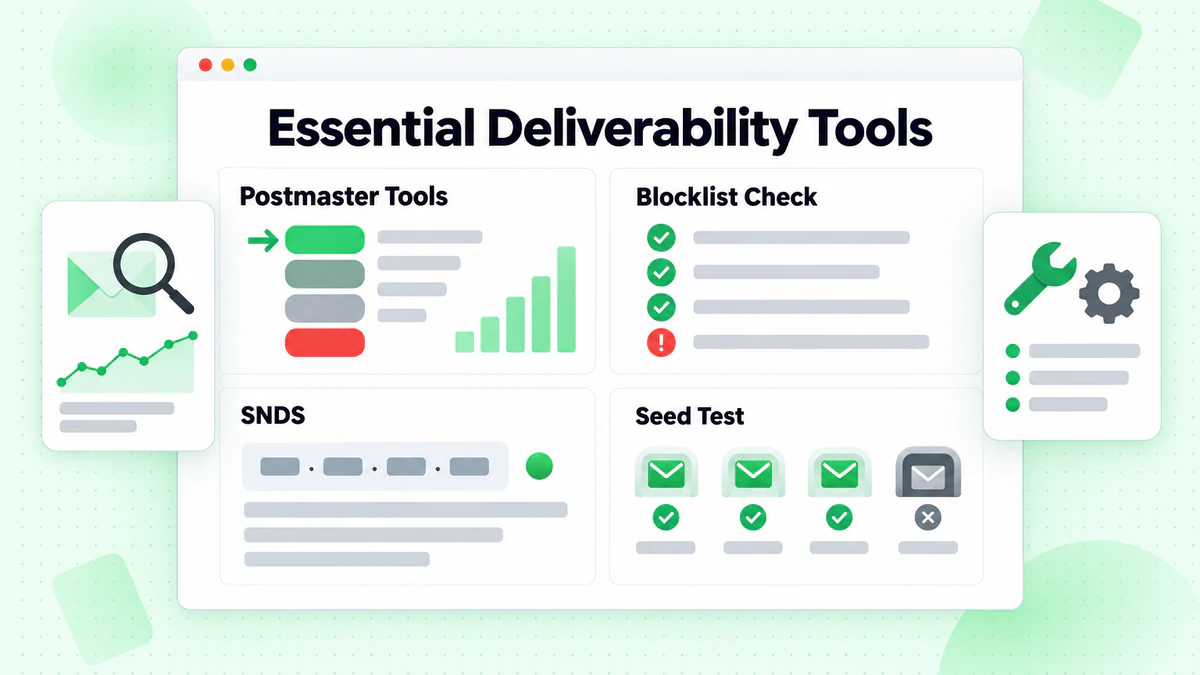
Chapter 31: Essential Deliverability Tools
Reputation Monitoring
Google Postmaster Tools (Free)
- Gmail reputation (High/Medium/Low/Bad)
- Spam rate tracking
- Authentication status
- Delivery errors
- User feedback
Setup: Verify domain ownership, access at postmaster.google.com
Microsoft SNDS (Free)
- IP reputation for Microsoft domains
- Spam complaint rates
- Trap hit data
- Sample messages
Setup: Register IP ranges at sendersupport.olc.protection.outlook.com
Sender Score (Free)
- 0-100 reputation score
- IP-based reputation
- Comparative benchmarking
- Historical trends
Access: senderscore.org
Talos Intelligence (Free)
- IP and domain reputation
- Threat intelligence
- Volume statistics
- Web reputation
Access: talosintelligence.com
Inbox Placement Testing
GlockApps
- Multi-provider inbox testing
- Spam filter analysis
- Authentication verification
- Content analysis
Validity Everest
- Enterprise inbox placement
- Reputation monitoring
- Campaign optimization
- Analytics dashboard
Mail-Tester
- Free spam score testing
- Authentication checking
- Content analysis
- Improvement recommendations
Email Verification Services
BillionVerify
- Real-time API verification
- Bulk list cleaning
- Catch-all detection
- Disposable email identification
- 99.9% accuracy rate
Access our email verification service for comprehensive list hygiene.
Comparison Considerations:
- Accuracy rates
- API speed
- Pricing models
- Integration options
- Support quality
Authentication Tools
MXToolbox
- SPF lookup and validation
- DKIM verification
- DMARC analysis
- Blacklist checking
DMARC Analyzer
- Report aggregation
- Visual analytics
- Threat identification
- Configuration guidance
EasyDMARC
- DMARC monitoring
- Report analysis
- Authentication tools
- Implementation guidance
Chapter 32: Recommended Reading and Learning
Industry Publications
Annual Reports:
- Validity Email Deliverability Benchmark Report
- Mailgun State of Email Report
- Litmus State of Email Report
- Return Path Deliverability Benchmark
Technical Documentation:
- Gmail Bulk Sender Guidelines
- Microsoft Sender Requirements
- Yahoo Sender Requirements
- RFC 5321 (SMTP)
- RFC 5322 (Email Format)
- RFC 7208 (SPF)
- RFC 6376 (DKIM)
- RFC 7489 (DMARC)
Communities and Forums
Email Geeks Slack:
- 25,000+ email professionals
- Deliverability discussions
- Code sharing
- Industry news
Litmus Community:
- Email design focus
- Technical discussions
- Resource sharing
Reddit r/emailmarketing:
- General email marketing
- Deliverability questions
- Tool recommendations
Conferences and Events
Litmus Live:
- Annual email conference
- Technical and strategic sessions
- Networking opportunities
MailCon:
- Email marketing focused
- Industry vendor presence
- Latest trends
Inbox Expo:
- Deliverability focused
- Technical deep dives
- Expert speakers
Part XI: Advanced AI SDR Vendor Analysis
Chapter 33: Comprehensive AI SDR Platform Comparison
The AI SDR landscape has evolved rapidly in 2025, with numerous platforms competing for market share. This chapter provides in-depth analysis of the major players to help organizations make informed decisions.
Evaluation Framework
When evaluating AI SDR platforms, organizations should consider:
Deliverability Infrastructure:
- Built-in warmup capabilities
- Multiple sending account management
- Domain rotation features
- Bounce handling sophistication
- Blocklist monitoring
AI Capabilities:
- Personalization quality
- Research depth
- Response handling intelligence
- Learning and adaptation
- Brand voice consistency
Integration Ecosystem:
- CRM integrations (Salesforce, HubSpot, etc.)
- Calendar integrations
- Data enrichment connections
- Workflow automation
- API availability
Compliance and Governance:
- Consent management
- Unsubscribe handling
- Data privacy controls
- Audit capabilities
- Regional compliance support
Total Cost of Ownership:
- Platform licensing
- Email sending costs
- Data enrichment fees
- Implementation effort
- Ongoing management
Detailed Platform Analysis
Apollo.io: The Data-First Platform
Company Profile: Apollo.io has established itself as a comprehensive sales intelligence platform with AI capabilities built on top of one of the industry's largest B2B contact databases.
Database Strengths:
- 265 million+ verified contacts
- 60 million+ companies
- 200+ data attributes per contact
- Real-time data refresh
- Intent data integration
AI SDR Capabilities:
Lead Sourcing: Apollo's AI can automatically identify ideal prospects based on:
- Firmographic criteria (industry, size, revenue)
- Technographic signals (technology stack)
- Intent indicators (hiring, funding, content engagement)
- Lookalike modeling from existing customers
Email Personalization: The platform generates personalized emails using:
- Prospect research (LinkedIn, company news, job changes)
- Industry-specific templates
- Dynamic variable insertion
- A/B testing integration
Deliverability Agent: Apollo's AI-powered deliverability agent represents a significant innovation:
- Automatically diagnoses deliverability issues
- Reduces troubleshooting from weeks to minutes
- Analyzes authentication, bounces, and domain setup
- Provides actionable recommendations
Performance Data:
- Users report 2-3x improved reply rates
- 30% productivity improvement claimed
- 500,000+ companies using the platform
- G2 Leader in AI Sales Assistant category (2025)
Pricing Structure:
- Free tier with limited functionality
- Basic: $49/user/month (2,500 credits)
- Professional: $79/user/month (5,000 credits)
- Organization: $119/user/month (10,000 credits)
Best Suited For:
- Organizations prioritizing data quality and coverage
- Teams needing combined prospecting and engagement
- Companies wanting deliverability AI assistance
- Mid-market to enterprise sales organizations
11x.ai (Alice): The Pure-Play AI SDR
Company Profile: 11x.ai has emerged as the leader in dedicated AI SDR technology, positioning Alice as a "digital worker" rather than a tool.
Technical Architecture: The January 2025 rebuild introduced multi-agent architecture:
- Lead Sourcing Agent: Identifies and qualifies prospects
- Research Agent: Gathers personalization data
- Writing Agent: Creates personalized messages
- Optimization Agent: Learns from results
- Orchestration Layer: Coordinates agent activities
Performance Metrics:
Production Scale:
- Millions of leads processed monthly
- Millions of personalized messages generated
- 2% reply rate (comparable to human SDRs)
- 35% response rate on cold pipeline re-engagement
Customer Success: Gupshup case study:
- 50% increase in SQLs per SDR
- 1.5x output boost without headcount increase
- Time freed for strategic activities
Differentiation:
- True autonomous operation (minimal human intervention)
- Sophisticated multi-agent reasoning
- Continuous learning from results
- Enterprise-grade scalability
Growth Trajectory:
- 50% month-over-month growth
- 10,000+ demo requests in first 10 months
- Significant Series A funding
- Rapid team expansion
Pricing:
- Custom pricing based on volume
- Typically $1,000-5,000+/month depending on scale
- Annual contracts common
Best Suited For:
- Organizations wanting true AI automation
- Companies with high outbound volume
- Teams with limited SDR headcount
- Businesses seeking productivity multiplication
Clay: The Data Enrichment Powerhouse
Company Profile: Clay has achieved remarkable growth ($1.5 billion valuation, 6x growth in 2024) by focusing on data enrichment as the foundation for personalized outreach.
Core Capability: Clay's differentiation lies in its ability to:
- Aggregate data from 75+ sources
- Waterfall enrichment (try multiple sources)
- AI-powered research for any question
- Custom workflow automation
Claude AI Integration: Clay's partnership with Anthropic enables:
- Natural language data queries
- Intelligent research automation
- High-quality copy generation
- Cost-effective AI processing
Customer Results:
Rippling Case Study:
- Triple enrichment rate vs. previous solution
- Breakthrough outbound performance
- Team-wide experimentation capability
- 30-person team using Clay without engineering support
General Results:
- Hundreds of hours saved in data collection
- Improved copy and messaging quality
- Better lead qualification
- Higher personalization effectiveness
Use Cases:
- Lead enrichment and qualification
- Account-based marketing research
- Competitive intelligence
- Customer data enhancement
- Personalization data gathering
Pricing:
- Starter: $149/month
- Explorer: $349/month
- Pro: $800/month
- Enterprise: Custom pricing
Best Suited For:
- Data-driven sales organizations
- ABM-focused teams
- Companies needing deep research
- Organizations with multiple data source needs
Instantly.ai: The Cold Email Specialist
Company Profile: Instantly has built its reputation on cold email infrastructure, adding AI capabilities to a solid deliverability foundation.
Deliverability Focus: The platform's core strengths include:
- Unlimited email account connections
- Built-in email warmup network
- Automatic domain rotation
- Smart sending patterns
- Deliverability analytics
AI Features:
- AI-powered personalization
- Smart campaign optimization
- Response detection and handling
- Subject line generation
- Send time optimization
Infrastructure Approach: Unlike platforms that bolt deliverability onto AI, Instantly built AI onto deliverability:
- Warmup integrated into sending workflow
- Account health monitoring
- Automatic throttling when issues detected
- Reputation scoring per account
Pricing Value: Instantly offers competitive pricing:
- Growth: $37/month (5,000 leads, unlimited accounts)
- Hypergrowth: $97/month (25,000 leads)
- Light Speed: $358/month (100,000 leads)
Best Suited For:
- Solo operators and small teams
- Budget-conscious organizations
- Cold email-focused strategies
- Companies prioritizing deliverability over AI sophistication
Reply.io: The Established Player
Company Profile: Reply.io has evolved from a sales engagement platform to incorporate AI capabilities while maintaining comprehensive feature breadth.
Platform Capabilities:
- Multi-channel sequences (email, LinkedIn, calls)
- AI writing assistance
- Response handling
- Meeting scheduling
- CRM synchronization
AI Integration:
- Jason AI (AI SDR assistant)
- Smart sequence optimization
- Personalization generation
- Intent signal detection
- Conversation analysis
Strengths:
- Mature, stable platform
- Comprehensive feature set
- Strong integrations
- Reliable deliverability
- Good support infrastructure
Pricing:
- Starter: $60/user/month
- Professional: $90/user/month
- Custom: Enterprise pricing
Best Suited For:
- Teams wanting AI augmentation (not full automation)
- Multi-channel outreach strategies
- Organizations needing proven, stable platforms
- Companies with existing sales engagement workflows
Artisan AI (Ava): The Digital Employee
Company Profile: Artisan positions Ava as an "AI employee" you can hire and onboard, emphasizing the human-like nature of the AI SDR.
Database Access:
- 300 million+ B2B contacts
- 65+ data points per contact
- Real-time data updates
- Social media integration
Personalization Approach: Artisan's "Personalization Waterfall":
- Check for recent social media activity
- Analyze company news and updates
- Review website behavior (if available)
- Examine LinkedIn profile changes
- Fall back to firmographic personalization
Customer Results: Bioaccess case study:
- 3%+ response rates
- Four sales calls with potential deals in two months
- CEO-level endorsement
User Experience:
- Natural language setup ("hire" Ava)
- Slack-style communication
- Progress reporting
- Human override capabilities
Considerations: User feedback indicates:
- Learning curve for optimal configuration
- Best for standard sales processes
- Requires supervision for complex situations
- Quality improves over time with feedback
Pricing:
- Starting at $1,500-2,000/month
- Annual contract required
- Volume-based pricing tiers
Best Suited For:
- Organizations wanting "hire-like" experience
- Teams new to AI SDR technology
- Standard B2B sales processes
- Companies willing to invest in setup optimization
Chapter 34: AI SDR Implementation Best Practices
Pre-Implementation Planning
Define Clear Objectives: Before implementing any AI SDR platform, establish:
- Target reply rate improvements
- Pipeline generation goals
- Cost per meeting targets
- Quality thresholds
- Compliance requirements
Infrastructure Assessment: Evaluate current email infrastructure:
- Domain age and reputation
- Existing authentication setup
- Current deliverability metrics
- ESP capabilities and limitations
- CRM integration requirements
Target Market Definition: AI SDRs perform best with clearly defined targets:
- Ideal Customer Profile (ICP) documentation
- Firmographic criteria (specific ranges, not broad categories)
- Technographic requirements
- Buying signals to prioritize
- Exclusion criteria (competitors, existing customers, etc.)
Implementation Phases
Phase 1: Infrastructure Setup (Week 1-2)
Domain Strategy:
- Register 3-5 new domains for cold outreach
- Use variations of main brand (e.g., getbrand.io, trybrand.com)
- Avoid exact brand matches to protect main domain reputation
- Implement full authentication on all domains
Mailbox Configuration:
- Create 3-5 mailboxes per domain
- Use professional-looking addresses (firstname@domain)
- Configure proper signatures
- Set up forwarding/monitoring
Authentication Setup:
- SPF records for all sending sources
- DKIM signing enabled
- DMARC at p=none initially
- Verify all records with testing tools
Phase 2: Warmup Period (Week 2-8)
Warmup Strategy:
- Start with 5-10 emails/day/mailbox
- Increase gradually (20%, then 10% increments)
- Monitor inbox placement continuously
- Pause increases if issues appear
Warmup Metrics to Track:
- Inbox placement rate (target: 90%+)
- Warmup network engagement
- Domain reputation scores
- Blocklist appearances
Warmup Service Selection: Choose based on:
- Sending volume plans
- Network quality requirements
- Analytics needs
- Budget constraints
Phase 3: Pilot Campaign (Week 6-10)
Initial Configuration:
- Start with small, high-quality prospect list
- Conservative volume (50-100 emails/day total)
- Human review of AI-generated content
- Close monitoring of all metrics
Messaging Development:
- Test multiple approaches
- Gather response data
- Refine based on results
- Establish winning templates
Quality Assurance:
- Review 100% of messages initially
- Reduce to sampling as quality established
- Maintain brand voice guidelines
- Ensure compliance with all regulations
Phase 4: Scale-Up (Week 10+)
Volume Progression:
- Increase by 25% weekly maximum
- Monitor deliverability at each tier
- Pause if metrics degrade
- Maintain quality throughout
Optimization Focus:
- A/B testing subject lines and messaging
- Refine targeting based on conversion data
- Adjust send times based on response patterns
- Implement learnings from successful sequences
Ongoing Management
Daily Monitoring:
- Bounce rates by domain/mailbox
- Reply rates by campaign
- Spam complaints
- Deliverability scores
Weekly Analysis:
- Campaign performance trends
- Messaging effectiveness
- Target market response patterns
- Competitive insights from responses
Monthly Review:
- ROI assessment
- Strategy refinement
- Platform optimization
- Team training needs
Chapter 35: Troubleshooting Guide for AI-Powered Email
Common Deliverability Issues and Solutions
Issue: Sudden Drop in Inbox Placement
Diagnostic Steps:
- Check domain reputation in Postmaster Tools
- Verify authentication records haven't changed
- Review recent sending patterns for spikes
- Check for blocklist appearances
- Analyze recent bounce and complaint rates
Common Causes:
- Authentication record changes (DNS updates)
- Volume spike triggering filters
- New campaign with poor engagement
- Bad list segment introduced
- Shared IP reputation issue
Solutions:
- Pause sending until issue identified
- Fix any authentication problems
- Reduce volume to baseline
- Remove problematic segments
- Consider dedicated IP or domain switch
Issue: High Bounce Rates
Diagnostic Steps:
- Categorize bounces (hard vs. soft)
- Identify patterns (domain, source, timing)
- Review list acquisition sources
- Check verification coverage
- Analyze specific error codes
Solutions:
- Implement real-time verification at capture
- Run full list verification
- Suppress problematic segments
- Adjust targeting criteria
- Review data provider quality
Issue: Increasing Spam Complaints
Diagnostic Steps:
- Review complaint sources (Gmail FBL, Microsoft SNDS)
- Analyze content of complained messages
- Check sending frequency
- Review opt-out clarity
- Assess targeting relevance
Solutions:
- Improve unsubscribe visibility
- Reduce sending frequency
- Better segment targeting
- Review AI-generated content quality
- Implement preference center
Issue: Poor AI Personalization Quality
Diagnostic Steps:
- Review sample of AI-generated messages
- Check input data quality
- Verify prompt/template configuration
- Assess research source availability
- Compare to manual alternatives
Solutions:
- Improve ICP definition
- Add more data enrichment sources
- Refine AI prompts/templates
- Implement human review layer
- Train AI on successful examples
Issue: Low Reply Rates Despite Good Deliverability
Diagnostic Steps:
- Verify inbox placement with seed testing
- Review subject line performance
- Analyze email content effectiveness
- Check send timing patterns
- Assess targeting quality
Solutions:
- A/B test subject lines
- Refine value proposition
- Adjust personalization approach
- Optimize send timing
- Improve prospect targeting
Chapter 36: The Human Element in AI-Powered Email
Why Human Oversight Remains Critical
Despite AI capabilities, human judgment remains essential for:
Brand Protection:
- AI can generate off-brand messaging
- Tone and voice require human validation
- Sensitive topics need human review
- Reputation risks require human judgment
Quality Assurance:
- AI errors can scale rapidly
- Edge cases need human handling
- Complex prospects require nuance
- Creative breakthroughs come from humans
Strategic Direction:
- Campaign strategy requires human insight
- Market positioning is a human decision
- Competitive differentiation needs creativity
- Long-term relationships need human touch
Compliance Oversight:
- Regulatory interpretation requires judgment
- Gray areas need human decisions
- Risk assessment is human responsibility
- Accountability must be human
Effective Human-AI Collaboration Models
Model 1: Human-in-the-Loop
- AI generates all content
- Humans review before sending
- Best for: High-stakes communications, new deployments
Model 2: Human-on-the-Loop
- AI sends autonomously
- Humans monitor and intervene when needed
- Best for: Scaled operations with established quality
Model 3: Human-Guided AI
- Humans define strategy and constraints
- AI executes within parameters
- Best for: Mature programs with clear guidelines
Model 4: AI-Augmented Human
- Humans write with AI assistance
- AI suggests improvements
- Best for: Complex/strategic communications
Building AI-Ready Teams
Skill Development Priorities:
Technical Skills:
- Understanding AI capabilities and limitations
- Prompt engineering basics
- Data quality assessment
- Deliverability fundamentals
Strategic Skills:
- Campaign strategy development
- A/B testing methodology
- Performance analysis
- Optimization thinking
Quality Skills:
- Brand voice judgment
- Compliance awareness
- Error detection
- Edge case handling
Team Structure Considerations:
Small Teams (1-3 people):
- Generalist role with AI tools
- External support for technical issues
- Clear process documentation
Medium Teams (4-10 people):
- Dedicated AI operations role
- Specialists for content, data, technical
- Regular knowledge sharing
Large Teams (10+ people):
- AI Center of Excellence
- Domain specialists with AI skills
- Innovation and optimization roles
- Quality assurance function
Continue reading the 2025 Email Deliverability Report:
- Part 1: Global Landscape & AI Revolution - Global deliverability statistics, authentication requirements, and AI impact on email
- Part 2: Email Verification & Strategy - Email verification methods, implementation strategies, and strategic recommendations
- Part 4: Industry Guides & Quick Reference - Marketing strategy integration, industry-specific guides, and quick reference materials
Bandingkan BillionVerify dengan ZeroBounce dalam hal akurasi dan kecepatan sebelum memilih penyedia verifikasi.