



High bounce rates and outdated contacts can quickly derail even well-crafted campaigns. For email marketing managers handling global B2B SaaS databases, keeping email lists accurate is the foundation for reliable deliverability. Exploring modern email verification services reveals how layered validation—such as real-time, bulk processing, and precise spam trap detection—protects sender reputation while increasing inbox placement. This introduction outlines how these tools go beyond basic checks to maintain clean, compliant, and high-performing contact databases.
Key Takeaways
| Point | Details |
|---|---|
| Email Verification Services | These services validate and clean email lists to improve deliverability and communication effectiveness for B2B SaaS marketing campaigns. |
| Critical Features | Essential features include real-time validation, bulk processing, and advanced spam trap detection to maintain high-quality contact databases. |
| Verification Types | Real-time API verification is ideal for live data, while bulk verification is suited for comprehensive cleaning of existing lists. |
| Risks of Validation | Be aware of potential false positives and incomplete verification, which can result in losing legitimate contacts and affecting marketing outcomes. |
What Are Email Verification Services?
Email verification services are specialized technological solutions designed to validate and clean email lists, ensuring high-quality contact databases for B2B SaaS marketing campaigns. These services systematically examine email addresses to determine their authenticity, deliverability, and potential risks before sending marketing communications.
At their core, email verification services perform multiple critical checks on email addresses:
- Domain validation: Confirming the email's domain actually exists and can receive emails
- Syntax checking: Ensuring the email address follows standard email format rules
- Mailbox verification: Determining if the specific email address is active and capable of receiving messages
- Spam trap detection: Identifying potentially harmful email addresses that could damage sender reputation
- Role-based email identification: Flagging generic emails like "support@" or "info@" that might have lower engagement rates
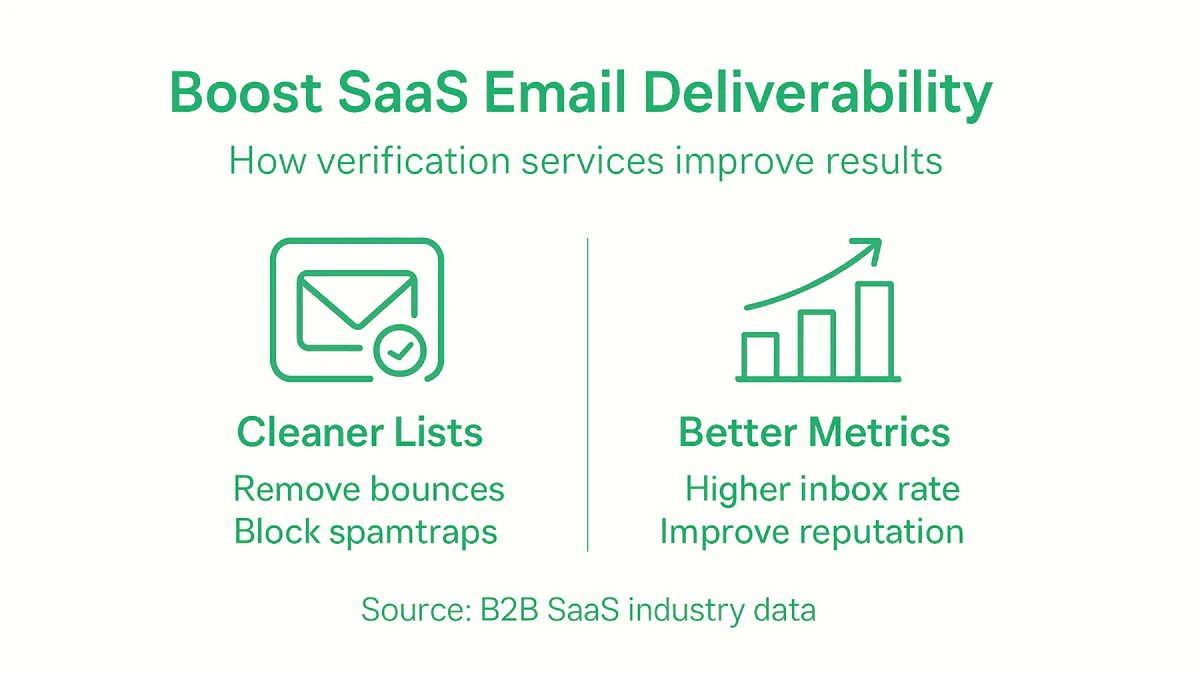
The primary goal of these services is to improve email marketing performance by reducing bounce rates, preventing spam complaints, and maintaining a clean contact list. By filtering out invalid, risky, or non-existent email addresses, companies can significantly enhance their email delivery accuracy and overall campaign effectiveness.
Deliverability Metrics Matter. A clean email list means higher inbox placement rates, improved sender reputation, and more reliable communication channels for B2B SaaS organizations. Email verification acts as a crucial quality control mechanism, protecting marketing investments and ensuring messages reach intended recipients.
Pro tip: Implement email verification as a routine step in your contact management process to maintain list hygiene and maximize marketing communication effectiveness.
Core Features of Verification Tools
Email verification tools have evolved to provide comprehensive solutions for maintaining high-quality contact databases. Advanced verification features now encompass a wide range of sophisticated capabilities designed to ensure email list integrity and marketing effectiveness.
The most critical features of modern email verification tools include:
- Real-time validation: Preventing invalid email entries at the point of data capture
- Bulk email list processing: Efficiently cleaning large contact databases
- Accuracy rate metrics: Delivering high-precision verification results
- Advanced spam trap detection: Identifying potentially harmful email addresses
- Disposable email identification: Filtering out temporary or throwaway email accounts
- Catch-all domain handling: Managing emails from domains with broad acceptance policies
- CRM integration: Seamless compatibility with customer relationship management platforms
Technical Verification Mechanisms go beyond simple syntax checking. These tools employ complex algorithms to perform deep analysis of email addresses, examining multiple dimensions of email validity. This includes checking domain records, verifying mail exchanger (MX) configurations, and conducting live connection tests to confirm email account existence.
Comprehensive email verification tools act as a critical quality control checkpoint, protecting marketing investments and ensuring communication effectiveness.
Compliance and Security are paramount in modern email verification solutions. Tools must adhere to strict privacy regulations, protect sensitive data, and provide detailed verification reports that help businesses understand their contact list quality.
Pro tip: Select an email verification tool that offers multiple verification layers and provides transparent, detailed reporting to maximize your email marketing performance.
Types of Email Verification Solutions
Email verification solutions have evolved to address diverse business needs, offering specialized approaches to maintaining email list quality. Email verification services are fundamentally categorized into two primary deployment models: real-time and bulk verification systems.
The primary types of email verification solutions include:
Real-time API Verification:
- Validates email addresses during data entry
- Prevents invalid emails from entering systems
- Ideal for sign-up forms and immediate data capture
Bulk Email List Verification:
- Processes large volumes of existing email addresses
- Comprehensive cleaning of entire contact databases
- Provides detailed reports on email list health
Technical Verification Approaches differ significantly between these solution types. Real-time APIs focus on immediate validation, using rapid syntax and domain checks to block problematic emails instantly. Bulk verification services perform more extensive diagnostics, including deep SMTP probing, comprehensive domain validation, and advanced threat detection.

Here's a side-by-side comparison of real-time and bulk email verification solutions:
| Aspect | Real-Time API Verification | Bulk Email List Verification |
|---|---|---|
| Typical Use Case | Sign-up forms, live data entry | Large database maintenance |
| Validation Speed | Instant, seconds per address | Minutes for thousands |
| Integration Complexity | Requires API setup | Upload and process via tool |
| Reporting Detail | Basic pass/fail per address | Comprehensive health report |
Email verification solutions are not one-size-fits-all. The right approach depends on specific business requirements, data volume, and integration needs.
Enterprise-Level Considerations become critical when selecting verification solutions. Businesses must evaluate factors like API speed, accuracy rates, integration capabilities, and compliance with data protection regulations. Some advanced solutions offer hybrid approaches, combining real-time and bulk verification strategies to provide comprehensive email list management.
Pro tip: Evaluate your specific email verification needs by conducting a thorough audit of your current data collection and marketing communication processes.
How Email Verification Works in Practice
Email verification is a sophisticated process that systematically validates email addresses through multiple precision layers. Email verification techniques employ comprehensive strategies to ensure maximum deliverability and data quality.
The email verification process typically involves several critical validation stages:
Syntax Validation:
- Checks email address formatting
- Identifies obvious typos and structural errors
- Confirms presence of required characters (@ symbol, domain)
Domain Verification:
- Validates domain registration status
- Confirms active DNS records
- Checks mail exchanger (MX) record configuration
SMTP Authentication:
- Simulates email sending process
- Verifies mailbox actual existence
- Determines email acceptance without sending message
Advanced Verification Intelligence goes beyond basic checks. Modern solutions incorporate sophisticated risk assessment algorithms that can identify potentially problematic email addresses, including catch-all domains, disposable email services, and potential spam traps.
Below is a summary of the technical layers in modern email verification systems:
| Technical Layer | Verification Purpose | Business Benefit |
|---|---|---|
| Syntax Validation | Checks address format | Reduces user entry errors |
| Domain Authentication | Confirms domain legitimacy | Improves sender reputation |
| SMTP Authentication | Verifies mailbox exists | Minimizes message bounces |
| Risk Intelligence | Detects threats/spam traps | Protects marketing outcomes |
Technical validation isn't just about confirming an email exists - it's about protecting your sender reputation and communication effectiveness.
The verification process provides nuanced insights into email quality, categorizing addresses based on their likelihood of successful delivery. Some advanced systems even track historical email performance, building predictive models that help marketers understand potential engagement rates before sending campaigns.
Pro tip: Implement a multi-layered email verification strategy that combines automated technical checks with periodic manual list cleaning to maintain optimal email list health.
Risks and Common Pitfalls of Email Validation
Email validation presents multiple complex challenges that can significantly impact marketing performance and communication strategies. While verification tools offer sophisticated solutions, businesses must understand the potential risks and nuanced limitations inherent in automated email screening processes.
Common risks and pitfalls in email validation include:
False Positives:
- Incorrectly marking valid email addresses as invalid
- Potentially losing legitimate potential contacts
- Creating unnecessary friction in data collection processes
Incomplete Verification:
- Overlooking sophisticated spam trap configurations
- Missing dynamically generated disposable email addresses
- Failing to detect temporary email service variations
Performance Limitations:
- Inconsistent accuracy across different email domains
- Varying verification speeds and response times
- Potential API connection reliability issues
Technical Complexity introduces significant challenges in email verification. Verification algorithms must constantly adapt to evolving email infrastructure, changing domain configurations, and increasingly sophisticated email generation techniques used by both legitimate businesses and potential bad actors.
Effective email validation requires a nuanced approach that balances technological precision with strategic flexibility.
Moreover, regulatory compliance adds another layer of complexity. Different international privacy regulations create additional constraints on how email addresses can be verified and processed, requiring verification tools to maintain robust, adaptable compliance mechanisms.
Pro tip: Implement a multi-layered verification strategy that combines automated tools with periodic manual review to maintain the highest possible email list integrity.
Elevate Your B2B SaaS Email Campaigns with Precision Verification
The article highlights the critical challenge of maintaining clean, reliable email lists to boost deliverability and protect sender reputation. Email marketers often struggle with high bounce rates, spam traps, and catch-all domains that can undermine campaign success. At BillionVerify, we understand that achieving 99.9% accuracy in email validation is not just a goal but a necessity to enhance your marketing performance and ensure your messages reach the right inbox every time.
Our solutions directly address common pain points like disposable email detection, role-based email identification, and bulk list cleaning detailed in the article. With real-time email verification API and comprehensive verification reports, BillionVerify empowers you to implement multi-layered strategies for list hygiene and improved engagement. Discover how our service can complement your efforts by visiting BillionVerify or learn more about our real-time API verification and bulk email list cleaning.
Are you ready to transform your email marketing effectiveness by eliminating invalid and risky contacts today

Start maintaining your clean, high-quality contact lists now with BillionVerify and experience the confidence that comes from superior deliverability. Visit https://billionverify.com to get started.
Frequently Asked Questions
What are email verification services?
Email verification services are tools designed to validate and clean email lists, ensuring that email addresses are authentic and capable of receiving messages, thus improving email marketing performance for B2B SaaS companies.
How do email verification services improve deliverability?
By filtering out invalid, risky, or non-existent email addresses, email verification services reduce bounce rates and spam complaints, leading to higher inbox placement rates and overall campaign effectiveness.
What are the key features to look for in an email verification tool?
Look for features such as real-time validation, bulk email processing, advanced spam trap detection, disposable email identification, and CRM integration to ensure high-quality contact management.
What are the potential risks of using email verification services?
Common risks include false positives that may incorrectly mark valid emails as invalid, incomplete verification leading to overlooked spam traps, and performance limitations like inconsistent accuracy across different domains.