



Every email marketing manager knows the frustration of campaigns derailed by outdated or invalid contact lists. When messages consistently bounce, sender reputation suffers and campaign effectiveness drops fast. With the right email verification API, you gain real-time insight into the quality and legitimacy of every address on your list, ensuring better deliverability and more meaningful engagement. Discover how modern APIs use sophisticated checks to protect your efforts and keep your messages reaching real inboxes.
Key Takeaways
| Point | Details |
|---|---|
| Email Verification APIs Enhance Communication | These APIs validate email addresses in real-time, ensuring high-quality communication by filtering out invalid and risky addresses. |
| Integration Improves Data Quality | Real-time validation during user registration and other touchpoints prevents poor data from entering your system. |
| Security and Compliance are Essential | Robust authentication, encryption, and access controls are vital for protecting sensitive data during email verification processes. |
| Reduce Bounce Rates Proactively | Implementing comprehensive verification strategies significantly decreases bounce rates, enhancing overall email campaign performance. |
Defining Email Verification APIs Clearly
An Email Verification API is a specialized software interface that systematically validates email addresses in real-time, checking multiple critical parameters to ensure data accuracy and improve communication effectiveness. These sophisticated tools analyze email domains, detect potential risks, and provide comprehensive insights about email address legitimacy before sending critical communications.
Email Verification APIs typically perform several core validation checks:
- Domain Verification: Confirms the email domain actually exists and can receive messages
- Syntax Checking: Validates that the email address follows standard formatting rules
- Disposable Email Detection: Identifies temporary or throwaway email addresses
- Role-Based Email Identification: Flags generic emails like "support@" or "info@"
- Server Connectivity: Verifies the email server is active and capable of receiving messages
These APIs work through complex technical processes that quickly validate email domains by cross-referencing extensive databases and using sophisticated algorithmic checks. The goal is not just to confirm an email exists, but to determine its quality, deliverability, and potential risk factors.
Email verification APIs transform raw contact lists into refined, high-quality communication channels by eliminating invalid or risky email addresses before they impact your marketing efforts.
Real-time validation represents a critical advantage of modern email verification APIs. Instead of performing bulk list checks, these tools can integrate directly into signup forms, CRM systems, and marketing platforms to provide instant email quality assessments.

Pro tip: Integrate email verification API checks at multiple touchpoints - during user registration, lead generation, and before major email campaigns to maintain consistently high data quality.
Core Features And How The APIs Work
Email verification APIs employ a sophisticated multi-layered approach to validate email addresses through comprehensive technical verification processes. These advanced systems go far beyond simple syntax checking, utilizing complex algorithms and real-time database cross-referencing to ensure email quality and deliverability.
The core technical verification processes typically include:
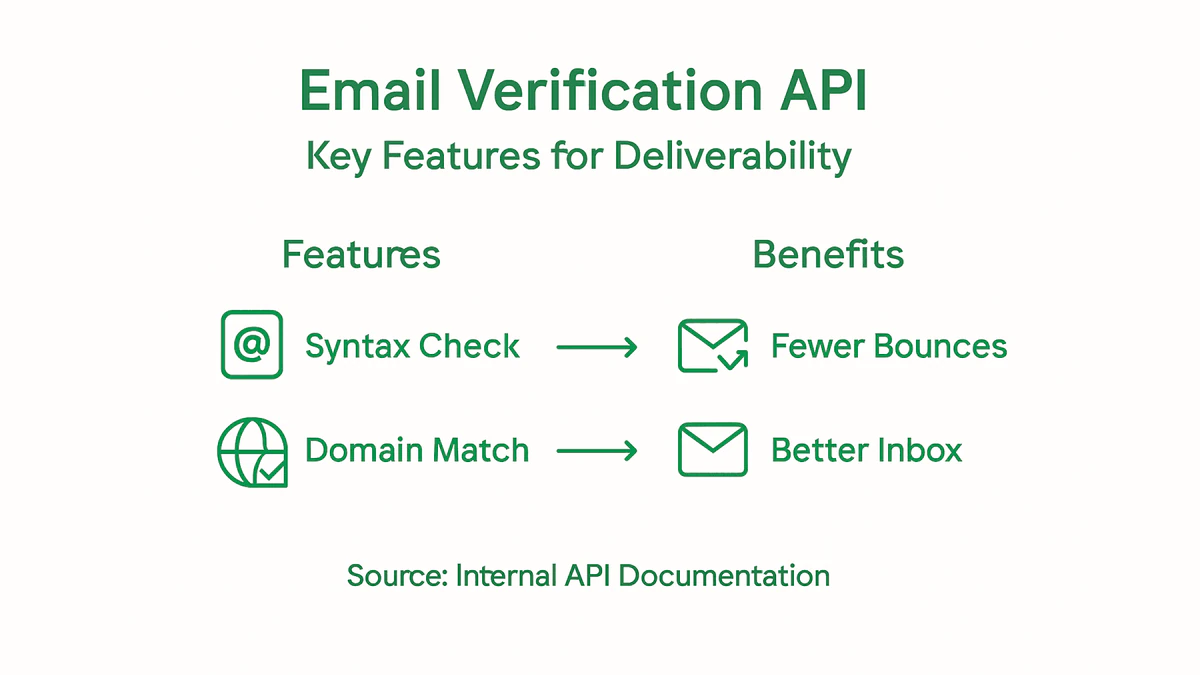
- Syntax Validation: Checks email address format against standard RFC guidelines
- Domain Verification: Confirms the email domain exists and can receive messages
- MX Record Checking: Validates mail exchange records for email routing
- SMTP Server Verification: Pings the email server to confirm active mailbox status
- Disposable Email Detection: Identifies and flags temporary or throwaway email addresses
- Risk Scoring: Assigns a quality rating to each email address based on multiple parameters
Modern email verification APIs leverage advanced technologies to detect potential email risks with remarkable precision. These systems use sophisticated techniques like domain reputation analysis, global IP blacklist cross-referencing, and advanced pattern recognition to identify potentially problematic email addresses before they can impact communication strategies.
Email verification APIs act as intelligent gatekeepers, filtering out low-quality or potentially harmful email addresses with surgical precision and protecting your communication infrastructure.
The technical architecture of these APIs allows for seamless integration across multiple platforms, providing real-time validation capabilities for businesses of all sizes. By offering fast response times and scalable infrastructure, these tools enable organizations to maintain high-quality email lists with minimal manual intervention.
Pro tip: Configure your email verification API to perform continuous list hygiene checks, not just at initial point of collection, to maintain ongoing data quality and email deliverability.
Types of Email Verification API Solutions
Email verification APIs have evolved into sophisticated solutions that cater to diverse business needs, with multiple verification approaches designed to address specific challenges across different industries and communication scales.
The primary categories of email verification API solutions include:
Single Email Verification APIs
- Ideal for businesses with low-volume email validation requirements
- Perfect for real-time validation during user registration
- Provides instant individual email quality assessment
Bulk Email Verification APIs
- Designed for large-scale email list cleaning
- Supports batch processing of thousands of email addresses
- Typically offers comprehensive reporting and analysis
Enterprise-Grade Verification APIs
- Advanced features like fraud detection and detailed email scoring
- Integration with complex business intelligence systems
- Provides extensive compliance and security checks
Each verification solution offers unique technical capabilities, including syntax validation, domain checking, SMTP verification, and disposable email detection. Modern APIs go beyond basic validation, incorporating sophisticated risk assessment technologies that help businesses maintain high-quality communication channels.
Email verification APIs are not just tools, but strategic assets that transform raw contact data into intelligent, actionable communication resources.
The technical sophistication of these APIs allows for seamless integration across various platforms, providing businesses with flexible, scalable solutions for maintaining email list hygiene and improving overall communication effectiveness.
Here's a quick comparison of common email verification API solution types and their ideal business use cases:
| API Solution Type | Best For | Key Business Benefit |
|---|---|---|
| Single Email Verification | User signup forms | Instant real-time validation |
| Bulk Email Verification | Marketing list cleaning | Efficient batch processing |
| Enterprise-Grade Solutions | Large corporations | Advanced scoring and compliance |
Pro tip: Select an email verification API that offers multiple validation layers and provides detailed analytics to maximize your email marketing performance.
Real-Time Impact On Bounce Rates
Email verification APIs play a critical role in dramatically reducing bounce rates by systematically filtering invalid email addresses before they can damage your marketing campaign's performance. By implementing real-time validation, businesses can proactively prevent communication failures and protect their sender reputation.
The key mechanisms for reducing bounce rates include:
Syntax Validation
- Eliminates improperly formatted email addresses
- Catches basic typos and structural errors
- Prevents sending to fundamentally invalid addresses
Domain Verification
- Confirms email domain actually exists
- Checks for active mail exchange (MX) records
- Prevents attempts to send emails to non-existent domains
Mailbox Availability Checks
- Verifies the specific email address can receive messages
- Identifies temporarily or permanently disabled email accounts
- Stops sending to addresses that will generate hard bounces
Comprehensive email verification significantly impacts marketing performance by reducing hard bounce rates, which can trigger negative consequences from email service providers. High bounce rates can lead to account restrictions, decreased deliverability, and potential blacklisting.
Reducing bounce rates isn't just about avoiding penalties - it's about maintaining a clean, responsive communication channel that delivers maximum marketing value.
By implementing robust email verification strategies, businesses can improve their email campaign metrics, enhance sender reputation, and ensure more reliable communication with their target audience.
Pro tip: Integrate email verification at multiple stages - during initial signup, list imports, and before major campaign sends to maintain consistently low bounce rates.
Integration, Compliance, And Data Security
Email verification APIs must adhere to rigorous security standards and comprehensive data protection protocols to ensure seamless, trustworthy integration across diverse technological ecosystems. These sophisticated systems go beyond simple email validation, providing robust safeguards for sensitive corporate and user information.
Key security and compliance elements include:
Authentication Mechanisms
- OAuth 2.0/2.1 token-based authentication
- API key management with periodic rotation
- Multi-factor authentication support
Data Protection Standards
- End-to-end encryption (TLS, AES-256)
- Compliance with GDPR, HIPAA regulations
- Data anonymization and minimization techniques
Access Control
- Role-Based Access Control (RBAC)
- Granular permission settings
- Comprehensive audit logging
Modern email verification APIs implement sophisticated security frameworks that protect both organizational and individual data integrity. These systems employ advanced encryption, strict access controls, and continuous monitoring to prevent unauthorized data access or potential breaches.
Security isn't just a feature - it's a fundamental requirement that transforms email verification from a simple utility to a trusted business intelligence tool.
Successful integration requires a holistic approach that balances technical sophistication with regulatory compliance, ensuring that email verification processes enhance rather than compromise data protection strategies.
This table summarizes how security features in email verification APIs address business needs:
| Security Feature | Mitigated Risk | Value to Organizations |
|---|---|---|
| Strong authentication | Unauthorized access | Ensures only trusted users connect |
| End-to-end encryption | Data interception | Safeguards sensitive email information |
| Role-based access control | Data leakage | Limits exposure to confidential data |
Pro tip: Always conduct a thorough security assessment before implementing an email verification API, focusing on encryption standards, compliance certifications, and data handling practices.
Risks And Mistakes To Avoid
Implementing email verification APIs requires careful navigation of potential security vulnerabilities and operational risks. Common integration pitfalls can compromise data integrity and expose organizations to significant operational challenges if not properly managed.
Critical risks to anticipate include:
Authentication Vulnerabilities
- Weak token management
- Hardcoded API keys
- Lack of multi-factor authentication
- Insufficient key rotation practices
Data Exposure Risks
- Unencrypted API traffic
- Oversharing sensitive information
- Inadequate access control mechanisms
- Poor data anonymization techniques
Operational Mistakes
- Ignoring API rate limits
- Failing to monitor unusual usage patterns
- Not updating API versions regularly
- Skipping comprehensive security audits
Organizations must implement robust safeguards to prevent potential breaches and maintain the integrity of their email verification processes. This involves creating multilayered security protocols that anticipate and mitigate potential vulnerabilities before they can be exploited.
Proactive risk management isn't about eliminating every possible threat, but creating resilient systems that can detect, respond, and adapt to potential security challenges.
Successful email verification API implementation demands a holistic approach that balances technical sophistication with comprehensive security planning. Regular assessments, continuous monitoring, and adaptive security strategies are essential for maintaining a robust verification infrastructure.
Pro tip: Conduct quarterly comprehensive security reviews of your email verification API integration, focusing on authentication mechanisms, data handling practices, and potential vulnerability points.
Enhance Your Email Deliverability with Reliable Verification Solutions
The article highlights the challenge of maintaining high-quality email lists to reduce bounce rates and protect sender reputation. Many businesses struggle with invalid or risky email addresses that cause hard bounces and damage marketing performance. Key pain points include the need for real-time validation, disposable and role-based email detection, and ongoing list hygiene to maximize deliverability and engagement.
BillionVerify addresses these challenges directly by offering a real-time email verification API boasting 99.9% accuracy and powerful features such as disposable email detection and detailed verification reports. Whether you need bulk email list cleaning to improve marketing campaigns or instant validation during user signup, BillionVerify integrates seamlessly to prevent low-quality addresses from impacting your campaigns.

Take control of your email marketing success today by leveraging BillionVerify's advanced verification technology. Visit BillionVerify now to explore how our solutions can reduce bounce rates, improve sender reputation, and boost your overall email deliverability.
Frequently Asked Questions
What is an Email Verification API?
An Email Verification API is a software interface that validates email addresses in real-time, checking critical parameters such as domain existence, syntax correctness, and mailbox availability to ensure effective communication.
How does real-time email verification impact bounce rates?
Real-time email verification significantly reduces bounce rates by filtering out invalid email addresses before they can affect your marketing campaigns, thus protecting your sender reputation and enhancing email deliverability.
What are the main features of Email Verification APIs?
Key features of Email Verification APIs include domain verification, syntax checking, disposable email detection, role-based email identification, MX record checking, and server connectivity verification, all aimed at ensuring high-quality email addresses.
Why should I integrate an Email Verification API during user registration?
Integrating an Email Verification API during user registration allows for immediate validation of email addresses, ensuring that only legitimate, deliverable emails are collected, which enhances data quality and minimizes future bounce-related issues.