



Struggling to understand why carefully crafted campaigns from your mid-sized B2B SaaS company end up in spam folders or go unseen entirely? The challenge often centers around your sender reputation, which mailbox providers use to measure your trustworthiness based on signals like recipient engagement and authentication. Poor email address reputation directly reduces inbox placement rates and increases filtering to spam or rejection folders, derailing marketing efforts and limiting pipeline growth. This article clarifies what drives reputation and offers actionable steps to keep your emails reaching inboxes worldwide.
Key Takeaways
| Point | Details |
|---|---|
| Email Reputation Is Crucial | A strong email reputation directly impacts deliverability, ensuring messages land in inboxes rather than spam folders. |
| Proactive Reputation Management | Maintain list hygiene, monitor key metrics, and respond promptly to issues to safeguard your sender reputation. |
| Engagement Drives Reputation | High recipient engagement is essential; prioritize relevant content and layered sending strategies to sustain interest. |
| Authentication Is Essential | Implement SPF, DKIM, and DMARC to authenticate emails, thereby enhancing trust with ISPs and improving overall reputation. |
Defining Email Address Reputation and Its Impact
Email address reputation is not a single metric but rather a composite score that email service providers (ESPs) and internet service providers (ISPs) assign to your sending domain and IP address based on how recipients engage with your messages. Think of it as a credit score for email marketers. When you send campaigns consistently, ISPs monitor patterns like open rates, click rates, complaint rates, and bounce rates to determine whether you should be trusted. At its core, email address reputation reflects recipient engagement and authentication signals that collectively indicate your trustworthiness as a sender. A strong reputation means your messages land in inboxes. A weak one means they disappear into spam folders or get rejected outright.
The connection between reputation and deliverability is direct and unforgiving. When your reputation suffers, your deliverability suffers alongside it. The mechanics work like this: ISPs maintain databases of sender behavior. They track which domains send legitimate, wanted mail and which ones engage in practices that harm their users. Activities like phishing attempts, sending unsolicited messages to purchased lists, or ignoring spam complaints tank your reputation almost immediately. Once that happens, ISPs apply filters that challenge your incoming mail, quarantine it, or reject it entirely. For marketing managers at mid-sized B2B SaaS companies, this creates a cascading problem. Your carefully crafted cold email sequences get blocked before prospects ever see them. Your webinar invitations never reach decision-makers. Your product launch announcements disappear into the void. Poor reputation doesn't just reduce your email effectiveness—it can paralyze your entire outreach strategy.
Managing email reputation requires a proactive approach built on three foundational practices. First, focus on prevention of abuse by maintaining strict list hygiene and respecting recipient preferences. This means regularly validating your email lists to remove invalid addresses, spam traps, and unengaged contacts that could trigger complaints. Second, implement constant monitoring by tracking key reputation signals like bounce rates, spam complaint rates, and authentication metrics like SPF, DKIM, and DMARC. Third, practice timely response when issues arise by investigating delivery failures and adjusting your sending patterns accordingly. The research shows that domain and IP reputation management involves these ongoing processes rather than one-time fixes. For B2B SaaS companies, this means building reputation management into your standard operational workflow, not treating it as an afterthought when deliverability problems emerge.
Pro tip: Start by auditing your current email list with a verification tool that identifies invalid, risky, and unengaged addresses before they damage your sender reputation. Removing these addresses before your next campaign launch prevents ISPs from logging complaints and bounce failures that would otherwise hurt your reputation score.
Key Components: IP, Domain, and Content Signals
Your email reputation rests on three distinct but interconnected pillars: IP reputation, domain reputation, and content signals. Understanding how each one works independently and together is crucial for B2B SaaS marketing managers who need predictable, high-volume deliverability. Your IP address is the physical server infrastructure from which your emails originate. ISPs track this address separately because it reflects the health and behavior of your sending infrastructure itself. If your IP has been used for spam in the past, or if it sends a sudden volume spike that looks suspicious, ISPs flag it. Your domain is your brand identity. It persists even if you change IP addresses. A domain carries historical reputation built over months or years of sending behavior. ISPs evaluate domain reputation more holistically, looking at long-term patterns rather than momentary spikes. Finally, content signals encompass everything inside your email: subject lines, body text, links, images, and formatting choices that either look legitimate or triggering. Content doesn't carry as much weight as IP and domain reputation when ISPs make initial filtering decisions, but it heavily influences whether recipients engage, complain, or report messages as spam.
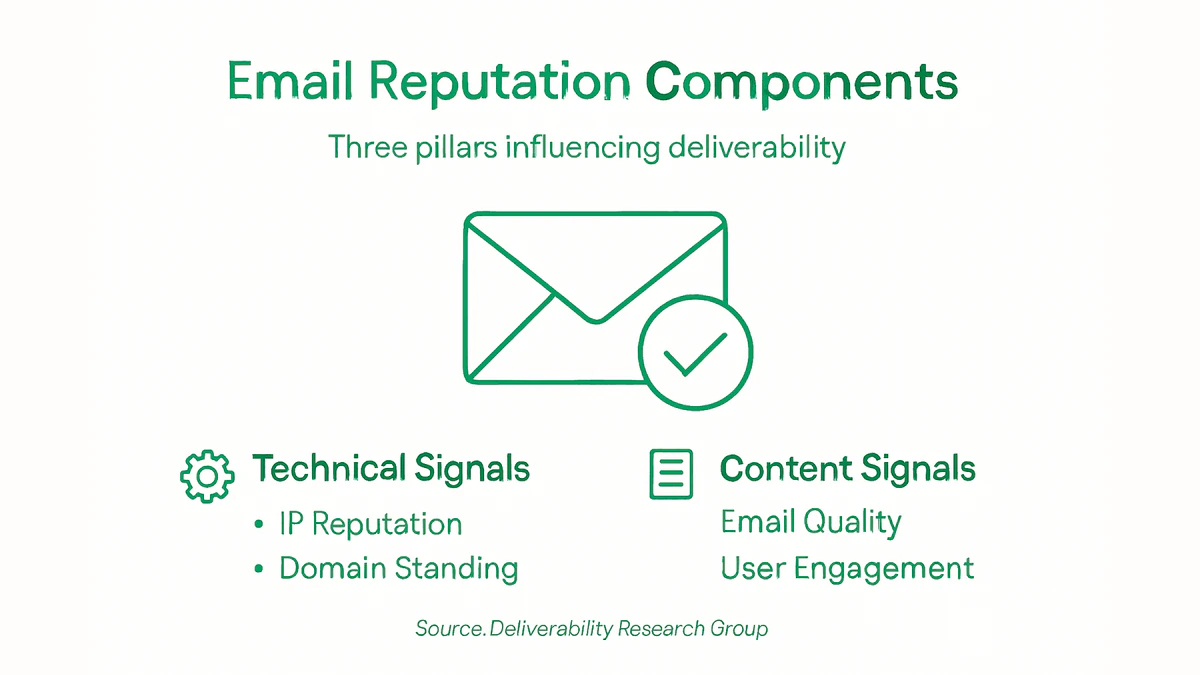
The interplay between these three components creates your overall sender reputation score. When you send from a new IP address or recently registered domain, you start with a blank slate, which means ISPs apply stricter scrutiny to your content. A spam-like subject line or aggressive sales pitch that might pass through from an established domain gets flagged immediately from a new one. This is why careful warm-up of new IPs and domains is essential before you launch high-volume campaigns. Authentication protocols like SPF, DKIM, and DMARC play a bridging role here. These protocols prove that your domain actually authorizes the IP address sending on its behalf, which strengthens trust for both domain and IP reputation simultaneously. Without proper authentication, even stellar engagement metrics get undermined because ISPs cannot verify you own the domain you claim to represent.
Here's a quick comparison of the three core components influencing sender reputation:
| Factor | What It Measures | How ISPs Use It | Typical Impact if Negative |
|---|---|---|---|
| IP Reputation | Health of sending infrastructure | Tracks IP for spam/misuse patterns | Filtering or blocking campaigns |
| Domain Reputation | Brand trust and consistency | Evaluates long-term sender record | Delivery delays or blacklisting |
| Content Signals | Message quality and engagement | Checks for spammy characteristics | Higher complaint or spam rates |
Content Quality and Engagement Signals
Content signals work differently than IP and domain reputation. Your subject lines, copy, and call-to-action buttons directly influence whether recipients open, click, or report your emails as spam. If your content consistently triggers complaints, ISPs lower your reputation score even if your IP and domain were pristine. The reverse is also true: exceptional content that generates high engagement can gradually improve a mediocre reputation, but this takes time. For B2B cold email specifically, this means balancing personalization with scale. Generic templates with obvious placeholders get marked as spam more frequently, damaging your IP and domain reputation in the process. Conversely, highly personalized emails that reference prospect companies and specific pain points generate better engagement, which ISPs interpret as legitimate, wanted mail.
Building strong IP, domain, and content signals requires coordinated effort across your entire email operation. Start by ensuring authentication methods protect your domain reputation and validate your IP infrastructure. Monitor engagement metrics obsessively because ISPs do the same. When you notice declining open rates or rising complaint rates on specific campaigns, investigate immediately. Are your subject lines too aggressive? Is your list including unengaged contacts who never opened previous emails? Are you sending to the right segment at the right frequency? These details compound over time. A 2 percent complaint rate today becomes a damaged reputation next month. A 0.1 percent complaint rate maintained consistently builds reputation capital that carries you through campaigns with slightly lower engagement.
Pro tip: Before launching any new campaign from a new IP address or domain, send a small test batch of your best-performing previous emails to your most engaged segments, monitor the results for 48 hours, then gradually increase volume only if engagement metrics stay strong and no complaints emerge.
How Reputation Influences Email Deliverability
Sender reputation operates as the primary gatekeeper between your campaigns and your recipients' inboxes. When ISPs receive an incoming email, they do not evaluate it in isolation. Instead, they run it through a complex assessment that checks your reputation first. This reputation score determines whether the email even gets a chance to be evaluated for spam characteristics. A strong reputation means ISPs grant your message the benefit of the doubt, allowing legitimate marketing content through even if it contains elements that might otherwise raise flags. A weak reputation means ISPs scrutinize everything relentlessly, rejecting or filtering emails that would sail through from a trusted sender. The relationship between reputation and deliverability is not correlative; it is causal. Poor reputation directly reduces the likelihood that emails will be accepted by mailbox providers, creating a compounding problem where damaged reputation triggers more filtering, which then damages reputation further.

Think of it this way: imagine two B2B SaaS companies sending nearly identical cold email sequences. Company A has spent two years building a pristine reputation with consistent engagement, low complaint rates, and proper authentication. Company B just launched their email program last month from a newly registered domain. Both companies send the same message to the same recipient segment. Company A's emails land in inboxes at a 94 percent rate. Company B's emails land at 67 percent. The difference is not the message quality. The difference is reputation. ISPs assign Company A higher trust status based on years of positive sending behavior. ISPs apply heightened scrutiny to Company B because the sending infrastructure is unproven. This disparity means Company B must work harder on every other variable just to achieve baseline deliverability. Poor sender reputation reduces inbox placement rates and boosts filtering to spam or rejection folders, creating a direct penalty on campaign effectiveness.
The practical impact on your business is substantial and measurable. Reputation influences not just whether emails arrive, but when they arrive and where they land. A high-reputation sender often sees emails delivered to primary inboxes within minutes. A low-reputation sender might see emails delayed, eventually landing in promotional tabs or spam folders after hours. Recipients never see delayed or misdirected emails, so they never respond. Your open rates plummet. Your click rates disappear. Your follow-up sequences fail because the original message never reached the right place. For marketing managers running cold email campaigns to build pipeline, this reputation penalty directly translates to lost pipeline revenue. Each percentage point of deliverability that slips due to reputation issues represents prospects who never receive your message and therefore never become qualified leads. The mathematics are brutal: if your reputation drops your deliverability from 92 percent to 82 percent on a 5,000 person campaign, you lose 500 potential conversations before they start.
Building and Maintaining High Reputation Status
The path forward requires understanding what reputation actually measures. Reputation is a composite influenced by sending practices, engagement metrics, spam complaint rates, and authentication protocols working together. You cannot fix reputation by manipulating one variable alone. Sending from a properly authenticated domain means nothing if your complaint rate is 1 percent. Maintaining excellent engagement means nothing if you ignore complaints for weeks. Building strong reputation requires synchronizing all components. Start by establishing baseline hygiene: authenticate your domain with SPF, DKIM, and DMARC. Monitor your complaint rates obsessively, aiming for under 0.1 percent. Track bounce rates separately and remove invalid addresses immediately. Most critically, focus relentlessly on engagement because ISPs use sender reputation to assess trustworthiness, and high reputation facilitates better inbox placement. This means sending to people who want your emails, at frequencies they expect, with content that resonates. When you consistently deliver value, engagement naturally improves, which ISPs interpret as proof that recipients trust you, which boosts your reputation score.
Pro tip: Monitor your reputation across major ISPs monthly using their feedback loops and reputation monitoring services, then immediately investigate any campaign that triggered complaints above 0.5 percent, isolating whether the issue was list quality, content relevance, or sending frequency so you can correct it before reputation damage spreads.
Common Causes of Poor Email Reputation
Poor email reputation rarely appears overnight. Instead, it accumulates gradually through specific behaviors and practices that damage trust with ISPs and recipients. For B2B SaaS marketing managers, understanding these causes is critical because reputation damage often happens silently. You might not realize your deliverability is tanking until campaigns fail mysteriously weeks later. The most common culprit is sending to unvalidated or purchased email lists. When you mail to addresses that do not exist, have never engaged with your company, or were scraped from public sources, you trigger bounces and spam complaints immediately. ISPs notice this pattern. A newly launched campaign with a 15 percent bounce rate tells ISPs that you do not maintain list quality, which tanks your reputation before legitimate contacts ever see your message. Similarly, ignoring spam complaints compounds the damage exponentially. When recipients mark your emails as spam, ISPs log those complaints and weight them heavily. If your complaint rate exceeds 0.1 percent on a regular basis, you signal to ISPs that your recipients do not want your mail. Complaint rates above 0.5 percent trigger automatic filters and blacklisting from major providers. The worst part is that complaint rates climb when you ignore the first warning signs. One complaint here, three there, and suddenly you cross the threshold where ISPs stop trusting you entirely.
Another major cause is poor email authentication or missing authentication entirely. SPF, DKIM, and DMARC exist specifically to prove that you own the domain you claim to represent. Without these protocols in place, ISPs cannot verify that your emails actually come from your legitimate infrastructure. This uncertainty triggers higher scrutiny and filtering. ISPs assume unauthenticated mail might be spoofed or malicious, so they default to caution. Even worse, cybercriminals abuse domains by sending phishing attacks or malware through unauthenticated channels. This means reputational damage from security incidents and breaches of trust undermines email infrastructure that lacks protective authentication, creating a vicious cycle where domain owners pay the price for criminals using their domains. Reputation also suffers when you engage in aggressive sending practices without warm-up periods. Launching a new domain and immediately sending 50,000 emails looks suspicious to ISPs. They see sudden volume from an unknown sender and assume it might be spam. Proper warm-up means gradually increasing sending volume over weeks, starting small and proving that recipients engage before scaling up. Skipping this step flags your domain as risky in ISP systems. Finally, sending frequency misalignment damages reputation silently. If you send cold emails daily to the same list, recipients stop engaging. Unopened emails accumulate. Unsubscribe rates climb. ISPs interpret this as signal that your mail is unwanted, which damages your sender reputation.
The Cascade Effect of Reputation Damage
What makes reputation damage particularly dangerous is that causes often compound. You send to a purchased list (bounce spike), ignore the first complaints (complaint rate rises), and skip domain authentication (ISPs apply extra filtering), all within the first two weeks of your campaign. Each problem multiplies the others. Suddenly your reputation score plummets, and ISPs begin blocking mail from your domain entirely. At that point, fixing reputation requires months of careful remediation. You must clean your list, implement authentication, monitor complaints obsessively, and send only to highly engaged segments until your reputation recovers. Many companies give up during this recovery period because they see no immediate improvement. But reputation recovery is possible if you address root causes systematically.
The path out requires identifying which specific factors are damaging your reputation. Is your bounce rate elevated? Your list needs cleaning. Are complaints rising? You need to audit your sending frequency and content relevance. Did you launch a new domain without warm-up? You need to start over with a careful gradual volume increase. The common thread across all these problems is lack of monitoring. Companies that track bounce rates, complaint rates, and engagement metrics weekly catch reputation damage early and correct it before serious harm occurs. Companies that ignore these signals until deliverability crashes face months of recovery work. For marketing managers juggling multiple campaigns, this means building reputation monitoring into your weekly reporting cadence, the same way you monitor conversion rates and pipeline impact.
The following table summarizes effective actions to recover from reputation damage:
| Recovery Step | Purpose | Typical Time to See Results |
|---|---|---|
| Clean email list | Remove bounces and spam traps | 1-2 weeks for deliverability boost |
| Implement authentication | Add SPF, DKIM, DMARC protocols | Few days after DNS updates |
| Send to engaged segments | Improve opens and lower complaints | 2-4 weeks for metric improvement |
| Monitor metrics weekly | Catch drops before issues compound | Immediate detection, ongoing result |
Pro tip: Before launching any campaign, run your email list through a validation tool to identify and remove bounces, role-based addresses, and disposable emails, then configure your email sending platform to automatically suppress unsubscribes and complaints from future sends, preventing reputation damage before it starts.
Best Practices for Maintaining Strong Reputation
Maintaining strong email reputation is not a one-time project but an ongoing operational discipline. The companies that keep deliverability high are those that build reputation management into their standard workflow, treating it with the same rigor they apply to compliance or security. The foundation starts with authentication infrastructure. SPF, DKIM, and DMARC are not optional extras for large enterprises. They are essential baseline requirements for any B2B SaaS company sending email at scale. SPF tells ISPs which IP addresses are authorized to send mail from your domain. DKIM digitally signs your messages so ISPs can verify they have not been tampered with. DMARC ties these together, letting you specify how ISPs should handle authentication failures. Together, these three protocols prove you are who you claim to be. Without them, ISPs treat your mail with suspicion. With them properly configured, you gain credibility from day one. The setup takes a few hours initially, but the reputation payoff extends indefinitely.
Once authentication is in place, focus relentlessly on list quality and hygiene. This means validating your email lists regularly to remove addresses that bounce, belong to role-based inboxes that generate high complaint rates, or have never engaged with your company. A clean list is smaller but more valuable. A list of 8,000 engaged contacts generates better reputation signals than a list of 15,000 that includes thousands of inactive addresses. Maintaining list hygiene by removing inactive addresses helps sustain high deliverability and sender trust, yet many companies resist this practice because they fixate on list size rather than list quality. The reality is brutal: one bounce-heavy campaign damages your reputation more than months of careful sending to clean data can repair. Implement a validation process before every campaign launch. Remove any addresses that have not engaged in the past 90 days. Unsubscribe anyone who asks, immediately. These practices feel like you are shrinking your audience, but you are actually protecting your ability to reach the people who matter.
Engagement and Sending Discipline
Engagement metrics drive reputation more than any other signal. ISPs measure whether recipients open, click, and interact with your mail. High engagement tells ISPs that your recipients want your mail. Low engagement tells them the opposite. This means your sending strategy must prioritize relevance and value. For B2B cold email, this translates to specific practices. Segment your list by engagement level and send different frequencies to different segments. Your most engaged contacts might receive emails twice per week. Your moderately engaged contacts receive one per week. Your low-engagement segment receives one per month or gets paused entirely. This tiered approach maintains high engagement rates while still reaching your full audience. Avoid sending the same message to everyone at the same frequency. Frequency misalignment creates engagement problems that cascade into reputation damage.
Consistent sending volume matters equally. Launching a new domain and immediately sending 100,000 emails looks suspicious to ISPs. Proper warm-up means starting with small volumes and gradually increasing over weeks as you prove that recipients engage. Send 1,000 emails in week one. If engagement is strong and no complaints emerge, increase to 3,000 in week two. Scale to 5,000 in week three. Only after four weeks of consistently strong engagement should you approach your target volume. This discipline takes patience, but it prevents ISPs from flagging your domain as risky. Beyond warm-up, maintain consistent weekly volumes. Sending 10,000 emails one week then going silent for three weeks then sending 20,000 looks erratic to ISPs. Consistent, predictable sending builds reputation. Sporadic sending raises flags. Most importantly, continuous monitoring of engagement rates and adapting sending practices helps maintain deliverability. This means checking your metrics weekly. Are open rates declining? Investigate your subject lines or recipient relevance. Are click rates dropping? Your content might not be resonating. Are complaints rising? Your frequency might be too aggressive. Acting on these signals immediately prevents small problems from becoming reputation disasters.
Pro tip: Create a weekly reputation dashboard tracking bounce rate, complaint rate, open rate, and click rate for each sending domain, then establish alert thresholds that trigger immediate investigation when any metric moves outside acceptable ranges, allowing you to catch reputation problems within days rather than discovering them after campaigns fail.
Strengthen Your Email Reputation and Maximize Deliverability Today
Maintaining a high email address reputation is crucial for ensuring your messages land in inboxes and not spam folders. The article highlights pain points such as unclean email lists, bounces, spam complaints, and the importance of authentication and engagement. These are the exact challenges that can silently destroy your sender reputation and weaken your outreach efforts.
BillionVerify is designed to help you overcome these obstacles by providing real-time email verification API and bulk email list cleaning with 99.9 percent accuracy. Our service detects disposable emails, role-based addresses, and catch-all servers so you can maintain strict list hygiene and prevent sending to risky contacts that damage your domain and IP reputation. Don’t let poor list quality cause your campaigns to fail. Get ahead of potential reputation issues by verifying and cleaning your lists before every send with BillionVerify.
Ready to protect your sender reputation and improve email deliverability? Visit BillionVerify now and discover how our verification tools help you clean your email lists effectively. Learn more about why maintaining a strong domain reputation is essential by reading our comprehensive insights on domain reputation management. Take control of your email campaigns today to build trust with your recipients and boost your marketing results.
Frequently Asked Questions
What is email address reputation?
Email address reputation is a composite score assigned by email service providers (ESPs) and internet service providers (ISPs), which reflects how trustworthy a sender is based on recipient engagement metrics such as open rates, click rates, complaint rates, and bounce rates.
How does email address reputation affect deliverability?
A strong email address reputation ensures that your messages land in recipients' inboxes, while a weak reputation can lead to emails being filtered into spam folders or rejected entirely, significantly reducing your outreach effectiveness.
What are the key components of email reputation?
Email reputation is influenced by three main components: IP reputation, domain reputation, and content signals. IP reputation relates to the sending infrastructure, domain reputation reflects brand trust and consistency, and content signals pertain to the email's quality and engagement potential.
How can I improve my email address reputation?
To improve your email reputation, focus on maintaining list hygiene, implementing proper authentication methods like SPF, DKIM, and DMARC, monitoring key engagement metrics, and adjusting your sending practices based on performance data to ensure you are sending relevant and wanted emails.