



Bounce rates can quietly erode even the most carefully crafted email campaigns, leaving global SaaS companies scrambling to maintain their sender reputation. For marketing managers, efficient email verification is much more than a technical task—it is the foundation for compliance, security, and sustained engagement. By implementing comprehensive email validation without double opt-in, businesses filter out invalid addresses and protect their domain credibility before messages go out, resulting in higher deliverability and campaign success.
Key Takeaways
| Point | Details |
|---|---|
| Email Verification Is Essential | Validating email addresses prevents poor deliverability and protects sender reputation. |
| Understanding Risky Emails Matters | Identifying and removing invalid or risky emails enhances email marketing effectiveness. |
| Regular List Cleaning Is Crucial | Implementing routine email list maintenance helps maintain high deliverability and compliance standards. |
| Email Verification Affects Compliance and Security | Comprehensive verification mitigates legal risks and protects against data breaches through better list management. |
Defining Email Verification and Deliverability
Email verification and deliverability represent critical processes for maintaining the health and effectiveness of digital communication strategies. These interconnected concepts determine whether your email messages successfully reach intended recipients and maintain your sender reputation.
Email verification is a systematic process of validating email addresses to ensure they are genuine, active, and capable of receiving messages. This involves multiple sophisticated checks:
- Confirming email address syntax and formatting
- Verifying domain existence and email server configuration
- Checking for disposable or temporary email addresses
- Identifying potentially risky or invalid email accounts
Deliverability measures an email's ability to reach the recipient's inbox without being filtered into spam folders or blocked entirely. It depends on multiple factors including sender reputation, email content quality, and recipient engagement metrics.
Email verification acts as a critical first line of defense against poor deliverability and wasted marketing resources.
The relationship between verification and deliverability is symbiotic. By removing invalid email addresses, businesses can significantly improve their sender score, reduce bounce rates, and enhance overall email marketing performance.
Key metrics that impact deliverability include:
- Hard bounce rate
- Spam complaint percentage
- Email engagement rates
- Domain and IP reputation
- Authentication protocols (SPF, DKIM, DMARC)
Pro tip: Conduct regular email list cleaning to maintain high deliverability standards and protect your sender reputation.
Key Types of Invalid and Risky Emails
Understanding the various types of invalid and risky email addresses is crucial for maintaining a high-quality email list and protecting your marketing communication strategy. Email databases can contain multiple problematic address categories that significantly impact deliverability and overall campaign performance.
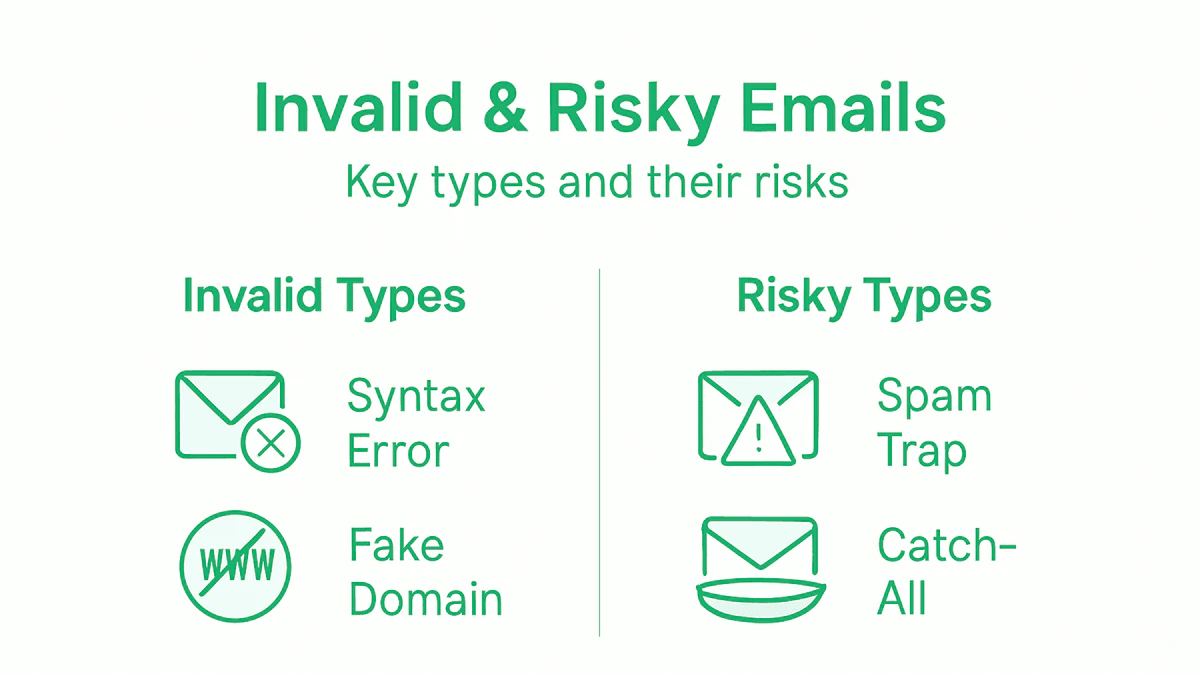
Invalid email addresses can be categorized into several distinct types:
- Syntax Errors: Emails with incorrect formatting (missing @ symbol, invalid characters)
- Non-Existent Domains: Addresses with domains that do not actually exist
- Disposable Emails: Temporary email addresses created for short-term use
- Role-Based Emails: Generic addresses like info@, support@, sales@ that often have strict filtering
High-Risk Email Categories pose unique challenges for marketers and communication professionals:
- Spam Trap Emails
- Catch-All Domain Emails
- Inactive Email Accounts
- Blacklisted Email Addresses
- Honeypot Emails
Identifying and removing these risky email addresses can dramatically improve your email marketing effectiveness and sender reputation.
Spam traps represent particularly dangerous email addresses designed to catch illegitimate senders. These addresses are typically created to identify poor email practices and can instantly damage your sender score if accidentally included in marketing campaigns.

Catch-all domain emails present another complex challenge. These addresses accept emails for any username within a specific domain, making verification more difficult and increasing the potential for invalid contact information.
Here is a comparison of common risky email address types and their potential impact on email marketing:
| Email Type | Risk Level | Potential Impact |
|---|---|---|
| Spam Trap | Critical | Immediate sender reputation damage |
| Catch-All Domain | High | Increased bounce rates |
| Disposable | Medium | Short-term engagement, high churn |
| Role-Based | Medium | Low engagement, triggering filters |
| Inactive | High | Low deliverability, wasted resources |
| Blacklisted Address | Critical | Campaigns blocked or blacklisted |
| Honeypot | Critical | Can lead to global blacklisting |
Pro tip: Implement a robust email verification process that systematically identifies and removes high-risk email addresses before they damage your marketing performance.
How the Verification Process Works
Email verification is a sophisticated technical process designed to validate and authenticate email addresses before they enter your marketing communication ecosystem. By implementing a comprehensive multi-step approach, businesses can systematically eliminate invalid, risky, and potentially harmful email contacts from their databases.
Key Verification Stages include:
- Syntax Validation: Checking email address structure for correct formatting
- Domain Verification: Confirming legitimate and active email domains
- SMTP Connection Testing: Pinging email servers to validate active mailboxes
- Disposable Email Detection: Identifying temporary or throwaway email addresses
- Spam Trap Identification: Flagging potentially dangerous email addresses
Technical Verification Mechanisms operate through several sophisticated techniques:
- Real-time API checking
- Bulk list validation
- Domain MX record analysis
- Mailbox existence confirmation
- IP reputation assessment
Email verification acts as a critical firewall protecting your sender reputation and marketing investments.
Verification without double opt-in involves comprehensive pre-send validation that examines email addresses through multiple technical lenses. This approach allows marketers to filter out problematic contacts before launching campaigns, ensuring higher deliverability and engagement rates.
The process involves intricate technical checks that go beyond simple syntax validation. Advanced verification systems analyze complex factors like domain reputation, historical bounce rates, and potential spam indicators to provide a holistic assessment of email address quality.
Pro tip: Implement automated email verification tools that perform real-time validation during list acquisition to prevent invalid email addresses from entering your marketing database.
Impact on Bounce Rates and Sender Reputation
Email bounce rates represent a critical metric that directly influences a sender's reputation and overall email marketing effectiveness. When email lists contain invalid or risky addresses, businesses face significant challenges in maintaining communication quality and digital credibility.
Bounce Rate Categories are typically classified into two primary types:
- Hard Bounces: Permanent delivery failures due to invalid or non-existent email addresses
- Soft Bounces: Temporary delivery issues caused by full mailboxes or server problems
- Reputation Impact: Persistent bounces signal potential spam behavior to email providers
- Deliverability Consequences: High bounce rates can trigger automatic filtering mechanisms
Sender Reputation Metrics are influenced by multiple factors:
- Email bounce rate percentage
- Recipient engagement levels
- Spam complaint frequency
- Email content quality
- Sending volume consistency
High bounce rates are a red flag that can dramatically reduce your email marketing performance and sender credibility.
Email deliverability verification practices demonstrate that proactive list management is essential for maintaining a positive sender reputation. Industry benchmarks reveal that verified email lists can achieve significantly higher delivery rates and minimize the risk of being flagged as a potential spam source.
The consequences of poor email list hygiene extend beyond immediate campaign performance. Repeated high bounce rates can lead to long-term reputation damage, potentially causing email service providers to blacklist your sending domain and severely limiting future communication capabilities.
Pro tip: Implement a quarterly email list cleaning process to systematically remove inactive and invalid email addresses, protecting your sender reputation and ensuring optimal campaign performance.
Compliance, Security Risks, and List Quality
Comprehensive email verification extends far beyond technical validation, serving as a critical mechanism for maintaining legal compliance, protecting organizational security, and preserving data integrity. Modern businesses must navigate complex regulatory landscapes while safeguarding their communication infrastructure against emerging digital threats.
Key Compliance Requirements include:
- GDPR: Ensuring explicit consent and data accuracy
- CAN-SPAM Act: Preventing unsolicited commercial email communications
- CCPA: Protecting consumer data privacy rights
- CASL: Canadian regulations governing electronic messaging
- Data Protection Standards: Maintaining accurate contact information
Security Risks Associated with Poor List Management:
- Potential exposure to spam traps
- Vulnerability to phishing attacks
- Risk of data breach through invalid contacts
- Compromised email infrastructure
- Potential legal and financial penalties
Unverified email lists represent significant legal and operational risk for organizations of all sizes.
Best practices for email verification demonstrate that proactive list management mitigates compliance risks while protecting organizational communication channels. Regular verification processes help businesses maintain high data quality standards and reduce potential security vulnerabilities.
The table below summarizes how email verification benefits key business objectives:
| Business Objective | Email Verification Benefit | Long-Term Result |
|---|---|---|
| Improve Inbox Placement | Filters invalid addresses pre-campaign | Higher engagement rates |
| Reduce Legal Risk | Ensures compliance with regulations | Fewer fines and penalties |
| Protect Brand Image | Prevents spam and blacklisting | Maintained sender reputation |
| Optimize Marketing ROI | Minimizes wasted resources on bounces | Increased campaign profitability |
| Enhance Data Security | Blocks risky or malicious addresses | Lower chance of data breaches |
The interconnection between list quality, security, and compliance creates a complex ecosystem where each element directly impacts organizational risk. Sophisticated email verification tools now integrate advanced checks that simultaneously address legal requirements, security concerns, and communication effectiveness.
Pro tip: Develop a comprehensive email list management policy that mandates quarterly verification, consent validation, and immediate removal of unresponsive or potentially risky contacts.
Protect Your Email Marketing ROI and Reputation with Accurate Verification
The article highlights the critical challenge of maintaining high email deliverability by eliminating invalid and risky email addresses such as spam traps, disposable emails, and role-based accounts. Businesses struggle with rising bounce rates and tarnished sender reputations that waste marketing resources and put compliance at risk. BillionVerify offers a comprehensive solution designed to tackle these exact pain points by providing real-time email verification and bulk list cleaning to ensure only high-quality, verified contacts receive your messages.
Trusted Features Include:
- 99.9% accurate verification with disposable email and catch-all domain detection
- Role-based email identification to avoid low engagement contacts
- Detailed verification reports to monitor list health and optimize campaigns

Take control of your sender reputation today by leveraging BillionVerify to perform regular email list cleaning. Experience improved inbox placement and protect your marketing investments. Don’t wait for bounce rates and spam complaints to damage your deliverability. Visit BillionVerify now and discover how our real-time email verification API and bulk cleaning services can keep your campaigns on track.
Frequently Asked Questions
What is email verification and why is it important?
Email verification is the process of validating email addresses to ensure they are genuine and capable of receiving messages. It's important because it helps improve email deliverability, reduces bounce rates, and protects your sender reputation.
How does email verification impact deliverability?
Email verification directly affects deliverability by removing invalid or risky email addresses from your list. A clean email list helps ensure your messages reach the intended recipients' inboxes rather than being filtered into spam folders.
What are some common types of invalid email addresses?
Common types of invalid email addresses include those with syntax errors, non-existent domains, disposable email addresses, and role-based emails. Each of these can negatively impact your email deliverability and marketing performance.
How often should I verify my email list?
It's recommended to conduct email list verification at least quarterly. Regular verification helps maintain list quality, improve deliverability rates, and protect your sender reputation.