



Is email verification worth the investment? This question haunts marketers and business owners evaluating email validation services. The cost seems clear—you pay per verification—but the returns feel abstract. How do you measure the value of emails that don't bounce, sender reputation that doesn't decline, and opportunities that aren't lost? For foundational concepts, read our complete guide to email verification.
In this comprehensive analysis, we'll quantify the ROI of email verification with concrete formulas, real-world examples, and a framework you can apply to your own business. By the end, you'll have the tools to calculate exactly what email verification is worth to your organization and make data-driven investment decisions.
Understanding the True Cost of Invalid Emails
Before calculating ROI, we must understand what invalid emails actually cost your business. These costs extend far beyond the obvious, creating a cascade of expenses that multiply over time.
Direct Costs of Invalid Emails
The most visible costs are direct and immediately measurable.
Wasted Email Service Provider Fees
Most email service providers (ESPs) charge based on list size or emails sent. Every invalid email address on your list represents wasted money.
Example calculation:
- Email list size: 100,000 addresses
- Invalid email percentage: 15% (industry average for unverified lists)
- ESP cost: $0.001 per email sent
- Monthly campaigns: 8 emails
- Monthly waste: 100,000 × 15% × $0.001 × 8 = $120
- Annual waste: $1,440
This seems modest for a 100,000-address list, but represents pure waste—money spent sending emails that never arrive.
Bounced Email Processing Costs
Processing bounced emails consumes resources. Each bounce requires server processing, notification handling, and potentially manual review.
Estimated costs:
- Soft bounce processing: $0.001 per bounce
- Hard bounce processing and removal: $0.005 per bounce
- Manual review for edge cases: $0.50 per case
For a list generating 1,000 bounces monthly, processing costs alone reach $50-100 monthly before considering downstream effects.
Indirect Costs: Sender Reputation Damage
The most significant costs are indirect, stemming from damaged sender reputation.
Understanding Sender Reputation
Email service providers like Gmail, Outlook, and Yahoo assign reputation scores to sending domains and IP addresses. These scores determine inbox placement—whether your emails land in the inbox, spam folder, or are blocked entirely.
Bounce rates directly impact sender reputation. ISPs interpret high bounce rates as indicators of poor list hygiene, purchased lists, or spam activity. Even legitimate senders suffer reputation damage from excessive bounces. Learn how to reduce email bounce rate effectively.
Quantifying Reputation Damage
Sender reputation damage manifests as reduced inbox placement rates. Consider this scenario:
Before reputation damage:
- Inbox placement rate: 95%
- List size: 100,000
- Emails reaching inbox: 95,000 per campaign
After reputation damage from poor list hygiene:
- Inbox placement rate: 75%
- Emails reaching inbox: 75,000 per campaign
- Lost visibility per campaign: 20,000 recipients
If your average email generates $0.10 in value per recipient reached, each campaign loses $2,000 in potential revenue from reduced placement alone. Across 8 monthly campaigns, that's $16,000 monthly—$192,000 annually.
Recovery Time and Cost
Rebuilding damaged sender reputation takes 30-90 days of consistently clean sending practices. During recovery:
- Reduced campaign frequency limits marketing effectiveness
- Special warming procedures require careful management
- Monitoring tools and expertise consume additional resources
- Lost revenue continues until reputation recovers
Conservative recovery cost estimate: $5,000-20,000 depending on severity and business impact.
Opportunity Costs
Beyond direct and indirect costs, invalid emails create opportunity costs.
Lost Customer Acquisition
Every invalid email captured at signup represents a lost potential customer. If someone mistyped their email address during registration, you've lost them forever—unless real-time email verification catches the error.
Calculation example:
- Monthly signups: 5,000
- Typo rate without verification: 3%
- Lost leads monthly: 150
- Customer lifetime value: $200
- Monthly opportunity cost: 150 × $200 = $30,000
Even if only 10% of these lost leads would have converted, that's $3,000 monthly in lost opportunity—$36,000 annually.
Abandoned Cart Recovery Failures
E-commerce businesses lose significant revenue when abandoned cart emails don't reach customers due to invalid addresses.
Example:
- Monthly abandoned carts: 2,000
- Average cart value: $75
- Recovery email success rate: 10%
- Invalid email rate in abandoned carts: 12%
- Lost recovery opportunities: 2,000 × 10% × 12% = 24 carts
- Monthly lost revenue: 24 × $75 = $1,800
- Annual lost revenue: $21,600
Support and Operational Costs
Invalid emails create downstream support and operational burdens.
Customer Support Tickets
When order confirmations, shipping notifications, and account emails don't arrive, customers contact support. Each ticket costs $10-25 to resolve.
If invalid emails generate 100 additional support tickets monthly at $15 average cost, that's $1,500 monthly—$18,000 annually.
Manual List Cleaning
Without automated email verification, teams spend time manually reviewing bounces, removing invalid addresses, and investigating delivery issues. At $30/hour, 10 hours monthly of manual list management costs $3,600 annually.
Calculating Email Verification ROI
Now let's calculate the return on email verification investment using realistic scenarios.
Basic ROI Formula
The fundamental ROI calculation:
ROI = (Total Benefits - Total Costs) / Total Costs × 100%
For email verification:
Benefits = Prevented ESP Waste + Prevented Reputation Damage +
           Prevented Lost Opportunities + Prevented Support Costs +
           Prevented Manual Labor

Costs = Email Verification Service Cost
Scenario 1: Small Business
Business profile:
- Email list: 25,000 addresses
- Monthly campaigns: 4
- ESP cost: $50/month flat rate
- Average email value: $0.05 per recipient
- Current invalid rate: 12%
- Customer lifetime value: $150
Current costs (without verification):
- ESP waste: minimal (flat rate)
- Reputation impact: 5% reduced deliverability = 25,000 × 5% × $0.05 × 4 = $250/month
- Lost leads: 500 monthly signups × 3% typos × 10% conversion × $150 = $225/month
- Support tickets: 20 tickets × $15 = $300/month
- Total monthly cost: $775
With email verification:
- Verification cost: 25,000 existing + 500 monthly × $0.003 = $76.50/month
- Reputation maintained: $0 loss
- Typos caught: $0 loss
- Support reduction: 80% fewer tickets = $60/month
- Total monthly cost: $136.50
Monthly savings: $638.50 Annual savings: $7,662 ROI: (7,662 - 918) / 918 = 735%
Scenario 2: Mid-Size E-commerce
Business profile:
- Email list: 250,000 addresses
- Monthly campaigns: 8
- ESP cost: $0.001 per email
- Average email value: $0.15 per recipient
- Current invalid rate: 15%
- Cart abandonment: 5,000 monthly
- Average cart value: $85
Current costs (without verification):
- ESP waste: 250,000 × 15% × $0.001 × 8 = $300/month
- Reputation impact: 10% reduced deliverability = 250,000 × 10% × $0.15 × 8 = $30,000/month
- Lost cart recovery: 5,000 × 10% × 15% × $85 = $6,375/month
- Lost signups: 3,000 × 3% × 15% × $250 CLV = $3,375/month
- Support tickets: 150 × $15 = $2,250/month
- Total monthly cost: $42,300
With email verification:
- Initial list cleaning: 250,000 × $0.002 = $500 (one-time)
- Ongoing verification: 3,000 signups × $0.003 + 5,000 carts × $0.003 = $24/month
- Monthly maintenance: 250,000 × 2% decay × $0.002 = $10/month
- Total monthly cost: $34 (after initial cleaning)
Monthly savings: $42,266 Annual savings: $507,192 Annual verification cost: $908 ROI: (507,192 - 908) / 908 = 55,730%
Scenario 3: Enterprise Marketing
Business profile:
- Email list: 2,000,000 addresses
- Monthly campaigns: 12
- ESP cost: $0.0008 per email
- Average email value: $0.20 per recipient
- Current invalid rate: 8% (some verification in place)
- Marketing-attributed revenue: $5M monthly
Current costs (with partial verification):
- ESP waste: 2M × 8% × $0.0008 × 12 = $1,536/month
- Reputation impact: 3% reduced deliverability = 2M × 3% × $0.20 × 12 = $144,000/month
- Lost revenue attribution: $5M × 3% deliverability loss = $150,000/month
- Support and operations: $5,000/month
- Total monthly cost: $300,536
With comprehensive email verification:
- Full verification service: $3,000/month (enterprise tier with API, bulk, real-time)
- Achieved invalid rate: 0.5%
- Reputation fully maintained
- Remaining costs: $3,000/month
Monthly savings: $297,536 Annual savings: $3,570,432 Annual verification cost: $36,000 ROI: (3,570,432 - 36,000) / 36,000 = 9,818%
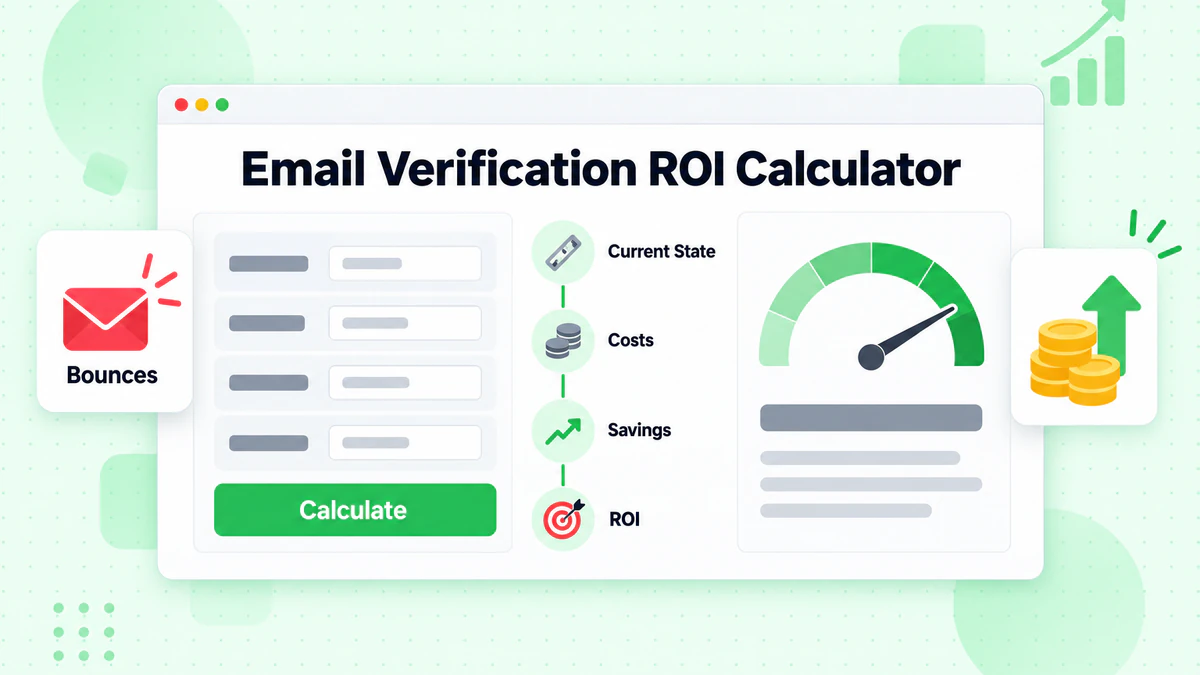
ROI Calculator Framework
Use this framework to calculate email verification ROI for your specific situation.
Step 1: Measure Current State
Gather these metrics from your current email operations:
List size and growth rate
- Current total addresses
- Monthly new addresses (signups, imports, etc.)
Email volume and costs
- Campaigns per month
- ESP pricing model and costs
- Average emails sent monthly
Quality metrics
- Current bounce rate
- Invalid email percentage (if known)
- Inbox placement rate
- Spam complaint rate
Business metrics
- Revenue per email or per subscriber
- Customer lifetime value
- Cart abandonment rate and recovery rate
- Support ticket volume and cost
Step 2: Estimate Invalid Email Costs
Calculate costs in each category:
ESP waste:
List Size × Invalid Rate × Cost per Email × Monthly Campaigns
Reputation damage:
List Size × Deliverability Impact × Value per Email × Monthly Campaigns
Lost opportunities:
(Lost Leads × Conversion Rate × CLV) + (Lost Cart Recoveries × Cart Value)
Support costs:
Invalid-Related Tickets × Cost per Ticket
Manual labor:
Hours Spent × Hourly Rate
Step 3: Project Verified State
With email verification:
- Invalid rate drops to under 2%
- Deliverability maintains at maximum
- Typos caught at entry
- Support tickets reduce 60-80%
- Manual review nearly eliminated
Step 4: Calculate Verification Costs
BillionVerify pricing example:
- Bulk verification: $0.002-0.004 per email
- Real-time API: $0.003-0.005 per verification
- Enterprise plans: Custom pricing with volume discounts
Calculate:
Initial list cleaning cost + Monthly new address verification +
Periodic list re-verification (quarterly recommended)
Step 5: Compute ROI
Annual Savings = (Current Annual Cost - Verified Annual Cost)
ROI = (Annual Savings - Verification Cost) / Verification Cost × 100%
Beyond Financial ROI: Strategic Benefits
Email verification provides strategic benefits beyond direct financial returns.
Competitive Advantage
While competitors struggle with deliverability issues, your emails consistently reach inboxes. This reliability compounds over time as your sender reputation strengthens while theirs degrades.
Customer Experience
Customers receive expected communications—order confirmations, shipping updates, account notifications. This reliability builds trust and reduces friction in customer relationships.
Marketing Agility
With clean lists and strong sender reputation, you can execute marketing campaigns confidently. No need to limit volume or frequency due to deliverability concerns.
Data Quality
Verified email addresses indicate higher overall data quality. Customers who provide valid emails likely provided accurate other information too, improving targeting and personalization.
Compliance Confidence
Clean email lists reduce compliance risks under regulations like GDPR and CAN-SPAM. You're sending to addresses that exist and can receive communications, demonstrating proper list management.
Common ROI Objections Addressed
Let's address common objections to email verification investment.
"Our bounce rate is already low"
A low bounce rate might indicate good list quality—or it might indicate you've already damaged your sender reputation so severely that emails aren't even attempted to invalid addresses. Verify your actual list composition, not just reported bounces.
"We can't afford verification right now"
Can you afford not to verify? Calculate your current costs using the framework above. Most businesses find they're already spending more on invalid email consequences than verification would cost.
"We'll just remove bounces after they happen"
Reactive bounce removal is too late. By the time you see bounces, the reputation damage is done. Each bounce has already signaled to ISPs that you're not managing your list properly.
"Our emails still get delivered"
Getting delivered isn't the same as reaching the inbox. Check your actual inbox placement rates across major providers. Many senders with "good" delivery rates have terrible inbox placement, with emails landing in spam folders.
"We verify manually when needed"
Manual verification doesn't scale and misses most issues. Humans can't check SMTP responses, detect disposable domains, or identify catch-all configurations. Automated verification is orders of magnitude more effective.
Implementing Email Verification for Maximum ROI
To maximize your email verification ROI, follow these implementation best practices.
Start with List Cleaning
Begin by verifying your existing email list. This immediately removes accumulated invalid addresses and establishes your quality baseline. Follow our guide on how to clean your email list for step-by-step instructions.
Implement Real-Time Verification
Add real-time email verification to all email capture points—signup forms, checkout, contact forms. This prevents invalid addresses from entering your system in the first place.
Schedule Regular Re-Verification
Email addresses decay at 2-3% monthly. Schedule quarterly bulk email verification of your full list to catch addresses that have become invalid since last verification. For ongoing maintenance tips, see our email list hygiene best practices.
Monitor and Measure
Track key metrics before and after implementing verification:
- Bounce rate
- Inbox placement rate
- Open and click rates
- Support ticket volume
- Revenue per email
These metrics prove the value of your verification investment and identify areas for optimization.
Choose the Right Service
Select an email verification service that matches your needs:
- Volume: Can it handle your list size and growth?
- Speed: Does it meet real-time verification requirements?
- Accuracy: What's the false positive/negative rate?
- Integration: Does it work with your existing tools?
- Support: Will you get help when needed?
BillionVerify offers the accuracy, speed, and scalability that businesses need to maximize email verification ROI, with pricing that ensures positive returns at any volume.
Conclusion
The ROI of email verification isn't just positive—it's typically extraordinary. Returns of 10x to 100x on verification investment are common, with enterprise implementations seeing returns exceeding 1000%.
The math is straightforward: invalid emails cost far more than verification. Every bounced email, every damaged reputation point, every lost opportunity represents money flowing out of your business. Email verification stops this drain while costing a fraction of the savings it generates.
For businesses that depend on email for marketing, sales, or customer communication, email verification isn't an optional optimization—it's a fundamental requirement for efficient operations. The only question isn't whether to verify, but how quickly you can implement verification to start capturing these returns. For help choosing the right solution, see our best email verification service comparison.
Calculate your own email verification ROI using the framework in this guide. Then contact BillionVerify to implement a verification strategy that maximizes your returns while minimizing costs. Your email marketing effectiveness—and your bottom line—will thank you.