



Sending a campaign to thousands of subscribers only to watch countless emails land in spam or bounce feels like wasted effort. For Email marketing managers at mid-sized e-commerce businesses, the importance of email deliverability hits home every time a promotion or order confirmation misses the inbox. The difference between reaching real customers and losing out on conversions comes down to how well you manage deliverability and bounce rates. This article breaks down what matters, why it matters, and how to control it for sustained results.
Key Takeaways
| Point | Details |
|---|---|
| Importance of Email Deliverability | Email deliverability is crucial for e-commerce success, as it directly impacts whether marketing emails reach customer inboxes, affecting conversions and revenue. |
| Core Factors of Deliverability | Key elements influencing email deliverability include authentication protocols, sender reputation, and list quality, requiring ongoing management to maintain effectiveness. |
| Consequences of Poor Deliverability | Poor deliverability leads to lost revenue opportunities, damaged sender reputation, and potential blacklisting, making proactive monitoring and list hygiene essential. |
| Strategies for Improvement | Implementing strong authentication measures, maintaining high list quality, and continuously monitoring engagement metrics can significantly enhance email deliverability. |
Defining Email Deliverability and Its Importance
Email deliverability is the ability of your marketing emails to reach subscriber inboxes without being blocked, filtered, or marked as spam. This goes beyond simply sending an email from point A to point B. It encompasses the entire technical and reputational infrastructure that determines whether mailbox providers like Gmail, Outlook, and Yahoo actually accept and display your messages to the people you're trying to reach.
For e-commerce businesses, this distinction matters tremendously. You can craft the perfect product announcement, design a visually stunning campaign, and send it to thousands of customers, but if those emails land in spam folders or bounce entirely, your marketing effort disappears. Your message never gets seen. No clicks. No conversions. Just wasted effort and marketing budget.
The core mechanics of email deliverability involve multiple layers of verification and assessment:
- Authentication protocols verify that you truly own the domain you're sending from
- Sender reputation tracks your historical email sending patterns and complaint rates
- Content analysis evaluates whether your message contains spam indicators
- List quality determines how many recipients are valid, active addresses versus traps or dead accounts
- Engagement metrics monitor whether subscribers actually open and click your emails
Email deliverability guides provide deeper technical context, but the practical reality is this: a 95% deliverability rate means 5% of your emails never reach intended recipients. For a business sending 100,000 emails per month, that's 5,000 lost opportunities.
Why does this matter specifically for e-commerce? Your revenue depends on reaching customers at scale. Whether you're announcing flash sales, following up on abandoned carts, or launching new products, your emails must land in inboxes consistently. One bad campaign that tanks your sender reputation can affect deliverability for weeks or months afterward, damaging future campaigns you have nothing to do with.
Email deliverability is not a set-it-and-forget-it metric. It requires ongoing attention, list hygiene, and proactive monitoring to maintain healthy sender reputation and consistent inbox placement.
The stakes become even higher when you consider that email remains one of the highest-ROI marketing channels for e-commerce. Studies consistently show that email generates approximately $40 for every $1 spent, but only when those emails actually reach their destinations. Poor deliverability directly kills that return on investment.
Beyond revenue impact, deliverability affects trust and brand perception. When customers don't receive your emails, they assume you're not delivering updates they expect. They miss order confirmations, tracking information, and exclusive offers. This creates friction, frustration, and a perception that your business is unreliable.
Mid-sized e-commerce operations face a particularly critical challenge with deliverability. You're large enough that mailbox providers scrutinize your sending patterns closely, but you may not have dedicated compliance teams managing sender reputation like enterprise companies do. This is why understanding and managing your deliverability actively is not optional for success.
Pro tip: Start by auditing your current email list for invalid addresses, role-based accounts, and inactive subscribers. This single action removes a major deliverability risk factor and improves your sender reputation immediately.
How Email Deliverability Impacts Campaign Outcomes
Email deliverability directly determines whether your marketing campaigns succeed or fail. When deliverability is poor, your carefully planned campaigns collapse before they even start. Emails that bounce, get filtered to spam, or fail authentication checks never reach customers, which means your message never gets seen, clicked, or converted.
Consider the math behind this reality. If you send 100,000 emails and experience a 17% failure rate, you've lost 17,000 potential customer interactions. That's not a rounding error—that's thousands of missed revenue opportunities. Poor deliverability significantly reduces conversions before your audience even gets a chance to engage with your content. A customer who never receives your flash sale notification can't buy your products, no matter how compelling your offer.

The impact extends beyond immediate conversion loss. When emails land in spam folders instead of inboxes, the damage is equally severe. You might achieve a technical "delivery" where the email reaches the mailbox provider's servers, but if it lands in promotions, spam, or updates tabs, engagement plummets. Open rates drop dramatically. Click-through rates disappear. Your cost per acquisition skyrockets because you're paying to reach an audience that never actually sees your message.
The Long-Term Reputation Damage
What makes deliverability particularly critical is its compounding effect on sender reputation. Each campaign that fails to reach inboxes or generates spam complaints damages your domain's and IP address's reputation with mailbox providers. This isn't a one-time penalty that goes away. A single poor-performing campaign can affect your sender reputation for weeks or months.
Here's what happens when your reputation tanks:
- Mailbox providers throttle your sending capacity, limiting how many emails you can send
- Your future campaigns get filtered more aggressively, regardless of content quality
- Recovery requires sustained effort and careful list management
- You lose marketing velocity during critical sales periods
High inbox placement drives better engagement metrics, while poor deliverability creates a downward spiral. Each failing campaign makes the next one harder. New promotional campaigns face skepticism from mailbox providers because your historical sending patterns have flagged you as risky.
For e-commerce businesses operating on seasonal campaigns and promotional windows, this is devastating. You can't afford to lose a week waiting for reputation recovery when you have a holiday sale happening now. Your competitors with healthy deliverability are capturing customers while you're stuck fighting with spam filters.
Quantifying the ROI Impact
Email marketing delivers approximately $40 in revenue for every dollar spent—but only when emails actually reach inboxes. Poor deliverability cuts that ROI in half, quarters it, or eliminates it entirely. A 95% deliverability rate sounds acceptable until you realize it means 5% of your revenue opportunity is simply gone.
Consider these specific impacts on campaign outcomes:
- Open rates collapse when emails land in spam folders instead of primary inboxes
- Click-through rates drop because fewer subscribers ever see your message
- Conversion rates plummet due to reduced audience exposure
- Customer lifetime value declines when subscribers miss follow-up communications
- List decay accelerates because bounce rates increase with poor authentication
Poor deliverability doesn't just reduce this quarter's revenue. It damages your sender reputation and limits future campaign reach, creating a cascading effect that compounds over time.
Mid-sized e-commerce operations feel this impact acutely. You're large enough that mailbox providers closely monitor your sending patterns, but you may lack the dedicated compliance resources of enterprise companies. One mistake—sending to an old list, poor list hygiene, weak authentication—can create reputation damage that takes months to repair.
The solution is proactive management. High deliverability requires consistent attention to authentication protocols, list quality, engagement rates, and sender reputation. This isn't something you set up once and forget. It's an ongoing operational priority that directly impacts your ability to reach customers and generate revenue.
Pro tip: Monitor your bounce rate weekly and investigate hard bounces immediately. A sudden spike in hard bounces often signals authentication or list quality issues that, if caught early, prevent long-term reputation damage.
Core Factors Influencing Deliverability Rates
Deliverability doesn't happen by accident. Multiple technical and behavioral factors work together to determine whether your emails reach inboxes or get filtered out. Understanding these core factors gives you control over your sender reputation and campaign performance. Some factors are purely technical, others depend on your sending practices, and several involve subscriber engagement patterns.
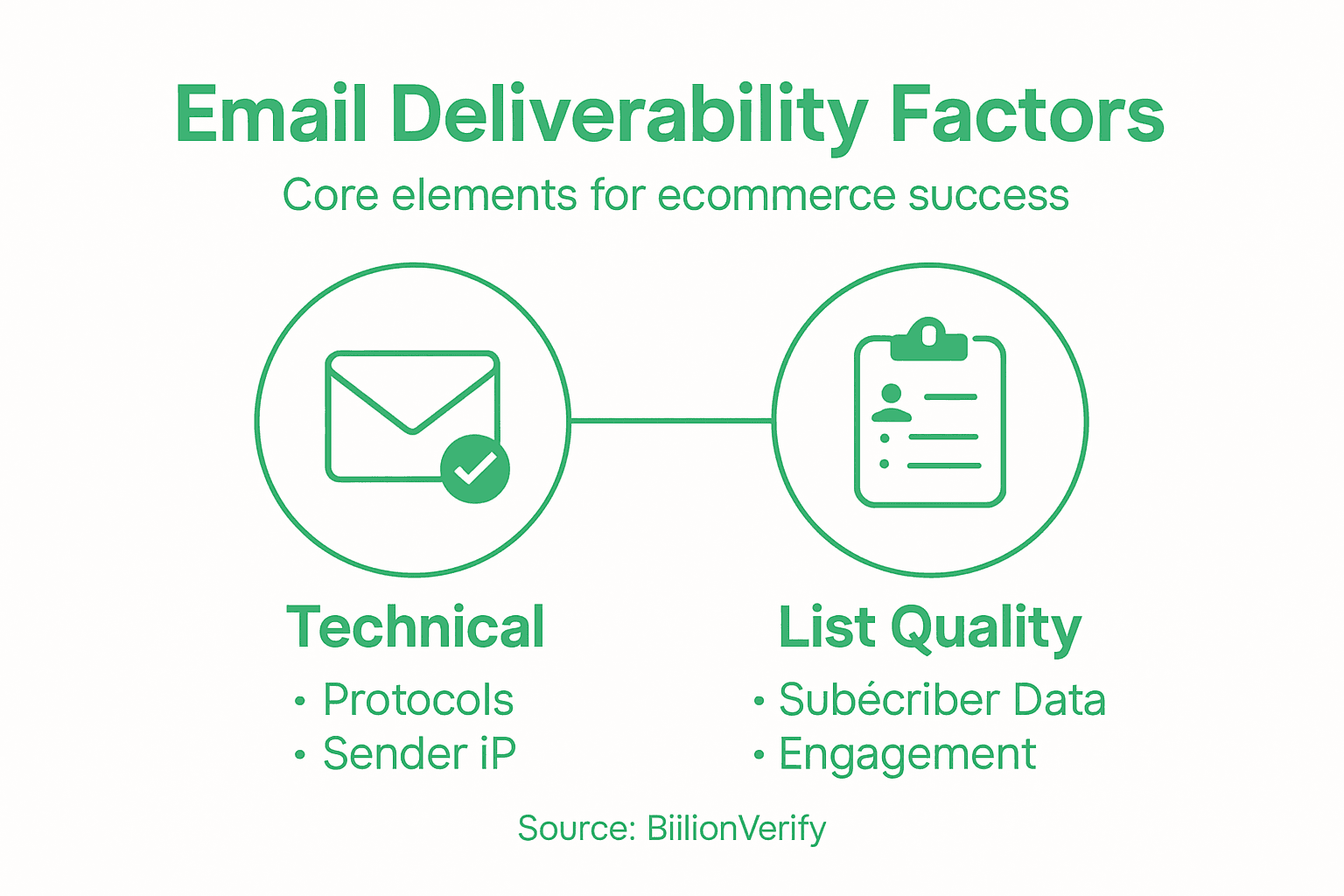
The foundation of deliverability rests on authentication protocols. These are technical standards that prove to mailbox providers that you actually own the domain you're sending from. Without proper authentication, mailbox providers have no way to verify that your email truly comes from your business rather than a spammer impersonating you. Three main protocols handle this: SPF (Sender Policy Framework), DKIM (DomainKeys Identified Mail), and DMARC (Domain-based Message Authentication, Reporting, and Conformance). Each one serves a specific purpose in the verification chain.
SPF tells mailbox providers which IP addresses are authorized to send emails on behalf of your domain. DKIM adds a digital signature to your emails, allowing providers to confirm that the message content hasn't been altered during transmission. DMARC ties these together and tells providers what to do if authentication fails—whether to quarantine the email, reject it, or accept it anyway. A sender without proper DMARC alignment faces immediate deliverability problems. Mailbox providers view unauthenticated mail with deep skepticism, even if the content is legitimate.
Here's a quick comparison of the three primary email authentication protocols and their unique roles:
| Protocol | Primary Purpose | Business Impact |
|---|---|---|
| SPF | Authorizes sending IP addresses | Reduces spoofing, improves trust |
| DKIM | Verifies email integrity | Confirms message not altered |
| DMARC | Sets policy for failed checks | Enables reporting, avoids abuse |
Sender Reputation and IP Warmup
Your sender reputation is the cumulative assessment mailbox providers make about your sending behavior. This includes metrics like bounce rates, complaint rates, unsubscribe rates, spam trap hits, and engagement levels. If you send to invalid addresses, you accumulate hard bounces. If subscribers mark your emails as spam rather than unsubscribing, your complaint rate rises. Each of these signals tells mailbox providers that you're not a trustworthy sender.
IP warmup is the process of gradually increasing email volume from a new IP address. When you start sending from a brand-new IP with no sending history, mailbox providers have no data about your behavior. They treat you as an unknown entity, which means they apply stricter filtering. By starting with small volumes and gradually increasing over time, you build a positive sending history that demonstrates reliability.
Key elements that shape sender reputation include:
- Bounce rates track how many emails fail to reach their destination
- Complaint rates measure how often subscribers mark you as spam
- Engagement metrics monitor opens, clicks, and deletions without opening
- List quality reflects the percentage of valid, active addresses in your database
- Authentication alignment shows whether SPF, DKIM, and DMARC properly validate your domain
Your sender reputation compounds over time. Each campaign either builds trust or erodes it, affecting not just current deliverability but future campaign performance for months to come.
Content and List Quality Factors
Your email content influences deliverability directly. Spam filters analyze message text, subject lines, sender names, links, and attachments to determine legitimacy. Certain words and phrases trigger spam filters immediately. Excessive capitalization, suspicious link shorteners, or multiple links in a short email raise red flags. This doesn't mean your content can't be promotional—it means you need to follow best practices that mailbox providers recognize as legitimate marketing.
List quality is equally critical. Sending to invalid email addresses, role-based accounts (like info@yourdomain.com), or spam traps destroys your sender reputation. Spam traps are email addresses created specifically by mailbox providers to catch senders with poor list hygiene. If you're mailing to addresses that should never have been collected, you'll eventually hit these traps. Each hit signals to mailbox providers that you don't validate your lists before sending.
For e-commerce businesses, list quality means:
- Removing addresses that haven't engaged in 6-12 months
- Validating new signups before adding them to campaigns
- Removing addresses that generate hard bounces immediately
- Identifying and filtering out role-based and catch-all accounts
- Monitoring for disposable email addresses used by temporary accounts
Email deliverability troubleshooting identifies specific list and content issues before they damage your reputation. The earlier you catch list quality problems, the less damage accumulates.
Subscriber engagement is the final major factor. Mailbox providers monitor whether subscribers actively interact with your emails. If you send to thousands of subscribers but only a small percentage open your messages, that signals low relevance. If engagement drops over time, mailbox providers assume your content is unwanted and filter more aggressively. Building engagement requires sending relevant content to properly segmented lists, not blasting everyone with generic messages.
Pro tip: Create a monthly sender reputation audit that tracks your bounce rate, complaint rate, and average open rate. These three metrics provide early warning signals that something is damaging your deliverability before the problem becomes severe.
Summarized below are key deliverability metrics and what changes in them might signal:
| Metric | What It Measures | Early Warning Sign |
|---|---|---|
| Bounce Rate | % undeliverable emails | Spike indicates list quality issues |
| Complaint Rate | % marked as spam | Increase signals content/targeting problem |
| Engagement Rate | Opens and clicks | Drop suggests inbox placement or fatigue |
Risks of Poor Deliverability for E-Commerce Teams
Poor email deliverability creates a cascade of problems that directly threaten your e-commerce business. This isn't a technical issue confined to your marketing department—it affects revenue, customer satisfaction, brand reputation, and operational costs across your entire organization. The risks compound because deliverability failures impact both marketing campaigns and critical transactional emails that customers depend on.
The most immediate risk is lost revenue. When your marketing emails fail to reach inboxes, your conversion rates plummet. Customers never see your flash sales, seasonal promotions, or personalized product recommendations. Poor deliverability directly reduces open and conversion rates, meaning your marketing budget produces minimal return. A 10% improvement in deliverability could mean thousands of additional dollars in recovered revenue for mid-sized e-commerce operations sending hundreds of thousands of emails monthly.
But the damage extends beyond promotional campaigns. Transactional emails—order confirmations, shipping notifications, tracking updates, and password resets—are equally vulnerable to poor deliverability. When a customer completes a purchase and never receives their order confirmation, they don't know if the transaction went through. They contact customer service in confusion. They lose trust in your business. They may even initiate chargebacks thinking the purchase failed. Disrupted customer communications harm retention and increase operational costs, forcing your support team to handle avoidable inquiries.
Reputation Damage and Blacklisting Risk
Your sender reputation is a valuable business asset, and poor deliverability destroys it. Each failed campaign, each spam complaint, each hard bounce accumulates on your domain's and IP address's reputation record. Mailbox providers use this historical data to filter future emails. Once your reputation becomes damaged, recovery takes weeks or months of careful list management and strategic sending.
The worst-case scenario is domain blacklisting. If your sending practices are egregious enough—hitting spam traps, generating excessive complaints, or sending to invalid addresses—mailbox providers can blacklist your entire domain. This means your business can't send any emails through normal channels. You can't reach customers at all. Your only option is to purchase a new domain and rebuild from zero, losing years of sender reputation development.
Blacklisting consequences for e-commerce teams include:
- Complete inability to reach customers via email
- Loss of all future campaign reach until blacklist removal
- Potential loss of customers who rely on email communication
- Damage to brand perception and customer trust
- Operational expenses for domain migration and reputation rebuilding
Poor deliverability isn't just a marketing problem. When order confirmations and shipping notifications fail to reach customers, customer satisfaction deteriorates, support costs spike, and your business reputation suffers.
Customer Experience and Retention Impact
Deliverability failures create friction throughout the customer journey. Customers expect to receive order confirmations within minutes of purchase. They expect shipping notifications when their packages leave the warehouse. They expect tracking updates so they know when to expect delivery. When these emails don't arrive, customers perceive your business as unreliable.
This perception translates into lower customer lifetime value. Customers who experience communication failures are less likely to purchase again. They leave negative reviews mentioning poor communication. They switch to competitors who maintain reliable email communication. For e-commerce businesses where repeat purchases drive profitability, this matters enormously.
Additionally, unreceived emails mean lost opportunities for engagement:
- Abandoned cart recovery emails never reach customers
- Post-purchase upsell recommendations go unseen
- Loyalty program communications fail to arrive
- Win-back campaigns can't reach lapsed customers
- VIP customer promotions are filtered out
Each unreceived email represents a missed chance to increase customer lifetime value or recover a lost sale. Multiply this across thousands of campaigns and hundreds of thousands of customers, and you're looking at substantial revenue loss.
Operational and Cost Implications
Poor deliverability increases your operational costs significantly. Your customer service team must handle additional inquiries from customers asking about missing emails and order confirmations. Your marketing team must spend time troubleshooting deliverability issues instead of optimizing campaigns. Your technical team may need to implement emergency fixes or domain migrations if blacklisting occurs.
These hidden costs often exceed the direct revenue loss from failed campaigns. You're paying staff to manage a problem that could have been prevented with proper list hygiene and authentication setup. For mid-sized operations without dedicated email compliance teams, this operational burden can overwhelm resources quickly.
Pro tip: Implement weekly monitoring of your bounce rate, complaint rate, and spam trap hits. Catching deliverability problems early prevents them from escalating into reputation damage that takes months to repair.
Proven Strategies to Enhance Deliverability
Enhancing email deliverability requires a strategic approach that addresses authentication, list quality, content standards, and ongoing monitoring. These aren't one-time fixes—they're operational practices that demand consistent attention. When implemented together, they dramatically improve your ability to reach customer inboxes and maintain sender reputation.
Start with authentication protocols as your foundation. SPF, DKIM, and DMARC work together to prove your legitimacy to mailbox providers. SPF records specify which IP addresses can send emails from your domain. DKIM adds cryptographic signatures to your messages, proving they haven't been altered in transit. DMARC brings these together and tells mailbox providers how to handle authentication failures. Without proper alignment across all three protocols, mailbox providers treat your emails with suspicion from the start.
Implementing these protocols correctly isn't optional—it's baseline infrastructure. A domain without DMARC alignment faces significantly higher filtering rates, regardless of content quality. Set up your authentication infrastructure first, then verify it's working correctly with testing tools. This foundation prevents the most common deliverability failures before they happen.
List Quality and Engagement Management
Maintaining a clean email list is equally critical. Sending to invalid addresses, role-based accounts, or spam traps destroys your sender reputation. Authenticating your domain protects against these foundational issues, but list quality requires active management. Remove addresses that generate hard bounces immediately. Identify and filter out role-based accounts like info@, sales@, or support@ addresses that aren't individual subscribers. Monitor for disposable email services that subscribers use for temporary signups.
Engagement-based list cleaning is equally important. Subscribers who haven't opened an email in 6-12 months likely won't engage with future campaigns either. Mailbox providers monitor engagement metrics, and sending to disengaged subscribers signals low relevance. Rather than sending to everyone regardless of engagement, segment your list and prioritize engaged subscribers in your campaigns.
List quality practices include:
- Running monthly hygiene audits to identify invalid addresses
- Removing hard bounces immediately after they occur
- Filtering out role-based and catch-all accounts before sending
- Identifying and removing disposable email addresses
- Re-engagement campaigns for subscribers inactive 6+ months
- Monitoring spam trap hits and removing affected segments
Content Standards and Pre-Send Testing
High-quality content that avoids spam-triggering elements is essential. Spam filters analyze subject lines, sender names, message text, links, and attachments for red flags. Excessive capitalization, common spam phrases, suspicious link shorteners, or multiple unrelated links raise immediate concerns. This doesn't mean your content can't be promotional—it means following best practices that legitimate marketers use.
Pre-send spam testing catches potential deliverability issues before you send to your entire list. These tools run your emails through spam filters to identify problematic elements. A subject line that triggers filters can be revised. A link that looks suspicious can be cleaned up. Catching these issues before sending saves your sender reputation from unnecessary hits.
Content best practices include:
- Avoiding excessive capitalization and punctuation marks
- Using clear, recognizable sender names
- Including visible unsubscribe links
- Balancing promotional content with value-driven content
- Testing links before sending to ensure they work correctly
- Avoiding attachments unless absolutely necessary
Consistent sending volume and frequency help mailbox providers establish baseline patterns for your domain, making it easier to distinguish legitimate campaigns from spam.
Monitoring and Continuous Optimization
Ongoing metric monitoring prevents problems from escalating into reputation damage. Track your bounce rate, complaint rate, engagement metrics, and spam trap hits weekly. A sudden spike in any metric signals an underlying issue that needs investigation. Early detection means you can fix problems before they damage your sender reputation significantly.
Your monitoring dashboard should highlight key performance indicators that directly impact deliverability. Bounce rates above 5% indicate list quality issues. Complaint rates above 0.1% suggest content or targeting problems. Engagement rates below your baseline might indicate deliverability filtering. When metrics deviate from normal patterns, investigate the cause immediately.
Create a monthly deliverability report that tracks trends over time. This historical data helps you identify seasonal patterns, spot emerging issues, and measure the impact of strategy changes. Share these metrics with stakeholders to emphasize the importance of ongoing deliverability management.
Pro tip: Set up automated alerts for your bounce rate and complaint rate that notify you immediately when they exceed safe thresholds. Early intervention prevents small problems from becoming reputation damage that takes months to repair.
Boost Your E-Commerce Email Deliverability with BillionVerify
Struggling with poor email deliverability that eats into your revenue and damages your sender reputation? The article highlights core challenges like managing list quality, avoiding spam traps, and maintaining authentication protocols—all essential to ensuring your campaigns reach customer inboxes consistently. Your e-commerce success depends on avoiding costly bounce rates, complaint spikes, and blacklisting risks that disrupt both promotional and transactional emails.
BillionVerify offers a powerful solution tailored for businesses like yours. With enterprise-grade email verification, including bulk validation, disposable email detection, and spam trap identification, BillionVerify ensures your email list is clean and ready to maximize inbox placement. Our platform supports real-time API integrations and connects seamlessly with major email marketing tools such as Mailchimp and HubSpot to automate your list hygiene without interrupting your workflow.

Experience the impact of higher deliverability and stronger sender reputation today. Visit BillionVerify to start cleaning your email lists and safeguard your campaigns against deliverability pitfalls. Don’t let poor email hygiene undermine your next big sale or transactional message. Take control now with BillionVerify’s email verification and turn your email marketing into a consistent revenue driver.
Frequently Asked Questions
What is email deliverability and why is it important for e-commerce?
Email deliverability refers to the ability of your marketing emails to successfully reach subscriber inboxes. It is crucial for e-commerce because if emails end up in spam folders or bounce, your marketing efforts go unseen, leading to missed sales opportunities and wasted budget.
How do authentication protocols affect email deliverability?
Authentication protocols like SPF, DKIM, and DMARC help verify that your emails are genuinely from your domain. Properly implemented protocols boost your credibility with mailbox providers and significantly enhance your chances of landing in inboxes rather than being filtered as spam.
What are some common factors that influence email deliverability rates?
Several factors impact email deliverability, including sender reputation, list quality, authentication alignment, content quality, and subscriber engagement. Maintaining good practices across these areas is essential to achieve higher deliverability rates.
How can I improve my email deliverability for promotional campaigns?
To improve email deliverability, regularly clean your email list of invalid addresses, ensure your authentication protocols are properly set up, create high-quality content that avoids spam triggers, and monitor your engagement metrics consistently. These steps help maintain a good sender reputation and improve inbox placement.