



Email marketing compliance isn't optional—it's essential for protecting your business, maintaining subscriber trust, and avoiding costly penalties that can reach millions of dollars. As regulations continue to evolve and enforcement intensifies worldwide, understanding and implementing proper compliance practices has never been more critical. This comprehensive handbook covers all major email regulations, practical implementation strategies, and the latest requirements for 2025.
Why Email Compliance Matters in 2025
The email compliance landscape has shifted dramatically. Regulators worldwide are actively enforcing penalties, and the stakes have never been higher.
The Financial Reality
Maximum Penalties by Regulation:
- GDPR: Up to €20 million or 4% of global annual revenue (whichever is higher)
- CAN-SPAM: Up to $51,744 per email violation
- CASL: Up to $10 million CAD per violation for organizations
- CCPA: Up to $7,500 per intentional violation
These penalties are per violation. A single non-compliant campaign to 100,000 subscribers could theoretically result in billions in fines. While maximum penalties aren't always assessed, enforcement is real and increasing.
Real Enforcement Examples
2024-2025 Notable Cases:
- Amazon (GDPR): €746 million for behavioral advertising without proper consent
- Meta/WhatsApp (GDPR): €225 million for transparency violations
- Vodafone Spain (GDPR): €8.15 million for marketing without consent
- CompuFinder (CASL): $1.1 million for Canada's first major CASL penalty
For more enforcement examples and lessons learned, see our guide on email marketing penalties.
Beyond Financial Penalties
Reputation Damage: Enforcement actions become public, damaging brand trust and customer relationships.
Deliverability Impact: Non-compliant practices lead to spam complaints, blacklisting, and reduced inbox placement.
Operational Disruption: Investigations consume resources, distract leadership, and may require significant process overhauls.
Customer Loss: Subscribers who feel their privacy was violated leave—and tell others.
The Ethical Foundation
Beyond legal requirements, compliance reflects fundamental respect for subscribers:
- They trusted you with personal information
- They deserve control over how it's used
- Their inbox is their personal space
- Consent and transparency build lasting relationships
Understanding the Global Regulatory Landscape
Email marketing is governed by overlapping regulations depending on where your business operates and where your subscribers are located.
Regulatory Models
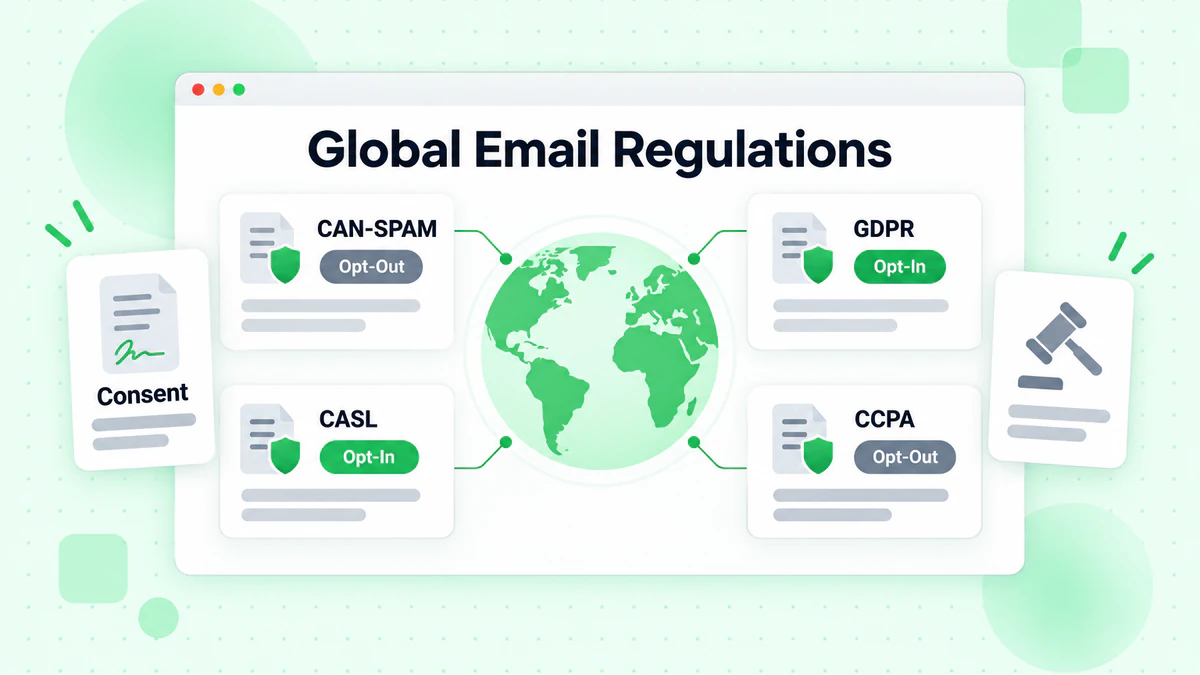
Opt-In Model (Consent Required):
- European Union (GDPR + ePrivacy)
- Canada (CASL)
- Australia (Spam Act)
- Most stricter jurisdictions
Opt-Out Model (Can Send Until Unsubscribe):
- United States (CAN-SPAM)
- Some less regulated markets
Key Insight: The global trend is toward opt-in requirements. Building consent-based processes now prepares you for future regulations.
For a complete country-by-country breakdown, see our international email laws guide.
CAN-SPAM Act (United States)
The Controlling the Assault of Non-Solicited Pornography And Marketing Act establishes baseline requirements for commercial email in the United States.
Who CAN-SPAM Applies To
Commercial Email: Email with a primary purpose of advertising or promoting a commercial product or service.
Transactional Email: Emails related to agreed-upon transactions (order confirmations, account updates) have fewer requirements but must still be accurate and honest.
Geographic Scope: If you email US recipients, CAN-SPAM applies regardless of where your business is located.
The Seven CAN-SPAM Requirements
1. No False or Misleading Header Information
The "From," "To," "Reply-To," and routing information must be accurate and identify the sender.
✅ Compliant: From: "Sarah at BillionVerify" <sarah@billionverify.com> ❌ Non-Compliant: From: "Customer Service" <reply@randomdomain.com> (if not that company)
2. No Deceptive Subject Lines
Subject lines must accurately reflect email content.
✅ Compliant: "Your Weekly Marketing Tips" ❌ Non-Compliant: "Re: Your Account" (if it's not a reply about their account)
3. Identify the Message as an Advertisement
Commercial emails must be clearly identifiable as advertisements, though the law provides flexibility in how to accomplish this.
4. Include Physical Postal Address
Every commercial email must include your valid physical postal address—street address, PO Box, or registered private mailbox.
5. Provide Clear Unsubscribe Mechanism
Must include a clear, conspicuous way to opt out that:
- Works for at least 30 days after sending
- Requires no login or fees
- Is easy to find and use
6. Honor Unsubscribe Requests Promptly
Must process opt-out requests within 10 business days. Cannot charge fees, require personal information, or create barriers.
7. Monitor Third-Party Compliance
If others send email on your behalf (affiliates, partners, agencies), you're responsible for their compliance.
CAN-SPAM Penalties
- Up to $51,744 per email violation
- Criminal penalties for harvesting, spoofing, or using botnets
- Both sender and company sending on their behalf can be liable
CAN-SPAM Best Practice
Important: CAN-SPAM doesn't require prior consent—but that doesn't mean you shouldn't get it. Permission-based marketing delivers better engagement, fewer complaints, and stronger customer relationships.
For detailed CAN-SPAM guidance, see our CAN-SPAM compliance guide.
GDPR (European Union)
The General Data Protection Regulation is the world's strictest privacy regulation, with significant implications for email marketing.
Who GDPR Applies To
GDPR applies if you:
- Have subscribers in the EU
- Have a business presence in the EU
- Offer goods or services to EU residents
- Monitor behavior of EU residents
Geographic reach: GDPR applies regardless of where your business is located.
GDPR Consent Requirements
GDPR requires explicit, informed, freely given consent before sending marketing emails.
Consent Must Be:
Explicit: Active opt-in required. No pre-checked boxes, no implied consent from silence or inactivity.
Informed: Clear explanation of what they're consenting to, who will contact them, and how data will be used.
Freely Given: Cannot condition a service on unnecessary consent. Subscribers shouldn't have to accept marketing to use your product.
Specific: Separate consent for different purposes (marketing vs. third-party sharing vs. different communication types).
Demonstrable: You must be able to prove consent was given—what, when, and how.
GDPR Consent Best Practices
✅ Compliant Form:
□ I agree to receive marketing emails from BillionVerify
  about email verification tips and product updates.
  View our Privacy Policy.
❌ Non-Compliant Form:
☑ I agree to receive emails from BillionVerify and partners
  (pre-checked box, bundled consent)
GDPR Data Subject Rights
EU subscribers have specific rights that you must honor:
- Right to Access: Request copies of their data
- Right to Rectification: Correct inaccurate data
- Right to Erasure: Request deletion ("right to be forgotten")
- Right to Restrict Processing: Limit how you use their data
- Right to Data Portability: Receive data in transferable format
- Right to Object: Object to processing, including marketing
- Right to Withdraw Consent: Revoke permission at any time
GDPR Penalties
- Up to €20 million or 4% of global annual turnover (whichever is higher)
- Lower tier: Up to €10 million or 2% for less severe violations
- Supervisory authority investigations and public enforcement actions
For comprehensive GDPR guidance, see our GDPR email marketing guide.
CCPA/CPRA (California)
The California Consumer Privacy Act, as amended by the California Privacy Rights Act, is the most comprehensive US state privacy law affecting email marketing.
Who CCPA Applies To
CCPA applies to businesses that:
- Do business in California, AND
- Meet ANY of these thresholds:
- Annual gross revenue over $25 million
- Buy, sell, or share personal information of 100,000+ California residents/households annually
- Derive 50%+ of annual revenue from selling/sharing personal information
CCPA Consumer Rights
Right to Know: Consumers can request disclosure of what personal information you collect, sources, purposes, and recipients.
Right to Delete: Consumers can request deletion of their personal information (with exceptions).
Right to Correct (CPRA): Consumers can request correction of inaccurate information.
Right to Opt Out of Sale/Sharing: Consumers can direct you not to sell or share their personal information—including for cross-context behavioral advertising.
Right to Non-Discrimination: Cannot penalize consumers for exercising their rights.
CCPA Email Marketing Implications
Data Collection Disclosure: Before collecting email addresses, inform consumers of what you collect and why.
Privacy Policy Requirements: Must disclose categories of personal information collected, purposes, third parties receiving data, and consumer rights.
"Do Not Sell or Share" Link: Required if you share subscriber data with advertising platforms for targeting.
CCPA Penalties
- Up to $2,500 per unintentional violation
- Up to $7,500 per intentional violation
- Private right of action for data breaches ($100-$750 per consumer per incident)
For detailed CCPA guidance, see our CCPA email marketing guide.
CASL (Canada)
Canada's Anti-Spam Legislation is among the strictest consent requirements in the world.
Who CASL Applies To
CASL applies to commercial electronic messages (CEMs) sent to or from Canada, including email, SMS, and social media messages.
CASL Consent Requirements
Express Consent (preferred and permanent):
- Clear, active opt-in
- Written record of consent
- Description of message purposes
- Sender identification
- Does not expire unless withdrawn
Implied Consent (limited and temporary):
- Existing business relationship: 24 months from last transaction
- Inquiry relationship: 6 months from inquiry
- Conspicuously published address: Must be relevant to recipient's role
Critical: Implied consent expires. You must convert to express consent or stop sending.
CASL Content Requirements
Every CEM must include:
- Clear sender identification
- Contact information (mailing address plus phone/email/web)
- Working unsubscribe mechanism (functional for 60 days)
- Process opt-outs within 10 business days
CASL Penalties
- Individuals: Up to $1 million CAD per violation
- Organizations: Up to $10 million CAD per violation
- Personal liability for directors and officers
- Private right of action (individuals can sue)
For comprehensive CASL guidance, see our CASL compliance guide.
Other Global Regulations
Email compliance extends beyond these major regulations.
United Kingdom (Post-Brexit)
UK GDPR: Largely mirrors EU GDPR with UK-specific elements.
PECR: Additional rules for electronic marketing, including soft opt-in for existing customers.
Australia (Spam Act 2003)
- Consent required (express or inferred)
- Sender identification and functional unsubscribe
- Penalties up to $2.22 million AUD per day
Brazil (LGPD)
Brazil's data protection law mirrors GDPR:
- Consent requirements
- Data subject rights
- Penalties up to 2% of Brazilian revenue (R$50 million cap)
Other Jurisdictions
- Japan: Act on Regulation of Transmission of Specified Electronic Mail
- South Korea: Act on Promotion of Information and Communications Network Utilization
- Singapore: Spam Control Act and PDPA
- India: Digital Personal Data Protection Act (2023)
Best Practice: When sending internationally, apply the strictest relevant standard.
For complete international coverage, see our international email laws guide.
Building a Compliant Email Program
Practical steps to achieve and maintain compliance across all regulations.
Consent Management
Proper consent management is the foundation of compliance.
At Point of Signup:
- Clear description of what they'll receive
- Active opt-in checkbox (unchecked by default)
- Link to privacy policy
- Separate consent for different purposes
- Record timestamp, source, and consent text
Consent Form Example:
Sign up for our newsletter

Email: [________________]

□ I want to receive weekly email marketing tips
  and product updates from BillionVerify.

By signing up, you agree to our Privacy Policy.
You can unsubscribe at any time.

[Subscribe]
Consent Records Must Include:
- Email address
- Date and time of consent
- Source (form URL, API, etc.)
- Exact consent text shown
- IP address (optional but helpful)
- Subsequent changes
Unsubscribe Best Practices
Make It Easy:
- One-click unsubscribe when possible
- No login required
- No lengthy forms
- Immediate confirmation
Preference Center Alternative: Offer alternatives to full unsubscribe:
- Reduce email frequency
- Choose email types
- Pause subscription temporarily
- Update email address
Footer Example:
You're receiving this because you signed up at billionverify.com.

Manage preferences | Unsubscribe

BillionVerify
123 Main Street, Suite 100
San Francisco, CA 94105
Data Subject Request Handling
GDPR requires response within 30 days (extendable to 90 days for complex requests).
Access Requests:
- Provide all data held on the individual
- Explain how it's used
- Deliver in commonly used format
Deletion Requests:
- Delete all data unless legitimate grounds exist to retain
- Confirm deletion
- Stop all processing
- Maintain suppression list to prevent re-adding
Process Setup:
- Designate responsible team member
- Create request intake process
- Document verification procedures
- Establish response templates
- Track all requests
- Maintain response SLAs
Privacy Policy Requirements
Your privacy policy must cover:
- What data you collect
- How you use it
- Who you share it with
- Data retention periods
- How to exercise rights
- How to contact you
GDPR-Specific Requirements:
- Controller identity and contact
- Data Protection Officer contact (if applicable)
- Legal basis for processing
- International transfer details
- Right to lodge complaint with supervisory authority
Data Protection Measures
Implement appropriate data protection measures:
Technical Measures:
- Encryption for subscriber data
- Access controls and authentication
- Security monitoring
- Regular vulnerability assessments
Organizational Measures:
- Data handling policies
- Staff training
- Vendor security assessment
- Incident response procedures
List Hygiene and Compliance
Clean Lists Are Compliant Lists
Bouncing emails can indicate:
- Outdated consent
- Invalid addresses
- Potential purchased lists
Learn more about email list hygiene and maintaining clean email lists.
Email Verification Supports Compliance:
- Confirms real, deliverable addresses
- Removes potential spam traps
- Identifies disposable emails
- Catches typos indicating poor collection practices
Use BillionVerify email verification:
- At point of collection with real-time API
- Before major campaigns with bulk verification
- Periodically for entire list maintenance
Common Compliance Mistakes
Avoid these frequent errors that lead to penalties.
Mistake 1: Buying or Renting Lists
The Problem: Purchased lists rarely have proper consent.
Violations:
- GDPR: No valid consent
- CASL: No express consent
- CAN-SPAM: Legal but destroys deliverability
The Fix: Only email people who opted in directly to your communications.
Mistake 2: Pre-Checked Consent Boxes
The Problem: Pre-checked boxes don't constitute valid consent under GDPR or CASL.
The Fix: Unchecked boxes requiring active, affirmative selection.
Mistake 3: Hiding or Breaking Unsubscribe Links
The Problem: Tiny, hard-to-find, or non-functional unsubscribe links.
Violations: CAN-SPAM, GDPR, CASL all require clear, working unsubscribe.
The Fix: Prominent, one-click unsubscribe in every email. Test regularly.
Mistake 4: Ignoring Unsubscribe Requests
The Problem: Continuing to email after opt-out requests.
Violations: All major regulations require prompt honoring of opt-outs.
The Fix: Immediate suppression, automated processing, real-time list sync.
Mistake 5: Missing Physical Address
The Problem: No postal address in commercial emails.
Violations: CAN-SPAM requires physical address.
The Fix: Include valid physical address in every commercial email footer.
Mistake 6: Bundled Consent
The Problem: Burying marketing consent in terms of service or other agreements.
Violations: GDPR requires freely given, specific consent.
The Fix: Separate, clearly labeled marketing consent with its own checkbox.
Mistake 7: No Consent Records
The Problem: Unable to prove when and how consent was obtained.
Violations: GDPR requires demonstrable consent.
The Fix: Comprehensive consent logging from day one.
Mistake 8: Ignoring International Regulations
The Problem: Assuming home country law applies to all subscribers.
Violations: Multiple jurisdictions may apply based on subscriber location.
The Fix: Apply strictest applicable standards; segment by jurisdiction if needed.
For more compliance failures and lessons learned, see email marketing penalties.
Compliance by Email Type
Different email types have different requirements.
Marketing Emails
Strictest requirements apply:
- Explicit consent required (GDPR, CASL)
- Full CAN-SPAM compliance
- Easy unsubscribe mandatory
- Advertisement identification required
See our email marketing best practices guide.
Transactional Emails
More flexibility but not unlimited:
- Can send without marketing consent
- Must relate to agreed transaction
- Cannot be primarily promotional
- Still need accurate headers and subjects
Examples: Order confirmations, shipping notifications, account updates, password resets.
Watch Out: Adding marketing content to transactional emails may convert them to commercial emails subject to full requirements.
Relationship Emails
Gray area requiring careful handling:
- Newsletters (typically commercial)
- Product updates (may be transactional)
- Renewal reminders (may be transactional)
Best Practice: Treat unclear cases as commercial/marketing and get proper consent.
Compliance Documentation
Documentation protects your business and demonstrates good faith compliance.
Essential Documents
Privacy Policy: What data you collect, how you use it, who you share it with, retention periods, how to exercise rights.
Consent Records: What they consented to, when, how, and the exact consent text shown.
Data Processing Records: Categories and purposes of processing, recipients, retention periods, security measures.
Procedure Documents: Data subject request process, breach notification process, consent collection procedures, unsubscribe handling.
Regular Review Schedule
Monthly:
- Review unsubscribe processing
- Check complaint rates
- Audit consent collection
Quarterly:
- Review compliance procedures
- Update documentation
- Train new team members
Annually:
- Full compliance audit
- Policy review and update
- Legal/regulation check
- Third-party assessment
Compliance Quick Reference Checklists
CAN-SPAM Checklist
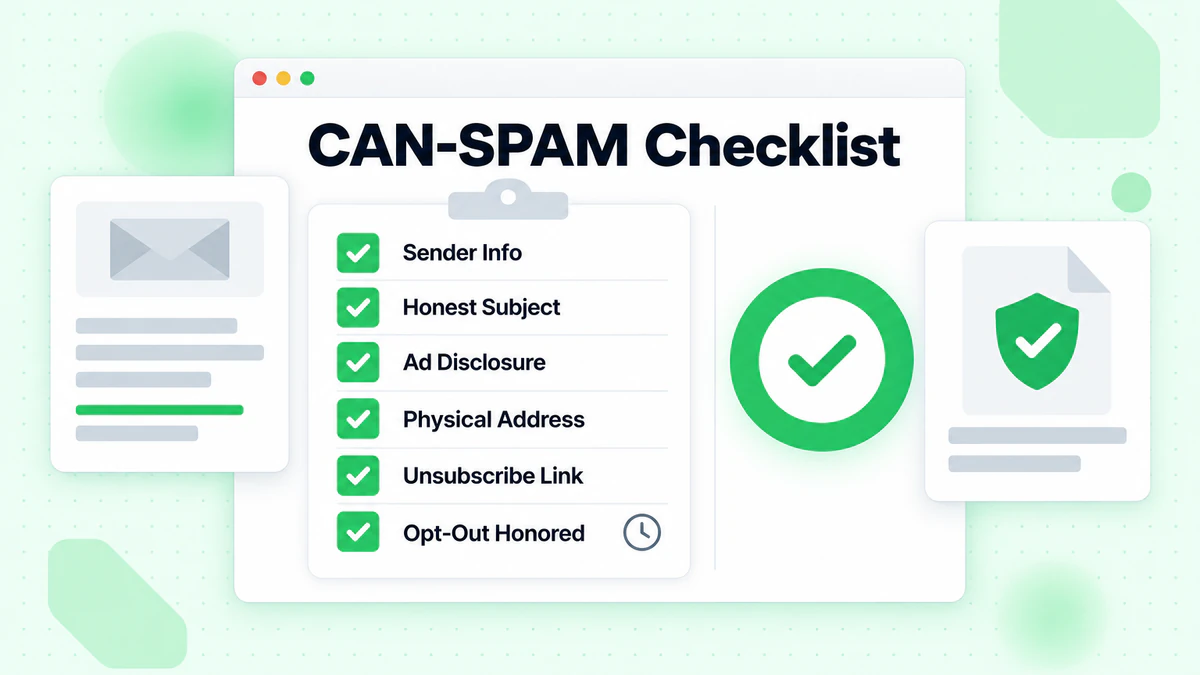
- [ ] Accurate sender information
- [ ] Honest subject lines
- [ ] Advertisement identification
- [ ] Physical address included
- [ ] Working unsubscribe link
- [ ] Honor opt-outs within 10 business days
- [ ] Monitor third-party compliance
GDPR Checklist
- [ ] Explicit consent obtained and recorded
- [ ] Consent records maintained with full details
- [ ] Privacy policy published and accessible
- [ ] Data subject rights process in place
- [ ] Data minimization practiced
- [ ] Appropriate security measures implemented
- [ ] International transfer safeguards (if applicable)
CASL Checklist
- [ ] Express or valid implied consent documented
- [ ] Implied consent expiration tracked
- [ ] Clear sender identification in every message
- [ ] Contact information included (address + phone/email/web)
- [ ] Working unsubscribe (functional 60 days)
- [ ] Opt-outs processed within 10 business days
CCPA Checklist
- [ ] Privacy policy includes required disclosures
- [ ] Notice at collection provided
- [ ] Consumer request handling process in place
- [ ] "Do Not Sell or Share" link (if applicable)
- [ ] Service provider agreements updated
2025 Compliance Trends
Stay ahead of evolving requirements.
Increased Enforcement
Regulators worldwide are investing in enforcement resources. Expect more investigations and larger penalties.
State Privacy Law Expansion
Beyond California, Virginia, Colorado, Connecticut, and Utah have enacted privacy laws. More states are following. Build adaptable compliance frameworks.
AI and Personalization Scrutiny
As AI becomes more prevalent in email marketing, expect scrutiny of automated decision-making and profiling practices.
Cookie and Tracking Changes
ePrivacy Regulation developments and browser changes are affecting email tracking. Prepare for reduced open tracking reliability.
Cross-Border Enforcement Cooperation
International enforcement cooperation is increasing. Non-EU companies can't assume they're beyond GDPR reach.
Conclusion
Email compliance isn't just about avoiding fines—it's about respecting subscribers and building sustainable marketing programs. The organizations that thrive are those that view compliance as an opportunity to build trust rather than merely a legal obligation.
Key Principles to Remember:
Consent is foundational: When in doubt, get explicit permission. It's the safest and most defensible approach.
Make unsubscribing easy: It protects you legally and respects subscriber preferences.
Document everything: If you can't prove compliance, you may not be compliant.
Stay current: Regulations evolve constantly; your practices must evolve too.
Quality over quantity: Compliant, verified lists outperform larger non-compliant lists.
Apply strictest standards: When regulations overlap, apply the strictest applicable requirement.
Compliance and list quality go hand in hand. Invalid addresses can indicate poor consent practices, while verified lists demonstrate proper collection methods. Use BillionVerify email verification to ensure your list contains only legitimate, properly collected, deliverable addresses.
Additional Resources:
- GDPR Email Marketing Guide
- CAN-SPAM Compliance Guide
- CCPA Email Marketing Guide
- CASL Compliance Guide
- Email Consent Management
- Email Privacy Policy Guide
- Email Data Protection
- Email Marketing Penalties
- International Email Laws
Ready to support your compliance efforts with verified, valid email addresses? Start with BillionVerify to ensure your subscriber list meets the highest quality standards.