



The General Data Protection Regulation (GDPR) fundamentally changed how businesses approach email marketing in the European Union and beyond. Since its enforcement in May 2018, organizations worldwide have had to rethink their email strategies to comply with what remains the world's strictest privacy regulation. This comprehensive guide covers everything you need to know about GDPR email marketing compliance in 2025—from consent requirements and legitimate interest to practical implementation strategies.
Understanding GDPR's Impact on Email Marketing
GDPR isn't just another privacy law—it represents a paradigm shift in how organizations must treat personal data, including email addresses. Understanding its scope and requirements is essential for any business with EU subscribers.
What Is GDPR?
The General Data Protection Regulation is a comprehensive data protection law that applies to:
All Organizations Processing EU Residents' Data:
- Companies based in the EU
- Companies outside the EU offering goods/services to EU residents
- Companies monitoring EU residents' behavior
- Any organization with EU subscribers on their email list
Key GDPR Principles:
- Lawfulness, Fairness, and Transparency: Process data legally and openly
- Purpose Limitation: Collect data only for specified, legitimate purposes
- Data Minimization: Collect only what's necessary
- Accuracy: Keep data accurate and up-to-date
- Storage Limitation: Don't keep data longer than needed
- Integrity and Confidentiality: Ensure appropriate security
- Accountability: Demonstrate compliance
How GDPR Affects Email Marketing
GDPR impacts email marketing in several critical ways:
Consent Requirements: Marketing emails typically require explicit, freely given consent—no more pre-checked boxes or bundled consent.
Data Subject Rights: Subscribers can access, correct, delete, or export their data at any time.
Documentation Obligations: You must prove when and how consent was obtained.
Transparency Requirements: Privacy policies must clearly explain how email data is used.
International Scope: These rules apply regardless of where your business is located.
GDPR Penalties and Enforcement
The stakes for non-compliance are significant:
Maximum Fines:
- Up to €20 million, OR
- 4% of global annual turnover (whichever is higher)
Lower Tier Penalties:
- Up to €10 million, OR
- 2% of global annual turnover for less severe violations
Real Enforcement Examples:
- Amazon: €746 million (behavioral advertising without consent)
- WhatsApp: €225 million (transparency violations)
- Google: €90 million (cookie consent issues)
- British Airways: €20 million (data breach)
Email marketing violations, while typically smaller, still result in significant fines and reputational damage.
Legal Bases for Email Marketing Under GDPR
GDPR requires a lawful basis for processing personal data. For email marketing, two bases are primarily relevant: consent and legitimate interest.
Consent as Legal Basis
For most marketing emails, consent is the safest and most straightforward legal basis.
GDPR Consent Requirements:
Freely Given: Consent cannot be coerced or conditional on unrelated services. A customer shouldn't have to agree to marketing emails to make a purchase.
Specific: Consent must be for specific purposes. "We'll send you emails" is too vague. "We'll send weekly marketing tips and product updates" is specific.
Informed: Subscribers must understand what they're consenting to, including who will contact them and how to withdraw consent.
Unambiguous: Requires a clear affirmative action—checking a box, clicking a button, or similar. Silence or pre-checked boxes don't qualify.
Demonstrable: You must be able to prove consent was given, including what, when, and how.
Consent Best Practices:
✅ Valid Consent Form:
Email: [________________]

□ Yes, I want to receive weekly email marketing tips
  and product updates from BillionVerify.

View our Privacy Policy for details on how we use your data.
You can unsubscribe at any time.

[Subscribe]
❌ Invalid Consent Form:
Email: [________________]

☑ I agree to receive emails and share my data with partners.
(Pre-checked, bundled consent, vague purposes)

[Submit]
Legitimate Interest as Legal Basis
Legitimate interest can justify some email marketing without explicit consent, but it's a higher-risk approach requiring careful documentation.
When Legitimate Interest May Apply:
- B2B marketing to business contacts (not consumers)
- Follow-up to existing customer relationships
- Marketing closely related to previous interactions
Requirements for Legitimate Interest:
Three-Part Test:
- Purpose Test: Is there a legitimate business interest?
- Necessity Test: Is email marketing necessary to achieve it?
- Balancing Test: Do the individual's rights outweigh your interest?
Legitimate Interest Assessment (LIA): You must document your assessment, including:
- The legitimate interest being pursued
- Why processing is necessary
- Impact on individuals' privacy
- Safeguards in place
- Conclusion and justification
Legitimate Interest Risks:
- Harder to defend if challenged
- Supervisory authorities tend to favor consent for marketing
- Consumer perception may be negative
- Must still offer easy opt-out
Recommendation: When in doubt, get consent. It's clearer, safer, and often improves engagement because subscribers actively chose to hear from you.
Soft Opt-In (Existing Customer Exception)
Some jurisdictions allow limited marketing to existing customers without fresh consent.
Conditions for Soft Opt-In:
- Customer provided email during a sale or negotiation
- Marketing is for similar products/services
- Opt-out opportunity given at collection time
- Easy opt-out in every message
Note: This comes from the ePrivacy Directive (separate from GDPR) and varies by EU member state. The upcoming ePrivacy Regulation may change these rules.
Consent Collection and Management
Proper consent collection is the foundation of GDPR-compliant email marketing. Here's how to do it right.
Consent Form Best Practices
Essential Elements:
- Clear Description: Exactly what emails they'll receive
- Unchecked Checkbox: Active opt-in required
- Separate Consents: Don't bundle marketing with terms of service
- Privacy Policy Link: Easy access to full details
- Withdrawal Information: How to unsubscribe
Example Compliant Form:
<form>
  <label for="email">Email Address</label>
  <input type="email" id="email" required>

  <label>
    <input type="checkbox" name="marketing_consent" required>
    I would like to receive weekly email marketing insights,
    product updates, and exclusive offers from BillionVerify.
  </label>

  <p class="privacy-notice">
    Your email will be processed according to our
    <a href="/privacy">Privacy Policy</a>.
    You can unsubscribe at any time by clicking the
    unsubscribe link in any email.
  </p>

  <button type="submit">Subscribe</button>
</form>
Double Opt-In Process
While not strictly required by GDPR, double opt-in (confirmed opt-in) is strongly recommended.
How Double Opt-In Works:
- User submits email address and checks consent box
- System sends confirmation email
- User clicks confirmation link
- Subscription becomes active
Benefits of Double Opt-In:
- Stronger Consent Proof: Click provides additional confirmation
- Better List Quality: Reduces typos and fake emails
- Improved Deliverability: Engaged subscribers from the start
- Reduced Complaints: People who confirm are less likely to mark as spam
Double Opt-In Email Example:
Subject: Please confirm your subscription to BillionVerify
"Hi [First Name],
Thanks for signing up for our email list!
Please confirm your subscription by clicking the button below:
[Confirm My Subscription]
By confirming, you agree to receive weekly email marketing tips and product updates from BillionVerify. You can unsubscribe at any time.
If you didn't sign up, simply ignore this email.
Best regards, The BillionVerify Team"
Consent Record Keeping
GDPR requires demonstrable consent—you must prove it was given.
What to Record:
- Email address
- Date and time of consent
- Source (which form, page, or method)
- Exact consent text shown
- IP address (optional but helpful)
- Any subsequent changes (consent withdrawal, updates)
Database Schema Example:
consent_records:
  - email: subscriber@example.com
  - consent_given_at: 2025-01-15T10:30:00Z
  - consent_source: "homepage_newsletter_form"
  - consent_text: "I would like to receive weekly..."
  - ip_address: "192.168.1.1"
  - double_optin_confirmed: true
  - double_optin_at: 2025-01-15T10:35:00Z
  - consent_withdrawn: false
Managing Consent Changes
Consent can be withdrawn as easily as it was given.
Processing Withdrawal:
- Implement one-click unsubscribe when possible
- Honor requests within 48 hours (immediately is best)
- Stop all marketing communications
- Record the withdrawal in your consent log
Preference Centers: Allow subscribers to modify rather than fully unsubscribe:
- Change email frequency
- Select content categories
- Update email address
- Pause temporarily
Data Subject Rights in Email Marketing
GDPR grants individuals specific rights over their personal data. Email marketers must be prepared to honor these requests.
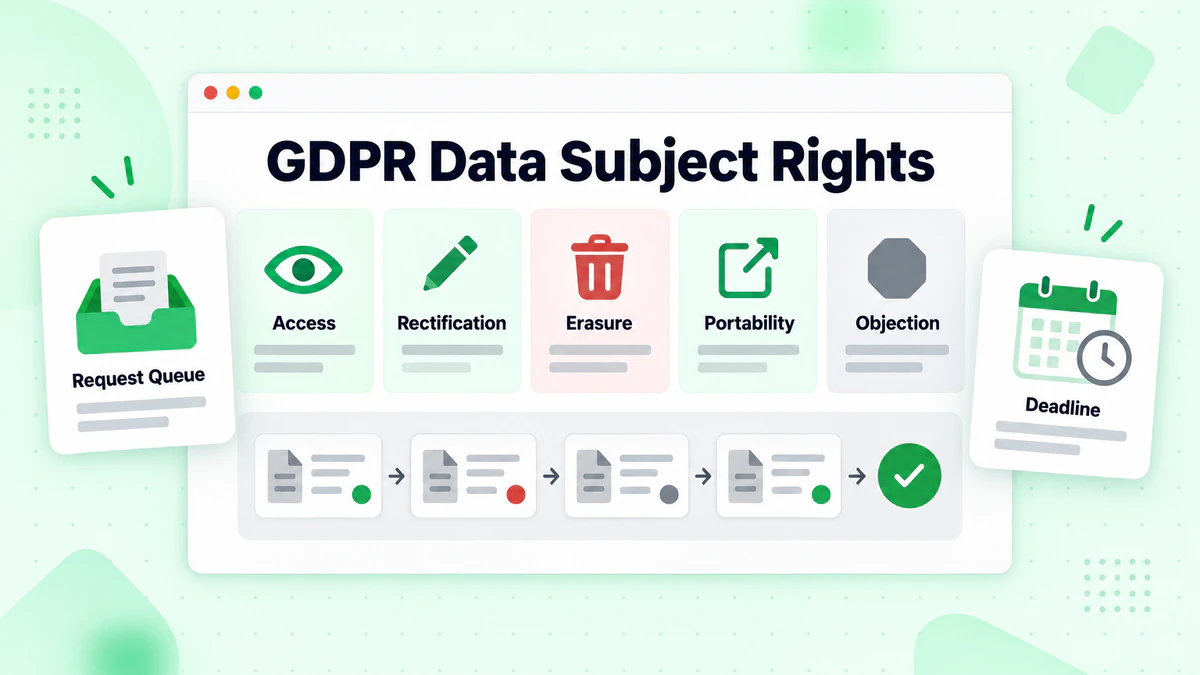
Right to Access (Article 15)
Subscribers can request copies of their data.
What You Must Provide:
- All data you hold about them
- Purposes of processing
- Categories of data
- Recipients or categories of recipients
- Retention periods
- Information about their rights
Response Requirements:
- Respond within one month (extendable to three months for complex requests)
- Provide data in commonly used electronic format
- Free of charge for reasonable requests
Right to Rectification (Article 16)
Subscribers can correct inaccurate data.
Implementation:
- Provide easy ways to update profile information
- Process corrections promptly
- Update across all systems
Right to Erasure (Article 17)
Also known as the "right to be forgotten."
When It Applies:
- Data no longer necessary for original purpose
- Consent withdrawn
- Individual objects and no overriding legitimate interest
- Unlawful processing
What to Delete:
- Email address from marketing lists
- Associated profile data
- Analytics tied to the individual
- Backup copies (within reasonable time)
What You May Keep:
- Records needed for legal compliance
- Suppression lists (to prevent re-adding)
- Anonymized analytics data
Right to Restrict Processing (Article 18)
Subscribers can request you limit how you use their data.
When It Applies:
- Accuracy contested (while you verify)
- Processing is unlawful but they prefer restriction to erasure
- You no longer need the data but they need it for legal claims
- They've objected to processing (pending verification)
Right to Data Portability (Article 20)
Subscribers can receive their data in a portable format.
Requirements:
- Provide in structured, commonly used format (CSV, JSON)
- Machine-readable
- Transmit directly to another controller if requested
Right to Object (Article 21)
Subscribers can object to processing based on legitimate interest.
For Marketing: No balancing test required. If someone objects to marketing, you must stop immediately.
Implementation:
- Easy unsubscribe in every email
- Clear objection process
- Immediate cessation of marketing
Email List Quality and GDPR Compliance
Maintaining a clean, verified email list supports GDPR compliance and improves marketing effectiveness. Understanding email deliverability fundamentals helps you build compliant programs.
Why List Quality Matters for Compliance
Invalid Emails Indicate Problems:
- Purchased or scraped lists (consent issues)
- Old data (accuracy requirement violations)
- Poor collection practices
High Bounce Rates Signal:
- Outdated consent records
- Potential data quality issues
- Need for re-verification
Email Verification and GDPR
Email verification helps ensure you're contacting valid addresses with proper consent.
Verification Benefits:
- Confirms addresses are real and deliverable
- Identifies disposable emails (potential fake signups)
- Catches typos that indicate rushed consent
- Removes addresses that may be spam traps
Using Verification Compliantly:
- Verify at point of collection (real-time API)
- Re-verify before campaigns using bulk verification
- Document verification as part of data quality processes
BillionVerify Integration: Use BillionVerify's email verification to maintain list quality:
- Real-time verification during signup
- Bulk verification for existing lists
- Catch-all detection
- Disposable email identification
List Cleaning Best Practices
Regular list hygiene supports both compliance and performance:
Regular Audits:
- Remove bounced addresses promptly
- Re-engage or remove inactive subscribers
- Verify consent records are complete
- Update outdated information
Re-Permission Campaigns: If consent records are unclear, run re-permission campaigns:
- Explain why you're reaching out
- Ask them to confirm continued interest
- Remove non-responders after reasonable time
- Document new consent for responders
Privacy Policy Requirements
Your privacy policy is a key GDPR compliance document. It must be clear, accessible, and comprehensive.
Required Privacy Policy Elements
Identity and Contact Details:
- Company name and address
- Data Protection Officer contact (if applicable)
- EU representative contact (if applicable)
Processing Details:
- What data you collect
- Purposes of processing
- Legal basis for each purpose
- Categories of recipients
- International transfer details
Individual Rights:
- How to exercise each right
- Right to lodge complaint with supervisory authority
- Right to withdraw consent
Data Retention:
- How long you keep data
- Criteria for determining retention periods
Automated Decision Making:
- Whether you use automated profiling
- Logic involved
- Significance and consequences
Privacy Policy Best Practices
Accessibility:
- Link from every signup form
- Link in email footers
- Clear, prominent placement on website
Readability:
- Use plain language
- Avoid excessive legal jargon
- Use headers and sections
- Consider layered approach (summary + details)
Currency:
- Review and update regularly
- Date stamp the policy
- Notify subscribers of material changes
International Data Transfers
If you process EU subscriber data outside the European Economic Area, additional requirements apply.
Adequate Countries
Some countries have been deemed to provide adequate protection:
- UK (post-Brexit)
- Canada (for commercial organizations)
- Japan
- South Korea
- Switzerland
- And others
Transfer to these countries doesn't require additional safeguards.
Standard Contractual Clauses (SCCs)
For transfers to non-adequate countries (including the US), use updated SCCs:
Requirements:
- Use current EU-approved clauses
- Conduct Transfer Impact Assessments
- Implement supplementary measures if needed
- Document your assessment
EU-US Data Privacy Framework
The new framework (adopted July 2023) allows transfers to certified US organizations:
Requirements:
- Recipient must be certified under the framework
- Check certification status regularly
- Update privacy policy to reflect framework
Practical Implementation Checklist
Use this checklist to assess and improve your GDPR email marketing compliance.
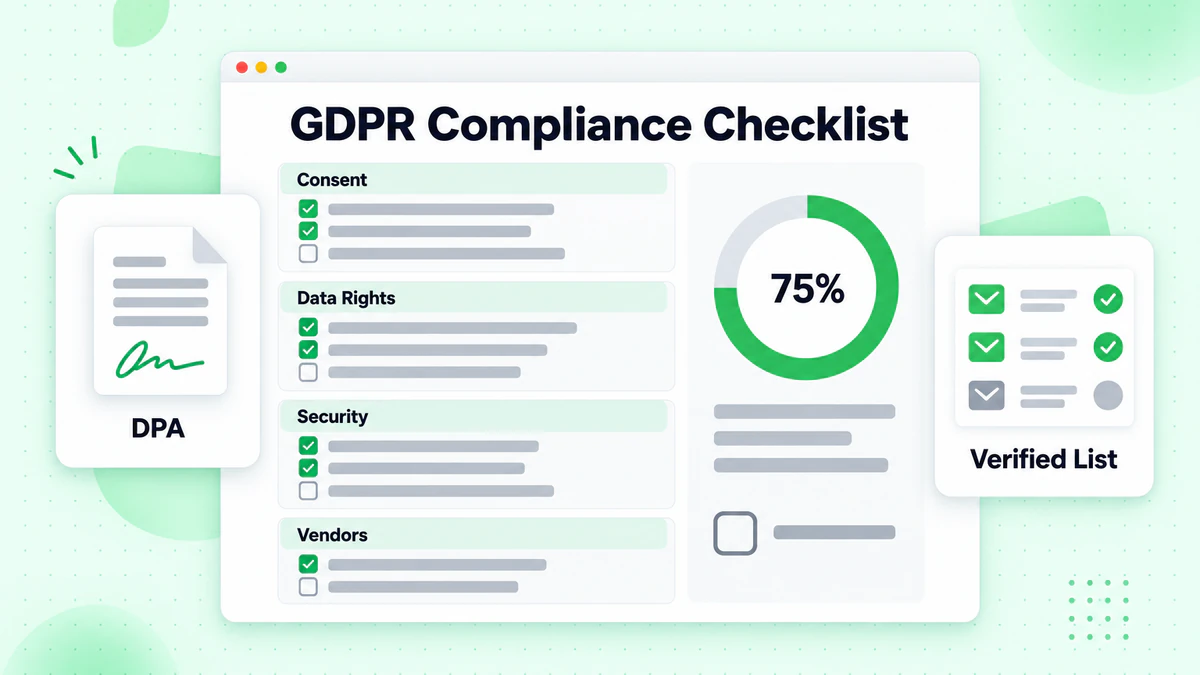
Consent and Collection
- [ ] All signup forms use unchecked consent boxes
- [ ] Consent language is clear and specific
- [ ] Purposes are explicitly stated
- [ ] Privacy policy is linked from all forms
- [ ] Consent is separate from terms/conditions
- [ ] Double opt-in is implemented
- [ ] Consent records include all required details
- [ ] Consent database is secure and backed up
Email Content and Sending
- [ ] Sender identity is clear and accurate
- [ ] Physical address included in footer
- [ ] Working unsubscribe link in every email
- [ ] Unsubscribe is processed promptly (within 48 hours)
- [ ] Preference center offers alternatives to full unsubscribe
- [ ] Email content matches consented purposes
Data Subject Rights
- [ ] Process exists for access requests
- [ ] Process exists for rectification requests
- [ ] Process exists for erasure requests
- [ ] Process exists for portability requests
- [ ] Response templates are prepared
- [ ] Staff are trained on handling requests
- [ ] Requests are tracked and documented
- [ ] 30-day response deadline is monitored
Data Quality and Security
- [ ] Email lists are regularly verified using email verification tools
- [ ] Invalid addresses are removed promptly
- [ ] Inactive subscribers are managed
- [ ] Data is stored securely
- [ ] Access is limited to authorized personnel
- [ ] Breach response plan is in place
Documentation and Governance
- [ ] Privacy policy covers all GDPR requirements
- [ ] Privacy policy is regularly reviewed
- [ ] Data processing records are maintained
- [ ] DPO is appointed (if required)
- [ ] Staff training is documented
- [ ] Legitimate Interest Assessments are documented (if applicable)
Common GDPR Email Marketing Mistakes
Learn from these frequent compliance failures.
Mistake 1: Pre-Checked Consent Boxes
The Problem: GDPR explicitly requires affirmative action. Pre-checked boxes don't qualify.
The Fix: Always start with unchecked boxes requiring active selection.
Mistake 2: Bundled Consent
The Problem: Combining email marketing consent with terms of service or purchase agreements.
The Fix: Separate consent for marketing, clearly labeled and optional.
Mistake 3: Vague Consent Language
The Problem: "We'll send you emails" doesn't specify what or how often.
The Fix: Be specific: "Weekly marketing tips and monthly product updates."
Mistake 4: Missing Consent Records
The Problem: Unable to demonstrate when or how consent was obtained.
The Fix: Log all consent details from day one. Retroactive documentation won't work.
Mistake 5: Ignoring Unsubscribes
The Problem: Continuing to email after opt-out requests.
The Fix: Immediate, automated unsubscribe processing. Test regularly.
Mistake 6: Purchased Lists
The Problem: Purchased lists almost never have valid GDPR consent for your marketing.
The Fix: Only email people who directly opted in to receive your communications. Build your list organically.
Mistake 7: Assuming B2B Is Exempt
The Problem: Believing GDPR doesn't apply to business email addresses.
The Fix: GDPR applies to all personal data, including business email addresses that identify individuals (john.smith@company.com).
Mistake 8: Not Verifying Email Addresses
The Problem: Sending to invalid addresses indicates poor data practices and damages deliverability.
The Fix: Use BillionVerify to verify addresses at collection and before campaigns.
GDPR and Email Marketing Technology
Choose and configure your tools to support compliance.
Email Service Provider (ESP) Selection
Look for ESPs with GDPR-compliant features:
Essential Features:
- Consent tracking and logging
- Easy unsubscribe management
- Data export functionality
- Data deletion capabilities
- Audit trails
Questions to Ask:
- Where is data stored? (EU vs. US)
- What security measures are in place?
- Will they sign a Data Processing Agreement?
- What happens if they're breached?
Data Processing Agreements
When using email marketing tools, you're typically a data controller and they're a data processor.
DPA Requirements:
- Signed agreement before processing begins
- Processor only acts on your instructions
- Appropriate security measures
- Assistance with data subject requests
- Notification of breaches
- Subprocessor transparency
Marketing Automation and GDPR
Automation features must respect consent:
Segmentation: Only use data for purposes covered by consent.
Personalization: Ensure data used for personalization was properly collected.
Trigger Campaigns: Verify consent covers automated sequences.
Lead Scoring: Document as part of legitimate interest or consent.
Preparing for Future Changes
GDPR isn't static, and related regulations continue to evolve.
ePrivacy Regulation
The upcoming ePrivacy Regulation will specifically address electronic communications, potentially affecting:
- Cookie consent requirements
- Email marketing rules
- Metadata protection
Monitor developments and prepare for potential changes.
AI and Email Marketing
As AI becomes more prevalent in email marketing, consider:
Automated Decision Making: GDPR restricts automated decisions with significant effects.
Profiling: Extensive profiling may require explicit consent.
Transparency: Subscribers have rights regarding AI-powered personalization.
Cross-Border Enforcement
Enforcement is becoming more coordinated:
- One-stop-shop mechanism for cross-border cases
- Increased cooperation between supervisory authorities
- More consistent penalty standards
Conclusion
GDPR compliance isn't a one-time project—it's an ongoing commitment to respecting subscriber privacy while building effective email marketing programs. The organizations that thrive under GDPR are those that see compliance as an opportunity to build trust rather than just a legal obligation.
Key Takeaways:
Consent is King: When in doubt, get explicit consent. It's the safest and most defensible approach.
Document Everything: Consent records, legitimate interest assessments, and data processing activities should all be thoroughly documented.
Honor Rights Promptly: Responding to data subject requests quickly demonstrates commitment to compliance.
Maintain List Quality: Regular email verification and list hygiene support both compliance and deliverability.
Stay Current: GDPR interpretation evolves through enforcement decisions. Monitor developments and adapt.
Build Trust: Transparent practices and respect for privacy build subscriber loyalty beyond mere compliance.
Remember: GDPR-compliant email marketing isn't about sending fewer emails—it's about sending better, more targeted emails to people who genuinely want to hear from you. This leads to higher engagement, better deliverability, and more sustainable marketing results.
For comprehensive guidance on all email regulations, see our complete email compliance guide. And ensure your email lists contain only valid, deliverable addresses by using BillionVerify's email verification service.