



What's a "good" cold email response rate? It's the question every sales professional, marketer, and founder asks when launching outreach campaigns. The answer isn't straightforward—response rates vary dramatically based on industry, targeting, personalization, and dozens of other factors.
This comprehensive guide breaks down everything you need to know about cold email response rates in 2025: current benchmarks, factors that influence responses, and actionable strategies to improve your numbers.
Understanding Cold Email Response Rates
Before diving into benchmarks, let's establish what we're actually measuring and why it matters.
What Counts as a "Response"?
Not all replies are created equal. When measuring response rates, you need to decide what counts:
Positive Responses:
- Interested in learning more
- Booking a meeting or call
- Requesting additional information
- Warm referral to the right person
Neutral Responses:
- "Not right now, check back later"
- Questions about your offering
- Requests to remove from list (but engaged enough to reply)
Negative Responses:
- "Not interested"
- Complaints or hostile replies
- Unsubscribe requests
Most meaningful metric: Positive response rate—the percentage of emails that generate genuine interest or meetings.
Response Rate vs. Reply Rate
These terms are often used interchangeably, but there's a distinction:
- Reply Rate: Any response, including "please remove me"
- Response Rate: Often used to mean the same, but sometimes filtered to meaningful replies
- Positive Response Rate: Only interested/engaged replies
- Meeting Book Rate: Replies that convert to scheduled meetings
For benchmarking purposes, this guide uses "response rate" to mean any reply, and specifies "positive response rate" when discussing interested replies only.
Why Response Rates Matter
Response rates are the critical bridge between email deliverability and revenue:
Pipeline Impact:
- A 1% improvement in response rate can mean 10-20% more pipeline
- Compounding effect across large campaigns
- Direct correlation to revenue metrics
Campaign Health Indicator:
- Low response rates signal messaging or targeting problems
- Declining rates indicate market saturation or deliverability issues
- High rates validate product-market fit and messaging
Resource Efficiency:
- Higher response rates mean lower cost-per-meeting
- Better allocation of sales team time
- Improved ROI on outreach tools and data
2025 Cold Email Response Rate Benchmarks
Based on aggregated data from major cold email platforms and industry surveys, here are the current benchmarks.
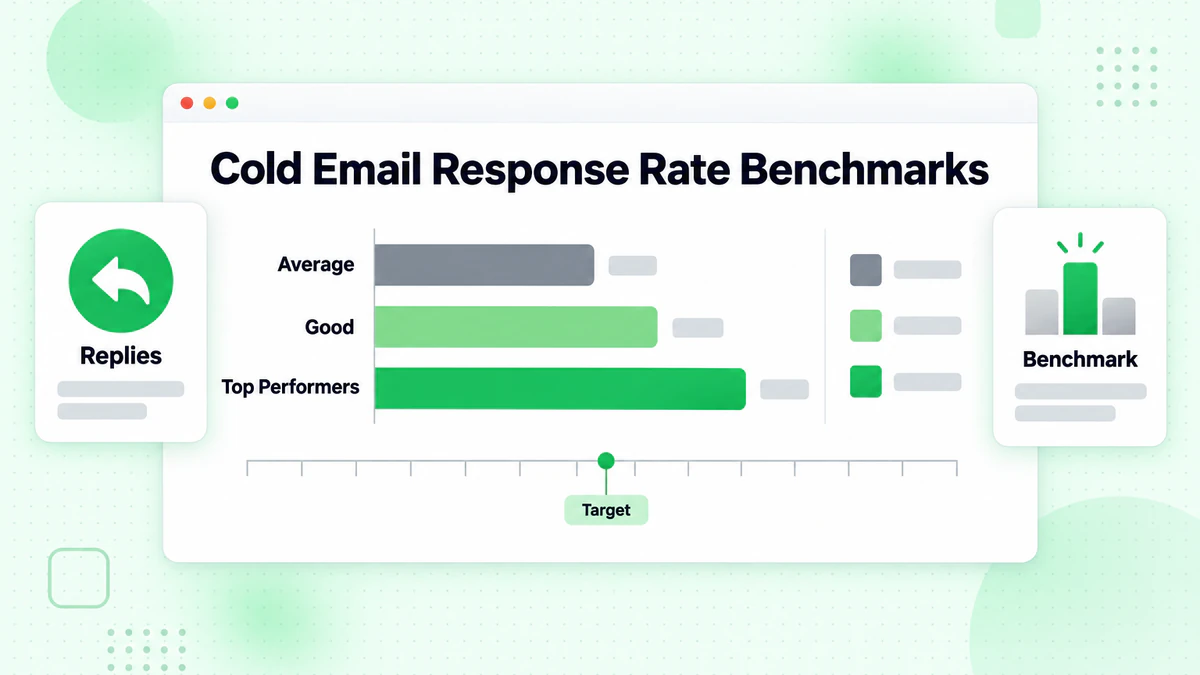
Overall Cold Email Benchmarks
| Metric | Poor | Average | Good | Excellent |
|---|---|---|---|---|
| Open Rate | <25% | 25-45% | 45-60% | >60% |
| Reply Rate (Any) | <1% | 1-3% | 3-8% | >8% |
| Positive Reply Rate | <0.5% | 0.5-2% | 2-5% | >5% |
| Meeting Book Rate | <0.2% | 0.2-1% | 1-3% | >3% |
Key Insight: The difference between "average" and "excellent" is often 4-8x. Small improvements create outsized results.
Response Rates by Industry
Different industries show dramatically different response patterns:
| Industry | Average Reply Rate | Top Performer Rate | Typical Meeting Rate |
|---|---|---|---|
| Technology/SaaS | 2.5-4% | 8-12% | 1-2% |
| Professional Services | 3-5% | 10-15% | 1.5-3% |
| Financial Services | 1.5-3% | 6-10% | 0.5-1.5% |
| Healthcare | 1-2% | 5-8% | 0.3-1% |
| Manufacturing | 2-3% | 7-10% | 1-2% |
| Real Estate | 3-5% | 10-14% | 2-4% |
| Education | 2-4% | 8-12% | 1-2% |
| Non-Profit | 4-6% | 12-18% | 2-4% |
| Retail/E-commerce | 1.5-2.5% | 5-8% | 0.5-1% |
| Legal | 2-3% | 6-9% | 1-2% |
Why the variation?
- Technology: Decision-makers receive high email volume, but are used to evaluating solutions
- Professional Services: Relationship-driven, respond well to peer-level outreach
- Healthcare: Heavily regulated, busy practitioners, strict inbox filters
- Non-Profit: Mission-aligned outreach performs well, smaller organizations more accessible
Response Rates by Company Size
Target company size significantly impacts response rates:
| Company Size | Average Reply Rate | Notes |
|---|---|---|
| SMB (1-50 employees) | 4-7% | Decision-makers accessible, faster decisions |
| Mid-Market (51-500) | 2-4% | More stakeholders, but still responsive |
| Enterprise (501-5000) | 1-2.5% | Gatekeepers, formal processes |
| Fortune 500 | 0.5-1.5% | High volume of inbound, strict filters |
Strategic Implication: Adjust expectations and volume based on target company size. Enterprise campaigns need 3-5x more prospects to generate equal meetings.
Response Rates by Role/Title
Who you're targeting matters as much as what you're selling:
| Target Role | Average Reply Rate | Best Approach |
|---|---|---|
| C-Suite (CEO, CFO, CTO) | 1-2% | Ultra-personalized, executive tone |
| VP Level | 2-3% | Value-focused, ROI-driven |
| Directors | 3-5% | Solution-oriented, case studies |
| Managers | 4-6% | Problem-specific, practical value |
| Individual Contributors | 5-8% | Tool-focused, efficiency gains |
| Founders/Owners | 4-7% | Direct, entrepreneurial tone |
Key Insight: Higher titles don't always mean lower response rates. Founders of SMBs often respond at higher rates than middle managers at enterprises.
Response Rates by Geographic Region
Location influences email engagement patterns:
| Region | Average Reply Rate | Best Send Times (Local) |
|---|---|---|
| North America | 2-4% | 9-11 AM, Tuesday-Thursday |
| Western Europe | 2-3% | 10 AM-12 PM, Tuesday-Wednesday |
| UK & Ireland | 2.5-4% | 9-10 AM, Tuesday-Thursday |
| Australia/NZ | 3-5% | 10-11 AM, Tuesday-Wednesday |
| DACH (Germany, Austria, Swiss) | 1.5-2.5% | Formal tone required |
| Nordics | 2-3% | Direct communication valued |
| Asia-Pacific | 1-2% | Relationship-building important |
Response Rates by Email Position in Sequence
Response rates vary significantly based on where an email falls in your sequence:
| Email Position | Open Rate | Reply Rate | Cumulative Reply |
|---|---|---|---|
| Email 1 | 40-55% | 2-4% | 2-4% |
| Email 2 | 35-50% | 3-5% | 5-8% |
| Email 3 | 30-45% | 2-4% | 7-11% |
| Email 4 | 25-40% | 2-3% | 9-13% |
| Email 5 | 20-35% | 1.5-3% | 10-15% |
| Email 6 (Breakup) | 20-30% | 2-4% | 12-18% |
Important Finding: The "breakup email" often shows a response rate bump. Closing the loop professionally triggers responses from prospects who intended to reply but hadn't.
For detailed follow-up strategies, see our cold email follow-up guide.
Factors That Impact Response Rates
Understanding what drives responses helps you optimize systematically.
High-Impact Factors (3-5x Difference)
These elements can dramatically swing your response rates:
1. List Quality and Targeting
The single biggest factor. Wrong people = no responses.
- Ideal Customer Profile (ICP) match: 3-5x higher responses
- Recent trigger events: 2-3x higher responses
- Verified email addresses: Essential for deliverability
Always verify your email list before launching campaigns. Invalid emails damage deliverability and waste resources.
2. Personalization Depth
Generic templates vs. researched personalization:
| Personalization Level | Typical Response Rate |
|---|---|
| No personalization | 0.5-1% |
| Name + Company only | 1-2% |
| Role-based customization | 2-4% |
| Research-based (recent news, posts) | 4-8% |
| Hyper-personalized (video, detailed research) | 8-15% |
For personalization strategies, see our cold email personalization guide.
3. Subject Line Effectiveness
Your subject line determines whether emails get opened:
| Subject Line Type | Open Rate Impact |
|---|---|
| Generic/Salesy | -30-50% |
| Curiosity-based | +10-20% |
| Personalized | +20-40% |
| Question format | +15-25% |
| Re:/Fwd: (when genuine) | +40-60% |
Master subject lines with our cold email subject line guide.
4. Timing and Send Day
When you send significantly impacts engagement:
| Day | Open Rate | Response Rate |
|---|---|---|
| Monday | Medium | Low (inbox clearing) |
| Tuesday | High | High |
| Wednesday | High | Highest |
| Thursday | High | High |
| Friday | Medium | Low (weekend mode) |
| Weekend | Low | Very Low |
Best times: 9-11 AM and 2-4 PM in recipient's local timezone.
Medium-Impact Factors (1.5-2x Difference)
5. Email Length
Shorter usually performs better for cold outreach:
| Email Length | Response Rate Trend |
|---|---|
| <50 words | Good for follow-ups, may lack context |
| 50-125 words | Optimal for most cold emails |
| 125-200 words | Acceptable if value-dense |
| >200 words | Response rate drops significantly |
6. Call-to-Action Clarity
Single, clear CTAs outperform multiple asks:
| CTA Type | Response Rate |
|---|---|
| No clear CTA | Very Low |
| Multiple CTAs | Low |
| Soft CTA ("thoughts?") | Medium |
| Specific low-friction CTA | High |
| Calendar link | Highest (for interested prospects) |
7. Social Proof Inclusion
Credibility markers improve trust and response:
- Recognized customer logos: +20-30% response lift
- Specific metrics/results: +15-25% response lift
- Mutual connections mentioned: +30-50% response lift
Lower-Impact Factors (Still Matter)
8. Sender Name and Email
- Personal name outperforms company name
- First name only can work for casual industries
- Custom domain essential (no @gmail.com)
9. Mobile Optimization
- 60%+ of emails opened on mobile
- Short paragraphs, scannable format
- Links must be tappable
10. Email Signature
- Photo increases trust
- Clear title and company
- LinkedIn link for credibility
- Avoid too many links/images (spam triggers)
How to Calculate and Track Response Rates
Accurate measurement drives improvement.
Basic Response Rate Formula
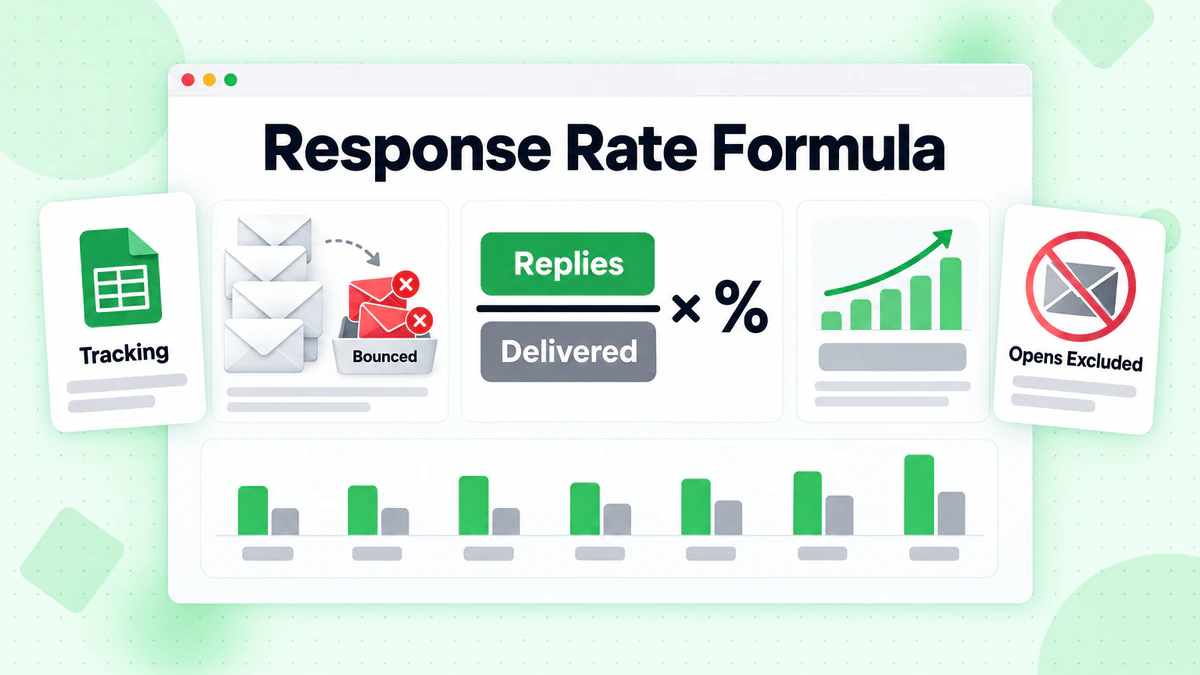
Response Rate = (Number of Replies / Number of Emails Delivered) × 100
Important: Use "delivered" not "sent." Bounced emails shouldn't be in your denominator.
Advanced Metrics Framework
Funnel Metrics:
Sent → Delivered → Opened → Replied → Positive Reply → Meeting → Opportunity
Calculate each step:
- Delivery Rate = Delivered / Sent
- Open Rate = Opened / Delivered
- Reply Rate = Replies / Delivered
- Positive Reply Rate = Positive Replies / Delivered
- Meeting Rate = Meetings / Delivered
- Opportunity Rate = Opportunities / Delivered
Setting Up Proper Tracking
Essential Tracking Elements:
- Email Platform Analytics: Open rates, click rates, reply detection
- CRM Integration: Link replies to opportunities
- UTM Parameters: Track website visits from emails
- Calendar Integration: Attribute meetings to campaigns
Recommended Tools:
- Instantly, Smartlead, or Reply.io for email metrics
- HubSpot, Salesforce, or Pipedrive for pipeline tracking
- Mixpanel or Amplitude for product engagement
Segmented Analysis
Don't just track overall rates. Segment by:
- Campaign/Sequence: Which messaging works?
- ICP Segment: Which persona responds best?
- Lead Source: Where do best responders come from?
- Time Period: Are rates improving or declining?
- Sales Rep: Who's getting better results?
Strategies to Improve Cold Email Response Rates
Now for the actionable part—how to systematically improve your numbers.
Strategy 1: Improve List Quality
Poor targeting is the #1 reason for low response rates.
Action Steps:
Define ICP Precisely
- Company size, industry, geography
- Technology stack (if relevant)
- Growth signals (hiring, funding, expansion)
- Pain points that match your solution
Add Trigger-Based Filters
- Recent funding rounds
- Leadership changes
- Job postings indicating need
- Technology adoption signals
Verify Every Email
- Remove invalid addresses before sending
- Use BillionVerify for real-time verification
- Re-verify lists older than 30 days
Score and Prioritize
- Rank prospects by fit score
- Focus personalization on top tiers
- Volume approach for lower tiers
Strategy 2: Level Up Personalization
Move beyond "Hi {FirstName}" to genuine relevance.
Personalization Framework:
Level 1 - Basic (1-2% response):
- First name, company name
- Industry-specific pain point
Level 2 - Role-Based (2-4% response):
- Title-specific challenges
- Department-relevant value prop
- Role-appropriate tone
Level 3 - Research-Based (4-8% response):
- Recent company news reference
- LinkedIn post or activity mention
- Mutual connection reference
- Specific technology they use
Level 4 - Hyper-Personal (8-15% response):
- Custom video mentioning their name
- Detailed analysis of their situation
- Reference to specific challenge they've discussed publicly
Scaling Personalization with AI:
Modern AI tools enable Level 3 personalization at scale:
- Clay for data enrichment
- Lavender for email optimization
- Instantly or Smartlead for AI-powered sequencing
See our cold email tools guide for detailed tool comparisons.
Strategy 3: Optimize Subject Lines
Your subject line is 80% of whether the email gets opened.
High-Performing Patterns:
Question Format
- "Quick question about [Company]'s [relevant area]?"
- "[First Name], struggling with [pain point]?"
Curiosity Gap
- "Idea for [Company]"
- "Noticed something about [relevant topic]"
Relevance Signal
- "[Mutual Connection] suggested I reach out"
- "Saw your post about [topic]"
Value Preview
- "How [Similar Company] increased [metric] by X%"
- "[Specific insight] for [Company]"
What to Avoid:
- ALL CAPS or excessive punctuation!!!
- Salesy language ("Limited time," "Act now")
- Misleading Re: or Fwd:
- Too long (keep under 50 characters)
Strategy 4: Perfect Your Opening Line
The first line determines whether they keep reading.
Effective Opening Patterns:
✅ Good Openings:
- "Noticed [Company] just [recent event]—congrats!"
- "Your post about [topic] resonated, especially [specific point]."
- "[Mutual connection] mentioned you're working on [challenge]."
- "Quick question: How is [Company] handling [relevant challenge]?"
❌ Avoid These:
- "I hope this email finds you well."
- "My name is [Name] and I work at [Company]."
- "I wanted to reach out because..."
- "I'm sure you're busy, but..."
Strategy 5: Nail the Value Proposition
Make the "what's in it for them" crystal clear.
Value Prop Framework:
[Similar Company/Persona] was struggling with [Pain Point].
After [Your Solution/Approach], they achieved [Specific Result].

Given [Company]'s [Situation/Challenge], thought this might be relevant.
Key Elements:
- Specific, not generic
- Quantified results when possible
- Relevant to their specific situation
- Believable, not exaggerated
Strategy 6: Optimize Send Timing
Timing can swing response rates 20-40%.
Data-Backed Timing:
Best Days: Tuesday, Wednesday, Thursday Best Times:
- 9:00-11:00 AM (morning productivity)
- 2:00-4:00 PM (post-lunch engagement)
Time Zone Considerations:
- Send in recipient's local time
- Use tools that auto-adjust per recipient
- Consider industry patterns (finance: earlier; creative: later)
Sequence Timing:
- Email 1 to 2: 2-3 days
- Email 2 to 3: 3-4 days
- Email 3 to 4: 5-7 days
- Email 4 to 5: 7-10 days
- Email 5 to 6: 10-14 days
Strategy 7: A/B Test Systematically
Continuous testing drives continuous improvement.
What to Test (in Priority Order):
- Subject Lines - Highest impact, easiest to test
- Opening Lines - Strong impact on read-through
- Value Propositions - Test different angles
- CTAs - Soft vs. direct asks
- Email Length - Shorter vs. longer
- Send Times - Morning vs. afternoon
Testing Framework:
- Test one variable at a time
- Minimum 100 emails per variant
- Statistical significance before declaring winner
- Document learnings in a swipe file
Strategy 8: Protect Deliverability
Emails can't get responses if they land in spam.
Deliverability Essentials:
Warm Up New Domains/Accounts
- Gradual send volume increase
- Use warmup tools (Instantly, Warmbox)
- 2-4 weeks before full campaigns
Verify Every Email
- Invalid emails damage sender reputation
- Use email verification before every campaign
- Remove risky addresses proactively
Monitor Key Metrics
- Bounce rate <2%
- Spam complaint rate <0.1%
- Open rates stable or improving
Technical Setup
For comprehensive deliverability guidance, see our cold email deliverability guide.
Strategy 9: Multi-Touch, Multi-Channel
Email alone has limits. Add other channels:
Multi-Channel Sequence Example:
- Day 0: Email 1
- Day 2: LinkedIn connection request
- Day 3: Email 2
- Day 5: LinkedIn message (no pitch)
- Day 7: Email 3
- Day 10: LinkedIn engagement (comment on their content)
- Day 14: Email 4 + phone call attempt
Channel Effectiveness:
- Email + LinkedIn: 2-3x response rate vs. email alone
- Email + Phone: Higher meeting rates, lower scale
- Email + Video: Higher engagement, production overhead
Strategy 10: Analyze and Iterate
Top performers constantly analyze and improve.
Weekly Review Checklist:
- [ ] Open rates by campaign/segment
- [ ] Reply rates by email position
- [ ] Positive vs. negative reply ratio
- [ ] Meeting conversion rates
- [ ] Deliverability metrics (bounces, spam)
Monthly Optimization:
- Retire underperforming sequences
- Promote winning variants
- Refresh stale messaging
- Update ICP based on response patterns
Quarterly Strategy:
- Full funnel audit
- Competitive messaging analysis
- ICP validation and refinement
- Tool stack evaluation
Common Response Rate Problems and Solutions
Problem: High Opens, Low Replies
Diagnosis: Email is getting attention but not compelling action.
Solutions:
- Strengthen value proposition
- Clarify CTA—make it specific and low-friction
- Reduce email length
- Add social proof
- Test different angles/pain points
Problem: Low Opens
Diagnosis: Subject line or deliverability issue.
Solutions:
- Test new subject lines
- Check spam folder placement
- Verify sender reputation
- Review deliverability setup
- Ensure proper warmup
Problem: High Negative Replies
Diagnosis: Targeting or messaging mismatch.
Solutions:
- Refine ICP and targeting criteria
- Soften messaging tone
- Reduce send frequency
- Improve relevance signals
- Check for over-automation signals
Problem: Declining Response Rates Over Time
Diagnosis: Market saturation, deliverability degradation, or message fatigue.
Solutions:
- Expand to new segments
- Audit deliverability metrics
- Refresh all messaging
- Test entirely new approaches
- Review sending patterns
Problem: Great Responses, No Meetings
Diagnosis: Qualification or conversion issue.
Solutions:
- Improve qualification in targeting
- Streamline meeting booking process
- Add calendar link to emails
- Follow up on positive replies faster
- Train on response handling
Industry-Specific Response Rate Optimization
Technology/SaaS
Typical Rate: 2.5-4% average, 8-12% top performers
What Works:
- Technical credibility signals
- Integration/compatibility mentions
- Quick demos over lengthy explanations
- Peer company references
- Developer/user community proof
What Doesn't Work:
- Generic "increase productivity" claims
- Overly formal tone
- Excessive marketing speak
Professional Services
Typical Rate: 3-5% average, 10-15% top performers
What Works:
- Peer-to-peer positioning
- Thought leadership content
- Relationship-building approach
- Industry expertise signals
- Specific methodology references
What Doesn't Work:
- Hard selling
- Transactional tone
- Generic capability statements
Financial Services
Typical Rate: 1.5-3% average, 6-10% top performers
What Works:
- Compliance and security emphasis
- ROI and risk quantification
- Executive references
- Regulatory expertise signals
- Conservative, professional tone
What Doesn't Work:
- Casual language
- Unsubstantiated claims
- Aggressive follow-up
Healthcare
Typical Rate: 1-2% average, 5-8% top performers
What Works:
- Patient outcome focus
- HIPAA compliance emphasis
- Clinical evidence and studies
- Peer institution references
- Respect for time constraints
What Doesn't Work:
- Sales-focused language
- Unsupported claims
- Ignoring compliance requirements
Response Rate Benchmarks by Campaign Type
Different campaign objectives yield different rates:
| Campaign Type | Typical Reply Rate | Notes |
|---|---|---|
| Cold outreach (New Logo) | 2-4% | Standard prospecting |
| Event Follow-Up | 10-20% | Warm, time-bound |
| Content Download Follow-Up | 8-15% | Expressed interest |
| Referral Introduction | 15-25% | Trust transfer |
| Customer Expansion | 10-18% | Existing relationship |
| Win-Back (Former Customers) | 8-12% | History exists |
| Partnership Outreach | 3-6% | Mutual benefit positioning |
| Investor Outreach | 1-3% | High volume recipients |
Building a Response Rate Dashboard
Track these metrics in real-time:
Essential Metrics
Volume Metrics:
- Emails sent per day/week
- Emails delivered
- Active sequences
Engagement Metrics:
- Open rate (overall and by email)
- Reply rate (overall and by email)
- Click rate (if applicable)
Outcome Metrics:
- Positive reply rate
- Meeting book rate
- Opportunity created rate
Health Metrics:
- Bounce rate
- Spam complaint rate
- Unsubscribe rate
Dashboard Views
Campaign View: Performance by individual campaign Sequence View: Performance by email position Segment View: Performance by ICP segment Time View: Trends over time Rep View: Performance by team member
Conclusion: The Path to Higher Response Rates
Cold email response rates aren't fixed—they're the result of systematic optimization across targeting, messaging, timing, and deliverability. The difference between 1% and 5% response rates comes down to disciplined execution of proven strategies.
Key Takeaways:
- Benchmarks are guides, not limits: Top performers consistently beat "average" rates by 3-5x
- List quality trumps everything: Right people, right time, verified emails
- Personalization scales with AI: Use modern tools to personalize at volume
- Subject lines matter most: Invest disproportionate effort here
- Deliverability is foundational: Verify emails before every campaign
- Measure to improve: Track segmented metrics, not just overall rates
- Test continuously: Small improvements compound over time
Your Action Plan:
- Audit current response rates by segment
- Identify your biggest gap (targeting, messaging, deliverability?)
- Implement one strategy from this guide
- Measure impact for 2-4 weeks
- Iterate and expand to next strategy
Start with the fundamentals: Before optimizing messaging, ensure your emails reach the inbox. Verify your email list with BillionVerify to protect deliverability and maximize every campaign's potential.
The teams achieving 8%+ response rates aren't using magic—they're executing the fundamentals consistently while continuously testing and improving. Your response rates can get there too.