



An email marketing funnel transforms casual subscribers into loyal customers through strategic, automated communication sequences. Instead of hoping subscribers eventually buy, a well-designed funnel guides them through a deliberate journey from awareness to purchase and beyond. This comprehensive guide shows you how to build email funnels that consistently convert.
Understanding Email Marketing Funnels
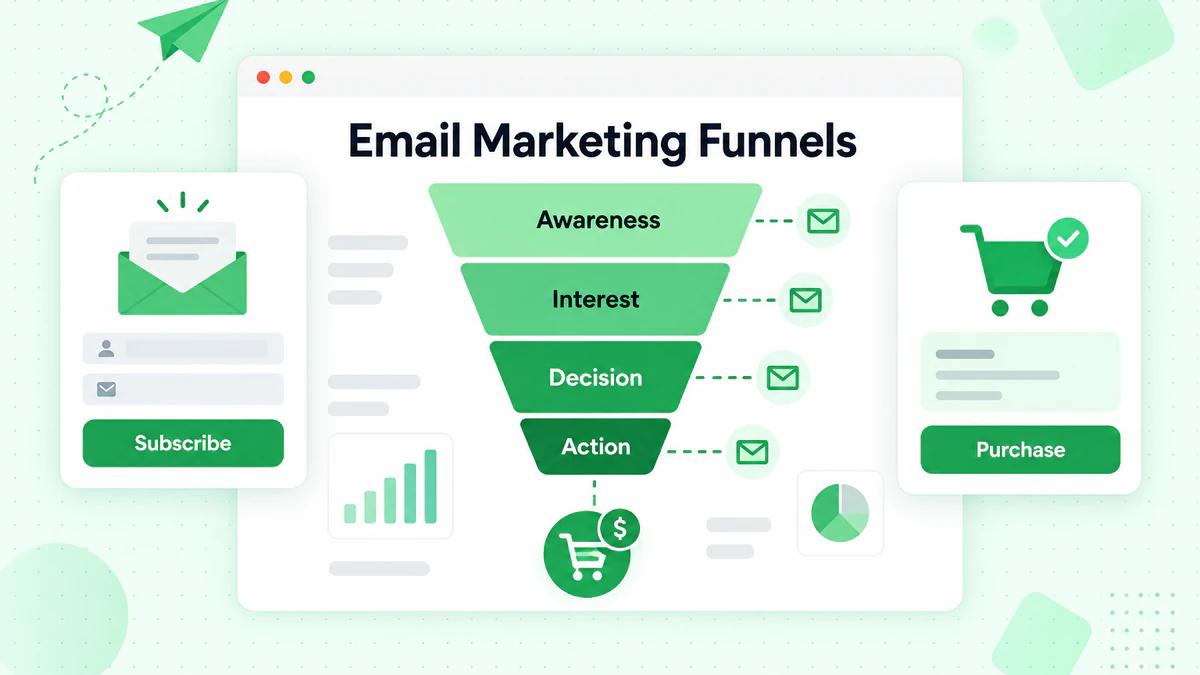
An email marketing funnel is a series of automated emails designed to move subscribers toward a specific goal, typically a purchase or conversion. Each email in the sequence serves a strategic purpose, building on previous messages to progressively warm up prospects.
Why Funnels Outperform Random Campaigns
Traditional email marketing often feels random—a newsletter here, a promotion there, with no clear connection between messages. Funnels provide structure and purpose.
Random Campaigns:
- Hope subscribers happen to be ready when you promote
- Same message to everyone regardless of relationship
- No systematic relationship building
- Inconsistent results
Strategic Funnels:
- Meet subscribers where they are in their journey
- Progressive messaging that builds toward conversion
- Deliberate trust and authority building
- Predictable, repeatable results
The Core Funnel Stages
Every email funnel follows a similar progression, even if the specific emails differ.
Stage 1: Awareness Subscribers just discovered you. They're curious but skeptical. Your goal is to deliver on your signup promise and make a strong first impression.
Stage 2: Interest Subscribers are paying attention. They open your emails and click occasionally. Your goal is to provide value that positions you as the go-to solution for their problem.
Stage 3: Consideration Subscribers are evaluating whether to buy. They're comparing options and looking for reasons to choose you. Your goal is to address objections and demonstrate your unique value.
Stage 4: Conversion Subscribers are ready to buy. They need a compelling reason to act now. Your goal is to make the purchase decision easy and urgent.
Stage 5: Retention Customers have purchased. Your goal shifts to delivering value, encouraging repeat purchases, and creating advocates.
Mapping Your Email Funnel
Before writing a single email, map out your funnel strategy.
Step 1: Define Your Goal
Every funnel needs a clear end goal. Without one, you can't design an effective path.
Common Funnel Goals:
- Purchase a specific product
- Sign up for a paid subscription
- Book a consultation or demo
- Upgrade from free to paid
- Complete an onboarding process
Be Specific: "Increase sales" is too vague. "Convert free trial users to annual subscribers" gives you a clear target.
Step 2: Understand Your Audience
Effective funnels speak directly to subscriber needs and concerns.
Questions to Answer:
- What problem brought them to you?
- What are their biggest objections to purchasing?
- What information do they need before deciding?
- What competing solutions are they considering?
- What triggers would prompt action?
Research Methods:
- Survey new subscribers
- Analyze customer support conversations
- Review sales call recordings
- Study competitor messaging
- Interview recent customers
Step 3: Map the Customer Journey
Plot the path from subscriber to customer, identifying what needs to happen at each stage.
Journey Mapping Template:
| Stage | Subscriber Mindset | What They Need | Email Purpose |
|---|---|---|---|
| Awareness | Curious, skeptical | Proof you're legitimate | Deliver lead magnet, introduce yourself |
| Interest | Engaged, learning | Valuable content | Educate, demonstrate expertise |
| Consideration | Evaluating options | Social proof, details | Case studies, objection handling |
| Conversion | Ready to decide | Reason to act now | Compelling offer, urgency |
Step 4: Determine Funnel Length
Funnel length depends on your product complexity and price point.
Short Funnels (3-5 emails):
- Low-price products
- Impulse purchases
- Simple decisions
- Warm traffic from referrals
Medium Funnels (7-10 emails):
- Medium-price products
- Considered purchases
- Some education required
- Mixed traffic sources
Long Funnels (12+ emails):
- High-price products
- Complex decisions
- Significant trust required
- Cold traffic
The Essential Funnel Emails
While every business needs customization, certain emails appear in virtually every high-converting funnel.
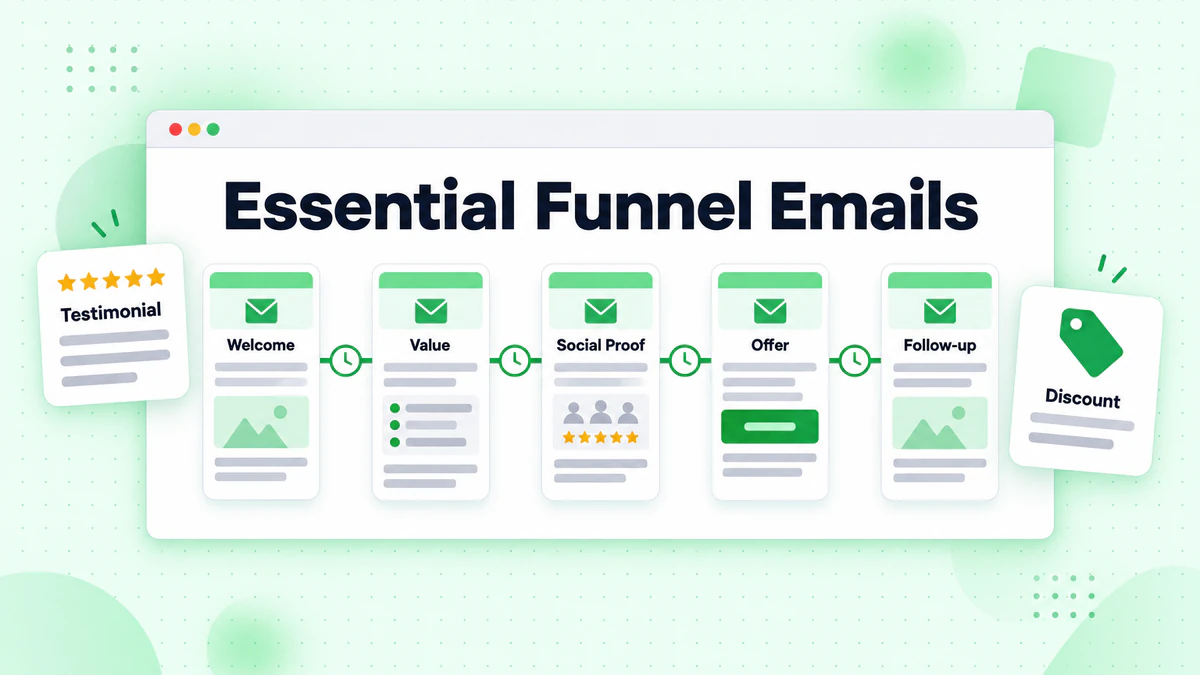
Welcome Email (Email 1)
The welcome email sets the tone for your entire relationship. It's your highest-open-rate email—make it count.
Welcome Email Elements:
Immediate Delivery: If you promised a lead magnet, deliver it first. Don't make subscribers hunt.
Gratitude: Thank them for subscribing. A simple acknowledgment builds goodwill.
Expectation Setting: Tell them what's coming. "Over the next week, I'll share..." prepares them to look for your emails.
Quick Win: Provide one immediately actionable tip. Give value before asking for anything.
Personal Touch: Write like a person, not a corporation. Share something about yourself or your mission.
Example Structure:
Subject: Your [Lead Magnet] is inside (+ a quick tip)

Hey [Name],

Thank you for joining [Company]! Your [lead magnet] is attached/linked below.

Before you dive in, here's a quick tip that most people miss...

[Actionable insight]

Over the next few days, I'll share [what's coming]. Keep an eye out—these are the strategies that [benefit].

Talk soon,
[Name]

P.S. Reply and tell me your biggest challenge with [topic]. I read every response.
Value Email Series (Emails 2-4)
The next several emails build trust through pure value delivery. No selling yet—just helping.
Value Email Principles:
Teach Something Useful: Share insights they can apply immediately, regardless of whether they buy.
Tell Stories: Case studies and examples make concepts concrete and memorable.
Build Authority: Demonstrate expertise through depth and unique perspectives.
Create Anticipation: Reference what's coming to keep them engaged.
Value Email Types:
The How-To Email: Walk through a specific process step by step.
The Mistake Email: Reveal common mistakes and how to avoid them.
The Myth-Buster Email: Challenge conventional wisdom with better approaches.
The Case Study Email: Share a success story with specific results.
The Framework Email: Introduce a mental model for thinking about the problem.
Transition Email (Email 5)
The transition email bridges from pure value to your offer. It connects the problem you've been discussing to your solution.
Transition Email Structure:
Acknowledge Progress: Recognize what they've learned from your previous emails.
Identify the Gap: Point out what's still missing or difficult about DIY approaches.
Introduce Your Solution: Position your product as the bridge from where they are to where they want to be.
Tease Details: Build curiosity about your offer without full pitch.
Example Opening:
Over the past few days, you've learned:
- [Insight from email 2]
- [Insight from email 3]
- [Insight from email 4]

But here's what most people discover when they try to implement this...

[Challenge or limitation of DIY approach]

That's exactly why I created [Product]...
Sales Emails (Emails 6-8)
Now you earn the right to sell. These emails present your offer compellingly.
Sales Email 1: The Reveal
Purpose: Present your offer in detail.
Elements:
- What the product is
- Who it's for (and not for)
- Key features and benefits
- How it works
- Pricing information
- Clear call-to-action
Sales Email 2: Social Proof
Purpose: Reduce risk through evidence.
Elements:
- Customer testimonials
- Case study results
- Notable clients or numbers
- Reviews and ratings
- Before/after examples
Sales Email 3: Objection Handling
Purpose: Address reasons people hesitate.
Common Objections to Address:
- "Is this right for me?"
- "What if it doesn't work?"
- "I don't have time."
- "It's too expensive."
- "I can figure this out myself."
Urgency Email (Email 9)
Create genuine reasons to act now rather than later.
Legitimate Urgency Elements:
- Limited-time pricing
- Bonus availability
- Enrollment deadline
- Limited spots or inventory
- Price increase announcement
Urgency Email Tips:
- Be truthful—fake scarcity destroys trust
- Remind them of the transformation awaiting
- Acknowledge their hesitation is normal
- Make the risk of inaction clear
Last Chance Email (Email 10)
The final push before the opportunity closes.
Last Chance Email Elements:
- Clear deadline reminder
- Summary of what they get
- What they'll miss by waiting
- Final testimonial or proof point
- Simple, direct CTA
Subject Line Examples:
- "[Hours] left to join"
- "Closing tonight at midnight"
- "Final reminder: [Offer] ends today"
Advanced Funnel Strategies
Once your basic funnel works, implement these advanced techniques.
Behavior-Based Branching
Not all subscribers should receive the same sequence. Branch your funnel based on behavior.
Branching Triggers:
Click Behavior: If they click on a specific topic, send more content on that topic.
Email Opens: Non-openers might need a subject line re-send; openers move forward.
Website Activity: Visited pricing page? Skip ahead to sales content.
Previous Purchases: Customers get different messaging than prospects.
Implementation Example:
Email 3: "What's your biggest challenge?"
   └── Clicks "Time Management" → Time-focused case study
   └── Clicks "Budget Constraints" → ROI-focused content
   └── Clicks "Team Adoption" → Implementation success stories
Re-engagement Loops
Some subscribers go cold during the funnel. Build in re-engagement sequences.
When to Trigger Re-engagement:
- No opens for 3-5 emails
- No clicks despite opens
- Abandoned mid-funnel
Re-engagement Sequence:
- Check-in email: "Still interested in [topic]?"
- Value refresh: Share your best content again
- Direct ask: "Should I stop emailing you about [topic]?"
Post-Purchase Funnels
The funnel doesn't end at purchase. Continue the journey.
Immediate Post-Purchase:
- Order confirmation
- Access instructions
- Quick start guide
- Welcome to customer community
Onboarding Sequence:
- Day 1: First steps to success
- Day 3: Check-in and tips
- Day 7: Success milestone celebration
- Day 14: Advanced features introduction
Retention Sequence:
- Usage tips and best practices
- Feature announcements
- Upgrade opportunities
- Referral requests
Funnel Optimization
Building a funnel is just the beginning. Optimization multiplies its effectiveness.
Key Metrics to Track
Funnel-Level Metrics:
- Overall conversion rate (subscribers to customers)
- Revenue per subscriber
- Time to conversion
- Drop-off points
Email-Level Metrics:
- Open rates by email position
- Click rates by email position
- Unsubscribe rates by email
- Reply rates
Finding and Fixing Drop-Off Points
Analyze where people leave your funnel and why.
Common Drop-Off Causes:
After Welcome Email: Lead magnet didn't deliver expected value. Fix: Improve lead magnet quality and relevance.
During Value Sequence: Content isn't engaging or relevant. Fix: Better segmentation, more compelling content.
At Transition Email: The pivot to selling feels jarring. Fix: Smoother transition, more bridge content.
During Sales Sequence: Objections aren't addressed. Fix: Add testimonials, guarantees, FAQ content.
At Purchase Point: Friction in buying process. Fix: Simplify checkout, add payment options.
A/B Testing Funnel Elements
Test systematically to improve conversion rates.
High-Impact Test Areas:
- Welcome email subject line
- Number of value emails before selling
- Order of objections addressed
- Timing between emails
- Offer presentation style
- Urgency mechanisms
Testing Best Practices:
- Test one element at a time
- Run tests to statistical significance
- Document winners in a testing playbook
- Re-test periodically as audience changes
Building Your First Funnel: Step by Step
Ready to build? Follow this implementation roadmap.
Week 1: Foundation
Day 1-2: Strategy
- Define your funnel goal
- Research your audience
- Map the customer journey
- Outline email sequence
Day 3-5: Content
- Write welcome email
- Draft 3 value emails
- Create transition email
Day 6-7: Setup
- Build emails in your platform
- Set up automation triggers
- Configure timing between emails
Week 2: Sales Sequence
Day 1-3: Sales Content
- Write sales email sequence
- Create urgency email
- Draft last chance email
Day 4-5: Supporting Elements
- Gather testimonials and social proof
- Prepare FAQ content
- Create any linked resources
Day 6-7: Testing
- Send test emails to yourself
- Check all links work
- Review on mobile and desktop
Week 3: Launch and Monitor
Day 1-2: Soft Launch
- Enable funnel for new subscribers
- Monitor initial results closely
- Fix any technical issues
Day 3-7: Active Monitoring
- Track open and click rates
- Watch for unexpected drop-offs
- Gather initial conversion data
Ongoing: Optimization
- Weekly metrics review
- Monthly content updates
- Quarterly strategy review
- Continuous testing
Funnel Success Factors
Beyond structure and content, these factors determine funnel performance.
List Quality
Even the best funnel fails with a low-quality list. Invalid emails, disengaged subscribers, and spam traps all hurt results.
List Quality Essentials:
- Verify emails at signup with BillionVerify
- Remove hard bounces immediately
- Clean lists regularly
- Segment by engagement
- Block disposable emails
Deliverability
Emails that don't reach the inbox can't convert. Protect your sender reputation.
Deliverability Checklist:
- Implement SPF, DKIM, and DMARC
- Maintain low bounce rates through verification
- Keep spam complaints under 0.1%
- Warm up new sending domains gradually
- Monitor blacklist status
Timing and Frequency
The spacing between emails affects engagement and conversion.
Timing Guidelines:
- Welcome email: Immediately after signup
- Value emails: 1-2 days apart
- Sales emails: Daily during launch window
- Allow longer gaps for complex decisions
Finding Your Rhythm:
- Test different timing
- Watch unsubscribe rates
- Survey subscribers about preferences
- Adjust based on engagement patterns
Common Funnel Mistakes
Avoid these pitfalls that derail funnel success.
Selling Too Soon
The Mistake: Pitching immediately after signup before building trust.
The Fix: Lead with 3-5 pure value emails before introducing your offer.
Generic Messaging
The Mistake: Writing for everyone and connecting with no one.
The Fix: Speak directly to a specific person with specific problems.
Ignoring Non-Converters
The Mistake: Subscribers who don't buy disappear into oblivion.
The Fix: Create paths for non-converters—nurture sequences, different offers, or re-engagement campaigns.
No Clear Call to Action
The Mistake: Vague CTAs like "Learn more" or "Check it out."
The Fix: Specific action language—"Start your free trial," "Claim your discount," "Book your call."
Forgetting Mobile Users
The Mistake: Designing emails only for desktop viewing.
The Fix: Design mobile-first, test on real devices, use responsive templates.
Funnel Examples by Business Type
Different businesses need different funnel structures.
E-commerce Product Funnel
Goal: First purchase from new subscribers.
Sequence:
- Welcome + discount code
- Best-seller showcase
- Customer review compilation
- "Why we're different" brand story
- Limited-time offer reminder
- Last chance + cart recovery
SaaS Free Trial Funnel
Goal: Convert trial users to paid subscribers.
Sequence:
- Trial welcome + quick start
- Feature highlight #1
- Success tip + feature highlight #2
- Case study: customer success
- Trial ending reminder + benefits recap
- Special offer for annual plan
- Final day: last chance
Service Business Funnel
Goal: Book a consultation or call.
Sequence:
- Welcome + free resource
- Educational content piece
- Common mistakes to avoid
- Client success story
- "Is this right for you?" qualifier
- Consultation offer
- Limited spots remaining
Course Creator Funnel
Goal: Sell an online course.
Sequence:
- Welcome + mini-lesson
- Free video lesson #1
- Free video lesson #2
- Free video lesson #3
- Student results showcase
- Course enrollment open
- FAQ and objection handling
- Bonus announcement
- Price increase warning
- Enrollment closing
Measuring Funnel Success
Track these metrics to evaluate and improve your funnel.
Primary Metrics
Conversion Rate: Percentage of funnel entrants who achieve the goal.
Revenue Per Subscriber: Total funnel revenue divided by subscribers who entered.
Time to Conversion: Average days from signup to purchase.
Secondary Metrics
Email-Level Engagement: Opens, clicks, and replies for each email.
Drop-Off Rate: Percentage of people who leave at each stage.
Unsubscribe Rate: Overall and by individual email.
Benchmarks
| Metric | Good | Great | Excellent |
|---|---|---|---|
| Funnel Conversion | 2% | 5% | 10%+ |
| Welcome Email Opens | 50% | 65% | 80%+ |
| Sales Email Opens | 25% | 35% | 45%+ |
Conclusion
A well-designed email marketing funnel is a reliable system for turning subscribers into customers. By understanding the stages of the customer journey, crafting strategic emails for each stage, and continuously optimizing based on data, you can build funnels that generate predictable, scalable revenue.
Remember these key principles:
- Value first: Build trust before selling
- Know your audience: Speak to specific problems and desires
- Guide the journey: Each email should have a clear purpose
- Optimize continuously: Use data to improve every element
- Protect deliverability: Clean lists ensure your emails reach subscribers
The best funnels feel like helpful conversations, not sales pitches. When you genuinely help subscribers solve problems and achieve goals, conversions become a natural outcome.
Ready to ensure your funnel emails reach every subscriber? Get started with BillionVerify to build your funnel on a foundation of verified, deliverable email addresses.