



Email marketing delivers an average return of $36 for every $1 spent, making it one of the highest-ROI marketing channels available. But these impressive numbers mean nothing if you can't calculate and optimize your own email marketing ROI. This comprehensive guide teaches you exactly how to measure, track, and improve the return on your email marketing investment.
Understanding Email Marketing ROI
Return on investment (ROI) measures the profitability of your email marketing efforts relative to what you spend. Understanding ROI helps you justify budgets, allocate resources, and make data-driven decisions about your email strategy.
Why Email Marketing ROI Matters
Tracking ROI transforms email marketing from a cost center into a measurable revenue driver.
Budget Justification: Concrete ROI numbers help secure and defend marketing budgets. When you can prove that every dollar spent returns multiple dollars in revenue, getting approval for investments becomes easier.
Resource Allocation: Understanding which campaigns and tactics deliver the best ROI helps you focus resources where they'll have the greatest impact.
Strategy Optimization: ROI data reveals what's working and what isn't, enabling continuous improvement of your email program.
Stakeholder Communication: Clear ROI metrics make it easy to demonstrate email marketing's value to executives, clients, or team members.
The Email Marketing ROI Formula
The basic formula for calculating email marketing ROI is straightforward:
ROI = ((Revenue Generated - Total Investment) / Total Investment) × 100
For example, if you spent $1,000 on email marketing and generated $10,000 in revenue:
ROI = (($10,000 - $1,000) / $1,000) × 100 = 900%
This means you earned $9 for every $1 invested, or a 9:1 return.
What Counts as Email Marketing Investment
To calculate accurate ROI, you must account for all costs associated with your email program:
Direct Costs:
- Email service provider (ESP) subscription fees
- Email verification service costs
- Email template design costs
- Copywriting and content creation
- List acquisition costs (paid advertising for leads)
Indirect Costs:
- Team member time spent on email marketing
- Software and tools for analytics and optimization
- Training and education expenses
- Agency fees if outsourcing
Often Overlooked Costs:
- Time spent on list management
- A/B testing resources
- Integration and technical maintenance
- Compliance and legal review
Measuring Revenue from Email Marketing
Accurately attributing revenue to email marketing is crucial for meaningful ROI calculations.
Direct Revenue Attribution
The simplest form of attribution tracks revenue from direct email clicks.
How to Track Direct Revenue:
- Use UTM parameters on all email links
- Set up conversion tracking in your analytics platform
- Connect email engagement to purchases through your e-commerce platform
- Tag revenue with the specific campaign that drove it
Direct Attribution Limitations:
- Doesn't capture influenced conversions
- Misses multi-touch customer journeys
- Can undervalue email's true impact
Multi-Touch Attribution
Email often plays a role in complex customer journeys involving multiple touchpoints. Multi-touch attribution models assign credit across all interactions.
Common Attribution Models:
First-Touch Attribution: Credits the first interaction (often email) that introduced the customer to your brand.
Last-Touch Attribution: Credits the final interaction before purchase. May undervalue email's nurturing role.
Linear Attribution: Distributes credit equally across all touchpoints in the customer journey.
Time-Decay Attribution: Gives more credit to touchpoints closer to the conversion.
Position-Based Attribution: Assigns more credit to first and last touches, with remaining credit distributed among middle interactions.
Tracking Email-Influenced Revenue
Beyond direct conversions, email influences purchases that happen through other channels.
Influenced Revenue Scenarios:
- Subscriber sees email, later purchases through website
- Email recipient visits store after receiving promotion
- Customer researches via email links, buys on mobile app
- Email nurturing leads to phone or chat conversion
How to Capture Influenced Revenue:
- Survey customers about how they heard about promotions
- Track email engagement before non-email conversions
- Use customer journey analytics tools
- Compare behavior of email subscribers vs. non-subscribers
Key Metrics That Impact Email Marketing ROI
Understanding the metrics that drive ROI helps you identify improvement opportunities.
Revenue-Driving Metrics
Revenue Per Email (RPE): Total revenue generated divided by emails sent. Shows the average value of each email sent.
Formula: Revenue / Emails Sent Example: $50,000 revenue / 100,000 emails = $0.50 RPE
Revenue Per Subscriber (RPS): Total email revenue divided by list size. Indicates the value of your email list.
Formula: Revenue / Total Subscribers Example: $50,000 / 25,000 subscribers = $2.00 RPS
Average Order Value (AOV) from Email: Average purchase amount from email-driven transactions.
Formula: Email Revenue / Email Orders Example: $50,000 / 500 orders = $100 AOV
Cost-Related Metrics
Cost Per Email Sent: Total email costs divided by emails sent. Helps understand your per-email investment.
Formula: Total Costs / Emails Sent Example: $2,000 / 100,000 emails = $0.02 per email
Cost Per Acquisition (CPA): Cost to acquire a customer through email marketing.
Formula: Email Costs / New Customers from Email Example: $2,000 / 100 new customers = $20 CPA
Cost Per Subscriber: Total list building costs divided by subscribers acquired.
Formula: Acquisition Costs / New Subscribers Example: $5,000 ad spend / 2,500 new subscribers = $2.00 per subscriber
Engagement Metrics That Affect ROI
Engagement metrics don't directly measure ROI but significantly impact it.
Open Rate Impact on ROI: Higher open rates mean more people see your offers, increasing conversion opportunities. A 5% improvement in open rates can translate to meaningful revenue gains.
Click-Through Rate Impact: Clicks indicate interest and drive traffic to conversion pages. Improving CTR directly increases revenue potential.
Conversion Rate Impact: The percentage of clickers who complete purchases. Small conversion rate improvements can dramatically increase ROI.
Deliverability Impact: Emails that don't reach the inbox can't generate revenue. Poor deliverability directly reduces ROI by wasting sending costs on undelivered emails.
Calculating Your Email Marketing ROI: Step-by-Step
Follow this process to calculate your email marketing ROI accurately.
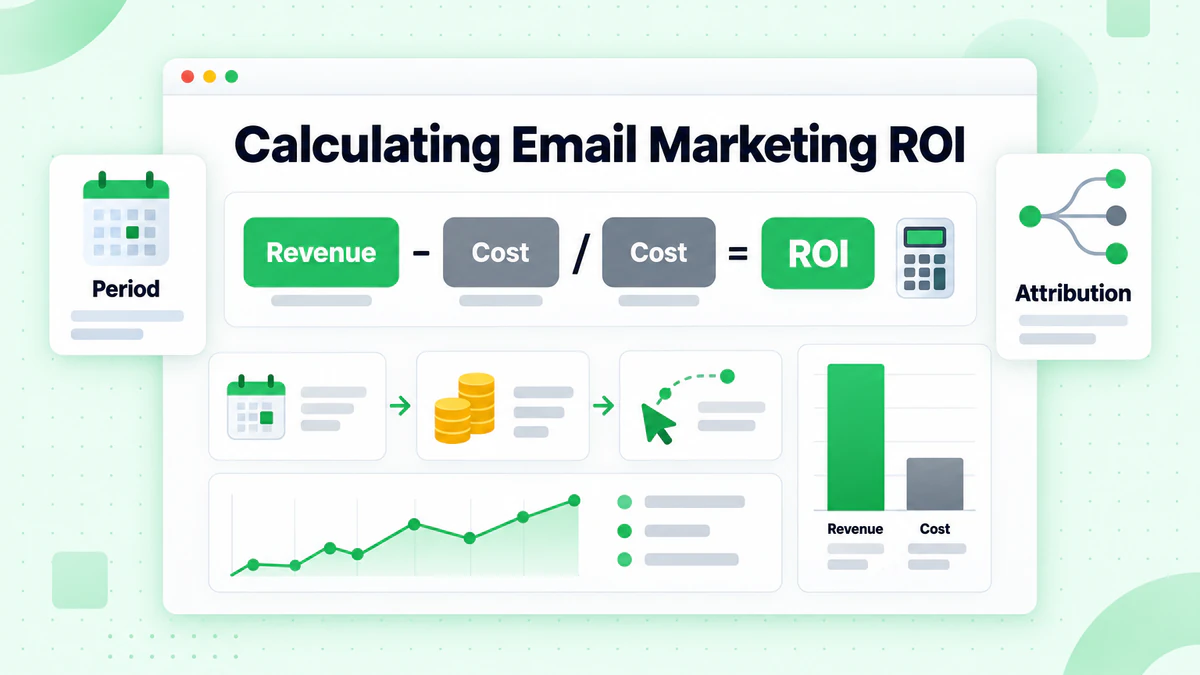
Step 1: Define Your Measurement Period
Choose a timeframe that captures the full customer journey while remaining actionable.
Common Measurement Periods:
- Monthly: Good for regular reporting and trend tracking
- Quarterly: Balances detail with bigger-picture view
- Campaign-specific: Evaluates individual campaign performance
- Annual: Shows overall program ROI
Considerations:
- Allow time for delayed conversions
- Account for seasonal variations
- Include the full sales cycle for your products
Step 2: Calculate Total Investment
Sum all costs associated with email marketing during your measurement period.
Investment Checklist:
| Category | Cost Components |
|---|---|
| Platform | ESP subscription, email verification, analytics tools |
| Content | Copywriting, design, photography, video |
| People | Salary/time allocation for email team members |
| Acquisition | Paid advertising for list building, lead magnets |
| Technical | Integrations, development, maintenance |
Step 3: Track Revenue Attribution
Identify all revenue attributable to email marketing.
Revenue Sources:
- Direct purchases from email clicks (use UTM tracking)
- Attributed revenue from multi-touch models
- Estimated influenced revenue
- Subscriber lifetime value increases
Step 4: Apply the ROI Formula
With investment and revenue figures, calculate your ROI.
Example Calculation:
Investments (Monthly):
- ESP subscription: $500
- Email verification: $100
- Content creation: $1,000
- Staff time (estimated): $2,000
- List building ads: $500
- Total Investment: $4,100
Revenue (Monthly):
- Direct email revenue: $35,000
- Estimated influenced revenue: $10,000
- Total Revenue: $45,000
ROI Calculation: ROI = (($45,000 - $4,100) / $4,100) × 100 = 997%
Step 5: Segment ROI by Campaign Type
Different email types deliver different ROI. Segment your analysis to identify top performers.
Campaign Type ROI Analysis:
- Welcome series ROI
- Promotional campaign ROI
- Abandoned cart ROI
- Newsletter ROI
- Re-engagement campaign ROI
Strategies to Improve Email Marketing ROI
Once you understand your current ROI, implement strategies to improve it.
Increase Revenue (Numerator Improvements)
Improve Deliverability: Emails that reach the inbox can generate revenue; those in spam cannot. Learn how to improve email deliverability to ensure your list is clean and deliverable.
- Verify new subscribers at signup with real-time verification
- Clean your existing list regularly
- Monitor and maintain sender reputation
- Implement proper email authentication
Optimize for Conversions: Increase the percentage of recipients who take desired actions.
- Write compelling subject lines to boost opens
- Create clear, persuasive CTAs
- Use urgency and scarcity appropriately
- Test and optimize landing pages
- Personalize based on subscriber data
Increase Average Order Value: Get more revenue from each email-driven purchase.
- Include upsell recommendations
- Offer free shipping thresholds
- Create bundle deals
- Use dynamic product recommendations
Send More Strategically: Find the optimal sending frequency to maximize revenue without increasing fatigue.
- Test different frequencies by segment
- Send more to engaged subscribers
- Reduce frequency for less engaged segments
- Use behavioral triggers for timely sends
Decrease Costs (Denominator Improvements)
Optimize List Quality Over Quantity: A smaller, engaged list often generates better ROI than a large, unengaged one.
- Focus acquisition on quality prospects
- Remove consistently unengaged subscribers
- Reduce spending on low-quality list sources
- Verify emails to avoid paying to send to invalid addresses
Reduce Bounces and Waste: Every email sent to an invalid address is wasted money. Learn to reduce email bounce rates.
- Use email verification to eliminate invalid addresses
- Remove hard bounces immediately
- Monitor soft bounces and address issues
- Block disposable emails at signup
Improve Efficiency: Do more with less through automation and optimization.
- Automate repetitive email tasks
- Create reusable email templates
- Use AI for content generation and optimization
- Consolidate tools where possible
Negotiate Better Rates: As your email program grows, negotiate better pricing.
- Compare ESP pricing regularly
- Negotiate based on volume commitments
- Consider annual plans for discounts
- Bundle services for better rates
Email Verification's Impact on ROI
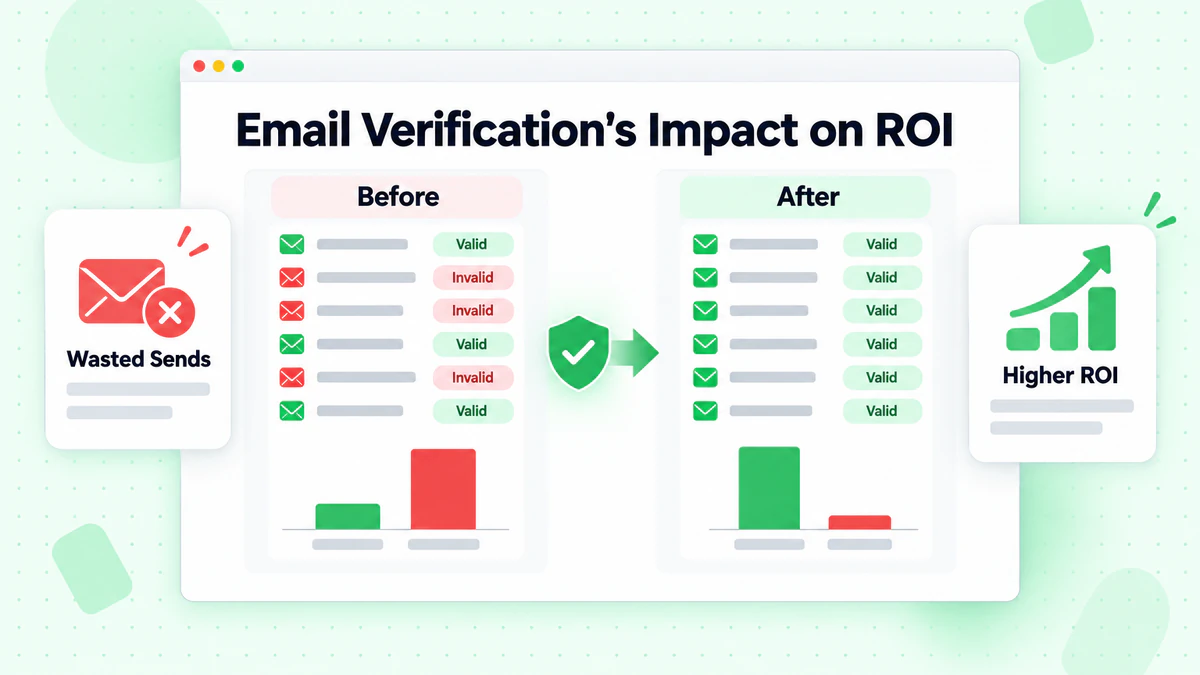
Email verification directly improves ROI by reducing costs and protecting revenue-generating capability.
Cost Reduction Through Verification
Reduced Sending Costs: Most ESPs charge based on list size or emails sent. Removing invalid addresses reduces these costs.
Example: A list with 10% invalid addresses means you're paying 10% more than necessary for your ESP. For a $500/month plan, that's $50 in wasted spend monthly, or $600 annually.
Lower Bounce-Related Costs: High bounce rates can trigger ESP penalties, rate limiting, or account suspension—all costly outcomes.
Decreased Remediation Costs: Cleaning up deliverability problems after the fact is expensive. Prevention through verification costs far less.
Revenue Protection Through Verification
Maintained Deliverability: Clean lists maintain good sender reputation, ensuring emails reach inboxes where they can generate revenue.
Preserved Engagement Rates: Invalid addresses drag down engagement metrics. Removing them shows true engagement levels and helps ISPs view your sends favorably.
Avoided Blacklisting: Spam traps and poor list hygiene can get you blacklisted, killing email revenue entirely until resolved.
Calculating Verification ROI
Email verification services like BillionVerify pay for themselves through cost savings and protected revenue.
Example ROI Calculation:
Without Verification:
- 100,000 subscribers
- 10% invalid addresses (10,000)
- $0.002 cost per email sent
- Monthly sends: 400,000 emails
- Wasted sending cost: $80/month
- Potential deliverability damage: Significant
With Verification:
- Email verification cost: ~$30/month for verification
- Savings on sending: $80/month
- Protected revenue from maintained deliverability: $1,000s/month
- Net benefit: Substantial positive ROI
Benchmarking Your Email Marketing ROI
Compare your ROI to industry benchmarks to contextualize performance.
Industry Average ROI Benchmarks
Overall email marketing averages a 36:1 ROI, but this varies significantly by industry:
| Industry | Average ROI |
|---|---|
| E-commerce | 45:1 |
| Software/SaaS | 40:1 |
| Financial Services | 38:1 |
| Media/Publishing | 35:1 |
| Travel/Hospitality | 33:1 |
| Healthcare | 28:1 |
| Retail | 42:1 |
Factors Affecting ROI Benchmarks
Your ROI may differ from benchmarks based on:
Business Model: E-commerce typically shows higher direct ROI than B2B with longer sales cycles.
Average Order Value: Higher AOV naturally increases revenue per email.
Customer Lifetime Value: Consider full customer value, not just first purchase.
Email Program Maturity: Established programs often outperform newer ones.
List Quality: Verified, engaged lists dramatically outperform poor-quality lists.
Reporting Email Marketing ROI
Communicating ROI effectively is as important as calculating it.
Creating ROI Reports
Essential Report Components:
- Executive summary with key ROI figure
- Investment breakdown by category
- Revenue attribution methodology
- Trend comparison to previous periods
- Segment-level analysis
- Recommendations for improvement
Visualization Best Practices:
- Use charts to show ROI trends over time
- Compare ROI across campaign types
- Show relationship between investment and revenue
- Highlight improvement areas visually
Presenting ROI to Stakeholders
For Executives:
- Lead with the bottom-line ROI number
- Connect email ROI to business objectives
- Show comparisons to other marketing channels
- Include growth projections
For Marketing Teams:
- Provide detailed metric breakdowns
- Include actionable insights
- Show what's driving ROI changes
- Recommend specific optimizations
For Finance Teams:
- Detail all cost components
- Show revenue attribution methodology
- Provide month-over-month comparisons
- Include forecasting data
Common ROI Calculation Mistakes
Avoid these pitfalls when calculating and reporting email marketing ROI.
Underestimating Costs
Mistake: Only counting ESP fees Solution: Include all costs: team time, content, tools, acquisition
Overestimating Revenue
Mistake: Claiming all revenue from customers who received emails Solution: Use proper attribution models that account for multi-touch journeys
Ignoring List Quality Impact
Mistake: Focusing only on list size growth Solution: Factor in engagement rates and list validity
Short-Term Focus
Mistake: Only measuring immediate conversions Solution: Include customer lifetime value and long-term impact
Not Accounting for Deliverability
Mistake: Ignoring emails that never reach inboxes Solution: Track deliverability and its impact on potential revenue
Building an ROI-Focused Email Program
Structure your email program to maximize and measure ROI effectively.
ROI-Focused Strategy
Prioritize High-ROI Activities:
- Focus on campaigns with proven returns
- Allocate more resources to top performers
- Cut or improve underperforming initiatives
Invest in Fundamentals:
- List hygiene and verification
- Deliverability maintenance
- Testing infrastructure
- Analytics capabilities
Continuous Optimization Cycle
- Measure: Calculate current ROI accurately
- Analyze: Identify improvement opportunities
- Test: Implement changes in controlled tests
- Learn: Document what works and what doesn't
- Scale: Roll out successful optimizations
- Repeat: Continue the cycle
Conclusion
Email marketing ROI isn't just a number—it's a framework for building and optimizing a profitable email program. By understanding how to calculate ROI accurately, track the right metrics, and implement improvement strategies, you can consistently increase the return on your email marketing investment.
Remember these key principles:
- Track comprehensively: Account for all costs and attribute revenue properly
- Benchmark realistically: Compare against relevant industry standards
- Optimize systematically: Use data to guide continuous improvement
- Protect your foundation: Maintain list quality with email verification
- Report effectively: Communicate ROI clearly to stakeholders
The highest email marketing ROI comes from sending relevant messages to engaged, valid subscribers. Investing in list quality through email verification isn't just about reducing bounces—it's about maximizing the revenue potential of every email you send.
Ready to improve your email marketing ROI with verified, deliverable lists? Get started with BillionVerify and ensure every email reaches a real subscriber.