



Compliance violations in email marketing now trigger fines reaching €20 million under GDPR, $10 million CAD under CASL, and over $50,000 per email under CAN-SPAM. Major providers like Google and Microsoft reject non-compliant messages outright, making authentication and regulatory adherence mandatory for deliverability. This guide equips email marketing professionals in enterprises and agencies with actionable strategies to navigate 2026's evolving compliance landscape, covering essential regulations, bulk sender requirements, authentication protocols, and permanent infrastructure implementation to optimize deliverability while avoiding costly penalties.
Key takeaways
| Point | Details |
|---|---|
| Transparency, consent, and respect | These three principles form the foundation of all email marketing compliance regulations worldwide. |
| Severe financial penalties | Non-compliance risks fines up to €20 million under GDPR, $10 million CAD under CASL, and $50,000+ per email under CAN-SPAM. |
| Mandatory authentication standards | Google, Yahoo, and Microsoft enforce strict SPF, DKIM, and DMARC requirements, rejecting messages that fail authentication. |
| Permanent infrastructure investment | Compliance requires ongoing systems for authentication, consent management, monitoring, and policy updates, not one-time fixes. |
| Bulk sender status persistence | Once you exceed 5,000 daily messages to Gmail addresses, bulk sender requirements typically remain permanent. |
Understanding email marketing compliance regulations in 2026
Email marketing compliance in 2026 rests on three major regulatory frameworks that enterprises and agencies must navigate simultaneously. The General Data Protection Regulation (GDPR) governs data protection and privacy across the European Union, requiring explicit consent before sending promotional emails and imposing fines reaching €20 million or 4% of annual turnover for violations. Canada's Anti-Spam Legislation (CASL) enforces similarly strict consent requirements with penalties up to $10 million CAD, while the United States operates under the Controlling the Assault of Non-Solicited Pornography And Marketing (CAN-SPAM) Act, which allows opt-out mechanisms rather than requiring opt-in consent.
These regulations share fundamental principles despite their geographic and structural differences. Transparency demands that senders clearly identify themselves and their intentions in every message. Consent requires documented permission from recipients before sending commercial communications, with GDPR and CASL mandating explicit opt-in and CAN-SPAM accepting implied consent with clear opt-out options. Respect for subscriber choice means providing simple, functional unsubscribe mechanisms and honoring removal requests promptly.
The financial stakes for non-compliance have never been higher. Beyond direct fines, violations damage sender reputation, trigger ISP blacklisting, and erode customer trust in ways that impact revenue for years. Regulatory enforcement has intensified as authorities recognize email marketing's role in privacy violations and consumer harassment. For detailed guidance on European requirements, review our GDPR email marketing guide, and for Canadian obligations, consult our CASL compliance guide.
Primary compliance obligations for enterprise email marketers include:
- Obtaining and documenting valid consent before adding contacts to promotional lists
- Maintaining clear, accurate sender identification in every message header and body
- Providing functional, visible unsubscribe mechanisms that process requests within 10 business days
- Keeping detailed records of consent, sending activity, and opt-out requests for audit purposes
- Ensuring all promotional content includes accurate subject lines that reflect message content
These obligations apply regardless of company size or sending volume. Small agencies face the same legal requirements as multinational corporations, making compliance knowledge essential for every email marketing professional.
Bulk sender regulations and email authentication requirements
Google redefined email deliverability in 2024 by establishing the 5,000 daily message threshold that designates bulk sender status for Gmail recipients. This classification triggers mandatory authentication and compliance requirements that persist even if sending volumes later decrease. Yahoo and Microsoft implemented parallel standards, creating a unified front among major inbox providers that collectively serve billions of users worldwide.

Authentication protocols form the technical foundation of bulk sender compliance. Sender Policy Framework (SPF) verifies that sending servers are authorized to send email on behalf of your domain. DomainKeys Identified Mail (DKIM) adds cryptographic signatures to messages, proving they haven't been altered in transit. Domain-based Message Authentication, Reporting, and Conformance (DMARC) builds on SPF and DKIM by instructing receiving servers how to handle messages that fail authentication checks. Together, these protocols create a verification chain that major providers now strictly enforce, rejecting non-compliant messages rather than routing them to spam folders.
The consequences of authentication failures have shifted dramatically. Previously, unauthenticated messages might land in spam folders where some recipients would still find them. Now, failed authentication results in outright rejection, meaning your messages never reach recipient inboxes at all. This binary outcome makes proper authentication configuration absolutely critical for enterprise deliverability.
| Provider | Daily Threshold | SPF Required | DKIM Required | DMARC Required | Enforcement Date |
|---|---|---|---|---|---|
| Google Gmail | 5,000 messages | Yes | Yes | Yes, quarantine or reject policy | February 2024 |
| Yahoo Mail | 5,000 messages | Yes | Yes | Yes, quarantine or reject policy | February 2024 |
| Microsoft Outlook | No specific threshold | Yes | Yes | Strongly recommended | Ongoing |
Bulk sender status typically remains permanent once triggered, even if your sending volume drops below the threshold temporarily. This persistence reflects ISP recognition that organizations capable of high-volume sending will likely return to those levels. Plan your authentication infrastructure with this permanence in mind, building systems that scale rather than temporary fixes.
Pro Tip: Monitor aggregate sending volumes across all subdomains and sending systems to avoid unintentional bulk sender status. Many enterprises discover they've crossed thresholds when combining volumes from marketing platforms, transactional systems, and internal communications that all send from company domains.
Best practices for maintaining authentication compliance include:
- Implementing SPF, DKIM, and DMARC on all sending domains before reaching bulk sender thresholds
- Setting DMARC policies to quarantine or reject to demonstrate commitment to authentication
- Monitoring DMARC reports regularly to identify and fix authentication failures
- Maintaining separate subdomains for different sending types to isolate reputation issues
- Testing authentication configuration changes in low-volume environments before production deployment
For comprehensive authentication guidance, explore our email compliance guide, which covers technical implementation details and troubleshooting strategies for enterprise environments.
Comparing penalties and compliance strategies across regions
Penalty structures vary significantly across regulatory frameworks, creating complex risk profiles for multinational email marketers. Understanding these differences helps prioritize compliance investments and assess potential exposure from violations.
| Regulation | Maximum Fine | Enforcement Authority | Key Penalty Factors | Notable Cases |
|---|---|---|---|---|
| GDPR | €20 million or 4% annual turnover | National data protection authorities | Violation severity, duration, affected individuals, cooperation | British Airways £20 million, Marriott £18.4 million |
| CASL | $10 million CAD organizations, $1 million individuals | Canadian Radio-television and Telecommunications Commission | Intent, prior violations, financial benefit | Compu-Finder $1.1 million |
| CAN-SPAM | $50,120+ per email | Federal Trade Commission, state attorneys general | Number of violations, deceptive practices | Multiple cases with millions in penalties |
Penalties extend beyond direct fines to include reputational damage that impacts customer acquisition costs, partner relationships, and employee morale. Public disclosure of violations appears in media coverage and regulatory announcements, creating lasting associations between your brand and non-compliance. ISP blacklisting resulting from compliance failures can take months to resolve, during which your entire email program operates at severely diminished effectiveness.
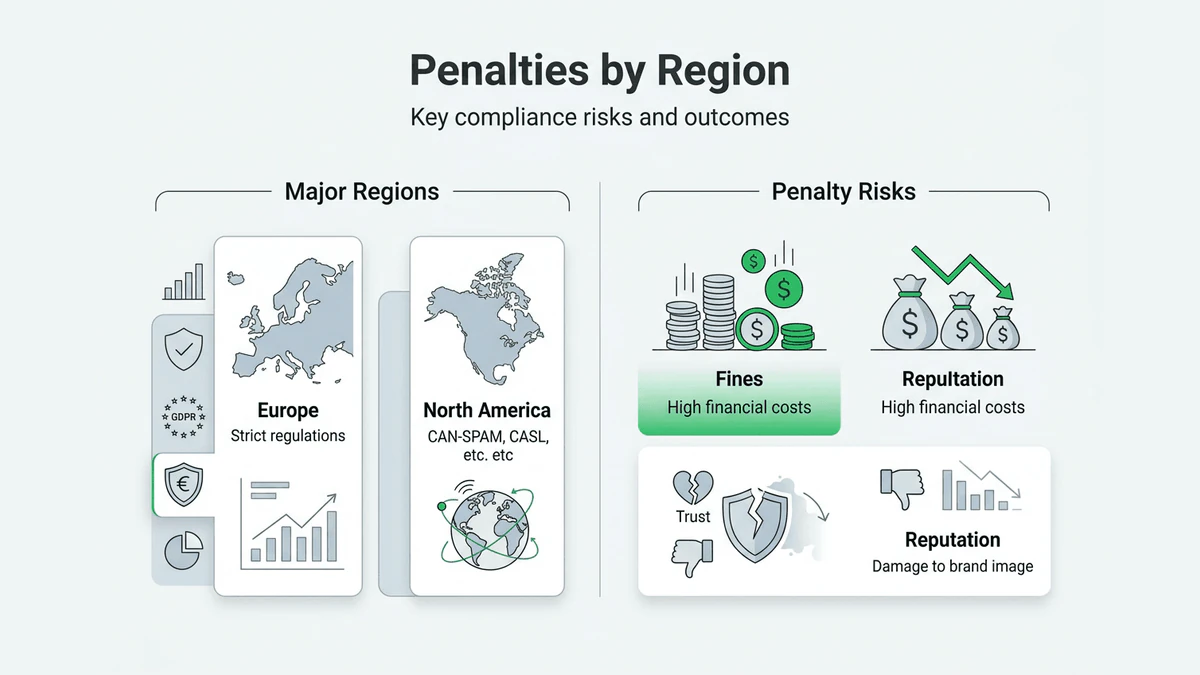
CAN-SPAM violations carry particularly severe per-message penalties that multiply quickly in high-volume environments. An agency sending 100,000 non-compliant emails faces theoretical exposure exceeding $5 billion, though actual penalties typically settle far lower based on negotiation and ability to pay. The risk profile alone justifies significant compliance investment.
Key compliance strategy steps for multinational email marketers:
- Map your sending operations to identify which regulations apply based on recipient locations and your business presence
- Implement the strictest applicable standard across all operations to simplify compliance and reduce errors
- Document consent mechanisms, retention periods, and opt-out processes in detailed policies accessible to all team members
- Establish regular compliance audits reviewing list acquisition, message content, authentication status, and unsubscribe functionality
- Train all staff involved in email marketing on regulatory requirements and organizational policies
- Build relationships with legal counsel experienced in email marketing compliance for complex situations
- Monitor regulatory developments in all markets where you send emails to adapt policies proactively
Pro Tip: Prioritize compliance in data management and consent recording systems to simplify adherence across regions. When your foundational data practices meet the highest standards, satisfying multiple regulatory frameworks becomes straightforward rather than requiring separate processes for each jurisdiction.
Overlapping compliance regimes require holistic approaches rather than siloed efforts. An email sent to a Canadian recipient from a US company with European data processing creates obligations under all three major frameworks. Building systems that satisfy the strictest requirements eliminates the need to segment compliance by recipient location, reducing complexity and error risk. For penalty details and avoidance strategies, review our guides on CAN-SPAM compliance and email marketing penalties.
Implementing permanent compliance infrastructure for sustained success
Treating compliance as permanent infrastructure rather than a temporary project transforms it from a cost center into a competitive advantage. Organizations that build lasting compliance systems regardless of current volume position themselves for sustainable growth without deliverability crises or regulatory penalties disrupting operations.
Permanent compliance infrastructure includes several interconnected components that work together to maintain regulatory adherence and optimal deliverability. Authentication configuration establishes the technical foundation, with properly implemented SPF, DKIM, and DMARC protecting your domain reputation and ensuring message acceptance. Consent management systems track how and when each subscriber joined your list, storing the evidence needed to demonstrate compliance during audits. Ongoing monitoring watches authentication reports, bounce rates, spam complaints, and deliverability metrics to identify problems before they escalate.
Staff training ensures everyone involved in email marketing understands compliance requirements and organizational policies. Regular sessions covering regulatory updates, policy changes, and best practices keep knowledge current across teams. Compliance audits conducted quarterly or semi-annually review all aspects of your email program, identifying gaps and verifying that documented policies match actual practices.
Critical infrastructure components for enterprise compliance:
- Authenticated sending infrastructure with SPF, DKIM, and DMARC configured on all domains and subdomains
- Consent management platform documenting opt-in methods, timestamps, and IP addresses for all subscribers
- Automated monitoring systems alerting teams to authentication failures, deliverability drops, or compliance risks
- Regular staff training programs covering regulatory requirements, organizational policies, and industry best practices
- Scheduled compliance audits reviewing list acquisition, message content, authentication status, and unsubscribe processes
- Documented policies and procedures accessible to all team members involved in email operations
- Email verification tools integrated into list acquisition workflows to maintain list hygiene automatically
Preparing for bulk sender status before crossing volume thresholds prevents the scrambling that occurs when organizations discover their messages are being rejected. Implementing authentication protocols, establishing monitoring systems, and building compliance processes while sending volumes remain manageable creates a foundation that scales smoothly as your program grows.
Pro Tip: Invest early in AI-first email verification tools to automate compliance and reduce risk. Modern verification platforms detect disposable addresses, spam traps, and invalid emails before they damage your sender reputation, while also identifying role-based and catch-all addresses that may require different handling under various regulations.
Continuous policy updates keep your compliance program aligned with evolving regulations and ISP requirements. Regulatory frameworks change as authorities respond to new technologies and enforcement experiences. ISPs adjust their filtering algorithms and authentication requirements based on emerging threats and industry standards. Organizations that treat compliance as static face sudden crises when changes render their practices inadequate. Those that build review and update processes into their infrastructure adapt smoothly to the changing landscape.
Compliance infrastructure delivers returns beyond avoiding penalties. Clean, engaged lists generate higher open rates, click-through rates, and conversions than lists bloated with invalid or uninterested addresses. Strong sender reputation ensures your messages reach primary inboxes rather than spam folders or facing rejection. Documented compliance processes reduce legal risk and simplify due diligence during audits, partnerships, or acquisition discussions. The investment in permanent infrastructure pays dividends across multiple dimensions of email marketing performance. Additional implementation guidance appears in our comprehensive email compliance guide.
Optimize your email compliance with BillionVerify solutions
Maintaining compliance while scaling email operations requires tools that automate verification and list hygiene without slowing your workflows. BillionVerify provides AI-first email verification designed specifically for enterprise compliance needs, detecting disposable emails, spam traps, role-based addresses, and risky domains that threaten your sender reputation and regulatory standing.
Our multi-layer verification technology processes millions of addresses monthly for agencies and enterprises that depend on email marketing for revenue. Real-time API integration ensures every address entering your systems meets quality standards, while bulk processing cleans existing lists efficiently. The platform integrates seamlessly with over 20 major email marketing systems and CRMs, making implementation straightforward regardless of your technology stack. Explore the BillionVerify platform to discover how AI-powered verification transforms compliance from a burden into a competitive advantage, protecting your sender reputation while improving campaign performance and ROI.
FAQ
What are the main email marketing compliance laws worldwide?
The primary regulations governing email marketing in 2026 include GDPR in Europe, CASL in Canada, and CAN-SPAM in the United States. Each framework establishes obligations for obtaining consent, providing unsubscribe options, and maintaining truthful sender identification. While GDPR and CASL require explicit opt-in consent before sending promotional emails, CAN-SPAM permits implied consent with clear opt-out mechanisms. For detailed European requirements, review our GDPR email marketing guide.
How do bulk sender rules impact enterprise email deliverability?
Bulk sender status triggers when you exceed 5,000 daily messages to Gmail addresses, activating mandatory authentication requirements that major providers strictly enforce. Messages failing SPF, DKIM, or DMARC authentication face outright rejection rather than spam folder placement, eliminating any chance of recipient access. This binary outcome makes proper authentication configuration absolutely critical for maintaining deliverability at enterprise scale. Comprehensive authentication guidance appears in our email compliance guide.
What steps can agencies take to maintain long-term compliance?
Agencies should establish permanent compliance infrastructure including authenticated sending systems, consent management platforms, and ongoing monitoring rather than treating compliance as a one-time project. Regular audits reviewing list acquisition methods, message content, authentication status, and unsubscribe functionality identify gaps before they cause problems. Updating policies continuously to reflect evolving regulations and ISP requirements ensures your practices remain current as the landscape changes. Additional implementation strategies appear in our comprehensive email compliance guide.
Why do authentication failures now result in message rejection?
Major inbox providers shifted from routing unauthenticated messages to spam folders to rejecting them entirely because authentication protocols now serve as the primary defense against phishing, spoofing, and email-based fraud. This change reflects the maturity of SPF, DKIM, and DMARC standards and the recognition that legitimate senders can implement these protocols without significant difficulty. Rejection creates stronger incentives for proper configuration while protecting users from increasingly sophisticated email threats that exploit authentication gaps.
How should multinational marketers handle overlapping compliance requirements?
Implement the strictest applicable standard across all operations rather than creating separate processes for each jurisdiction. When your foundational practices satisfy GDPR's explicit consent requirements and comprehensive documentation standards, meeting CASL and CAN-SPAM obligations becomes straightforward. This unified approach reduces complexity, minimizes errors from managing multiple systems, and simplifies training by establishing consistent policies that apply regardless of recipient location or regulatory framework.