



Most email marketers track send volume and open rates, yet overlook the single metric that determines whether any of that effort pays off: inbox placement. Your emails can register a 98% delivery rate while 60–85% of messages quietly land in spam folders, promotions tabs, or simply disappear. That gap between "delivered" and "seen" is where campaign ROI is won or lost, and closing it requires understanding the mechanics, benchmarks, and verification strategies that separate high-performing programs from those burning budget on invisible messages.
Key Takeaways
| Point | Details |
|---|---|
| Inbox placement matters most | An email 'delivered' is not always visible—track inbox rates to safeguard ROI. |
| Multifactor optimization | Technical setup, list hygiene, and engagement signals work together for highest deliverability. |
| Benchmark and monitor | Compare your rates to current industry averages and use dedicated monitoring tools for accuracy. |
| Tackle technical and human factors | Address both invisible tech errors and real-user behavior for resilient inbox performance. |
| Verification tools simplify success | Robust verification solutions automate cleaning, authentication, and compliance for top inbox rates. |
What is email deliverability and why does it matter?
Deliverability is not the same as delivery rate. Delivery rate measures every message your mail server accepted without a hard bounce. Deliverability, by contrast, measures whether those accepted messages actually land in the inbox rather than the spam folder or a filtered tab. Email deliverability is the foundation for ROI in any email program, because a message that never reaches the inbox cannot generate a click, a conversion, or revenue.
"Sent" is not the same as "seen." Inbox placement is the only metric that confirms your message had a real chance to perform.
Marketers who rely on open rates as a proxy for deliverability are working with incomplete data, especially after Apple's Mail Privacy Protection inflated open metrics across the industry. The more reliable signal is inbox placement rate, which you can only measure through seed testing or dedicated monitoring tools. Following email marketing best practices and consulting a complete inbox guide are practical starting points for closing the visibility gap.
The business case is direct. Higher inbox placement means more subscribers see your offer, more clicks flow through, and your cost per acquisition drops. Every percentage point of inbox placement you recover translates into measurable revenue, making deliverability one of the highest-leverage investments in your marketing stack. Understanding deliverability fundamentals is the first step toward treating it as a strategic priority rather than a technical afterthought.
Core mechanics: What drives deliverability performance?
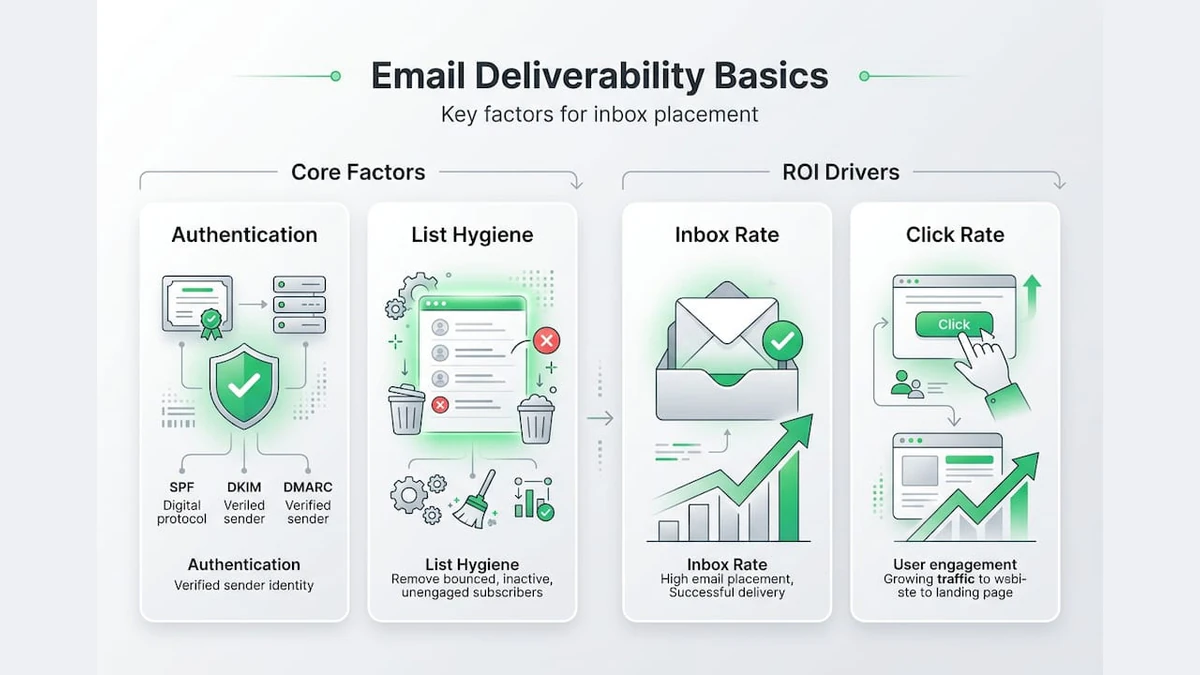
Six interconnected factors determine whether your messages reach the inbox, and all six must work together for sustained performance.
- Sender reputation is the trust score mailbox providers assign to your sending IP and domain. A poor reputation, built through high bounce rates or spam complaints, is the fastest path to the junk folder.
- Authentication protocols (SPF, DKIM, and DMARC) verify that your messages genuinely originate from your domain. SPF, DKIM, and DMARC each serve a distinct role: SPF authorizes sending IPs, DKIM signs message content, and DMARC enforces policy and provides reporting.
- List hygiene removes invalid, inactive, and risky addresses before they generate bounces or spam complaints. Ongoing email list management outperforms batch cleaning because list decay is continuous, not seasonal.
- Engagement signals such as opens, clicks, replies, and unsubscribes tell mailbox providers whether subscribers want your mail. Low engagement accelerates filtering.
- IP warmup is essential for new senders or those scaling volume. Sending too much too fast from a cold IP triggers rate limiting and filtering penalties.
- Content quality affects spam filter scoring. Excessive capitalization, misleading subject lines, and heavy image-to-text ratios all raise filter risk.
| Factor | Primary impact | Timeframe to see results |
|---|---|---|
| Authentication (SPF/DKIM/DMARC) | Blocking prevention | Immediate |
| Sender reputation | Inbox vs. spam routing | Days to weeks |
| List hygiene | Bounce and complaint rates | 1 to 2 send cycles |
| Engagement segmentation | Filter scoring | 2 to 4 weeks |
| IP warmup | Volume scaling | 4 to 8 weeks |
| Content optimization | Spam filter scoring | Per campaign |
Pro Tip: Pair your deliverability workflow for SaaS with automated list verification to catch risky addresses before they ever reach your sending queue.
Data and benchmarks: How does your deliverability stack up?
Benchmarks give your metrics context. Without them, a 75% inbox placement rate looks acceptable until you realize top B2B senders consistently exceed 90%.

| Segment | Average inbox placement | Acceptable bounce rate | Spam complaint threshold |
|---|---|---|---|
| B2B | 85 to 92% | Under 2% | Under 0.08% |
| B2C / retail | 70 to 82% | Under 3% | Under 0.10% |
| E-commerce | ~62% | Under 3% | Under 0.10% |
| SaaS / transactional | 88 to 95% | Under 1% | Under 0.05% |
Global inbox placement averages 60 to 85%, and e-commerce senders often sit at the lower end of that range due to high list churn and promotional content volume. If your program falls below these benchmarks, the gap is almost always traceable to one of the six mechanics described above.
Key diagnostic signals to watch:
- Bounce rate above 3% signals list decay or poor acquisition practices.
- Spam complaint rate above 0.10% triggers automatic filtering adjustments at Gmail and Yahoo.
- Inbox placement below 70% indicates a reputation or authentication problem requiring immediate attention.
- Open rate decline without list growth often reflects worsening inbox placement, not reduced interest.
Regular email hygiene best practices and consistent monitoring against industry deliverability benchmarks are the fastest ways to identify where your program needs work.
Methodologies to optimize deliverability: What works in 2026?
Once you know your benchmarks, applying proven tactics in the right sequence produces the fastest gains.
- Align your authentication stack. Confirm SPF includes all sending sources, DKIM keys are rotated at least annually, and DMARC is set to at minimum a "quarantine" policy with reporting enabled.
- Schedule IP warmup deliberately. Start new IPs at 500 to 1,000 messages per day, doubling volume every 3 to 5 days while monitoring bounce and complaint rates closely.
- Clean your list before every major campaign. Use a verification provider to remove invalid, disposable, role-based, and catch-all addresses. Review list hygiene tips for a structured cadence.
- Segment by engagement tier. Send your most promotional content only to subscribers who have engaged in the past 90 days. Re-engagement campaigns for the 90 to 180 day segment should use a separate IP or subdomain.
- Implement double opt-in for new subscribers. This single step reduces invalid addresses at the source and signals genuine interest to mailbox providers.
- Enable one-click unsubscribe. Google and Yahoo now require it for bulk senders, and compliance directly reduces spam complaints.
- Monitor with dedicated tools. Google Postmaster Tools, GlockApps, and seed-based inbox testing give you placement data that open rates cannot provide. Explore deliverability tools to build a complete monitoring stack.
Authentication setup, list verification, segmentation, and monitoring are not optional extras. They are the baseline for any program that expects consistent inbox placement.
Pro Tip: Review stepwise deliverability tactics to build a repeatable optimization checklist your team can run before every major send.
Challenges and edge cases: Why do good emails miss the inbox?
Even programs with solid authentication and clean lists encounter unexpected filtering. Understanding why helps you respond faster.
- DKIM failures from forwarding or key rotation gaps are common in Outlook environments. A message can pass SPF but fail DKIM if the receiving server modifies headers during forwarding, triggering a DMARC failure despite legitimate sending.
- New domain penalties are real. Mailbox providers assign low trust scores to domains with no sending history, and new IPs face significant deliverability penalties during the warmup period.
- Automated warmup tools generate artificial engagement signals that some mailbox providers now detect and discount, making genuine subscriber engagement the more durable warmup strategy.
- Gmail's Promotions tab is not a spam folder, but placement there reduces visibility and click rates significantly for e-commerce senders.
- Private blocklists maintained by individual ISPs or enterprise mail gateways are invisible to standard monitoring tools and require direct outreach to resolve.
Blocklist incidents and rate limiting from Outlook can affect even well-authenticated senders, particularly during high-volume seasonal campaigns.
Reviewing email list cleaning pitfalls before scaling volume helps prevent the most common triggers for these edge cases.
Expert perspectives: Is tech, content, or engagement the real driver?
The deliverability community is divided on which lever matters most. Technical experts argue that without proper authentication, nothing else works. Engagement specialists counter that authentication is necessary but not sufficient, and that mailbox providers increasingly weight behavioral signals over technical compliance.
Both camps are right, and that is precisely the problem with choosing sides. In 2026, Google and Yahoo's bulk sender requirements mandate authentication and low complaint thresholds as table stakes. But meeting those requirements only keeps you in the game. Sustained inbox placement above 85% requires ongoing engagement management, content relevance, and list quality working together.
Pro Tip: Review advanced deliverability strategies to see how leading programs balance technical compliance with engagement-driven content calendars.
A balanced framework for sustained inboxing includes:
- Technical foundation: SPF, DKIM, DMARC fully configured and monitored.
- List quality: Verified, permission-based addresses cleaned on a regular cadence.
- Content relevance: Segmented messaging that matches subscriber intent and behavior.
- Engagement monitoring: Active suppression of unresponsive subscribers before they become complaint risks.
- Ongoing testing: Seed tests and postmaster data reviewed after every major campaign.
Following deliverability best practices that integrate all five dimensions is the only reliable path to consistent inbox placement at scale.
Boost your inbox reach with advanced verification
If you're ready to take the next step in mastering inbox placement, best-in-class tools can handle much of the heavy lifting. List hygiene, real-time validation, spam trap detection, and catch-all domain identification are time-intensive tasks when done manually, but they become systematic and scalable with the right verification platform.
BillionVerify's verification platform is built specifically for e-commerce, SaaS, and high-volume email programs that cannot afford deliverability failures. With multi-layer verification that detects disposable addresses, role-based emails, risky domains, and spam traps, BillionVerify automates the list hygiene work that directly protects your sender reputation. The platform integrates with over 20 major email marketing systems and CRMs, processes millions of verifications per month, and provides the real-time API access that fast-moving marketing teams need. Start verifying today and convert your list quality into measurable inbox placement gains.
Frequently asked questions
What is the difference between delivery rate and inbox placement rate?
Delivery rate counts all emails accepted by the receiving server without a hard bounce. Inbox placement rate measures how many of those accepted messages actually reach the inbox, and global inbox placement can be as low as 60% even when delivery rates appear strong.
How often should email lists be cleaned for best deliverability?
Experts recommend cleaning lists at least quarterly and before every major campaign. B2B lists are especially vulnerable because B2B email data decays at roughly 30% annually, meaning nearly a third of your contacts become invalid within a year.
Does SPF, DKIM, or DMARC guarantee inbox placement?
No. Authentication prevents outright blocking and spoofing, but authentication alone is insufficient for inboxing. Engagement quality and content relevance carry equal or greater weight in mailbox provider filtering decisions.
What's the easiest way to monitor deliverability issues?
Google Postmaster Tools and GlockApps provide direct inbox versus spam placement data that open rates cannot replicate. Monitoring must go beyond open rates to include spam rate tracking and seed-based inbox testing for accurate diagnostics.
How do new sending domains or IPs affect deliverability?
New domains and IPs carry no sending history, which mailbox providers treat as a risk signal. New IPs can lose up to 30 percentage points in deliverability compared to established senders, making a structured warmup schedule essential before scaling volume.