



Your email list is losing value right now, even if you haven't sent a single campaign this week. Email databases decay by 22 to 30% annually as contacts change jobs, abandon addresses, or simply lose interest. That means a list of 100,000 subscribers could shrink to fewer than 75,000 genuinely reachable contacts within a year. This guide covers exactly what list cleaning is, why it matters more than most marketers realize, and how to build a systematic process that protects your sender reputation and drives measurable campaign results.
Key Takeaways
| Point | Details |
|---|---|
| List decay is rapid | Email lists lose 22-30% of contacts yearly, making regular cleaning essential. |
| Cleaning boosts results | Proper list cleaning means higher inbox placement, better open rates, and improved engagement. |
| Best cleaning methods | Combining manual, bulk, and real-time verification protects deliverability and ROI. |
| Track your metrics | Monitor bounces, spam complaints, and inbox rates to ensure your cleaning strategy works. |
| Don’t delete too fast | Aim to re-engage low-engagement contacts before final removal to avoid losing leads. |
Defining list cleaning and why it matters
Email list cleaning is the process of removing invalid, inactive, or unengaged email addresses from a mailing list to improve deliverability, engagement, and sender reputation. It is not simply deleting a few bounced addresses after a campaign. It is a structured, ongoing strategy that determines whether your messages reach real inboxes or disappear into spam folders.
A "dirty" list is one filled with outdated addresses, role-based emails like info@ or support@, disposable addresses, and contacts who haven't opened a message in months. These addresses drag down your entire program. Maintaining strong campaign email hygiene is what separates high-performing senders from those who get blacklisted.
The negative impacts of ignoring list hygiene are concrete and measurable:
- Higher bounce rates that signal poor sender quality to inbox providers
- Spam complaint rates that rise above acceptable thresholds, triggering filters
- Lower open and click-through rates that reduce your sender score over time
- Blacklisting risk that can shut down your entire sending domain
The upside is equally clear. Clean lists achieve 98% inbox placement compared to 60 to 70% for dirty lists, with open rates improving by up to 50% and click-through rates rising by as much as 75%. Understanding the marketing ROI from clean lists makes the business case straightforward: a smaller, engaged list consistently outperforms a large, unverified one.
"Quality always beats quantity in email marketing. A list of 10,000 engaged subscribers will generate more revenue than 100,000 unverified contacts."
How fast do email lists decay?
Unmaintained email lists become outdated faster than most marketers expect. B2B lists decay at roughly 2.5% per month, which compounds to over 25% annually. B2C lists follow a similar trajectory, driven by abandoned personal accounts and shifting consumer interests.
The main causes of decay include job changes that invalidate work email addresses, subscribers who lose interest and stop engaging, and addresses that simply become invalid over time. Each of these scenarios adds dead weight to your list and erodes your sender reputation with every send.

Here is how decay affects lists of different sizes over time:
| List size | Annual loss (25%) | Quarterly loss (6.25%) |
|---|---|---|
| 10,000 | 2,500 contacts | 625 contacts |
| 50,000 | 12,500 contacts | 3,125 contacts |
| 100,000 | 25,000 contacts | 6,250 contacts |
| 500,000 | 125,000 contacts | 31,250 contacts |
These numbers make a strong case for treating list hygiene as a continuous process rather than a one-time fix. Reviewing list hygiene fundamentals regularly keeps your data current and your campaigns effective.
"B2B marketers face the steepest decay curve because professional email addresses are tied to employment status, which changes constantly in competitive industries."
Pro Tip: Schedule a quarterly audit of your list even if you run automated verification at sign-up. Automated tools catch new problems, but a scheduled audit catches patterns that develop over time, such as entire company domains going dark.
The mechanics of effective list cleaning
Knowing that lists decay quickly, the next step is understanding the specific checks and workflows that make cleaning effective. Key mechanics include syntax checks, MX record lookups, removing hard and soft bounces, eliminating duplicates, flagging role-based and disposable emails, identifying spam traps, and segmenting by engagement level.
A practical cleaning workflow follows these steps:
- Run a syntax check to catch malformed addresses like missing @ symbols or invalid domain formats.
- Perform MX record lookups to confirm the receiving domain can accept email.
- Remove hard bounces immediately after any campaign send.
- Monitor soft bounces across three to five sends before removing them.
- Flag and suppress role-based addresses that rarely convert and often trigger complaints.
- Identify disposable and catch-all domains for separate handling.
- Segment by engagement to separate active subscribers from those who haven't interacted in 90 or 180 days.
Choosing the right cleaning tips for better campaigns depends on your list size and sending frequency. Here is a comparison of the three main approaches:
| Method | Best for | Speed | Accuracy |
|---|---|---|---|
| Manual review | Lists under 1,000 | Slow | Moderate |
| Bulk verification (CSV) | Lists 1,000 to 1M+ | Fast | High |
| Real-time API | Sign-up forms, CRMs | Instant | Very high |
For most SaaS and e-commerce teams, combining bulk verification for existing lists with real-time verification best practices at the point of entry delivers the strongest results. Following a step-by-step cleaning guide ensures no critical check gets skipped.
Pro Tip: Implement real-time API verification at every sign-up form. Stopping invalid addresses before they enter your database is far more efficient than cleaning them out later.
Benchmarks and metrics to track success
Cleaning your list without measuring the outcome is like running a campaign without checking results. Tracking the right metrics confirms whether your cleaning efforts are working and helps you justify the investment to stakeholders.
Key metrics to monitor after every cleaning cycle:
- Bounce rate: Target below 2%, with an ideal range of 0.5 to 1%
- Spam complaint rate: Must stay below 0.1 to 0.3%
- Inbox placement rate: Clean lists reach 98% inbox placement versus 60 to 70% for unverified lists
- Open rate improvement: Expect gains of up to 50% after a thorough cleaning
- Click-through rate (CTR): Improvements of up to 75% are achievable with a properly segmented, clean list
Here is how benchmarks compare before and after cleaning across key industries:
| Metric | Before cleaning | After cleaning |
|---|---|---|
| Bounce rate | 5 to 10% | Below 1% |
| Spam complaint rate | 0.5 to 1% | Below 0.1% |
| Inbox placement | 60 to 70% | 95 to 98% |
| Open rate | 15 to 20% | 25 to 35% |
| CTR | 1 to 2% | 3 to 5% |
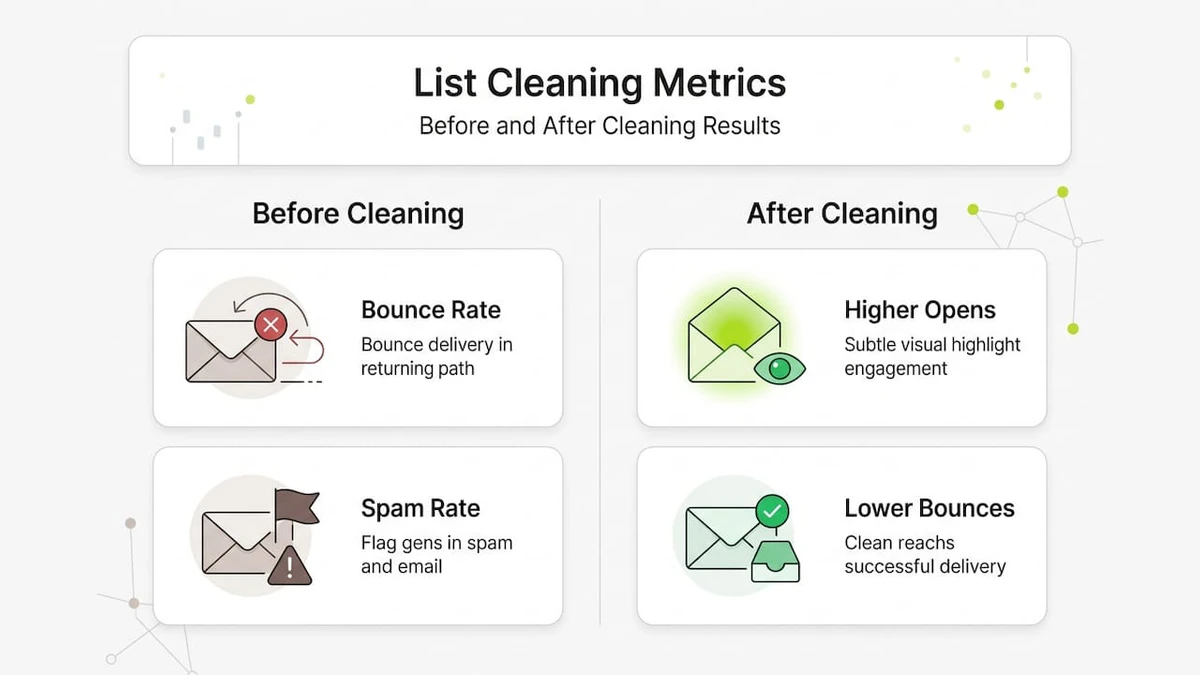
Reviewing manager cleaning strategies alongside these benchmarks gives marketing leaders a clear framework for setting performance targets and evaluating vendor tools.
How often should you clean your list?
Frequency depends on your send volume, audience type, and how aggressively you acquire new contacts. A general baseline recommendation is every three to six months, with adjustments based on your specific situation.
Here is a practical schedule by list type:
- High-volume senders (over 100,000 emails per month): Clean monthly to stay ahead of decay and maintain sender reputation.
- Moderate senders (10,000 to 100,000 per month): Quarterly cleaning keeps bounce rates in check without excessive overhead.
- Small senders (under 10,000 per month): Bi-annual cleaning is sufficient, provided you use double opt-in at sign-up.
- B2B lists of any size: Clean every three months minimum, given the higher churn rate tied to job changes.
"B2B email lists face a unique challenge: a single company restructuring or acquisition can invalidate hundreds of contacts overnight, making frequent verification essential for enterprise senders."
For SaaS marketers specifically, more frequent cleaning often pays off because your audience is highly active and expects relevant, timely communication. Using a bulk verification checklist tailored to SaaS workflows helps standardize the process across your team.
Advanced nuances and common pitfalls
Effective cleaning isn't just about the basics. Several edge cases and common mistakes can undermine even a well-structured cleaning program.
Key nuances and pitfalls to watch for:
- Catch-all domains accept any email sent to them, making it impossible to confirm individual address validity. Segment these contacts and test with low send volumes before including them in major campaigns.
- Apple Mail Privacy Protection (MPP) pre-loads email pixels, inflating open rates artificially. Relying on opens alone to measure engagement will lead you to keep unresponsive contacts too long. Shift your focus to clicks and conversions as primary engagement signals.
- Over-aggressive deletion is a real risk. Removing addresses without first normalizing data (fixing formatting errors, correcting common typos) can eliminate legitimate leads. Always normalize before you delete.
- Soft bounces should be monitored across three to five sends before removal, not deleted after a single failure.
- Re-engage before deleting inactive contacts with a targeted win-back campaign. Some will convert; those who don't can then be safely removed.
Pro Tip: Create a quarantine segment for addresses that fail certain checks but aren't definitively invalid. Run a small re-engagement sequence before making a final removal decision. This approach protects good leads while still improving list quality.
Reviewing the full validation process guide and fast email validation tips helps teams build a nuanced approach that avoids these common errors.
List cleaning vs. scrubbing vs. prevention
These three terms are often used interchangeably, but they describe distinct processes with different scopes and timing.
List cleaning covers the basics: removing bounced addresses, unsubscribes, and obvious invalids. List scrubbing goes deeper, analyzing engagement patterns, suppressing long-term inactives, and identifying spam traps that basic cleaning misses. Prevention focuses on stopping bad data from entering your list in the first place.
| Process | Scope | Timing | Best use case |
|---|---|---|---|
| List cleaning | Bounces, invalids, unsubs | After campaigns | Routine maintenance |
| List scrubbing | Engagement analysis, traps | Quarterly or bi-annually | Deep hygiene overhaul |
| Prevention | Sign-up validation, double opt-in | Continuous | New list growth |
Prevention delivers the strongest long-term ROI because it eliminates the cost of cleaning addresses that should never have been collected. Key prevention strategies include:
- Double opt-in at every sign-up point to confirm address validity and subscriber intent
- Real-time API validation that checks addresses the moment they are submitted
- Automated suppression of role-based and disposable addresses at the point of entry
- Regular domain monitoring to catch risky or newly blacklisted domains early
Understanding email list hygiene explained in full helps marketing teams decide which combination of cleaning, scrubbing, and prevention fits their current program maturity and growth stage.
How BillionVerify supports your list cleaning strategy
Building a reliable list cleaning process requires tools that can scale with your program and handle the complexity of modern email verification.
BillionVerify provides enterprise-grade email verification that covers every layer of the cleaning process, from real-time API validation at sign-up to bulk processing of millions of addresses per month. Its multi-layer verification detects disposable emails, spam traps, role-based addresses, catch-all domains, and risky domains with high accuracy. With integrations across more than 20 major email marketing platforms and CRMs, BillionVerify fits directly into the workflows that SaaS and e-commerce teams already use. Start verifying today and protect the sender reputation your campaigns depend on.
Frequently asked questions
What is email list cleaning?
Email list cleaning is the process of removing invalid, inactive, or unengaged addresses from your mailing list to improve deliverability, engagement, and sender reputation. It is an ongoing practice, not a one-time task.
How often should I clean my email list?
Most senders should clean their lists every 3 to 6 months, but high-volume senders exceeding 100,000 emails per month benefit from monthly verification to stay ahead of decay.
What are the risks of not cleaning my list?
Neglecting list hygiene leads to bounce rates above 2%, rising spam complaints, reduced inbox placement, and long-term damage to your sender reputation that can affect all future campaigns.
Should I delete every inactive email right away?
No. Run a re-engagement campaign first to recover any contacts who are still reachable. Only remove addresses that remain unresponsive after a structured win-back sequence.
How do I prevent bad emails from entering my list?
Combine double opt-in with real-time API validation at every sign-up point. This blocks invalid and disposable addresses before they enter your database, reducing the volume of cleaning required later.