



SaaS email marketing teams at mid-sized and large enterprises consistently wrestle with the same frustrating cycle: bounce rates climb, compliance requirements shift, and deliverability metrics fluctuate without warning. The unique compliance and deliverability issues that SaaS companies face are not accidental. They stem from high send volumes, complex automation workflows, and lists that degrade faster than most teams realize. This guide walks you through every stage of the SaaS email marketing process, from preparation and validation to execution and optimization, so your campaigns reach the right inboxes and stay compliant.
Key Takeaways
| Point | Details |
|---|---|
| Segment and validate lists | Always clean and verify SaaS email lists to improve deliverability and engagement. |
| Follow a clear workflow | Use a structured, step-by-step process for creating, sending, and optimizing campaigns. |
| Monitor and troubleshoot | Regularly check campaign metrics to identify issues early and maintain high performance. |
| Stay compliant | Adhere to major email regulations like GDPR, CAN-SPAM, and CCPA to avoid penalties. |
| Leverage automation tools | Choose solutions that automate validation and compliance to scale SaaS campaign success. |
What makes SaaS email marketing different?
SaaS email marketing is not a single campaign type. It spans onboarding sequences, product update announcements, trial follow-up drips, renewal reminders, and lead nurturing flows, all running simultaneously across segmented audiences. Each of these touchpoints carries its own deliverability risk and compliance obligation. That complexity is what separates SaaS email programs from simple promotional blasts.

Sender reputation management becomes especially demanding at scale. When you are sending millions of emails per month across multiple product lines and user segments, even a small percentage of invalid addresses can trigger spam filters or get your domain flagged. Real-time validation reduces those risks by catching bad addresses before they ever reach your sending infrastructure.
Privacy regulations add another layer. GDPR, CAN-SPAM, and CCPA each impose specific requirements on consent, data handling, and opt-out mechanisms. Staying current with these laws is not optional. Segmentation and validation are crucial for both engagement and compliance in SaaS email campaigns.
- Onboarding emails require verified addresses from day one
- Trial follow-ups must respect opt-out signals immediately
- Product update emails need accurate segmentation to avoid irrelevant sends
- Lead nurturing flows depend on list hygiene to maintain engagement scores
Pro Tip: Validate every new subscriber address at the point of capture using real-time API verification. Catching invalid emails before they enter your CRM is far more efficient than cleaning them out later.
Now that you see the unique challenges of SaaS email marketing, let's outline what you need before launching your campaigns.
Essential prerequisites for a successful SaaS email campaign
Launching a SaaS email campaign without the right infrastructure in place is one of the most common causes of poor deliverability. A strong deliverability workflow and verified lists are foundational to campaign success. Before your first send, confirm that each of the following elements is operational.
| Prerequisite | Purpose | Priority |
|---|---|---|
| Email service provider (ESP) | Manages sending infrastructure and tracking | Critical |
| Email verification platform | Validates list quality before and during sends | Critical |
| CRM integration | Syncs contact data and segmentation rules | High |
| SPF, DKIM, and DMARC records | Authenticates your sending domain | Critical |
| Suppression list management | Prevents sending to unsubscribed or bounced contacts | High |
| Compliance documentation | Records consent and opt-in timestamps | Critical |
Common gaps that teams overlook before launch include:
- Missing or misconfigured DMARC policies that leave the domain vulnerable
- No process for removing role-based addresses (info@, support@, admin@)
- Catch-all domains included in lists without secondary verification
- Consent records that do not meet GDPR or CCPA standards
- No warm-up plan for new sending domains or IP addresses
Compliance is not a one-time checkbox. GDPR requires explicit consent and the right to erasure. CAN-SPAM mandates a functioning unsubscribe mechanism and accurate sender identification. CCPA gives California residents the right to opt out of data sales. Each regulation applies differently depending on your audience geography, so your legal and marketing teams need to align before any campaign goes live.
With your groundwork in place, you're ready to follow a proven, step-by-step process. Let's break it down.
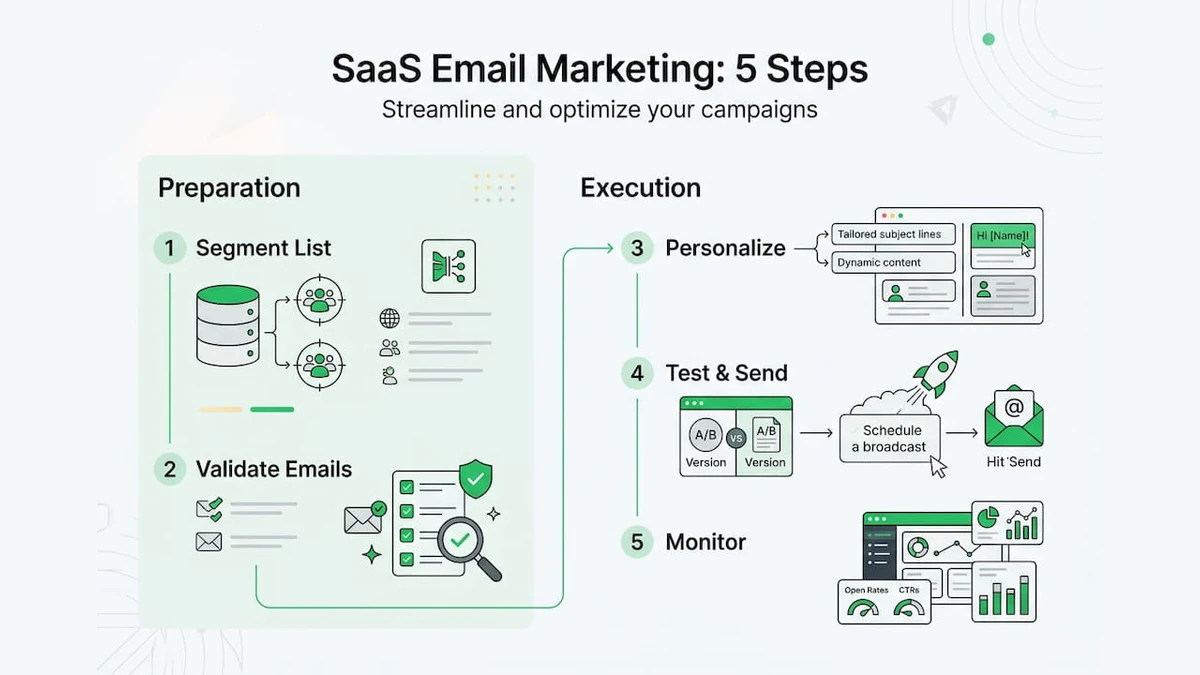
SaaS email marketing process: Step-by-step breakdown
A repeatable, structured workflow is what separates high-performing SaaS email programs from inconsistent ones. Follow these steps for every campaign cycle.
- Segment your lists. Remove invalid, inactive, and non-compliant email addresses before building any audience. Use behavioral data, product usage signals, and lifecycle stage to create precise segments. Poorly segmented lists inflate your send volume without improving results.
- Craft and personalize your messages. Write subject lines and body copy that reflect the recipient's stage in the product journey. Personalization goes beyond first-name tokens. Reference specific features they have used or milestones they have reached.
- Validate emails in real time before sending. Run your finalized list through a verification platform to flag disposable addresses, spam traps, and risky domains. This step alone can reduce bounce rates by a significant margin.
- Deploy with tracking and rate limits. Use your ESP's sending throttle to avoid sudden volume spikes that trigger spam filters. Enable open, click, and bounce tracking from the start.
- Run email A/B testing on subject lines, send times, and CTAs. A/B testing is key for optimizing messaging and improving open rates. Test one variable at a time and apply winning variants to your full audience.
Comparison: Traditional vs. real-time validation
| Factor | Traditional validation | Real-time validation |
|---|---|---|
| When it runs | Before campaign, batch only | At point of capture and pre-send |
| Bounce rate impact | Moderate reduction | Significant reduction |
| Spam trap detection | Limited | High accuracy |
| Compliance support | Manual review required | Automated flagging |
| Scalability | Slows at high volume | Handles millions per month |
Pro Tip: Pair real-time validation with lead nurturing email workflows so that every contact entering a drip sequence has already been verified. This prevents bad addresses from degrading your sender reputation mid-campaign.
Executing your campaigns is just the start. Monitoring and troubleshooting keep your results strong.
Troubleshooting and optimizing your campaigns
Even well-planned SaaS email campaigns run into problems. Knowing how to diagnose and fix issues quickly is what keeps your program on track. Ongoing monitoring and list maintenance are vital for long-term campaign effectiveness.
The most common mistakes that damage SaaS email performance include:
- Sending too fast without a warm-up plan, which triggers volume-based spam filters
- Using unsegmented lists that mix engaged users with cold or inactive contacts
- Skipping pre-send validation, allowing spam traps and invalid addresses to reach your ESP
- Ignoring unsubscribe requests beyond the legally required window
- Failing to monitor blacklist status for your sending domains and IPs
To detect blacklisting, use tools like MXToolbox or your ESP's built-in reputation monitoring. If your domain appears on a major blacklist, pause sending immediately, identify the source of the problem (usually a spike in complaints or bounces), and submit a delisting request with documentation of corrective action.
"Deliverability is not a set-and-forget metric. It requires weekly review of bounce rates, complaint rates, and engagement trends to catch problems before they escalate."
Quick wins for improving open and click rates:
- Re-engage inactive segments with a targeted win-back sequence before removing them
- Clean your list of contacts with no opens or clicks in the past 90 days
- Review your deliverability best practices checklist monthly
- Audit your subject lines for spam trigger words using a pre-send testing tool
- Confirm that your unsubscribe link is visible and functional in every email
With your campaigns in top shape, let's look at what measurable results you can expect.
What results should you expect?
SaaS marketing teams that implement structured validation and segmentation workflows consistently see measurable improvements across core performance metrics. The data below reflects typical outcomes for teams that move from ad-hoc list management to systematic verification.
| Metric | Before validation | After real-time validation |
|---|---|---|
| Bounce rate | 8 to 12% | Below 2% |
| Open rate | 18 to 22% | 28 to 35% |
| Spam complaint rate | 0.3 to 0.5% | Below 0.08% |
| Deliverability rate | 82 to 88% | 95 to 99% |
| List decay per month | 2 to 3% | Under 1% |
Key insight: SaaS marketers using real-time validation report higher deliverability and lower complaint rates, which directly translates to better inbox placement and stronger sender reputation over time.
List quality improvement also compounds. A cleaner list today means fewer suppression issues next quarter, lower ESP costs from reduced send volume to invalid contacts, and higher engagement scores that improve your domain's standing with inbox providers. Teams that invest in cold email strategies alongside their inbound campaigns see the most consistent long-term growth when both channels use verified, segmented lists.
The long-term ROI of a verified list extends beyond open rates. It protects your sending infrastructure, reduces the risk of blacklisting, and ensures that your compliance posture stays defensible as regulations evolve.
Automate and optimize your SaaS email marketing process with BillionVerify
Ready to improve your SaaS email marketing process even further? BillionVerify gives enterprise email marketing teams the tools to clean lists, validate addresses in real time, and automate compliance checks at scale, without slowing down your campaign workflow.
With AI-powered email verification built for high-volume SaaS environments, BillionVerify detects disposable emails, spam traps, role-based addresses, catch-all domains, and risky domains before they reach your ESP. The platform integrates with over 20 major email marketing systems and CRMs, so your verification workflow fits directly into your existing stack. Whether you are managing millions of verifications per month or building out a new deliverability program, BillionVerify scales with your team's needs and keeps your sender reputation protected at every stage of the campaign cycle.
Frequently asked questions
What is the first step in improving SaaS email campaign deliverability?
The first step is to segment and validate your email lists to remove invalid or unengaged addresses. Clean, segmented lists form the foundation of every high-performing SaaS email program.
How often should SaaS teams validate their email lists?
SaaS teams should validate lists at least before every major campaign, and monthly for active lists. Ongoing list maintenance prevents gradual list decay from compounding into serious deliverability problems.
What metrics indicate poor email performance in SaaS?
High bounce rates, low open rates, and increased spam complaints are the primary warning signals. Tracking these metrics weekly through your deliverability workflow allows you to catch and correct issues before they escalate.
Are there compliance laws specific to SaaS email marketing?
Yes, compliance with GDPR, CAN-SPAM, and CCPA is mandatory for SaaS email campaigns targeting users in the EU, US, and California respectively. Regulatory compliance requirements apply regardless of company size or send volume.