



TL;DR:
- Email hygiene involves ongoing list validation, removal of inactive contacts, and monitoring for spam traps.
- Proper tools, CRM integration, and consistent review are essential for maintaining good deliverability.
- Treat hygiene as a continuous process, updating practices quarterly to adapt to evolving ISP filters.
Email deliverability doesn't fail overnight. It erodes gradually, through accumulated bad addresses, ignored bounce signals, and hygiene processes that never get built or consistently maintained. For e-commerce and SaaS marketers, a degraded sender reputation means fewer inboxes reached, lower engagement, and measurable revenue loss. This guide walks through every stage of building a scalable, practical email hygiene process, from foundational definitions and tool selection to step-by-step implementation and ongoing refinement. Whether you're starting from scratch or auditing an existing workflow, the frameworks here are built for teams that take deliverability seriously.
Key Takeaways
| Point | Details |
|---|---|
| Email hygiene is critical | A clean list is essential for deliverability, engagement, and sender reputation. |
| Double opt-in improves results | Using double opt-in can increase open rates and lower spam complaints. |
| Automate with the right tools | Automation and AI solutions make ongoing list hygiene easier and more reliable. |
| Process is ongoing | Regular reviews and updates are necessary to keep email hygiene effective. |
Understanding email hygiene and why it matters
Email hygiene refers to the ongoing practice of maintaining a clean, accurate, and engaged subscriber list. It encompasses everything from validating addresses at the point of capture to removing chronically inactive contacts and monitoring for spam trap hits. The goal is simple: ensure that every address on your list is real, reachable, and worth sending to. Understanding email hygiene in marketing as a strategic discipline rather than a one-time task is the first shift marketers need to make.
Neglecting hygiene creates compounding problems. Spam traps, which are addresses maintained by ISPs and blacklist operators to catch senders with poor practices, can land your domain on blocklists almost immediately. Hard bounces signal to mailbox providers that you're not managing your list responsibly. Rising unsubscribe rates reduce your engaged segment, which directly impacts inbox placement algorithms that weigh engagement signals heavily.
The business impact is concrete. Poor hygiene inflates your cost-per-send, reduces open and click rates, and over time forces ISPs to route your mail to spam folders. Clean lists and ROI are directly linked because every dollar spent on campaigns sent to invalid or unengaged addresses is wasted spend.
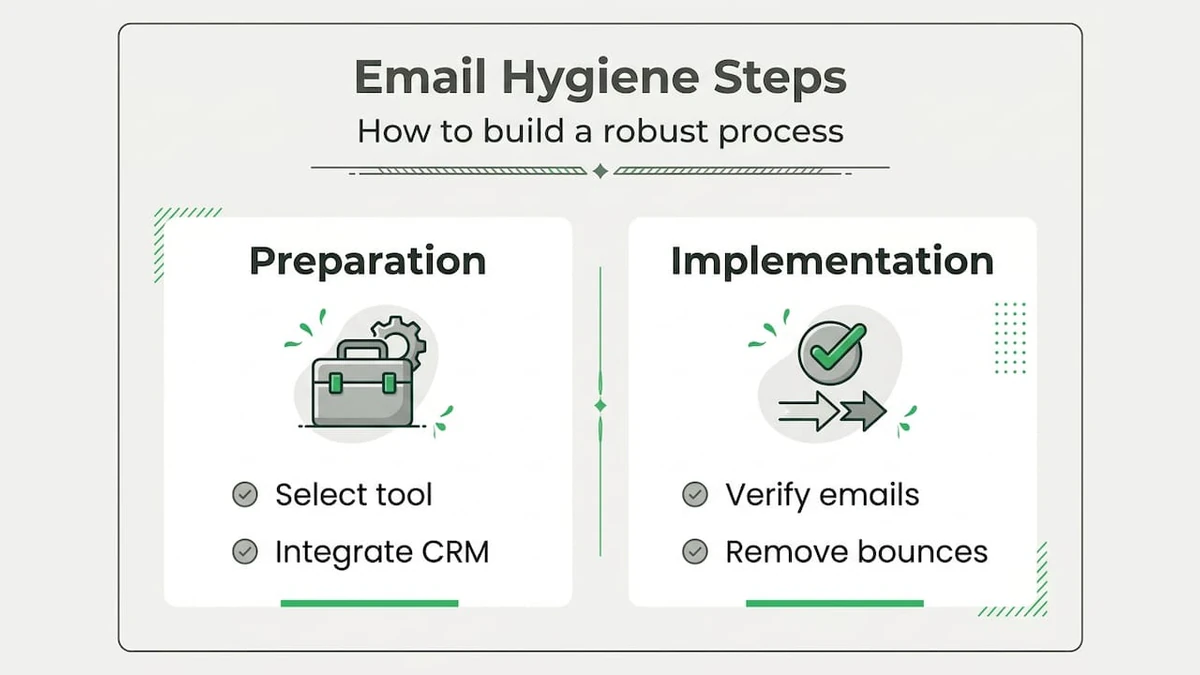
Here's a comparison of key metrics before and after implementing a structured hygiene process:
| Metric | Before hygiene process | After hygiene process |
|---|---|---|
| Bounce rate | 6-12% | Under 2% |
| Open rate | 12-18% | 22-35% |
| Spam complaint rate | 0.3-0.8% | Under 0.08% |
| Deliverability rate | 75-85% | 92-98% |
The improvements are not marginal. They represent the difference between campaigns that perform and campaigns that quietly undermine your sender reputation month after month.
Key risks that hygiene directly mitigates include:
- Spam trap hits: Sending to abandoned or honeypot addresses triggers blacklisting
- Hard bounce accumulation: Sustained bounce rates above 2% damage domain reputation
- Low engagement signals: ISPs interpret poor open rates as irrelevance or spam behavior
- Unsubscribe spikes: Sudden surges indicate list quality or targeting problems
"Double opt-in increases open rates by up to 9%, demonstrating that list quality consistently outperforms raw list size when it comes to measurable engagement."
This single data point reframes the entire hygiene conversation. More isn't better. Better is better.
What you need: Tools and prerequisites for building an email hygiene process
Understanding the stakes, what does your team actually need to get started? Building an effective hygiene process requires three foundational components: a reliable email verification tool, CRM integration that supports segmentation and tagging, and clearly documented consent policies that govern how addresses enter your system.
Your verification tool is the core of the operation. It must handle real-time verification at the point of signup, bulk processing for existing lists, and API integration with your CRM or marketing automation platform. Beyond basic syntax checks, it should detect disposable email addresses, role-based accounts like info@ or support@, catch-all domains, and known spam traps. Without this layer, invalid addresses flow into your list unchecked.

For keeping your email list clean, CRM integration is equally critical. Your CRM needs to store opt-in timestamps, consent type, engagement history, and suppression status. Without these data points, you can't make informed decisions about who to clean, quarantine, or reactivate.
Here's a comparison of approaches to help you choose the right model for your operation:
| Approach | In-house hygiene | Automated hygiene platform |
|---|---|---|
| Setup cost | Low initially | Moderate upfront |
| Ongoing accuracy | Degrades without updates | Continuously maintained |
| Disposable email detection | Limited | Real-time, multi-layer |
| Behavioral monitoring | Manual | Automated and rule-based |
| Scalability | Poor at volume | Designed for millions of records |
Note that blocking disposable addresses can reduce abuse but may also exclude privacy-focused subscribers who use masked email services legitimately. Your policy should account for this nuance, particularly in SaaS contexts where privacy-conscious users are common.
Essential data points your system must track before you begin:
- Opt-in status: Single or double opt-in, with timestamp
- Engagement history: Last open, last click, frequency of interaction
- Unsubscribe and bounce feedback: Logged and suppressed immediately
- Source of acquisition: Organic, paid, imported, or partner list
Pro Tip: Always preserve original consent records and activity logs. If a subscriber disputes a communication or a compliance audit occurs, these logs are your primary defense and your clearest signal for making hygiene decisions.
Step-by-step process: How to implement effective email hygiene
With your essentials in place, here's how to actually build and operate your hygiene process. The workflow below is designed to be repeatable, automatable, and scalable across both e-commerce and SaaS environments.
Collect with intent. Every address that enters your system should come through a consent-gated form. Define your opt-in standard before launch. Understanding double opt-in explained is essential here because the method you choose affects both list quality and growth velocity.
Verify at the point of capture. Run real-time verification via API at signup. Flag or block invalid, disposable, and role-based addresses before they enter your CRM. This is your first and most cost-effective filter.
Segment by risk on ingest. When importing existing lists, run bulk verification and tag each address by status: valid, risky, catch-all, or invalid. Do not treat all addresses equally.
Monitor engagement continuously. Set automated rules to flag contacts who haven't opened or clicked in 90, 120, and 180 days. Engagement decay is a leading indicator of deliverability risk.
Quarantine before you delete. Move flagged addresses into a suppression segment rather than deleting them outright. Quarantine allows you to run a reactivation campaign before making a final removal decision.
Remove confirmed invalids and non-responders. After a reactivation attempt with no response, remove the address from active sends. Apply cleaning tips for campaigns to maintain consistent standards across all campaign types.
On the opt-in decision: double opt-in offers higher quality, lower growth, while single opt-in accelerates list growth but carries higher spam risk. For SaaS products with high-value user journeys, double opt-in is almost always the right choice. For e-commerce with high-volume acquisition campaigns, a hybrid approach, using single opt-in with immediate verification, can balance speed and quality.
Statistic callout: Double opt-in lists consistently produce higher open rates and lower complaint rates, making them the preferred standard for deliverability-focused teams.
Pro Tip: Automate your hygiene workflow to trigger with every new list ingest, not just on a scheduled basis. This prevents bad data from aging inside your CRM between cleaning cycles.
Troubleshooting and refining your email hygiene process
Even great processes run into snags. Here's how to keep improving yours when warning signs appear.
The earliest indicators that your hygiene process needs attention include a sudden spike in hard bounces above 2%, a drop in deliverability rates across major ISPs, and a rising spam complaint rate approaching or exceeding 0.1%. Any one of these signals warrants an immediate audit. All three together indicate a systemic problem.
Common process mistakes that create these warning signs:
- Deleting too aggressively: Removing addresses without a quarantine phase risks losing valid contacts who simply haven't engaged recently
- Ignoring behavioral tracking: Hygiene based only on address validity misses the engagement decay that precedes deliverability problems
- Not differentiating opt-in types: Treating single and double opt-in subscribers identically leads to misaligned expectations and higher complaint rates
- Skipping re-engagement before removal: Deleting without a reactivation attempt means losing recoverable subscribers
- Failing to monitor acquisition sources: Imported or partner lists carry higher risk and need stricter initial verification
For bulk cleaning and ROI, the fix is rarely a single aggressive purge. More effective is tightening your quarantine rules, reviewing engagement logs for patterns, and running a structured re-engagement sequence before making final removal decisions.
Addressing email marketing mistakes and unsubscribe rate spikes requires looking at both content relevance and list composition. Sometimes the problem isn't the addresses, it's the segmentation.
"Overly aggressive cleaning risks removing valid or privacy-focused subscribers who appear inactive but remain genuinely interested, particularly in SaaS contexts where usage patterns don't always correlate with email engagement."
This is a critical caution. Behavioral silence is not the same as disengagement. Refine your process to distinguish between the two before acting.
Our perspective: Email hygiene isn't set-and-forget, it's continuous optimization
There's a persistent myth in email marketing: once you've built a hygiene process and cleaned your list, the hard work is done. In practice, this belief is one of the most reliable predictors of deliverability decline.
Deliverability threats evolve constantly. ISPs update their filtering algorithms. Spam trap networks expand. User behavior shifts. An address that was valid and engaged six months ago may now be abandoned or converted into a trap. A hygiene process calibrated for last year's threat landscape will underperform against today's.
The highest-performing marketing teams we observe treat hygiene as a quarterly discipline, not an annual project. They review quarantine rules, analyze subscriber loss patterns, and recalibrate engagement thresholds based on current campaign data. They also track hygiene and sender reputation as interconnected metrics, not separate concerns.
Our recommendation: set a recurring calendar audit every 90 days. Review your bounce trends, complaint rates, and unsubscribe patterns from the previous quarter. Adjust your quarantine thresholds and re-engagement triggers accordingly. This cadence keeps your process current and your sender reputation protected.
Try an advanced email hygiene solution
Building a rigorous hygiene process is only as effective as the tools supporting it. Manual verification and periodic list reviews leave gaps that automated, multi-layer platforms are specifically designed to close.
BillionVerify's AI-powered email verification platform handles real-time verification, bulk processing, and deep threat detection including disposable addresses, spam traps, catch-all domains, and role-based accounts, all at enterprise scale. With integrations across more than 20 major CRMs and email marketing platforms, it fits directly into the workflows your team already uses. If you're ready to move from reactive list management to a proactive, automated hygiene operation, BillionVerify is built for exactly that scale and complexity.
Frequently asked questions
What is the difference between email list cleaning and verification?
Email verification checks whether an address is technically valid and deliverable, while list cleaning goes further by removing inactive, risky, or chronically unengaged contacts. Both are necessary for a complete hygiene process, and double opt-in increases list quality while reducing the volume of addresses that need aggressive cleaning later.
How often should I clean my email list?
Clean your email list at minimum once per quarter, and trigger an unscheduled audit whenever you observe a measurable decline in open rates, deliverability, or an increase in bounce rates. List hygiene is ongoing, not a project with a finish line.
Can I use only single opt-in and still maintain good email hygiene?
Yes, but it requires more rigorous real-time verification at the point of capture to compensate for the higher spam risk. Double opt-in delivers higher quality and is the stronger long-term choice for deliverability-focused teams.
What are signs my email hygiene process needs improvement?
Rising hard bounce rates above 2%, increasing spam complaints, and declining open rates are the clearest indicators. Common mistakes include aggressive cleaning without quarantine phases and ignoring engagement behavior as a hygiene signal.