



Email bounce rate determines whether your messages reach inboxes or vanish into the void, yet many marketers misunderstand its true impact on campaign success and sender reputation. While open rates and click-throughs grab attention, bounce rate quietly signals the health of your email list and your standing with internet service providers. A single campaign with elevated bounces can trigger reputation damage that takes weeks to repair, making bounce rate one of the most critical metrics for sustainable email marketing performance.
Key Takeaways
| Point | Details |
|---|---|
| Bounce rate impact | Bounce rate signals list health to ISPs and can influence future deliverability and sender reputation. |
| Hard vs soft bounces | Hard bounces are permanent delivery failures requiring removal, while soft bounces are temporary and may become hard if repeated. |
| Industry benchmarks | Healthy bounce rates stay under 2 percent, with SaaS and B2B typically 1.0 to 2.0 percent and ecommerce at 0.5 to 2.0 percent, while hard bounce targets are below 1 percent for SaaS and under 0.5 percent for highly engaged ecommerce lists. |
| Verification strategies | Implement email verification and double opt-in to reduce bounces and improve deliverability. |
| Monitor bounce spikes | Tracking sudden bounce spikes enables quick remediation to protect sender reputation. |
Understanding email bounce rate and its impact
Email bounce rate is the percentage of sent emails rejected by receiving servers, calculated as (bounces divided by total sent) multiplied by 100. This metric serves as your first warning system for list quality problems and potential deliverability crises. When emails bounce, they never reach the intended recipient, wasting your campaign budget and signaling to ISPs that your list contains problematic addresses.
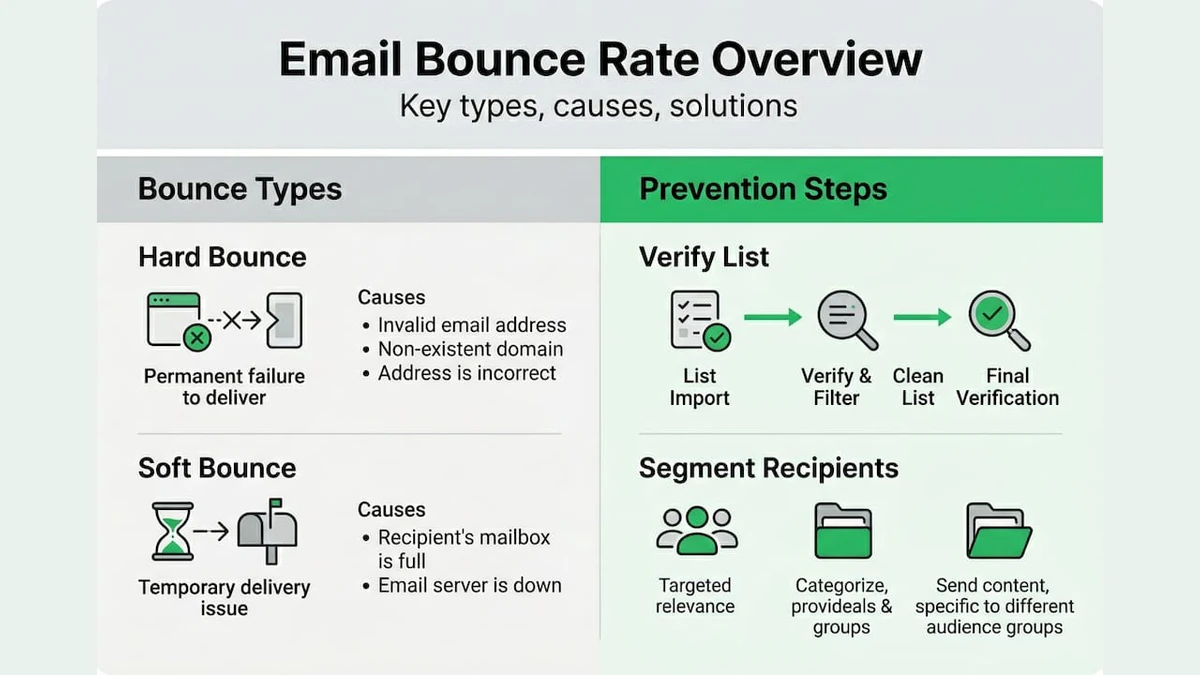
Two distinct bounce types exist with vastly different implications for your sender reputation. Hard bounces occur when emails hit permanent delivery failures like non-existent addresses, closed accounts, or invalid domains. These addresses will never accept your messages and must be removed immediately. Soft bounces represent temporary issues such as full inboxes, server downtime, or messages exceeding size limits. While less severe initially, repeated soft bounces to the same address eventually convert to hard bounces in ISP systems.
Your bounce rate directly reflects list health and acquisition practices. Lists built through organic sign-ups typically maintain bounce rates well under 1%, while purchased or scraped lists often exceed 10-20%. ISPs monitor bounce patterns closely, using them as key factors in sender reputation algorithms. A sudden spike in bounces triggers spam filters and can land your domain on blocklists within hours.
High bounce rates create cascading consequences beyond failed deliveries. Your sender score drops as ISPs classify you as a potential spammer, reducing inbox placement rates for future campaigns. Email service providers may throttle your sending capacity or suspend accounts showing persistent bounce problems. Most critically, reputation damage accumulates over time, requiring consistent good behavior across multiple campaigns to rebuild trust with receiving servers.
Understanding email verification basics helps marketers prevent bounce rate problems before they start, protecting both campaign performance and long-term deliverability.
Industry benchmarks for bounce rates in e-commerce and SaaS
Healthy overall bounce rates stay below 2%, with specific targets varying by industry, audience type, and list acquisition methods. SaaS and B2B companies typically see bounce rates between 1.0-2.0%, while e-commerce businesses range from 0.5-2.0%. These benchmarks assume well-maintained lists with regular hygiene practices and organic subscriber acquisition.
| Industry Segment | Hard Bounce Target | Soft Bounce Range | Combined Acceptable |
|---|---|---|---|
| SaaS/B2B | Below 1.0% | 0.5-1.5% | 1.0-2.0% |
| E-commerce | Below 0.8% | 0.3-1.2% | 0.5-2.0% |
| Marketing Agencies | Below 1.2% | 0.6-1.8% | 1.5-2.5% |
| Transactional Email | Below 0.5% | 0.2-0.8% | 0.5-1.5% |
Hard bounce rates deserve special attention since they indicate permanent delivery failures requiring immediate list cleanup. SaaS companies should target hard bounce rates below 1%, while e-commerce businesses with highly engaged lists can achieve rates under 0.5%. Any hard bounce rate exceeding 2% signals serious list quality issues demanding urgent intervention.
Soft bounce benchmarks vary more widely based on factors like email size, sending frequency, and recipient server reliability. B2B senders often experience higher soft bounce rates due to corporate email systems with strict size limits and aggressive spam filters. Consumer-focused e-commerce campaigns typically see lower soft bounce rates since personal email providers like Gmail and Yahoo handle larger message volumes more reliably.
Bounce spikes above 2% require immediate action to protect your sender reputation, with recovery typically taking 1-2 campaigns of clean sending behavior. A sudden increase often indicates list contamination from a bad data source, technical issues with your sending infrastructure, or changes in recipient server policies. Monitor your bounce rate after every campaign, comparing it to your historical average to catch problems early.
Industry benchmarks shift over time as email authentication standards evolve and ISPs tighten filtering rules. What qualified as acceptable in 2024 may trigger reputation penalties in 2026. Stay current with industry standards by regularly reviewing your metrics against published benchmarks and adjusting your list hygiene practices accordingly.
Common causes and nuanced differences between hard and soft bounces
Hard bounces stem from permanent delivery obstacles that no amount of retry attempts will overcome. The most common cause involves non-existent email addresses resulting from typos during sign-up, abandoned accounts, or intentionally fake submissions. Invalid domain names represent another frequent hard bounce trigger, occurring when users enter addresses at domains that never existed or have expired. Blocked addresses also generate hard bounces when recipient servers explicitly reject your sending domain due to previous spam complaints or blocklist inclusion.
Soft bounces arise from temporary conditions that may resolve with time or retry attempts. Full mailboxes top the list, especially common with free email providers where users exceed storage limits. Server downtime or maintenance windows cause soft bounces when recipient mail servers temporarily refuse connections. Message size restrictions trigger soft bounces when your email exceeds the recipient server's maximum allowed size, particularly problematic for image-heavy campaigns sent to corporate addresses.
- Recipient server temporarily unavailable or undergoing maintenance
- Mailbox full and unable to accept new messages
- Email message size exceeds recipient server limits
- Temporary DNS resolution failures preventing delivery
- Greylisting policies requiring sender retry attempts
- Rate limiting when too many messages arrive simultaneously
The critical distinction between bounce types lies in their permanence and reputation impact. Hard bounces damage sender reputation immediately and severely because they indicate poor list quality or questionable acquisition practices. ISPs treat repeated soft bounces like hard bounces after multiple failed delivery attempts, typically converting them after 3-5 consecutive soft bounces to the same address. This conversion happens automatically in ISP systems, meaning a temporarily full mailbox becomes a permanent reputation liability if you keep sending.

Understanding bounce code nuances helps you respond appropriately to delivery failures. SMTP error codes in the 5xx range indicate permanent failures requiring immediate address removal, while 4xx codes signal temporary issues worth retry attempts. Some soft bounce scenarios deserve immediate attention despite their temporary classification. An address consistently soft bouncing across multiple campaigns likely represents an abandoned account or chronic mailbox management problem, making it a candidate for suppression.
Pro Tip: Set up automated rules to suppress addresses after 3 consecutive soft bounces rather than waiting for ISP systems to convert them to hard bounces. This proactive approach protects your reputation while giving legitimately temporary issues time to resolve.
List segmentation by bounce history enables smarter sending strategies. Create segments for addresses with single soft bounces versus multiple occurrences, adjusting your sending frequency and message size accordingly. Addresses showing patterns of soft bounces during business hours but successful delivery on weekends may indicate corporate server policies worth accommodating through strategic send time optimization.
Proven strategies to reduce bounce rates and improve deliverability
Email verification stands as the most effective bounce prevention method, catching invalid addresses before they damage your sender reputation. Real-time and bulk verification APIs check addresses against multiple validation layers including syntax verification, domain validation, mailbox existence confirmation, and risk assessment. Implementing verification at the point of capture prevents bad addresses from entering your database, while regular bulk verification cleanses existing lists of addresses that have become invalid over time.
Authentication protocols form your second line of defense, proving to receiving servers that your messages originate from legitimate sources. SPF records authorize specific IP addresses to send on behalf of your domain, preventing spoofing attempts that trigger hard bounces. DKIM signatures add cryptographic verification to your messages, ensuring they remain unaltered in transit. DMARC policies tell receiving servers how to handle messages failing SPF or DKIM checks, reducing the likelihood of legitimate emails bouncing due to authentication failures.
Double opt-in confirmation dramatically reduces initial bounce rates by requiring subscribers to verify their addresses before joining your list. This process catches typos, temporary addresses, and spam trap submissions that single opt-in methods miss. While double opt-in may reduce your list growth rate by 20-40%, the subscribers you do acquire show 40-60% lower bounce rates and significantly higher engagement metrics.
- Remove hard bounces immediately after each campaign
- Suppress addresses after 3 consecutive soft bounces
- Segment inactive subscribers and reduce sending frequency
- Verify email addresses at point of capture using real-time APIs
- Run quarterly bulk verification on your entire database
- Monitor bounce rate trends to catch list quality degradation early
List hygiene practices maintain bounce rates within acceptable ranges through systematic cleaning and segmentation. Establish suppression lists for addresses that have bounced, unsubscribed, or complained, ensuring they never receive future campaigns. Segment your list by engagement level, reducing sending frequency to inactive subscribers who show higher bounce risk. Remove subscribers who haven't engaged in 12+ months, as these addresses often represent abandoned accounts likely to hard bounce.
- Implement real-time email verification APIs at all capture points
- Enable double opt-in confirmation for new subscribers
- Configure SPF, DKIM, and DMARC authentication protocols
- Run monthly bulk verification on your complete database
- Suppress addresses after 3 soft bounces or 1 hard bounce
- Segment inactive users and adjust sending cadence
- Monitor bounce rates after every campaign for spikes
- Review and update your verification process quarterly
| Strategy | Implementation Difficulty | Bounce Reduction Impact | Cost |
|---|---|---|---|
| Real-time API verification | Low | 85-95% | Low |
| Double opt-in | Low | 40-60% | Free |
| Authentication (SPF/DKIM/DMARC) | Medium | 15-25% | Free |
| Monthly list hygiene | Low | 30-50% | Low |
| Engagement-based segmentation | Medium | 20-35% | Free |
Purchased and scraped email lists guarantee bounce rate disasters regardless of other prevention efforts. These lists contain outdated addresses, spam traps, and recipients who never consented to receive your messages. Even seemingly legitimate purchased lists from "verified" sources typically show bounce rates exceeding 10%, immediately damaging your sender reputation. Build your list organically through sign-up forms, content downloads, and customer transactions to maintain the low bounce rates essential for long-term deliverability success.
Pro Tip: Coordinate your verification strategy with your marketing mix approach to ensure email quality aligns with your broader customer acquisition and retention goals.
Optimize your email marketing with AI-first verification
Reducing bounce rates requires technology that catches invalid addresses before they damage your campaigns and sender reputation. BillionVerify's AI-first email verification platform combines real-time validation APIs with bulk processing capabilities to maintain clean lists at scale. The system detects disposable addresses, spam traps, role-based emails, and catch-all domains that traditional verification methods miss, ensuring your messages reach genuine recipients.
Integrating advanced verification into your email workflow protects your sender reputation while improving campaign ROI through higher deliverability rates. BillionVerify processes millions of verifications monthly for enterprise clients in e-commerce and SaaS, offering seamless connections to over 20 major email platforms and CRMs. The multi-layer verification technology reduces hard bounces by 95%+ while identifying risky addresses that could trigger spam filters or damage your domain reputation.
Implementation takes minutes through simple API integration or bulk file uploads, with results returned in real-time for immediate list cleaning. The platform scales effortlessly from small validation batches to enterprise-level processing, making it practical for businesses at any stage. Start protecting your sender reputation today with verification technology designed specifically for high-volume email marketers who demand accuracy and reliability.
Frequently asked questions about email bounce rate
What's the difference between bounce rate and delivery rate?
Bounce rate measures the percentage of emails that failed to deliver, while delivery rate represents successful deliveries as a percentage of total sent. These metrics are inversely related: a 2% bounce rate equals a 98% delivery rate. Delivery rate alone can be misleading since it doesn't distinguish between inbox placement and spam folder delivery, making bounce rate a more precise indicator of list quality and technical deliverability issues.
How does bounce rate affect sender reputation over time?
Consistently high bounce rates signal poor list quality to ISPs, gradually lowering your sender score and reducing inbox placement rates for future campaigns. A single campaign with a 5% bounce rate can drop your reputation score by 10-20 points, requiring 3-5 clean campaigns to recover. Chronic bounce problems above 3% can result in permanent blocklisting, making it nearly impossible to reach subscribers even after improving list quality.
Why do soft bounces become hard bounces after repeated failures?
ISPs automatically convert soft bounces to hard bounces after 3-5 consecutive delivery failures to the same address, treating them as abandoned or problematic accounts. This conversion protects receiving servers from wasting resources on addresses unlikely to accept messages. The threshold varies by ISP, with some providers converting after just 2 soft bounces while others allow up to 7 attempts before permanent classification.
How does double opt-in help lower bounce rate?
Double opt-in requires subscribers to confirm their email address by clicking a verification link, catching typos and fake submissions before they enter your list. This process eliminates 40-60% of invalid addresses that single opt-in methods miss, including temporary emails, spam traps, and intentional misspellings. The confirmation step also verifies that the mailbox actively receives and processes messages, reducing future soft bounce risk from full or abandoned accounts.
When should I pause email campaigns due to high bounce spikes?
Pause sending immediately when bounce rates exceed 5% or double your historical average, as continued sending accelerates reputation damage. Investigate the cause by analyzing bounce codes, checking recent list additions, and verifying your authentication settings. Resume sending only after identifying and fixing the root cause, removing bounced addresses, and confirming your sender reputation hasn't been blocklisted. Learn more about API email verification strategies to prevent future bounce spikes.