



API email verification can reduce your email bounce rates by up to 98%, dramatically improving your sender reputation. For email marketing professionals and e-commerce managers, keeping lists clean is no longer optional but essential for campaign success and deliverability. This guide explains what API email verification is, how it works through layered technical checks, and why it matters for protecting your marketing ROI. You'll learn practical implementation steps, common misconceptions, and how real-time verification compares to traditional bulk methods.
Key takeaways
| Point | Details |
|---|---|
| API email verification validates emails instantly to reduce bounces | Real-time API checks prevent invalid addresses from entering your database at registration or signup, reducing bounce rates by up to 98%. |
| It detects risky emails like disposable and spam traps | Multi-layer verification identifies disposable emails, spam traps, role-based addresses, catch-all domains, and blacklisted addresses that harm campaigns. |
| Real-time API verification outperforms bulk batch methods | Immediate validation at data entry prevents bad data accumulation, while bulk verification only cleans existing lists periodically. |
| Verification improves deliverability but isn't a cure-all | Email verification complements but doesn't replace quality content, sender reputation management, and engagement strategies. |
| Integration best practices optimize results and ROI | Selecting compatible APIs, automating workflows, respecting rate limits, and ensuring data privacy compliance maximize verification benefits. |
Introduction to API email verification
API email verification is automated real-time email validation performed through programming interfaces that connect directly to your websites, forms, or marketing systems. When a user submits an email address, the API instantly checks its validity before the address enters your database. Maintaining clean email lists is critical to improve deliverability and protect sender reputation, preventing costly bounce rates and blacklisting.
Email list hygiene matters because invalid addresses directly harm your sender reputation with inbox providers. High bounce rates trigger spam filters, reducing deliverability for legitimate subscribers. Marketers and e-commerce managers face this challenge daily across multiple touchpoints.
Common industry use cases include:
- User registration forms validating emails before account creation
- E-commerce checkout processes verifying customer contact information
- Newsletter signup widgets preventing fake or disposable email entries
- Marketing automation platforms cleaning imported contact lists
API solutions enable scale and automation that manual verification cannot match. Instead of checking addresses individually or waiting for periodic bulk cleans, APIs validate millions of emails in real time without human intervention. This prevents bad data from accumulating in the first place, saving resources and protecting campaign performance. Learn more about email verification basics to understand foundational concepts.
How API email verification works: technical mechanisms
Understanding the technical workflow helps you appreciate why API email verification delivers superior results compared to simple syntax checks. The process happens in milliseconds but involves multiple sophisticated verification layers.
When an email address is submitted, the API executes these sequential checks:
- Syntax validation confirms the email follows standard formatting rules like username@domain.extension structure
- Domain verification checks if the domain exists, has valid DNS records, and maintains active mail exchange servers
- Mailbox existence ping sends a verification request to the mail server to confirm the specific address accepts mail
- Risky email classification analyzes the address against databases of disposable services, spam traps, and known problematic domains
Email verification APIs operate through layered checks including syntax, domain, mailbox existence, and risky email detection to ensure comprehensive validation. Each layer adds precision, catching different types of invalid or risky addresses that earlier checks might miss.

Speed and scalability advantages become critical for enterprise-level operations. Modern APIs process verification requests in under 200 milliseconds, handling thousands of concurrent requests without degrading user experience. This real-time speed enables inline validation during form submission without noticeable delays.
The API response payload provides marketers with actionable data for decision making. Typical responses include validation status (valid, invalid, risky), specific risk flags (disposable, catch-all, role-based), deliverability scores, and recommended actions. This structured data allows you to implement custom rules, like blocking disposable emails but accepting risky catch-alls based on your risk tolerance. Review our email verification technical guide for implementation details.
Types of invalid and risky emails detected
Not all problematic emails are created equal. Understanding the specific categories verification APIs identify helps you set appropriate filtering rules and understand the threats to your email marketing effectiveness.
Disposable and temporary emails represent addresses created through temporary email services that expire after hours or days. Users provide these addresses to access content without commitment, resulting in zero long-term engagement value. These addresses inflate your list size while contributing nothing to revenue, and they often bounce after the temporary mailbox expires.
Role-based emails like info@company.com or support@business.com go to departments rather than individuals. Disposable, role-based, spam trap, and catch-all emails negatively impact campaign engagement and bounce rates because multiple people may access these inboxes, diluting personal relevance. Role-based addresses show significantly lower engagement rates and higher complaint rates than personal addresses.
Spam traps and blacklisted domains pose the most serious deliverability threat. Spam traps are addresses deliberately created by inbox providers and anti-spam organizations to identify senders with poor list hygiene. Sending to even one spam trap can trigger blacklisting, damaging deliverability across your entire email program. Blacklisted domains have established patterns of abuse or complaints.
Catch-all domains present a nuanced risk scenario. These mail servers accept all emails sent to their domain, regardless of whether specific mailboxes exist. A catch-all configuration means validation cannot definitively confirm mailbox existence. Some catch-alls represent legitimate small businesses routing all mail to one inbox, while others mask invalid addresses. Understand more about risky email types and how they impact campaigns.
Comparison: real-time API verification vs bulk verification
Choosing between real-time API verification and traditional bulk list cleaning isn't an either/or decision, but understanding their differences helps you deploy each method strategically.
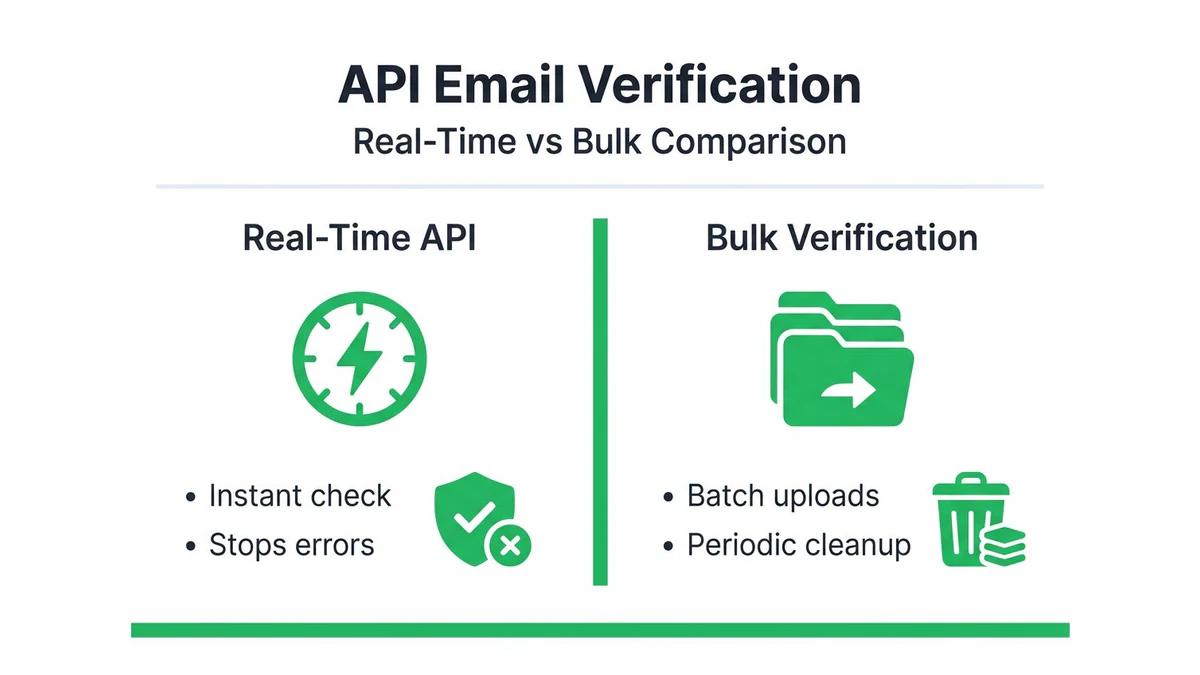
Bulk verification processes entire email lists in periodic batches, typically uploaded as CSV files for offline validation. You submit your list, wait for processing (minutes to hours depending on size), then download results showing valid, invalid, and risky addresses. This approach works well for cleaning inherited lists, purchased databases, or accumulated contacts before major campaigns.
Real-time API verification validates individual addresses instantly at data entry points like signup forms, registration pages, or checkout processes. Integration happens through API calls that return validation results in milliseconds, allowing immediate acceptance or rejection of submitted addresses. This prevents invalid emails from ever entering your database.
| Feature | Real-time API | Bulk Verification |
|---|---|---|
| Validation timing | Immediate at entry | Periodic batch processing |
| Prevention vs correction | Prevents bad data entry | Corrects existing data |
| User experience impact | Inline validation feedback | No user interaction |
| Best use case | Ongoing data collection | Cleaning existing lists |
| Processing speed per email | Under 200ms | Minutes to hours total |
| Automation level | Fully automated | Manual upload/download |
Real-time API verification reduces invalid registrations by up to 85% compared to bulk-only verification because it stops problems at the source. Bulk verification only identifies existing problems after they've accumulated, requiring you to handle the removal process and associated contact loss.
The limitations of bulk-only approaches include delayed correction that allows bad data to accumulate between cleaning cycles, and the risk of campaigns using stale data if verification doesn't happen immediately before sending. Lists degrade over time as addresses become invalid, so verification from weeks ago may not reflect current status.
Pro Tip: Combine both methods for optimal results by implementing real-time API verification on all data entry points while scheduling monthly bulk verification of your existing database to catch addresses that became invalid since entry. Learn more about bulk vs real-time verification and review our bulk verification workflow guide for detailed implementation steps.
Common misconceptions about email verification
Setting realistic expectations prevents disappointment and helps you use email verification as part of a comprehensive deliverability strategy rather than expecting it to solve all problems.
Misconception: Verification fixes all deliverability issues. Reality is that email verification improves bounce rates but does not guarantee perfect deliverability or replace good email content. Deliverability depends on multiple factors including sender reputation, content quality, engagement rates, authentication protocols, and recipient inbox provider algorithms. Verification addresses one critical component but cannot compensate for spam-triggering content or poor sending practices.
Misconception: All invalid emails are equally harmful. Some email types classified as risky may still deliver value. Catch-all domains, for example, often belong to small businesses that route all company email to shared inboxes. Blocking all catch-alls means losing potentially legitimate contacts. Similarly, some role-based addresses represent sole proprietors using generic-looking addresses for their personal business.
Misconception: Verification replaces content quality and sender reputation management. Even with a perfectly clean list, poor content triggers spam filters and low engagement damages sender reputation. Verification ensures your messages reach valid mailboxes, but recipients must still want to open and engage with your emails. Focus on:
- Compelling subject lines that avoid spam trigger words
- Valuable content that recipients anticipate and appreciate
- Consistent sending schedules that build recognition
- Easy unsubscribe options that respect recipient preferences
Pro Tip: Balance verification strictness to avoid false positives by testing different risk tolerance levels in your API configuration, starting with blocking only high-risk categories (disposable, spam traps) while accepting medium-risk addresses (catch-alls, role-based) to measure impact on both deliverability and list growth. Explore more about email verification misconceptions to set appropriate expectations.
Practical implementation and integration best practices
Successful API email verification requires thoughtful implementation beyond simply connecting an API. Following these stepwise practices maximizes benefits while avoiding common pitfalls.
- Identify specific needs and goals by analyzing your current bounce rates, list sources, and verification pain points to determine where real-time validation provides the most value.
- Select an API provider that offers the verification layers you need, provides clear documentation, supports your required request volume, and fits your budget.
- Implement real-time checks at critical data entry points including registration forms, newsletter signups, checkout pages, and lead capture forms.
- Schedule automated bulk cleans of your existing database on a monthly or quarterly basis to maintain ongoing list hygiene for contacts acquired before API implementation.
- Monitor results and adjust by tracking metrics like bounce rate reduction, list growth rate changes, and deliverability improvements to optimize verification settings.
- Test integrations thoroughly in staging environments before production rollout to ensure verification calls don't disrupt user experience or cause form submission failures.
Effective integration includes platform compatibility, workflow automation, handling API limits, and data privacy adherence to ensure seamless operation. Most enterprise-grade verification services support direct integration with over 20 major marketing platforms and CRMs including Mailchimp, HubSpot, Salesforce, ActiveCampaign, and Klaviyo through native plugins or webhooks.
Workflow automation benefits extend beyond simple validation. Configure automatic actions based on verification results, like routing high-risk signups to a separate nurture track or flagging catch-all domains for manual review. API rate limits require attention in high-traffic scenarios. Implement request queuing, caching of recent results, and fallback logic if the API becomes temporarily unavailable.
Data privacy compliance remains critical when sending email addresses to third-party verification services. Ensure your API provider maintains GDPR and CCPA compliance, processes data securely, doesn't store validated addresses unnecessarily, and provides data processing agreements documenting their privacy commitments.
Pro Tip: Test integrations in staging before production by creating test forms with known valid, invalid, and risky email addresses to confirm the API responds correctly and your application handles all response types appropriately without breaking user experience. Review our email verification integration guide for detailed technical implementation instructions.
Benefits to ROI, deliverability, and engagement
The business case for API email verification becomes clear when you examine measurable improvements companies achieve after implementation. These outcomes directly impact revenue and marketing efficiency.
Bounce rate reductions represent the most immediate and dramatic improvement. Organizations typically see bounce rates drop from 5-10% down to under 2% after implementing comprehensive verification. Lower bounce rates protect sender reputation because inbox providers use bounce rates as a key signal for filtering decisions.
Engagement improvements follow naturally from cleaner lists:
- Open rates increase by 15-30% when invalid and risky addresses are removed because you're measuring engagement only from legitimate, active recipients
- Click-through rates improve as your audience consists of real people genuinely interested in your content rather than disposable addresses or spam traps
- Conversion rates rise because you're investing sending resources in contacts capable of taking desired actions
Blacklist risk mitigation prevents the catastrophic reputation damage that occurs when you accidentally email spam traps or consistently hit invalid addresses. Email verification reduces bounce rates, improves open and click rates, lowers spam complaints, and enhances ROI by ensuring you only send to legitimate, engaged contacts. Once blacklisted, recovery takes weeks or months and damages deliverability across your entire program.
"Email verification isn't just about reducing bounces. It's about protecting your sender reputation, maximizing the return on every email you send, and ensuring your marketing investments reach real people who can become customers. The financial impact extends beyond immediate campaign performance to long-term brand deliverability and customer relationship value."
These combined benefits deliver measurable ROI improvements. When you reduce wasted sends to invalid addresses, lower the risk of deliverability problems, and improve engagement metrics, the cost per acquisition decreases while customer lifetime value increases. Learn more about email verification business benefits and how to improve email marketing roi through strategic verification implementation.
Explore AI-first email verification with BillionVerify
Ready to implement the API email verification strategies outlined in this guide? BillionVerify offers AI-driven email verification technology with multi-layer validation that detects disposable emails, spam traps, role-based addresses, catch-all domains, and risky domains with enterprise-grade accuracy.
Our platform provides seamless real-time API integration with over 20 major marketing platforms and CRMs, plus powerful bulk verification for existing lists. Whether you're processing thousands or millions of emails monthly, BillionVerify scales to meet your needs while maintaining sub-200ms response times. The AI-powered verification engine continuously learns from billions of validation data points to improve accuracy and reduce false positives.
Explore AI-first email verification solutions designed specifically for email marketers and e-commerce managers who demand reliable deliverability and measurable ROI improvements. Start with a free trial to see how verification transforms your campaign performance.
Pro Tip: Take advantage of free trials to test API performance with your actual forms and traffic patterns before committing, ensuring the verification speed and accuracy meet your specific requirements.
Frequently asked questions
What is API email verification?
API email verification is an automated real-time service that validates email addresses through programming interfaces connected to your websites, forms, or marketing systems. When users submit email addresses, the API instantly checks validity through multiple layers including syntax validation, domain verification, mailbox existence, and risky email detection before the address enters your database.
How does real-time API verification improve email list quality?
Real-time API verification prevents invalid, disposable, and risky email addresses from entering your database at the point of collection. This proactive approach reduces bounce rates by up to 98%, protects sender reputation, and ensures your list contains only legitimate contacts capable of engagement. Unlike bulk verification that cleans existing lists periodically, real-time validation stops bad data at the source.
Can API email verification reduce spam complaints?
Yes, API email verification significantly reduces spam complaints by detecting and blocking spam traps, disposable emails, and risky domains that generate complaints. When your list contains only legitimate, opted-in contacts who provided valid addresses, complaint rates drop dramatically. However, verification must be combined with quality content and proper permission-based sending practices for maximum complaint reduction.
What types of emails should I block using verification?
At minimum, block disposable emails, known spam traps, and blacklisted domains which provide zero value and actively harm deliverability. Consider your risk tolerance for catch-all domains and role-based addresses, as these categories include both risky and potentially legitimate contacts. Test different filtering levels by starting strict and gradually accepting medium-risk categories while monitoring bounce and engagement metrics to find your optimal balance.
How do I integrate an email verification API with my marketing platform?
Most enterprise verification providers offer native plugins or webhook integrations for major platforms like Mailchimp, HubSpot, Salesforce, and ActiveCampaign. Integration typically involves obtaining API credentials, configuring verification settings, implementing API calls at data entry points, and setting up automated actions based on verification results. Test thoroughly in staging environments with known valid and invalid addresses before production deployment to ensure proper functionality without disrupting user experience.