




Financial services email marketing is commercial email sent by banks, credit unions, lenders, brokers, advisers, insurers and fintech companies. It follows the same law as any other promotional email, and then a second layer applies that depends on who sends it and what the message promotes. A deposit offer meets Truth in Savings requirements, a loan ad falls under Truth in Lending, and a broker-dealer newsletter goes through FINRA review. Whichever layer applies, the sender must also pass the authentication checks that the large mailbox providers now run.
This guide merges the two earlier posts on banking and fintech email into one and rebuilds them from primary sources. Every requirement below was read on a regulator, standards body or mailbox provider site in November 2026, and each one names its section so you can check it. The earlier posts quoted open rates and bounce benchmarks with no source, and those figures are gone. We have no connection with any agency or provider named here, regulations change, and none of this is legal advice, so run each campaign past your email compliance team.
Key facts (checked November 2026):
- The FTC's CAN-SPAM compliance guide says each separate email in violation can draw penalties of up to $53,088, and that the law makes no exception for business-to-business email.
- The FDIC's provision on the official advertising statement requires an insured bank to include it in advertisements that promote deposit products or non-specific banking services.
- FINRA Rule 2210 treats a written communication to more than 25 retail investors within 30 days as a retail communication, which a registered principal must approve.
- Regulation P, in § 1016.12, generally bars a financial institution from giving a customer's account number to a nonaffiliated third party for email marketing.
- Google's email sender guidelines require SPF, DKIM and DMARC from anyone sending more than 5,000 messages a day to Gmail, and ask every sender to keep spam rates below 0.3%.
Which Laws Reach Which Sender
Financial services email marketing is regulated by who you are, not by the channel you use. A national bank, state credit unions, registered advisers and lending apps can all send the same welcome email and still answer to different agencies. The first job for any financial services firm is to write down which laws reach it, because the rest of this guide applies only in part to each sender.
The table gives the main requirement family for each type of sender, with the citation that sets it. It covers the United States only, and it is a map, not a full list. State insurance advertising law is not covered here.
| Sender | What reaches its email | Citation |
|---|---|---|
| Any sender of marketing email | Header, subject, address and opt-out duties | CAN-SPAM, 15 U.S.C. 7704 |
| FDIC-insured bank | Insurance wording, claims ban | Part 328, sections 328.6 and 328.102 |
| NCUA-insured credit union | Accuracy duty and NCUA wording | Part 740, sections 740.2 and 740.5 |
| Institution advertising deposits | Yield wording and disclosures | Savings ads, § 1030.8 |
| Lender advertising loans or cards | Percentage rate and triggering terms | Lending ads, § 1026.24 |
| Broker-dealer | Public communications, supervision, retention | FINRA 2210 and 3110, SEA 17a-4 |
| Registered investment adviser | Advertising and testimonials | Investment adviser marketing provision |
| Any financial institution | Privacy notices, account number limits | Privacy, part 1016 |
| Firms the FTC oversees | Written security program | Safeguards Rule, 16 CFR 314 |
Fintech companies sit in several rows at once, as many financial services firms do. A lending app answers to the credit advertising requirements, a company that holds customer data answers to the security program, and a company that mentions a partner bank answers to the FDIC name provision. A later part returns to this.
CAN-SPAM Basics for Financial Email
CAN-SPAM is the base layer for financial services email marketing, and every commercial message must meet it. The FTC guide lists eight duties. Do not use header information that is false or misleading. Do not use deceptive subject lines. Identify the message as an ad. Give a valid physical postal address. Explain how to opt out. Honor opt-outs within 10 business days, and keep the opt-out mechanism working for at least 30 days after sending. Last, remember that hiring another company to send your email does not shift your legal responsibility, because both the advertiser and the sender can be held liable.
The penalty is the figure in the key facts above, and it applies per email. A campaign to a large list multiplies it quickly, which is why opt-out handling is worth automating. The FTC also states that the law covers messages between companies, so a wealth manager writing to company owners follows the same duties as a lender writing to households. Our CAN-SPAM guide covers the act in more detail.
Account messages are not all marketing
Lenders send plenty of servicing email alongside their promotions, and CAN-SPAM treats the two differently. A transactional or relationship message is exempt from most duties, though its routing information must still be accurate. The FTC text on the primary purpose of a message lists what counts. It includes content that facilitates, completes or confirms a transaction the recipient already agreed to, and safety or security details about a product the recipient uses. It also covers a change in the terms or features of an account, a shift in the recipient's standing, and regular balance details or statements.
The FTC guide adds that the law reads these categories narrowly, so a note to an existing customer is not exempt merely because of who receives it. Mixed content is where institutions get caught. If a statement notice also carries a product promotion, the whole email is treated as commercial when the subject line would lead a reader to expect a promotion, or when the servicing content does not appear at the start of the body. Our guide to transactional emails covers the design side of keeping the two apart.
Harvested and guessed addresses
CAN-SPAM also governs how addresses are collected, in § 7704(b). It covers addresses taken by automated means from a website that posted a notice barring transfer of its addresses for email purposes. It also covers addresses generated by automated tools that combine names, letters or numbers into possible mailboxes. Both matter to a firm that prospects by guessing an executive's mailbox from a name and a company domain. Collect addresses from people who gave them to you, and test any guessed one before sending.
Promotions by Banks and Credit Unions
Once an email promotes a bank product, product-specific law applies on top of CAN-SPAM. The provisions here were written for advertising in any medium, and none of them carves out email. A promotional email is therefore an advertisement, and the team that reviews a branch flyer should review the email too.
The FDIC and NCUA wording
Any bank with FDIC coverage must include the statement defined in § 328.6 in each advertisement that promotes deposit offerings, or that names the institution without describing any particular product. The wording, in substance, is "Member of the Federal Deposit Insurance Corporation", and the short forms "Member FDIC" and "FDIC-Insured" are allowed. It must be clearly legible, and the text lists a few exempt items such as stationery and some signs.
Federal credit unions follow NCUA's § 740.5, which asks for the matching line in all advertisements, including the main internet page. It accepts "Federally insured by NCUA", or a shorter version without the first word, and the text may be no smaller than the smallest font used for information elsewhere in the ad. NCUA's accuracy provision adds that no advertising may be inaccurate or deceptive in any particular. A footer is the natural home for either line, provided it stays legible on a phone.
Deposit rate emails
Rate emails come with a long list of mandatory wording. Regulation DD, in § 1030.8, says an advertisement may not be misleading or inaccurate. If it states a rate of return, it must use the term "annual percentage yield", and the short form APY is allowed once the full term appears. The only other rate it may state is the "interest rate", and only if that is not more conspicuous than the yield. The same text bars calling an account "free" or "no cost" if any maintenance or activity fee may be imposed.
When the yield appears, the ad must also state the following, to the extent applicable, clearly and conspicuously. It must say whether a variable rate may change after opening, and for how long the yield is offered or the date it is accurate as of. It must give the minimum balance to earn the yield and the minimum opening deposit if that is higher. It must say that fees could reduce earnings. For time accounts it must give the term and state that a penalty will or may be imposed for early withdrawal. A bonus triggers a separate list of terms.
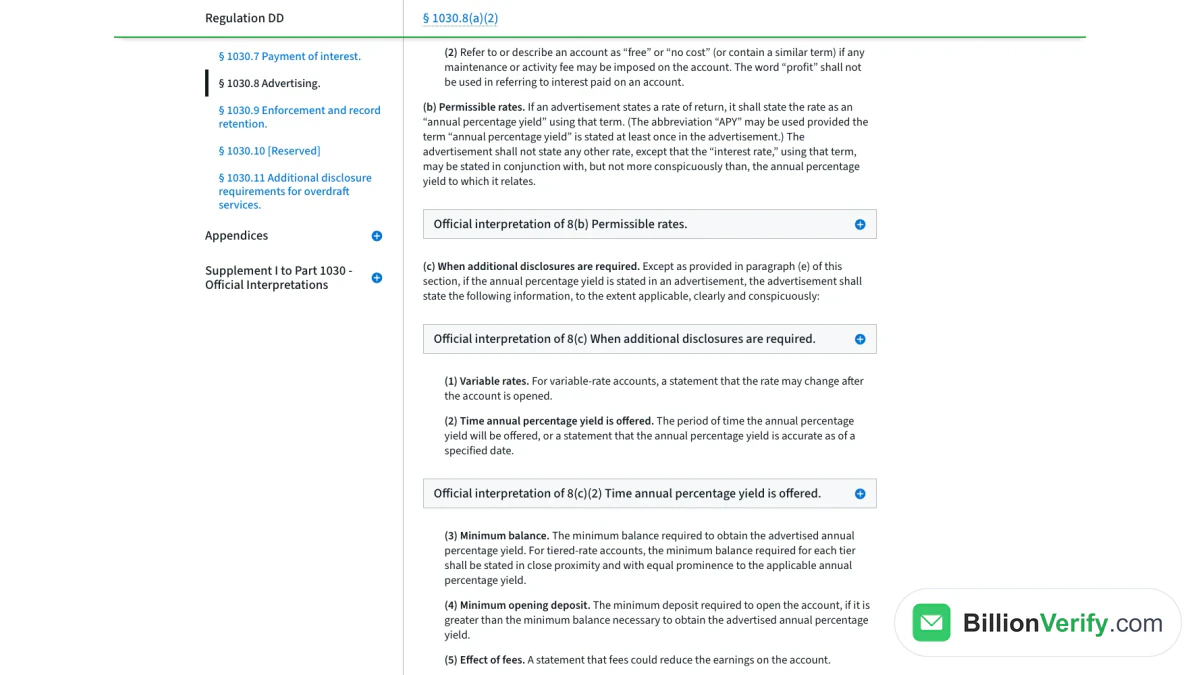
Screenshot: the CFPB page for § 1030.8 with the yield wording and the extra disclosures, captured in November 2026.
Subsection (e) exempts some media from part of that list, and its examples are television, radio, billboards and telephone response machines. Email is not named. Do not assume a rate email can shorten the disclosures, and ask your email compliance reviewer before you try.
Loan and card emails
For credit, the controlling text is Regulation Z, § 1026.24. An ad that states specific credit terms may state only terms the creditor actually arranges or offers. A stated finance charge rate must be an "annual percentage rate", using that term. The text then names triggering terms: the amount or percentage of any down payment, the number of payments or period of repayment, the amount of any payment, and the amount of any finance charge. If an email mentions one, it must also state, as applicable, the down payment, the repayment terms and the rate. A subject quoting a monthly payment is stating one of those terms.
Fair lending covers the audience and the imagery as much as the offer. Regulation B, in § 1002.4(b), says a creditor may not make a statement, in advertising or otherwise, that would lead a reasonable person to believe the creditor would deny an application, or grant it on worse terms, because of a prohibited basis. The provision counts visual images such as photographs and videos as statements. A segment or a hero picture that signals who is welcome is therefore a compliance question, not only a design choice.
Broker-Dealers and Advisers
Securities firms face a different set of requirements, and email sits squarely inside them. Rule 2210(a) splits written communications, electronic ones included, by audience. Correspondence goes to 25 or fewer retail investors during any 30 calendar days. Anything wider is a retail communication, and an institutional communication goes only to institutional investors. The split decides who must review a message before it leaves.
An appropriately qualified registered principal has to sign off on each retail communication under 2210(b)(1)(A), subject to the exceptions in the rest of that paragraph. Correspondence falls under the supervision standard in FINRA 3110. Its paragraph (b)(4) calls for written procedures for reviewing correspondence, suited to the firm's business, size and customers, with a principal's review evidenced in writing. The supplementary material says merely opening a communication is not sufficient. A firm whose procedures do not require review before use must provide for training, documentation of that training, and surveillance and follow-up.
The content standard applies to everything. Rule 2210(d)(1) says communications must be fair and balanced and based on principles of fair dealing and good faith. It bars false, exaggerated, unwarranted, promissory or misleading claims, and it bars predicting or projecting performance or implying that past performance will recur. A subject line is a claim too, so "guaranteed" and "can't lose" belong in the email compliance log, not the campaign. Anyone building FINRA email compliance into a template library should start from those two paragraphs of the rule.
Records follow the same path. Rule 2210(b)(4) points to SEA Rule 17a-4, whose clause (b)(4) covers originals of communications received and copies of communications sent that relate to the firm's business. That includes items subject to self-regulatory standards on communications with the public. Such records must be kept for not less than three years, the first two in an easily accessible place. A marketing platform that cannot export a sent message and its approval has a records problem before it has an email problem.
Registered investment advisers answer to the SEC's own advertising provision instead, 17 CFR 275.206(4)-1. It defines an advertisement as a communication to more than one person, or to one person if it includes hypothetical performance, that offers advisory services. Its general prohibitions bar untrue statements, claims the adviser cannot substantiate on demand, and benefit claims that give no balanced treatment of material risks. Testimonials and endorsements need clear disclosures and a written agreement, subject to exemptions, and an SEC staff FAQ on testimonials was updated in January 2026. A client quote about the adviser in a newsletter can be a testimonial, so route it through the same review.
Privacy, Consent and Data Handling
Marketing to financial customers means handling data the law treats as sensitive. The standards here govern what you may send, what you may share and how you must protect it, and email compliance gets harder when outside vendors are involved.
Privacy notices and account numbers
The Gramm-Leach-Bliley privacy provisions for lenders, banks and similar firms sit in part 1016. A customer must receive a clear and conspicuous notice of privacy practices when the relationship begins, and again at least once in each 12 consecutive months, unless an exception applies. Under § 1016.9 the notice must reach the consumer in writing or, if the consumer agrees, electronically. An example of what is not a reasonable expectation of actual notice is an emailed copy sent to a consumer who never dealt with the institution online. A privacy notice emailed to a branch-only customer therefore does not count.
Another provision, § 1016.12, matters most to marketing vendors. It bars disclosing an account number or similar access code for a credit card, deposit or transaction account to an unaffiliated outside company for telemarketing, direct mail or email marketing to the consumer. An exception covers a service provider that performs marketing for your own products and cannot initiate charges to the account. An encrypted number does not count if the recipient has no means to decode it. In practice, keep payment identifiers out of the merge fields you send to an email platform.
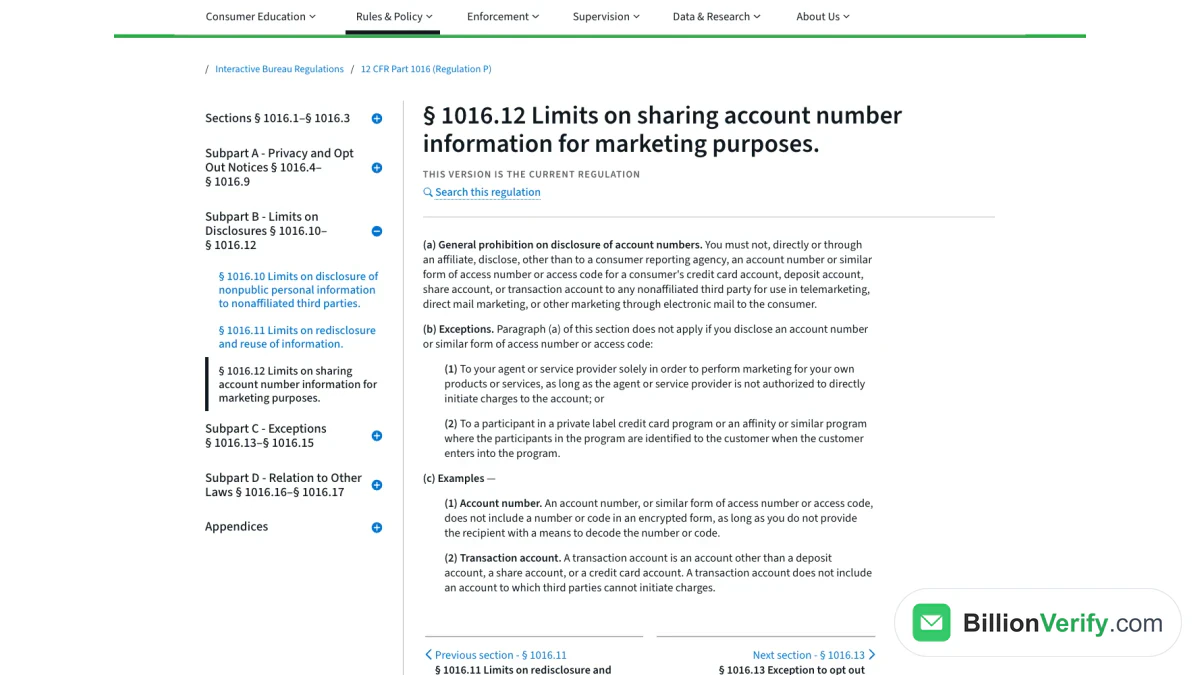
Screenshot: CFPB's Regulation P text for § 1016.12, showing the ban on sharing payment-card and checking numbers and its exceptions, viewed in Nov 2026.
Electronic delivery and security
Required disclosures delivered electronically also meet the E-SIGN Act. Under 15 U.S.C. 7001(c), electronic delivery of information that the law requires in writing counts only if the consumer has affirmatively consented and has not withdrawn that consent. Before agreeing, the consumer must see a clear statement of the right to a paper copy, the right to withdraw, and the hardware and software needed to read the records. The consent itself must show the consumer can open the format in use. Consent captured at account opening has to meet that standard.
For companies under FTC jurisdiction, the Safeguards Rule in 16 CFR 314.4 sets the security baseline. It calls for encryption of customer information held or sent over external networks, multi-factor authentication for anyone accessing an information system, and oversight of service providers by contract. An email platform that stores customer data is a service provider. The FTC's business guidance lists mortgage brokers, finance companies, tax preparers and non-federally insured credit unions among covered firms.
Outside the United States, consent comes first. The UK regulator says you must not send marketing email to individuals unless they have specifically consented, with a soft opt-in for existing customers who were given a simple way to opt out when their details were first collected and in every message. Our guide to GDPR email marketing covers the EU side.
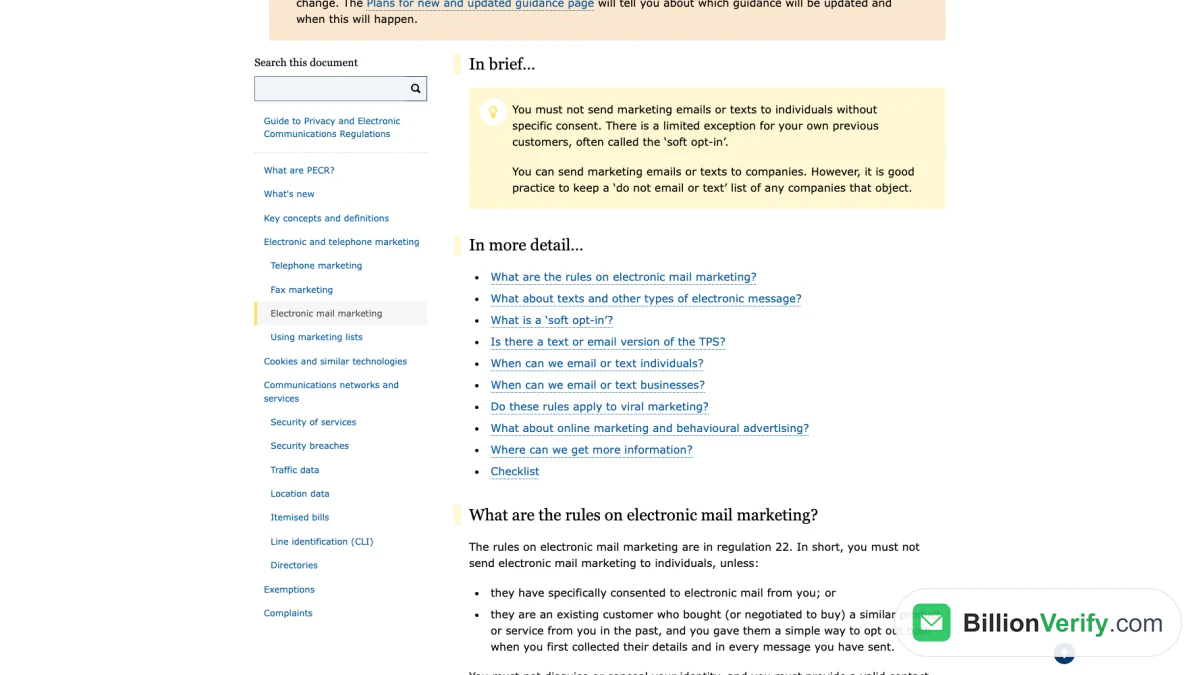
Screenshot: the ICO guide to electronic mail marketing with the consent requirement and the soft opt-in conditions, taken in Nov 2026.
Fintech and Non-Bank Lenders
Fintech companies often assume that being a non-bank means lighter duties, yet a lending app is still a financial services company. The law follows the activity, not the license. A lending app that advertises credit is covered by the credit-ad and equal credit provisions. The CFPB's page on privacy duties says they may reach mortgage lenders without a bank charter, businesses that extend credit or service loans, mortgage brokers, tax preparers and debt collectors. The FTC says its Safeguards Rule depends on the activities your business undertakes, not on how the company is categorized.
The sharpest fintech trap is the FDIC name. Under § 328.102 no person may represent or imply that an uninsured financial product is insured or guaranteed by the FDIC through FDIC-associated terms or images in an advertisement. It targets promotions that suggest the sender is associated with an insured bank without a clear, conspicuous, prominent and accurate description of the association. It also bars wording that inaccurately states or implies that anyone other than an insured depository institution is insured. The definitions in § 328.101 name email marketers among third-party publishers, so the ban reaches the sender and the vendor.
A fintech that holds funds at a partner bank should therefore write the relationship out in plain words. "Funds are held at Example Bank, Member FDIC" is a statement about the bank, and it should not sit next to a product name in a way that suggests the product is itself insured. Non-deposit products, a class the text extends to insurance products, annuities, mutual funds, securities and crypto-assets, need the clearest wording. The eCFR version read in November 2026 shows amendments to the definitions, the latest dated January 29, 2026, so check the current text before you build templates around it.
Authentication and Deliverability Standards
Compliance gets a message approved, and authentication gets it delivered. Financial services email marketing also has to clear the mailbox providers' own standards for large senders. Google's guidelines apply to all senders to personal Gmail accounts. They call for SPF or DKIM authentication, valid forward and reverse DNS records, a TLS connection, messages formatted to RFC 5322, and spam rates reported in Postmaster Tools below 0.3%.
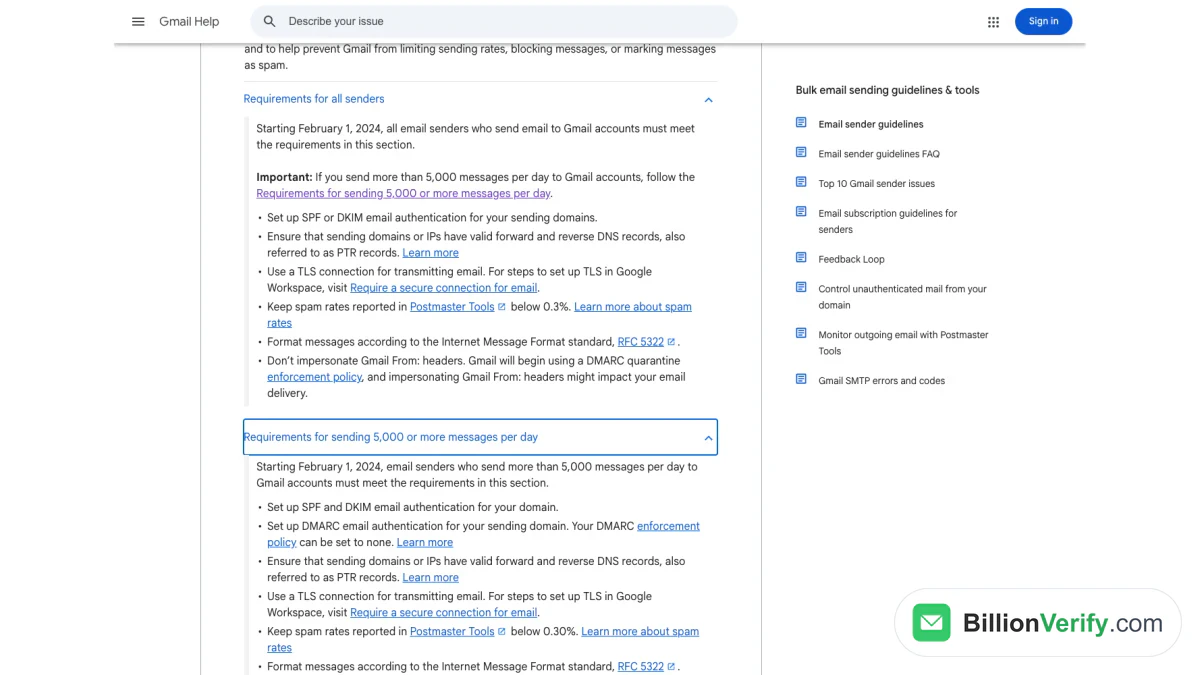
Screenshot: Google's help page on sender requirements, with the baseline for every sender and the bulk tier, as of Nov 2026.
At the bulk tier, Google asks for both mechanisms, plus a DMARC record whose policy can be set to none. Marketing and subscribed mail must support one-click unsubscribe, which means a clearly visible unsubscribe link in the body and the List-Unsubscribe and List-Unsubscribe-Post headers. The header method is defined in RFC 8058, written because mail software sometimes fetches the URLs in headers and triggers unsubscriptions by accident. Google's monitoring advice goes further than the 0.3% cap. It says to hold the rate under 0.10% and to avoid ever reaching 0.30%.
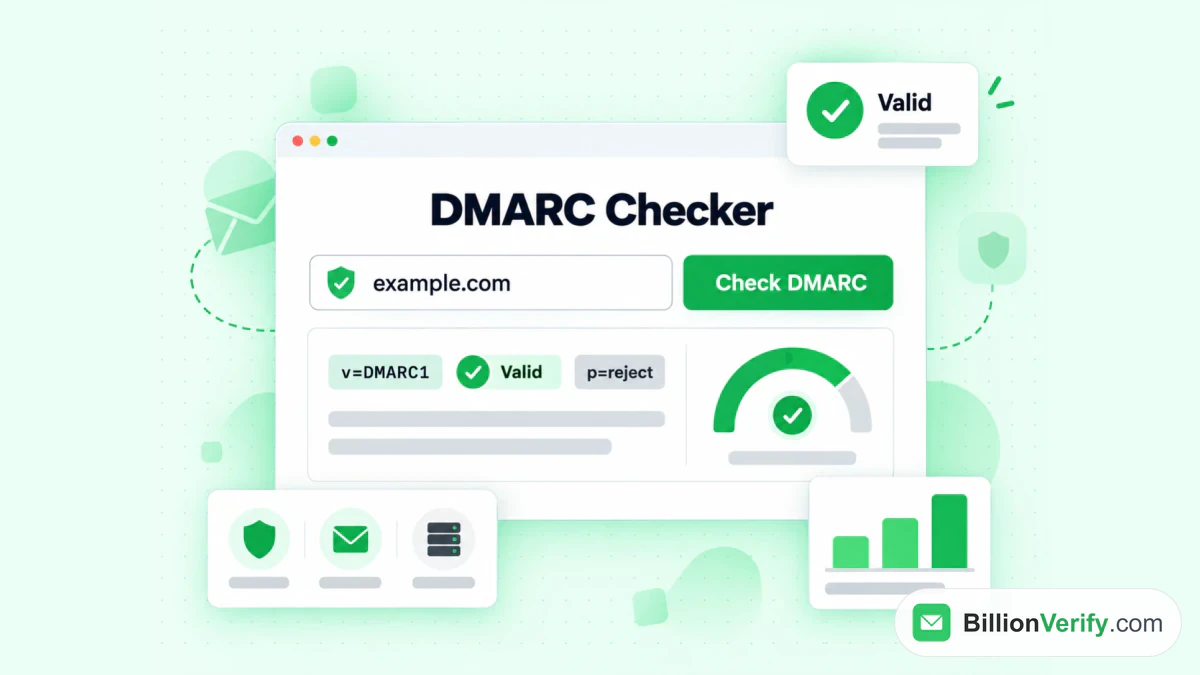
Microsoft's announcement for high-volume senders applies to domains sending over 5,000 emails per day. DKIM and SPF must pass, and DMARC must be at least p=none and align with one of them. The post sets May 5, 2025 for enforcement and names the rejection text "550; 5.7.515 Access denied". For a lender, the better target is stronger than the minimum. The DMARC standard, RFC 7489, lets a domain owner ask receivers to treat failing mail under the policies none, quarantine or reject. A reject policy on your sending domain asks receivers to refuse mail that fails the check, which makes it harder for a phisher to send in your name, and you can read a published record with the DMARC checker.
Verify Addresses Before Sending
Authentication covers your domain, and the list covers your reputation. A financial services email list grows at account opening, on loan applications, through branch staff and from business contacts, and each channel adds typos and abandoned inboxes. Every bounce counts against the domain you send from, so a bad list erodes the sender reputation that Google and Microsoft are measuring. The cost is not only deliverability. A mistyped address means a privacy notice, a statement alert or a security notice lands in a stranger's inbox, and the institution believes it delivered something it did not.
Check at the point of entry. The free tool lets you check whether an email address exists with no signup, running syntax, DNS, MX and live SMTP tests and reporting disposable, role and catch-all results separately. For sign-up forms, imports and existing customer files, BillionVerify applies the same layers through a REST API or in bulk, and its bulk email verification page covers file uploads. Valid and invalid results cost a credit each, unknown results cost nothing, and catch-all domains are reported as their own category instead of valid. A free plan gets 20 credits on each day it is used, up to 600 a month, with no credit card. Our article on email verification during signup shows where the check fits in a form.
Contact data has more than one field. If an application also collects a mobile number, a phone number validator checks whether the number is valid for its country and reports its line type. When a new applicant's address looks odd for other reasons, a reverse email lookup reads the domain, organization and public profile behind it. Neither tool replaces your identity verification program, and neither feeds a credit decision.
Building a Compliant Program
A working financial services email marketing program starts with sorting messages by type, because the type decides the governing law. The table classes common financial emails under the CAN-SPAM primary-purpose test and names the additional requirement you will probably meet. The class column is a starting point for review, not a ruling, because a message with mixed content can change class.
| Message | CAN-SPAM class | Likeliest additional requirement |
|---|---|---|
| Fraud or security alert | Transactional (security information) | Keep promotion out of the email |
| Monthly statement notice | Transactional (periodic statement) | E-SIGN consent for electronic delivery |
| Notice of changed terms | Transactional (change in terms) | Product-specific disclosures |
| Privacy notice | Required notice | Privacy delivery standards |
| CD or savings rate promotion | Commercial | Deposit-ad requirements and the insurance wording |
| Loan or card offer | Commercial | Advertising and fair-lending requirements |
| Newsletter from a broker-dealer | Commercial | FINRA 2210 review and retention |
| Product update from a fintech | Commercial | FDIC insurance claims, security program |
Most failures come from missing process, not from missing law, whether the sender is a bank or a broker, so build an email compliance program once and let every campaign inherit it. Start by mapping each message type to its class and to the provision that governs its content. Keep promotional content out of transactional messages, or move the servicing content to the top and use a neutral subject.
Lock the required statements into a template that campaign staff cannot edit. That means the insurance line, the postal address and the opt-out link. Send no account numbers or access codes to an email vendor, and put the vendor under a written security contract. Authenticate the sending domain with every standard above, and add the unsubscribe headers.
Verify addresses when you collect them and again before large sends. Finally, archive every sent message together with its approval, for the retention period your regulator sets.
Segmentation deserves the same discipline. Separate service messages from marketing consent so an unsubscribe from promotions never blocks a fraud alert, and honor channel preferences. The opt-out duty applies to marketing messages, and the transactional class exists so that customers keep receiving the notices they need. Document each consent with a date and a source, because an auditor will ask for it, and keep the suppression list somewhere every sending system reads it.
FAQs
Does CAN-SPAM apply to emails from a bank?
Yes, for the commercial ones. When a bank promotes a product, the email has to meet all the CAN-SPAM duties, while pure servicing messages such as statements, balance details and security alerts fall into the servicing category and are exempt from most of them. Their routing information still has to be accurate, and a message that mixes the two is judged by its subject line and layout.
Does every financial email need "Member FDIC"?
No. The FDIC provision asks for the statement in ads that promote deposit offerings or name an insured institution generally. Statements of condition, stationery and certain other items are exempt. NCUA-insured institutions follow NCUA's own wording instead, and fintech companies must not borrow insurance terms to imply coverage they lack.
Are emails from a financial adviser regulated?
They can be. A broker-dealer email that reaches a wider group than the correspondence limit is a retail communication under FINRA standards, and a registered adviser's email that markets advisory services to more than one person is an advertisement under the SEC provision. One-on-one messages without performance claims fall outside the SEC definition, but a broker-dealer's correspondence is still supervised.
Can a privacy notice be sent by email?
Only with the consumer's agreement, and only where the customer already transacts with you online. The privacy provisions do not treat an emailed copy as reasonable proof of delivery for a person who never used an online channel. Customers who bank online and agreed to electronic delivery are the usual case.
What do mailbox providers require from financial senders?
Above the 5,000-a-day threshold, Gmail wants SPF, DKIM, DMARC and a simple unsubscribe mechanism on marketing mail. Microsoft asks domains at that volume to pass SPF and DKIM and to publish DMARC at p=none or stricter. Smaller senders still have to meet Google's baseline authentication and its spam-rate cap.
Do these regulations apply to fintech apps that are not banks?
Often yes. Credit advertising law applies to anyone who advertises credit, the Safeguards Rule follows activity rather than charter type, and the FDIC ban applies to any person who implies insurance. A fintech that partners with a bank must describe the partnership accurately and avoid insurance terms next to uninsured products.
Watch: How to Verify Emails From BBB Business Listings
Watch: Email Verification Pricing: Plans vs Credits Explained