



Your email campaigns are falling flat. Bounce rates hover around 8%, open rates barely crack 15%, and your sender reputation takes hit after hit. The culprit? Invalid email addresses polluting your list and sabotaging every send. Email verification isn't just technical housekeeping, it's your direct path to higher engagement, better deliverability, and campaigns that actually reach inboxes. This guide walks you through proven verification strategies that slash bounce rates to under 2% while boosting open rates by nearly 30%. You'll discover how layered verification protects your domain, saves marketing dollars, and transforms struggling campaigns into engagement powerhouses.
Key takeaways
| Point | Details |
|---|---|
| Verification cuts bounce rates dramatically | Proper email verification reduces bounce rates from 8.4% to just 1.2%, protecting sender reputation. |
| Inbox placement improves over 30% | Verified lists achieve 34% better inbox placement, ensuring your messages reach real recipients. |
| Layered methods maximize accuracy | Combining syntax checks, domain validation, SMTP verification, and catch-all detection delivers 97-99% accuracy. |
| Invalid emails drain marketing budgets | Companies lose hundreds of dollars per employee annually on wasted sends and skewed metrics. |
| Ongoing verification sustains gains | Regular list cleaning maintains engagement improvements and prevents reputation decay over time. |
Understanding the impact of invalid emails on engagement
Invalid emails silently destroy your email marketing performance. Every undeliverable address in your list creates a bounce that damages engagement metrics, wastes budget, and signals to ISPs that your campaigns might be spam. When bounce rates climb above 5%, email providers start flagging your domain, and sustained high bounces can land you on blacklists that block legitimate messages for weeks or months.
The financial impact hits harder than most marketers realize. Invalid emails cost companies $792 per employee annually through wasted sends, inflated support costs, and metrics that mislead strategy decisions. A campaign targeting 10,000 unverified addresses can generate 2,000+ bounces in a single send, triggering spam filters that damage deliverability across your entire email program. That's not just one failed campaign, it's systematic reputation damage that compounds over time.
Three critical ways invalid emails sabotage engagement:
- High bounce rates signal poor list hygiene to ISPs, pushing your emails toward spam folders instead of inboxes
- Wasted sends inflate cost per acquisition and distort ROI calculations, making profitable campaigns appear unprofitable
- Damaged sender reputation creates a negative feedback loop where even valid subscribers stop receiving your messages
Your sender reputation functions like a credit score for email. ISPs track bounce rates, spam complaints, and engagement patterns to decide whether your messages deserve inbox placement. A single campaign with 2,000 bounces can trigger blocks lasting weeks, during which even your best content never reaches subscribers. The solution starts with understanding that list quality directly determines campaign success, and verification is how you achieve that quality.
"Every bounce is a signal to ISPs that you're not maintaining your list properly. Consistent high bounces tell them you might be a spammer, even when you're running legitimate campaigns."
Protecting your sender reputation isn't optional anymore. With inbox providers getting stricter about deliverability standards in 2026, maintaining clean lists through verification has become essential infrastructure for email marketing success. The alternative is watching engagement metrics decline while competitors with verified lists capture the attention and revenue you're missing. Taking steps to reduce email bounce rate protects both your current campaigns and your long-term email program viability.
Preparing your email list: key verification concepts and tools
Email verification isn't a single process, it's two distinct operations that many marketers confuse. Format validation and existence verification serve different purposes and catch different types of invalid addresses. Understanding this distinction helps you choose the right tools and set realistic expectations for list cleaning results.

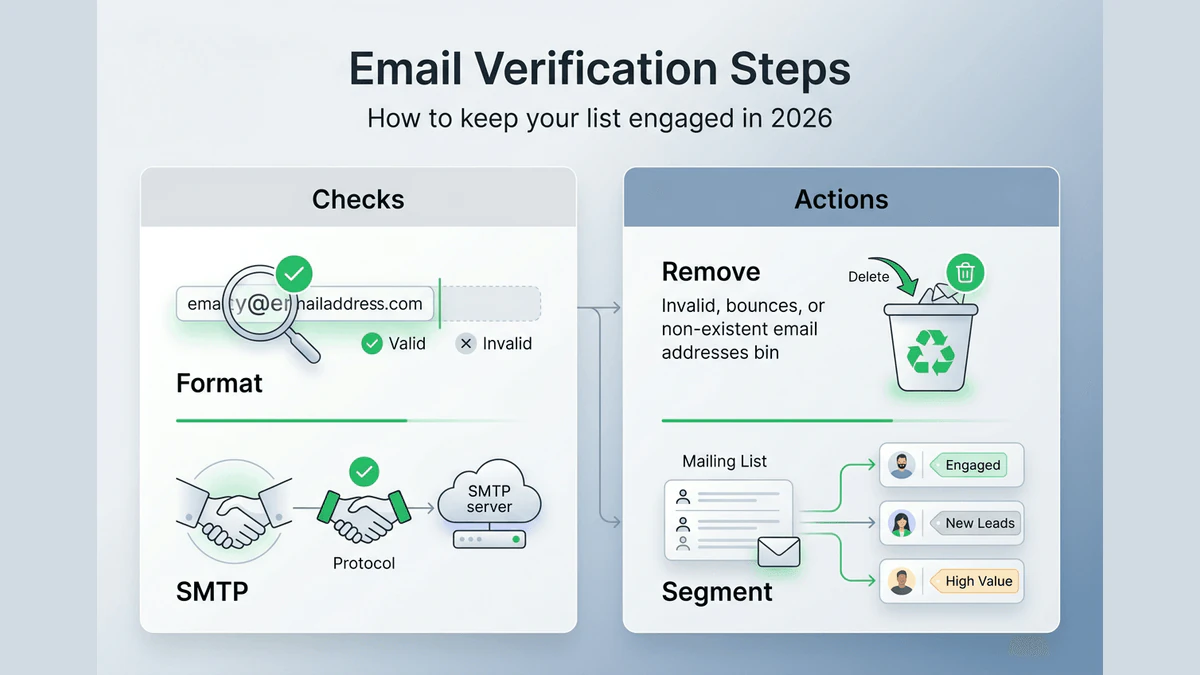
Format validation checks whether an email address follows correct syntax rules: username, @ symbol, domain name, and valid top-level domain. This catches obvious typos like missing @ symbols or spaces in addresses. However, syntax validation only catches 5-8% of invalid addresses because most typos still follow valid formatting patterns. An address like "johndoe@gmial.com" passes syntax checks despite the misspelled domain, and it will bounce when you send.
Existence verification goes deeper by confirming that a mailbox actually exists at that address. This process connects to mail servers, queries whether the address is active, and returns detailed status information without sending an actual email. Existence checks catch the 92-95% of invalid addresses that slip past format validation, including abandoned accounts, typos in usernames, and addresses on domains that no longer accept mail.
Key verification concepts every marketer should understand:
- Syntax validation is fast and cheap but catches only obvious formatting errors
- Existence verification requires server communication and provides much higher accuracy
- Catch-all domains accept all emails, making it impossible to verify individual addresses without specialized detection
- SMTP validation communicates directly with recipient servers for the most reliable existence checks
The verification landscape includes multiple tools and approaches, each with different accuracy levels and costs. Basic regex checkers only validate format. DNS lookups confirm domains exist but can't verify individual mailboxes. SMTP validation provides the highest accuracy by simulating email delivery without actually sending messages. Understanding these differences helps you build an email validation process that balances thoroughness with efficiency.
Pro Tip: Start with a small sample of your list to test verification tools before processing your entire database. Compare results across 500-1000 addresses to see which service catches the most invalids without generating false positives that remove valid subscribers.
Your preparation phase should also include segmenting your list by engagement history. Addresses that have never opened an email in six months might be invalid even if they pass verification, while recently engaged subscribers deserve priority verification to ensure they keep receiving your campaigns. This strategic approach to list hygiene combines verification technology with engagement data for maximum impact. Learning essential email verification methods sets the foundation for executing effective verification workflows that actually improve campaign performance.
Executing an effective email verification workflow
A comprehensive verification workflow applies four distinct layers of checking, each adding precision to catch different types of invalid addresses. This layered approach balances speed, cost, and accuracy to deliver the cleanest possible lists without removing valid subscribers or breaking your budget.
Layer one: Syntax and format validation
- Check for proper email structure with username, @ symbol, domain, and valid TLD
- Identify obvious typos like double @ symbols, missing dots, or invalid characters
- Flag addresses with suspicious patterns like random character strings or excessive numbers
- Remove addresses with known disposable email domains that users abandon immediately
Layer two: Domain validation
- Verify the domain exists through DNS lookup and has valid MX records for receiving email
- Check domain reputation to identify spam traps, blacklisted domains, or high-risk providers
- Detect role-based addresses like info@ or support@ that typically generate lower engagement
- Flag recently created domains that might indicate temporary or fraudulent accounts
Layer three: SMTP validation
- Connect to the recipient's mail server using SMTP protocol without sending actual email
- Simulate the email delivery process to verify the mailbox exists and accepts messages
- Receive detailed server responses that indicate deliverability status with high precision
- Achieve 97-99% accuracy by confirming mailbox existence directly with authoritative servers
Layer four: Catch-all detection
- Identify domains configured to accept all emails regardless of whether individual mailboxes exist
- Apply specialized testing to determine if addresses on catch-all domains are likely valid
- Flag these addresses for separate handling since standard verification can't confirm them
- Use engagement history and additional signals to decide whether to keep or remove catch-all addresses
SMTP validation stands out as the most reliable verification method because it communicates directly with recipient servers. Unlike syntax checks that only examine formatting, SMTP validation confirms that a real mailbox exists at that address and is currently accepting mail. The process mimics email delivery up to the final send step, receiving authoritative responses from the server that manages that mailbox.
| Verification Method | Accuracy Rate | Speed | Cost | Best For |
|---|---|---|---|---|
| Syntax validation | 5-8% | Instant | Free | Initial filtering |
| DNS/MX lookup | 15-20% | Fast | Very low | Domain verification |
| SMTP validation | 97-99% | Moderate | Moderate | Existence confirmation |
| Catch-all detection | Variable | Slow | Higher | Complete accuracy |
Pro Tip: Automate verification to run monthly on your entire active list and in real time for new signups. This prevents invalid addresses from accumulating and maintains the engagement gains you achieve through initial cleaning. Set up verification as a background process that flags problematic addresses for review rather than auto-removing them, giving you control over final decisions.
The key to workflow success is applying verification at multiple touchpoints throughout your email program. Verify new subscribers immediately at signup to catch typos before they enter your database. Run bulk verification monthly on your active list to identify accounts that have become invalid since last check. Implement real-time verification through your email service provider's API to validate addresses during campaign sends. This multi-point approach maintains list quality continuously rather than treating verification as a one-time project. Staying current with email verification tips for 2026 ensures your workflow incorporates the latest techniques and addresses emerging deliverability challenges.
Verifying success: interpreting results and maintaining engagement gains
Verification results tell a story about your list health and campaign potential. Campaigns sent to unverified lists bounce at 8.4%, while verified lists average just 1.2% bounces. That seven-fold reduction in bounces directly translates to better inbox placement, higher engagement, and protected sender reputation. Understanding how to read verification reports and act on their insights determines whether you capture these benefits or leave them on the table.
Verification services return addresses categorized by deliverability status: valid, invalid, risky, catch-all, and unknown. Valid addresses passed all checks and are safe to email. Invalid addresses failed verification and will bounce if you send to them. Risky addresses show warning signs like temporary issues or questionable domains. Catch-all addresses exist on domains that accept all mail, making individual verification impossible. Unknown addresses couldn't be verified due to server timeouts or other technical issues.
Your interpretation strategy should match these categories to your risk tolerance:
- Always email valid addresses since they confirmed as deliverable through all verification layers
- Never email invalid addresses as they will bounce and damage your sender reputation
- Carefully evaluate risky addresses by checking engagement history before deciding to keep or remove them
- Segment catch-all addresses for monitoring and remove them if they show zero engagement after two campaigns
The engagement improvements from verification show up immediately in campaign metrics. Verification improves inbox placement by 34% because ISPs see lower bounce rates and interpret your campaigns as legitimate, wanted messages. Open rates increase by 28% as more emails actually reach inboxes where subscribers can see and click them. These aren't marginal gains, they're transformational improvements that can turn unprofitable campaigns profitable and good campaigns into great ones.
| Metric | Unverified List | Verified List | Improvement |
|---|---|---|---|
| Bounce rate | 8.4% | 1.2% | 86% reduction |
| Inbox placement | 62% | 83% | 34% increase |
| Open rate | 18% | 23% | 28% increase |
| Click rate | 2.1% | 3.2% | 52% increase |
Common mistakes undermine verification benefits even after you've cleaned your list. Ignoring catch-all domains allows unverifiable addresses to accumulate, gradually degrading list quality. Skipping ongoing verification means new invalids enter your database through signups while existing addresses decay over time. Treating verification as a one-time project rather than continuous process guarantees your engagement gains will erode within months. The solution is building verification into your regular marketing operations as standard infrastructure.
Pro Tip: Integrate verification reports with your email platform's analytics dashboard to track how list quality correlates with campaign performance over time. This visibility helps you spot quality degradation early and demonstrates the ROI of verification investments to stakeholders who control your email marketing budget.
Maintaining engagement gains requires treating verification as an ongoing discipline rather than a completed task. Set up monthly automated verification runs on your active subscriber base to catch addresses that have become invalid since your last check. Implement real-time verification at signup to prevent invalid addresses from entering your database in the first place. Monitor engagement metrics continuously to identify when list quality starts declining so you can intervene before it impacts campaign performance. Following proven email hygiene practices ensures your verified list stays clean and your engagement metrics stay high month after month.
Boost your email engagement with BillionVerify's AI-first verification
You've learned how verification transforms email engagement, now it's time to implement these strategies with tools built for enterprise scale and accuracy. BillionVerify delivers AI-driven email verification that combines all four verification layers into a seamless workflow, catching invalid addresses that slip past basic checkers while processing millions of emails monthly.
Our platform integrates directly with over 20 major email service providers and CRMs, letting you verify lists in real time during signups or in bulk before campaigns. The multi-layer verification technology detects disposable emails, spam traps, role-based addresses, catch-all domains, and risky domains with industry-leading accuracy. You'll see measurable improvements in inbox placement, open rates, and click-through rates while protecting your sender reputation from bounce-related damage. Start your verification journey with BillionVerify and experience the engagement gains that come from truly clean email lists.
FAQ
How often should I verify my email list to maintain engagement?
Verify your list before every major campaign and run comprehensive verification monthly on your active subscriber base. Regular verification prevents invalid addresses from accumulating and maintains the low bounce rates that protect sender reputation. For high-volume senders, weekly verification ensures optimal list quality.
What is the difference between syntax validation and SMTP validation?
Syntax validation only checks email format, catching 5-8% of invalid addresses through obvious formatting errors. SMTP validation confirms mailbox existence by communicating with recipient servers, achieving 97-99% accuracy. SMTP validation is essential for thorough list cleaning since most invalid addresses pass syntax checks.
Can catch-all domains affect my email campaign success?
Catch-all servers accept all emails regardless of whether individual mailboxes exist, hiding invalid addresses within domains. This makes standard verification impossible and can lead to false positives where you keep addresses that will actually bounce. Specialized catch-all detection identifies these domains so you can handle them separately based on engagement history.
What impact does email verification have on open and click rates?
Verification improves inbox placement by 34% and open rates by 28% by reducing bounces that damage sender reputation. Better inbox placement means more subscribers actually see your emails, directly boosting clicks and overall campaign ROI. These improvements compound over time as your sender reputation strengthens with consistent low bounce rates.