



Many marketers believe simple syntax checks clean email lists effectively, but syntax-only checks catch fewer than 40% of invalid addresses while full verification exceeds 95% accuracy. This guide explains multi-layer SaaS email verification that drastically improves accuracy, enhances deliverability, and protects your sender reputation. You'll learn how advanced verification processes reduce bounce rates and maximize campaign ROI through precise, enterprise-grade validation techniques.
Key takeaways
| Point | Details |
|---|---|
| Multi-layer verification | SaaS email verification uses syntax, domain, mailbox, and risky address detection to achieve over 95% accuracy. |
| Risky address detection | Identifying disposable, role-based, catch-all, and spam trap emails protects sender reputation and prevents blacklisting. |
| API integration | Real-time validation during signup and bulk verification for existing lists ensure continuous email hygiene. |
| Bounce rate reduction | Full verification reduces hard bounce rates by over 80% compared to syntax-only methods. |
| Campaign performance | Proper implementation increases engagement by 15-20% and significantly improves marketing ROI. |
Introduction to SaaS email verification
SaaS email verification identifies and filters invalid or risky addresses to prevent deliverability issues before they damage your campaigns. For SaaS and e-commerce marketers managing high-volume email programs, poor list quality creates serious problems. Hard bounces hurt sender reputation, spam complaints trigger blacklisting, and invalid addresses waste marketing budgets.
Unique challenges exist in SaaS and e-commerce contexts. You handle diverse email types from user registrations, trial signups, transactional notifications, and promotional campaigns. Volume scales rapidly as your business grows, making manual verification impossible. Without proper email verification services, these challenges compound quickly.
Key problems from poor list quality include:
- Hard bounces signaling to ISPs that you send to invalid addresses
- Spam trap hits destroying sender reputation overnight
- Role-based emails generating low engagement and complaint rates
- Disposable addresses inflating list size while providing zero value
- Catch-all domains creating false positives and wasting sends
Effective email deliverability workflow for SaaS requires understanding exactly how verification technology works. The following sections explain technical mechanics, risky email types, common misconceptions, and practical implementation strategies that transform campaign performance.
How SaaS email verification works: multi-layer verification explained
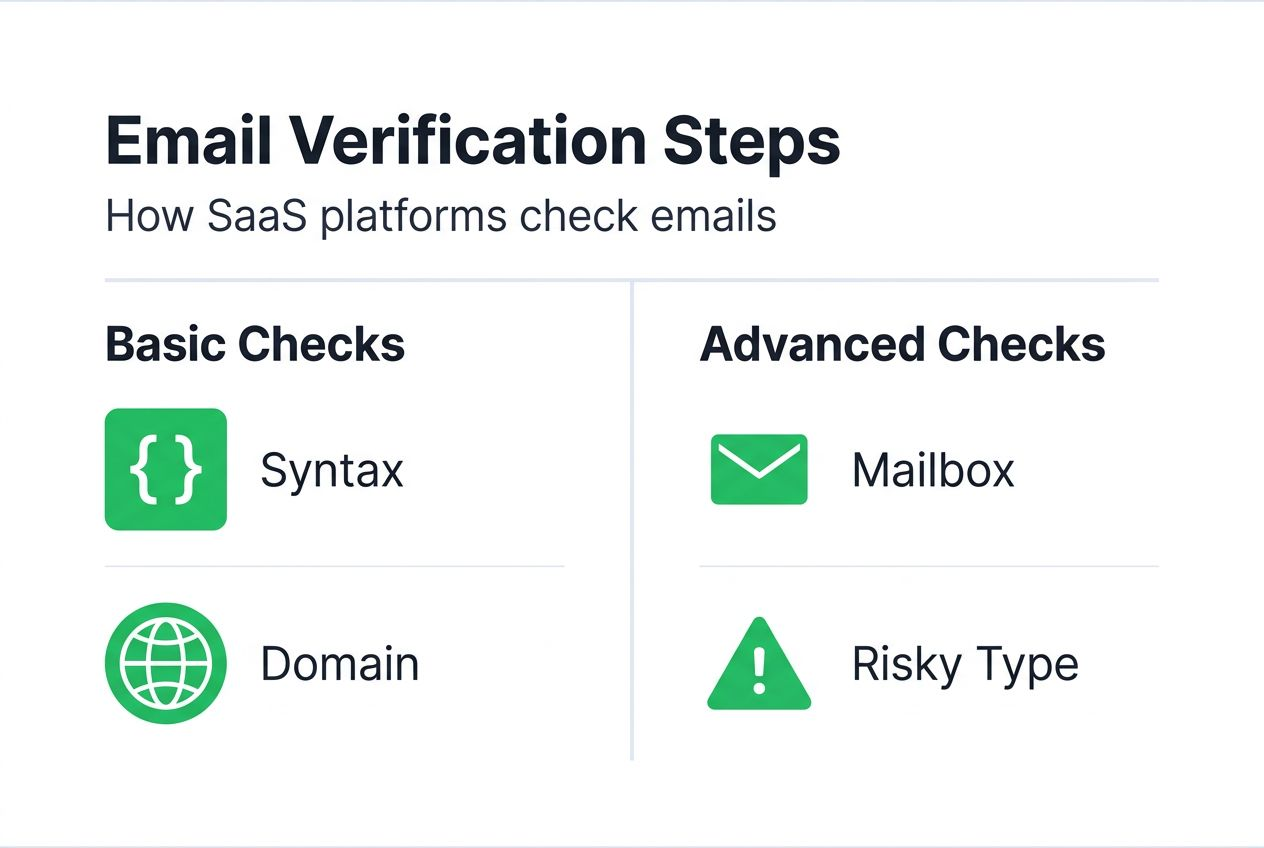
Multi-layer verification involves syntax checks, domain validation, mailbox confirmation, and risky address detection to ensure comprehensive accuracy. Each layer removes specific types of invalid or harmful emails that simpler methods miss. Understanding this stepwise process helps you appreciate why enterprise-grade verification delivers superior results.
The four essential verification layers work sequentially:
- Syntax and formatting check validates email structure against RFC standards, catching obvious errors like missing @ symbols or invalid characters.
- Domain existence and MX record verification confirms the domain is registered and configured to receive email through proper mail exchange records.
- Mailbox existence via SMTP handshake simulation connects to the recipient server to verify the specific mailbox exists and accepts messages.
- Specialized detection identifies risky addresses including disposable emails, role-based accounts, catch-all domains, and spam traps that threaten deliverability.
Each layer is essential because different validation stages catch different problems. Syntax checks eliminate formatting errors but can't detect fake domains. Domain verification confirms server existence but can't tell if specific mailboxes are valid. Mailbox checks confirm recipients exist but miss risky address types. Only combining all layers achieves comprehensive protection.
Pro Tip: Prioritize API integration for seamless real-time verification during user signup to prevent risky addresses entering lists in the first place, saving cleanup effort later.
Integrating verification into your email deliverability workflow for SaaS becomes straightforward when you understand these mechanics. The role of email validation SaaS extends beyond simple checks to protect your entire email infrastructure from deliverability threats.
Identifying risky email addresses: types and impact
Risky email addresses silently sabotage campaigns even when they pass basic syntax and domain checks. Understanding these threats helps you configure verification tools properly and protect sender reputation proactively. Disposable emails make up 3-5% of SaaS lists and cause poor engagement plus high bounce rates.

Disposable emails are temporary addresses created through services offering quick, throwaway inboxes. Users employ them to access gated content or free trials without providing real contact information. These addresses expire quickly, causing hard bounces when you send follow-up campaigns. They inflate list size artificially while delivering zero engagement value.
Role-based emails use generic prefixes like info@, support@, sales@, or admin@ rather than individual names. Multiple people often monitor these inboxes, making personalization impossible. They generate low engagement because messages get lost in high-volume queues. Worse, they carry higher spam complaint risks when recipients mark bulk emails as unwanted.
Catch-all domains accept all email addresses regardless of whether specific mailboxes exist. Verification tools can't definitively confirm if individual@catchalldomain.com is real because the server accepts everything. This creates false positives where verification passes but actual delivery fails, wasting sends on non-existent recipients hidden behind accepting servers.
Disposable emails silently sabotage deliverability and engagement, often undetected by basic checks.
Spam traps represent the most dangerous risky address type. ISPs and blacklist operators deliberately plant these addresses to identify senders with poor list hygiene. Hitting spam traps triggers immediate reputation damage and potential blacklisting. They appear in lists through:
- Purchased or scraped contact databases
- Abandoned addresses recycled as traps after dormancy periods
- Typo domains designed to catch careless senders
Effective email deliverability workflow for SaaS requires identifying and removing all these risky types before sending campaigns. Following email deliverability best practices B2B SaaS means implementing verification that catches these threats automatically.
Common misconceptions about SaaS email verification
Marketers often hold incorrect beliefs about email verification that prevent them from implementing truly effective solutions. Correcting these misconceptions helps you choose verification tools wisely and configure them properly. Syntax checking alone misses over 60% of invalid emails; combining domain and mailbox validation is crucial.
Myth #1: Syntax check alone is sufficient for list cleaning. This catches only obvious formatting errors like missing @ symbols or invalid characters. It misses fake domains, non-existent mailboxes, and all risky address types. Relying solely on syntax validation leaves your campaigns vulnerable to high bounce rates and reputation damage.
Myth #2: Role-based emails are always safe because they belong to legitimate companies. While technically valid, these addresses generate poor engagement because multiple people monitor them and personalization fails. They carry higher spam complaint risks when recipients mark bulk promotional emails as unwanted, damaging sender reputation.
Myth #3: Catch-all domains are safe since the server accepts all emails. Acceptance doesn't guarantee delivery to real recipients. Many addresses behind catch-all domains don't exist, causing soft bounces or silent failures. This wastes sends and skews campaign metrics with false positive validation results.
Understanding the difference between verification and validation clarifies these concepts. Verification checks technical validity through syntax, domain, and mailbox tests. Validation adds contextual assessment including engagement history, risky address detection, and deliverability predictions. Comprehensive solutions combine both approaches.
Pro Tip: Regularly update verification processes to include risky address detection, not just technical validity checks, to maintain list hygiene as threat patterns evolve.
Choosing proper email verification services requires looking beyond marketing claims to understand actual detection capabilities. Services offering only syntax or domain checks provide incomplete protection regardless of how they brand themselves.
Comparison framework: verification methods and their effectiveness
Comparing verification methods by accuracy, detection capabilities, and practical suitability helps you choose the right approach for your campaigns. Syntax validation yields less than 40% accuracy; domain checks raise accuracy to 70%; mailbox verification surpasses 90%; adding risky type detection maximizes deliverability protection.
| Verification Method | Accuracy | Speed | Risky Detection | Best For |
|---|---|---|---|---|
| Syntax Only | <40% | Instant | None | Initial formatting filter |
| Domain/DNS Check | ~70% | Fast | None | Basic list screening |
| Mailbox Verification | >90% | Moderate | Limited | Pre-campaign validation |
| Full Multi-Layer | >95% | Moderate | Comprehensive | Enterprise campaigns |
Syntax validation offers instant speed but catches only formatting errors. It's useful as a first-pass filter but inadequate alone. Domain and DNS checks add server existence confirmation, improving accuracy moderately. Mailbox verification via SMTP handshake confirms recipient existence, reaching 90%+ accuracy but missing risky address types.
Full multi-layer verification combining all stages plus specialized risky address detection achieves maximum protection. It processes slightly slower due to comprehensive checks but delivers accuracy exceeding 95%. For enterprise SaaS and e-commerce campaigns, this thoroughness justifies the modest speed tradeoff.
Processing method choices include:
- Manual verification suits tiny lists but scales poorly and lacks consistency
- Automated batch processing cleans existing lists efficiently before major campaigns
- Real-time API validation checks addresses instantly during signup or form submission
- Hybrid approaches combine real-time signup checks with scheduled batch maintenance
Choose verification methods based on your specific needs. Real-time validation prevents bad addresses entering your database. Batch processing cleans legacy lists accumulated before implementing verification. Combining both maintains optimal list quality continuously.
Implementing bulk email verification best practices means selecting tools offering comprehensive detection rather than settling for basic syntax checks marketed as complete solutions.
Implementing SaaS email verification: best practices and integration
Practical implementation transforms verification knowledge into measurable campaign improvements. API integration supports real-time validation during signup; bulk verification improves existing lists; continuous monitoring preserves data quality.
Follow this stepwise integration approach:
- Use verification API for real-time sign-up validation by connecting your registration forms to validation endpoints that check addresses instantly before database entry.
- Perform bulk verification before major campaigns to clean legacy lists, removing invalid and risky addresses accumulated before implementing real-time checks.
- Automate continuous hygiene with scheduled verification runs that recheck your database periodically, catching addresses that became invalid since initial validation.
Real-time validation during signup provides the strongest protection. It prevents invalid addresses entering your system, eliminating cleanup costs. Users receive immediate feedback about email errors, improving data quality at the source. This approach works best for high-traffic registration flows and trial signups.
Bulk email verification cleans existing databases efficiently. Upload your list, process verification in batches, then download results with detailed status codes. Remove hard invalids immediately, suppress risky addresses, and flag catch-all domains for monitoring. Schedule bulk runs quarterly to maintain hygiene.
Monitor these key metrics continuously:
- Hard bounce rates should stay below 2% after implementing comprehensive verification
- Soft bounce rates indicate temporary issues but watch for patterns suggesting invalid addresses
- Engagement metrics improve as verification removes undeliverable and low-quality addresses
- Sender reputation scores stabilize and improve when ISPs see consistent delivery patterns
Pro Tip: Combining real-time and batch verification ensures optimal list quality, catching new invalids at entry while maintaining existing database hygiene through scheduled cleanups.
Integrating an email verification API requires technical setup but pays dividends through automated protection. Follow bulk email verification workflow best practices to streamline implementation and maximize verification effectiveness across all touchpoints.
Real-world case studies and measurable outcomes
Concrete examples demonstrate how comprehensive email verification transforms campaign performance and protects sender reputation. SaaS clients reduced hard bounce rates by over 80%, increased engagement rates by 15-20%, and avoided blacklisting incidents after implementing advanced email verification.
| Metric | Before Verification | After Verification | Improvement |
|---|---|---|---|
| Hard Bounce Rate | 12.3% | 2.1% | 83% reduction |
| Engagement Rate | 18.5% | 22.1% | 19% increase |
| Spam Complaints | 0.8% | 0.2% | 75% reduction |
| Sender Score | 72 | 94 | 31% improvement |
A mid-size SaaS company with 500,000 contacts implemented multi-layer verification before a product launch campaign. They removed 47,000 invalid addresses and flagged 23,000 risky emails. The campaign achieved 22% open rates versus their previous 18% average. Hard bounces dropped from 11% to under 2%, protecting their sender reputation.
An e-commerce retailer using purchased lists experienced frequent blacklisting issues. After implementing real-time API validation for new signups and bulk verification for existing contacts, they eliminated spam trap hits completely. Their sender score improved from 68 to 91 within three months. Email revenue increased 34% due to improved inbox placement.
Key lessons learned from successful implementations:
- Start with bulk verification to clean legacy lists before adding real-time validation
- Remove hard invalids immediately but monitor catch-all domains before suppressing
- Recheck your database quarterly as email validity changes over time
- Track sender reputation metrics alongside standard campaign analytics
- Invest in comprehensive verification covering risky address detection, not just syntax checks
These outcomes demonstrate tangible ROI from proper verification implementation. Reduced bounce rates protect sender reputation while improved engagement drives revenue growth. The investment in enterprise-grade verification pays for itself through better deliverability and campaign performance.
Following proven email deliverability workflow for SaaS patterns based on these case studies accelerates your path to similar results.
Conclusion and next steps
Advanced SaaS email verification dramatically improves list quality, deliverability, and campaign ROI through multi-layer validation that catches invalid and risky addresses. You've learned how syntax, domain, mailbox, and risky address detection layers work together to achieve over 95% accuracy. Understanding disposable emails, role-based addresses, catch-all domains, and spam traps helps you configure verification tools properly.
Start implementing these strategies immediately:
- Integrate verification API for real-time checks during user registration and signup flows
- Run bulk verification on existing contact databases to remove accumulated invalid addresses
- Schedule quarterly verification runs to maintain continuous list hygiene
- Monitor bounce rates, engagement metrics, and sender reputation scores to track improvements
Continuous monitoring and removal of risky emails ensures lasting results. Email validity changes over time as addresses expire, domains shut down, and users abandon accounts. Regular verification maintenance protects your sender reputation and maximizes deliverability consistently.
AI-powered verification from BillionVerify supports these goals through enterprise-grade solutions designed specifically for high-volume SaaS and e-commerce marketing. Their platform combines comprehensive multi-layer validation with seamless API integration and bulk processing capabilities. Explore their services to enhance your email campaigns with verification technology that delivers measurable improvements in deliverability, engagement, and ROI.
Enhance your campaigns with BillionVerify email verification
BillionVerify's enterprise-ready email verification platform provides the multi-layer validation technology discussed throughout this guide. Tailored specifically for SaaS and e-commerce marketers managing high-volume email programs, the platform delivers comprehensive protection against invalid and risky addresses.
Capabilities include real-time API access for instant signup validation, bulk processing handling millions of verifications monthly, and specialized detection for disposable emails, role-based addresses, catch-all domains, and spam traps. This comprehensive approach reduces bounce rates by over 80%, improves sender reputation scores significantly, and boosts engagement metrics by 15-20%.
The platform integrates seamlessly with over 20 major email marketing systems and CRMs, making implementation straightforward regardless of your existing technology stack. Enterprise-grade accuracy exceeding 95% ensures your campaigns reach real recipients while protecting your sender reputation from deliverability threats.
Visit BillionVerify's platform today to request a demo, explore integration options, and start enhancing your email deliverability immediately. Transform your campaign performance through verification technology designed specifically for enterprise marketing needs.
Frequently asked questions
What is SaaS email verification and why is it essential?
SaaS email verification is a specialized multi-layer process that validates email addresses through syntax checks, domain verification, mailbox confirmation, and risky address detection to ensure messages reach real recipients. It's essential for protecting sender reputation, reducing bounce rates below 2%, and improving campaign ROI by eliminating invalid and harmful addresses before sending. Most platforms apply verification through APIs for real-time signup validation and bulk processing to clean existing databases, maintaining high-quality contact lists that maximize deliverability. Without proper email verification services, campaigns suffer from high bounce rates, spam trap hits, and blacklisting that devastate email program effectiveness.
How do risky emails like disposable or role-based addresses affect my campaigns?
Disposable emails increase bounce rates significantly because they expire quickly after users access gated content or free trials, leaving you sending to non-existent addresses that harm sender reputation. Role-based emails like info@ or support@ generate low engagement since multiple people monitor them, making personalization impossible and increasing spam complaint risks when recipients mark bulk emails as unwanted. Both types waste marketing budget on sends that deliver zero engagement value while damaging the reputation metrics ISPs use to determine inbox placement. Implementing comprehensive email deliverability workflow for SaaS with risky address detection filters these threats automatically.
What are the best practices for integrating email verification in SaaS marketing workflows?
Use API integration for real-time validation during user registration to prevent invalid addresses entering your database, providing immediate feedback that improves data quality at the source. Regularly perform bulk email verification on legacy lists accumulated before implementing real-time checks, scheduling quarterly runs to catch addresses that became invalid over time. Monitor bounce rates, engagement metrics, and sender reputation scores continuously to identify verification gaps and adjust settings accordingly. Automate verification processes wherever possible through scheduled batch runs and API triggers to ensure consistent list quality without manual intervention, following proven email verification API integration patterns that scale with your marketing needs.