



Disposable email addresses sabotage your campaigns silently. These temporary inboxes expire within hours, triggering hard bounces that wreck sender reputation and tank your deliverability rates. Email marketing managers face a stark reality: lists contaminated with disposable emails waste budget, damage IP scores, and reduce ROI by double digits. This guide reveals how detecting disposable emails transforms your metrics, protects your reputation, and unlocks sustainable campaign performance through proven multi-layer detection strategies.
Key takeaways
| Point | Details |
|---|---|
| Disposable emails cause severe bounce rate inflation | These temporary addresses expire quickly, creating hard bounces that damage sender reputation and increase blacklisting risk. |
| Multi-layer detection outperforms blacklists alone | Combining domain lists, syntax checks, and behavioral analytics reduces false negatives and catches new disposable providers. |
| Detection requires balancing accuracy and privacy | Blocking all disposable emails alienates legitimate privacy-conscious users; nuanced approaches prevent false positives. |
| Implementing detection cuts bounce rates by 30% | Real-time and bulk verification integrated into workflows dramatically improve list quality and campaign ROI. |
| Continuous monitoring maintains long-term hygiene | Automated detection combined with regular audits keeps lists clean and deliverability metrics stable. |
Understanding disposable emails and their impact
Disposable email addresses are temporary, often single-use email accounts created for brief interactions. Users generate them to avoid spam, protect privacy during online sign-ups, or bypass registration requirements without exposing their primary inbox. These addresses operate through specialized services that provide instant email access without permanent storage.
Common motivations drive disposable email adoption:
- Privacy protection when signing up for newsletters or trials
- Avoiding long-term marketing communications and tracking
- Testing services without commitment
- Fraudulent account creation and bonus exploitation
Disposable email addresses show an average lifespan of a few hours to a few days, making them unreliable for sustained communication. Once the temporary inbox expires, emails sent to these addresses generate hard bounces. This creates a cascade of deliverability problems.
The short lifespan fundamentally conflicts with email marketing timelines. Campaign schedules, nurture sequences, and transactional messages often span days or weeks. When disposable addresses expire mid-campaign, your carefully crafted messages hit dead inboxes. Bounce rates spike, engagement metrics plummet, and sender reputation takes a hit.
List quality degrades rapidly when disposable emails accumulate. You pay for contacts who never intended to engage. Your open rates suffer because a portion of your list literally cannot receive messages. Campaign performance metrics become unreliable, making optimization decisions nearly impossible. Effective disposable email detection prevents this contamination before it damages your operations.
How disposable emails undermine deliverability and sender reputation
Disposable emails create hard bounces when their temporary inboxes expire or were never valid. Internet Service Providers (ISPs) and email service providers track bounce rates meticulously. High hard bounce rates signal poor list hygiene and trigger algorithmic penalties that push your messages to spam folders or block delivery entirely.

Your sender IP reputation deteriorates with each bounce. ISPs assign reputation scores based on bounce patterns, complaint rates, and engagement metrics. Sustained high bounce rates from expired disposable emails lower your score rapidly. Once your reputation drops below critical thresholds, legitimate emails to real customers start landing in spam.
Blacklisting becomes a tangible risk as bounce rates climb. Email providers and third-party blacklist operators monitor sender behavior. Patterns indicating spam or poor practices, including disposable email addresses causing hard bounces, can land your domain or IP on blacklists. Recovery from blacklisting requires weeks of remediation and strict monitoring.
Spam filters detect suspicious bounce patterns characteristic of disposable email contamination. Modern filters use machine learning to identify senders with degraded list quality. Your inbox placement rate suffers even for engaged subscribers when filters flag your domain. Fewer messages reach primary inboxes, crushing campaign effectiveness.
Complaint rates also increase indirectly. Recipients who signed up with disposable emails often had no genuine interest. If they access your messages before expiration, they're likelier to mark them as spam. Each complaint compounds reputation damage beyond bounces alone.
Maintaining clean lists by reducing bounce rates through disposable email exclusion preserves deliverability. The impact of bounce on marketing success extends beyond immediate campaign metrics to long-term sender viability. Regular email list verification removes disposable addresses before they inflict damage, protecting both reputation and ROI.
Detection methods and technologies for disposable emails
Static domain blacklists form the foundation of disposable email detection. These databases catalog known disposable email providers like Guerrilla Mail, Mailinator, and TempMail. Verification systems check submitted addresses against these lists, flagging matches immediately. However, blacklists require constant updates as new services launch daily. Outdated lists miss emerging providers, creating false negatives.
Syntax and pattern analysis adds another detection layer. Disposable email services often use predictable formats: random strings, sequential numbers, or obvious temporary markers in usernames. Algorithms scan for these patterns, identifying suspicious addresses even from unlisted domains. This catches new providers but generates false positives when legitimate users choose unconventional email formats.
Behavioral and real-time usage pattern analytics represent advanced detection. These systems analyze domain age, mail server configuration, and historical usage data. Newly registered domains hosting email services trigger suspicion. Domains with high user turnover or no long-term accounts pattern match disposable providers. Real-time API queries during sign-up capture the freshest intelligence.
| Detection Method | Strengths | Limitations |
|---|---|---|
| Domain Blacklists | Fast, reliable for known providers | Requires constant updates, misses new services |
| Syntax Pattern Checks | Catches unknown providers | Higher false positive rate |
| Behavioral Analytics | Adapts to new threats, highest accuracy | Requires larger datasets, slightly slower |
| Combined Multi-Layer | Minimizes false negatives and positives | More complex implementation |
Combining multiple detection layers reduces both false negatives (missing disposable emails) and false positives (blocking legitimate users). A multi-tiered approach flags addresses matching blacklist entries immediately, applies pattern analysis to unknowns, and validates questionable cases through behavioral checks. This maximizes accuracy while maintaining speed.
Pro Tip: Regularly update detection databases and incorporate real-time APIs for best results. Monthly blacklist refreshes miss too many new providers. Daily or continuous updates through API integration ensure your verification stays current. Pair this with behavioral analytics to catch disposable services before they appear on any list.
Effective disposable email detection methods leverage all available technologies in concert. Single-method approaches leave gaps that contaminate your list and undermine deliverability gains.
Common misconceptions about disposable email detection
Many marketers assume all disposable emails originate from fraudulent intent. This oversimplification ignores legitimate privacy use cases. An estimated 10-15% of disposable emails are from privacy-conscious users legitimately using temporary emails, not fraudsters. Blocking these users indiscriminately alienates potential customers who value data protection. Blanket blocking policies damage conversion rates by rejecting valid prospects.
Another misconception holds that detection completely eliminates fake sign-ups. Disposable email filtering catches one fraud vector, but determined bad actors use other methods. Stolen credentials, synthetic identities, and burner phone numbers bypass email verification. Comprehensive fraud prevention requires layered identity verification beyond email validation alone. Relying solely on disposable detection creates false security.
Marketers frequently underestimate disposable email prevalence in their lists. Many believe their audience would never use temporary addresses. Reality contradicts this assumption. Even B2B lists contain disposable emails from users testing services, avoiding sales follow-up, or protecting work inboxes. Underestimating contamination leads to inadequate cleaning strategies and persistent deliverability issues.
Overzealous detection creates false positives that block legitimate customers. Aggressive pattern matching flags unconventional but real email addresses. Users with custom domains, alphanumeric usernames, or international email providers get caught in filters designed for disposable services. Each false positive represents lost revenue and damaged customer experience.
Some marketers believe one-time cleaning suffices for long-term list health. Lists degrade continuously as new sign-ups arrive and disposable addresses infiltrate. Historical cleaning doesn't protect against future contamination. Ongoing verification and real-time detection at point of capture prevent accumulation.
Awareness of these nuances enables smarter, balanced detection policies. Understanding disposable email myths helps implement systems that maximize legitimate user capture while filtering harmful addresses. The goal is precision, not blanket exclusion.
Impact of disposable emails on email marketing metrics
Disposable emails inflate bounce rates dramatically, cascading through your entire deliverability infrastructure. When 10% of your list consists of expired temporary addresses, hard bounce rates spike to 8-12% on average. Industry benchmarks recommend keeping bounces below 2%. Exceeding this threshold triggers ISP penalties that suppress inbox placement for your entire domain.
SaaS companies experience particularly acute conversion rate damage. Trial sign-ups using disposable emails never convert to paying customers. These users accessed your product temporarily with no purchase intent. Your trial-to-paid conversion rate appears lower than reality, skewing product decisions and marketing budget allocation. Cleaning disposable emails from cohort analysis reveals true conversion potential.
| Metric | Before Detection | After Detection | Improvement |
|---|---|---|---|
| Bounce Rate | 9.2% | 1.8% | 80% reduction |
| Inbox Placement | 68% | 89% | 31% increase |
| Open Rate | 14.3% | 21.7% | 52% increase |
| Conversion Rate | 2.1% | 3.4% | 62% increase |
Cleaning lists of disposable emails reduces bounce rates by 25-30%, improving inbox placement immediately. When your messages actually reach inboxes instead of bouncing, engagement metrics reflect true audience interest. Open rates rise as the denominator shrinks to real, accessible addresses. Click-through rates improve because engaged users represent a larger list percentage.
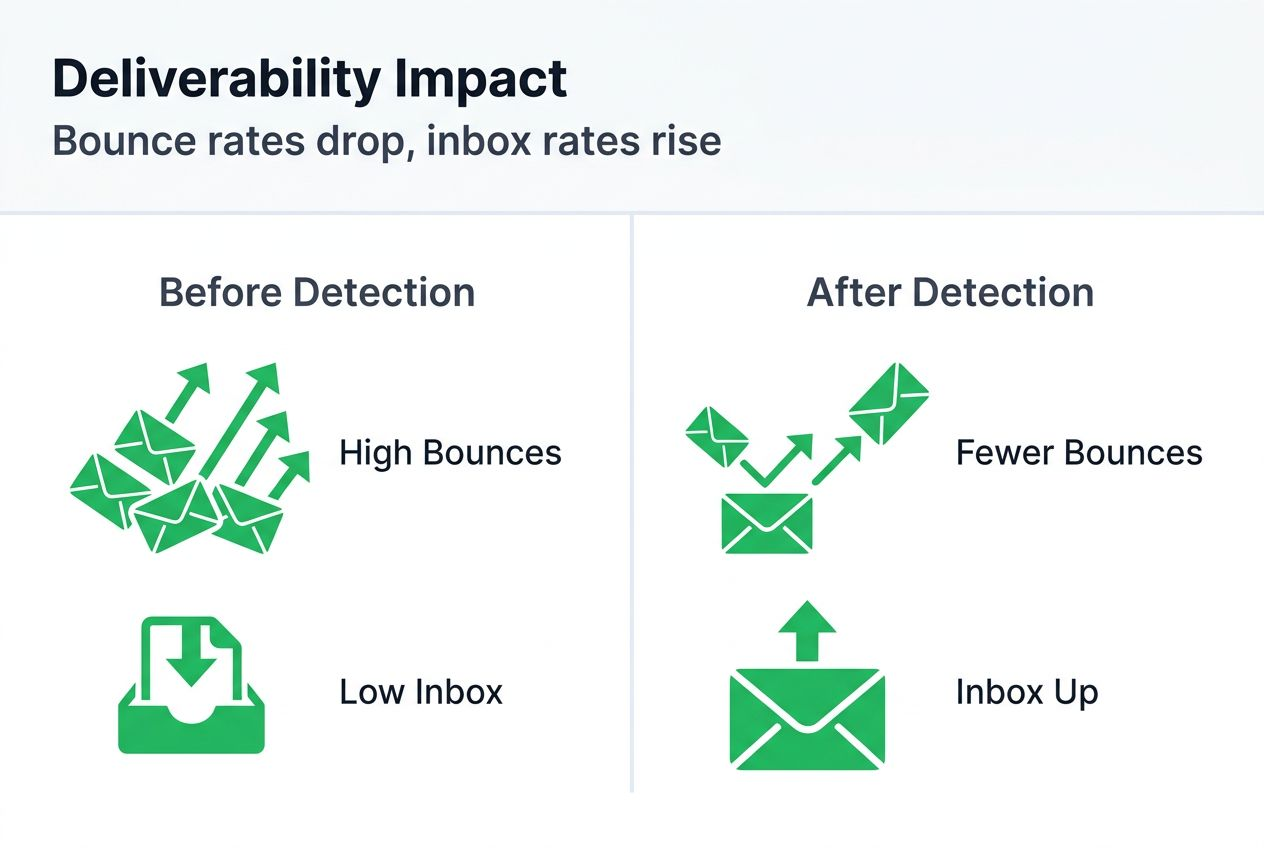
Campaigns targeting verified lists report higher ROI due to better engagement and reduced waste. You stop paying to send messages to dead addresses. Email service provider costs decrease as send volume aligns with actual reachable contacts. More importantly, revenue per email sent increases when recipients can actually receive and engage with offers.
Real-world data demonstrates improved sender reputation after implementing detection. Domains consistently maintaining bounce rates below 2% through disposable email filtering avoid blacklisting. ISP trust scores climb steadily, earning better inbox placement and higher deliverability rates. The compounding effect amplifies over time as sustained good practices build reputation capital.
E-commerce businesses see direct revenue impact. Promotional campaigns reach more customers when deliverability improves. Cart abandonment sequences actually arrive, recovering sales that bounced messages would have lost. Customer lifetime value metrics become more accurate when based on genuine, reachable contacts rather than contaminated lists.
The importance of email deliverability becomes clear through these metrics. Disposable email contamination undermines every aspect of campaign performance. Implementing detection reverses this damage, unlocking the full potential of your email marketing ROI. Regular email list cleaning maintains these gains long-term.
Implementing disposable email detection in marketing workflows
Integrating detection into your marketing stack requires a structured approach that balances thoroughness with operational efficiency. Follow these steps to deploy effective verification across your entire email ecosystem.
Integrate multi-layer disposable email detection systems via APIs and bulk verification. Select a verification provider offering both real-time API endpoints and bulk processing capabilities. Connect the API to your sign-up forms, landing pages, and lead capture tools. This creates an immediate filter preventing disposable addresses from entering your database. Schedule bulk verification runs monthly or quarterly to catch addresses that slipped through or degraded over time.
Use real-time checks during sign-up and ongoing bulk cleaning for continuous list hygiene. Implement server-side validation that queries the verification API before accepting form submissions. Display user-friendly error messages when disposable addresses are detected, encouraging users to provide permanent emails. Complement real-time filtering with scheduled bulk verification of your entire database to remove disposable emails that bypassed initial checks or became disposable after signup.
Combine detection with identity verification to reduce false positives and bad sign-ups. Layer email verification with additional checks like phone verification, CAPTCHA, or social login options. This multi-factor approach catches fraud while accommodating legitimate privacy users who might use disposable emails. Allow manual review queues for borderline cases flagged by detection systems but showing other legitimacy indicators.
Monitor bounce rates and sender reputation metrics regularly to adjust thresholds. Track hard bounce rates, spam complaint rates, and inbox placement percentages weekly. Set alerts for unusual spikes indicating detection gaps. Use A/B testing to optimize verification strictness, balancing false positive rates against contamination prevention. Adjust detection sensitivity based on your specific audience behavior and risk tolerance.
Pro Tip: Automate detection integration with your CRM and marketing tools for seamless scalability. Configure your verification provider to sync results directly with your CRM custom fields. Tag contacts as verified, risky, or disposable automatically. Build segmentation rules that exclude disposable addresses from campaigns while preserving them for analysis. This automation eliminates manual work and ensures consistent application across all campaigns.
Integration with email automation workflows amplifies detection benefits. Verified contacts flow into nurture sequences while questionable addresses route to re-engagement or verification campaigns. Your marketing automation becomes more efficient, targeting only genuine prospects.
Comprehensive email hygiene strategies extend beyond initial implementation. Establish governance policies defining how often to verify, what actions to take on different result types, and how to handle edge cases. Train your team on interpreting verification results and making informed decisions about borderline contacts.
Summary and best practices
Disposable email detection significantly improves bounce rates, sender reputation, and campaign success by removing temporary addresses before they damage deliverability. The evidence is clear: implementing multi-layer verification reduces hard bounces by 25-30%, improves inbox placement by 30%, and increases conversion rates by protecting list quality.
Balance detection accuracy with user privacy to avoid alienating legitimate users. Not all temporary email usage signals fraud. Privacy-conscious customers deserve respectful treatment while you protect list integrity. Implement nuanced policies that flag rather than automatically block questionable addresses, allowing manual review for high-value prospects.
Adopt continuous monitoring and real-time detection to maintain ongoing list hygiene. One-time cleaning provides temporary relief but lists degrade constantly. Real-time API verification at point of capture prevents contamination while scheduled bulk verification catches degradation. Weekly metric monitoring ensures your detection stays effective as threats evolve.
Use a multi-layered detection approach combining blacklist, syntax, and behavioral analysis. Single-method detection leaves gaps that undermine deliverability gains. Domain blacklists catch known providers, pattern analysis identifies new threats, and behavioral analytics reduce false positives. Together, these layers maximize accuracy.
Regularly update detection tools and integrate with identity verification for best results. Monthly database updates miss too many new disposable services. Daily or continuous updates through API integration keep protection current. Pairing email verification with phone validation, CAPTCHA, or social login creates comprehensive fraud prevention that disposable detection alone cannot achieve.
Optimize your email list with advanced verification solutions
Detecting disposable emails transforms deliverability, but implementation complexity stops many marketers from capturing these gains. BillionVerify's enterprise-grade verification platform removes this barrier with seamless integration designed specifically for e-commerce and SaaS marketing teams.
Our multi-layer detection technology combines real-time email verification API endpoints with powerful bulk email verification processing. Integrate disposable email filtering into your sign-up forms, marketing automation, and CRM within hours. Our system catches temporary addresses at point of capture while scheduled bulk runs clean existing lists automatically.
The platform handles millions of verifications monthly, scaling effortlessly as your business grows. Integration guides for over 20 major marketing platforms and detailed developer documentation make implementation straightforward. Start protecting your sender reputation today with email verification solutions built for enterprise performance and marketing team ease of use.
FAQ
What is a disposable email address and why does it matter?
Disposable email addresses are temporary, self-destructing email accounts users create for brief interactions without exposing their primary inbox. They matter because these addresses expire within hours or days, generating hard bounces that damage sender reputation, trigger spam filters, and waste marketing budget on contacts who cannot receive your messages.
How does disposable email detection improve campaign ROI?
Detecting and removing disposable emails reduces bounce rates by 25-30% and improves inbox placement by up to 31%. Cleaner lists mean more messages reach engaged recipients who can actually convert. You eliminate wasted sends to dead addresses, reduce email service provider costs, and increase revenue per contact by focusing budget on reachable prospects, directly improving campaign ROI.
What are common errors marketers make in detecting disposable emails?
Marketers often rely solely on outdated domain blacklists that miss new disposable services launched daily. They block legitimate privacy-conscious users by treating all temporary emails as fraud, damaging conversion rates. Many also perform one-time cleaning instead of implementing continuous real-time detection, allowing contamination to rebuild and undermine list quality.
How can I implement disposable email detection in my marketing stack?
Use API-based verification services for real-time checks during sign-up and bulk verification for periodic list cleaning. Integrate verification endpoints into your forms and landing pages to block disposable addresses at capture. Connect bulk verification with your CRM for automated scheduled cleaning. Follow email automation workflows to maintain continuous hygiene without manual intervention.